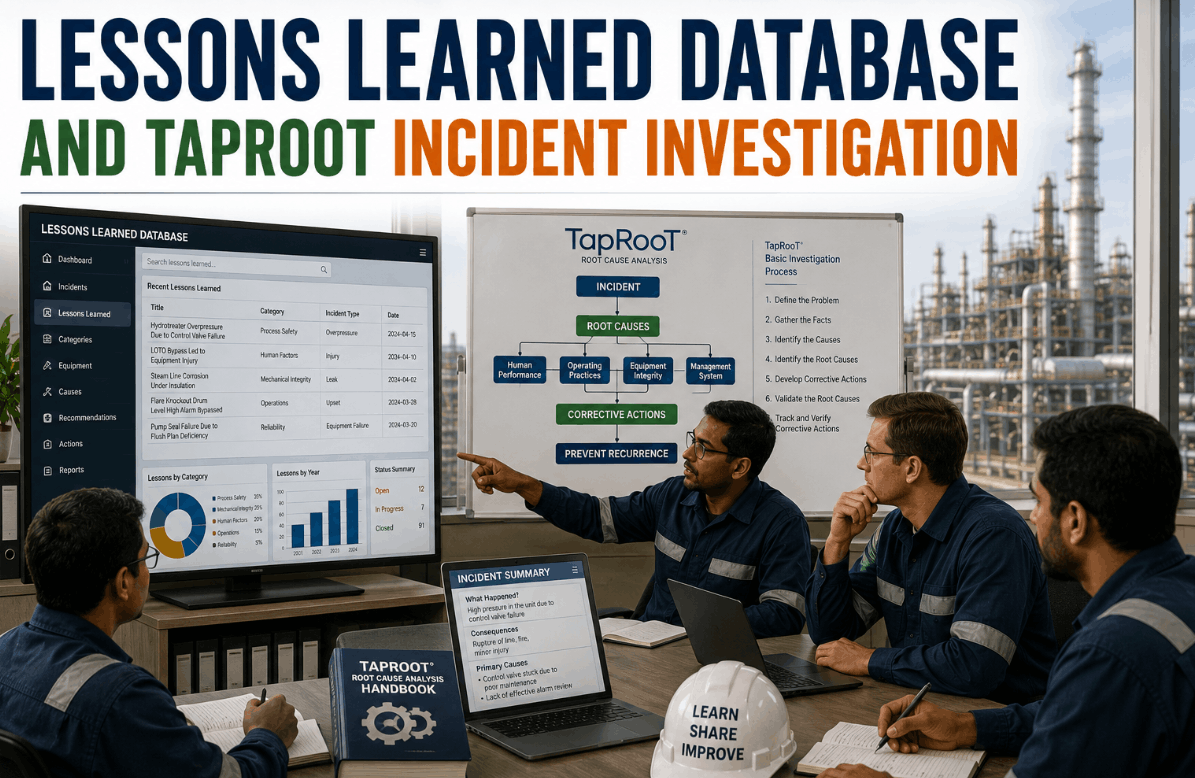
Most industrial plants relearn the same lessons every three to five years. A near-miss occurs, an investigation is completed, a corrective action is assigned — and then the finding gets buried in a folder on a shared drive, never connected to the next incident that shares the same root cause. The result is a predictable, costly cycle: the same equipment failures, the same human factors, the same procedural gaps — investigated repeatedly, with no institutional memory binding one event to the next. iFactory AI's incident learning platform breaks this cycle by combining a structured digital investigation workflow — aligned with industry-standard methods including TapRooT and ICAM — with a fully searchable, taxonomy-driven lessons-learned database. Every finding is classified, every corrective action is tracked to closure, and every lesson is retrievable by keyword, equipment type, incident category, or causal factor — before the next preventable event occurs.
Why Investigation Quality Determines Whether Plants Learn or Repeat
The most common failure in industrial incident management is not the investigation itself — it is what happens to the output. Facilities that conduct technically sound root cause analyses using TapRooT, ICAM, or Bow Tie methodologies still suffer repeat incidents when findings are documented in siloed report formats that cannot be searched, shared across sites, or linked to corrective action tracking systems. A lessons-learned database is only as valuable as the quality of the investigation feeding it. Low-rigor investigations — those that stop at immediate cause identification or produce "retraining" as the sole corrective action — generate entries that look complete but provide no systemic learning value. Safety managers and reliability engineers who Book a Demo of iFactory AI's platform immediately recognize that the gap between their investigation process and their learning retention is the single most addressable driver of repeat incidents in their facilities.
TapRooT vs. ICAM: Choosing the Right Investigation Framework for Your Facility
Both TapRooT and ICAM are proven, structured root cause analysis methodologies used across U.S. oil and gas, refining, chemicals, and heavy manufacturing environments. The choice between them — or the decision to support both — depends on your industry context, investigation team composition, and the complexity of incidents you routinely face. iFactory AI's investigation module supports both frameworks within a single platform, allowing facilities to configure investigation templates that match their selected methodology without forcing investigators to work outside familiar processes. Safety engineers planning an investigation program upgrade are encouraged to Book a Demo to see how each framework maps to the platform's digital workflow and lessons-learned taxonomy.
| Attribute | TapRooT RCA | ICAM Method |
|---|---|---|
| Primary Origin | System Improvements Inc. (USA, 1991) | Australian mining & heavy industry sector |
| Investigation Structure | 5-Step (precursor) or 7-Step (major accident) process | 7-Step process: scene, timeline, ICAM chart, corrective actions |
| Causal Factor Mapping | SnapCharT® sequence of events diagram | PEEPO timeline + ICAM factor categorization chart |
| Root Cause Categories | Root Cause Tree® — 15 categories, 87 root causes | 4 levels: Task/Environment, Individual/Team, Job, Organizational |
| Human Factors Coverage | Extensive — dedicated human performance module | Strong — individual and team action analysis built in |
| Best Suited For | Oil & gas, refining, process safety, equipment reliability | Mining, construction, utilities, cross-industry heavy operations |
| iFactory AI Integration | Supported | Supported |
Building a Searchable Lessons-Learned Database That Actually Gets Used
A lessons-learned database that cannot be searched by causal factor, equipment type, or incident classification is not a learning system — it is an archive. The defining difference between a lessons-learned system that prevents repeat incidents and one that simply satisfies an audit requirement is taxonomy: structured, consistent classification of every finding in a way that allows investigators working on a new incident to surface directly relevant precedents in seconds. iFactory AI enforces this taxonomy at the point of investigation entry — requiring every finding to be classified by incident type, equipment category, causal factor level, corrective action type, and verification method before the investigation record can be closed.
Incident Classification at Point of Entry
Every investigation record is tagged at intake with incident type (process safety, occupational safety, equipment reliability, environmental), severity level, primary equipment involved, and the investigation framework applied — creating the metadata foundation for future cross-referencing and trend analysis.
Causal Factor Tagging by Framework Level
Each identified causal factor is mapped to a defined taxonomy level — whether TapRooT Root Cause Tree categories or ICAM's four-level organizational factor structure — ensuring that root causes can be aggregated across incidents to reveal systemic patterns invisible in single-event reviews.
Corrective Action Tracking to Verified Closure
Every corrective action receives an assigned owner, a target completion date, a verification method, and a closure date field that cannot be system-completed without documented evidence of implementation. Open corrective actions beyond their due date trigger automatic escalation to the facility HSE manager.
Cross-Site Learning Distribution
High-transferability lessons are flagged during the investigation for wider distribution — automatically generating a safety bulletin template pre-populated with the incident summary, causal factors, and corrective actions, routed to designated contacts at sister facilities or business units.
Trend Analysis & Generic Cause Identification
The platform aggregates root cause data across all closed investigations to surface generic cause patterns — entire classes of incidents traceable to the same organizational factor, training gap, or procedural deficiency — enabling system-level fixes that eliminate whole incident categories rather than one event at a time. Book a Demo to see the trend analytics dashboard in action.
The Investigation-to-Learning Workflow: From Scene to Database in Five Stages
iFactory AI structures the complete investigation lifecycle — from initial notification through root cause identification, corrective action assignment, verified closure, and database entry — in a single, connected digital workflow. No investigation finding leaves the process without a classification, an owner, and a due date.
Incident Notification & Scene Capture
Field personnel log the incident via mobile app, capturing timestamped photos, GPS location, equipment ID, and initial description. The notification auto-routes to the investigation team based on severity classification and initiates the formal investigation record.
Structured Investigation Execution
Investigators work through the TapRooT or ICAM framework using guided digital templates — building the sequence of events timeline, identifying causal factors, applying the Root Cause Tree or ICAM chart, and documenting interview records and evidence references within the platform.
Corrective Action Development & Assignment
Each identified root cause generates a corrective action record using the hierarchy of controls framework. Actions are assigned to named individuals with due dates, escalation rules, and verification method requirements — preventing the "retraining only" trap that characterizes low-effectiveness investigations.
Lessons-Learned Classification & Database Entry
Upon investigation closure, the platform enforces classification of the 1–3 most transferable learning points against the facility taxonomy. The classified lesson enters the searchable database immediately — available to investigators at any site accessing the platform from that point forward.
Expert Perspective: Why Most Lessons-Learned Programs Fail to Prevent Repeats
The fundamental problem with most corporate lessons-learned programs is that they are designed for documentation compliance rather than knowledge transfer. A lessons-learned record that satisfies an audit but cannot be found by the next investigator facing a similar scenario has zero preventive value. The four failure patterns below account for the majority of repeat incidents in U.S. process facilities — and each is directly addressable through disciplined investigation management and a properly structured database. Safety professionals building or rebuilding their incident learning programs are encouraged to Book a Demo to benchmark their current program against iFactory AI's investigation architecture.
Most paper-based and informal investigations identify the immediate cause — the broken part, the spilled chemical, the missed procedure step — and stop there. Without structured root cause analysis using TapRooT or ICAM methodology, the organizational and systemic factors that allowed the immediate cause to develop are never addressed, and the incident recurs.
An investigation whose corrective actions are assigned but never confirmed as implemented is an investigation that prevents nothing. Without a digital tracking system that enforces closure verification and escalates overdue actions, significant percentages of corrective actions across a facility remain perpetually open — a gap that routinely surfaces during PSM compliance audits.
PDF reports filed by date on a network drive, SharePoint folders organized by year, and email threads containing investigation summaries are not searchable lessons-learned systems. When the next investigator faces an incident with shared characteristics, they cannot retrieve the relevant precedent — and the same causal pathway is analyzed from scratch.
Multi-site organizations routinely see the same incident type occur at Site A and Site B within months of each other — because the lesson from Site A was never systematically distributed to Site B's operations and maintenance teams. Without a platform that enables structured cross-site learning distribution, geographic isolation creates repeated exposure to known hazards.
"Before iFactory AI, our lessons-learned records were PDFs emailed to a distribution list after every investigation. Nobody could search them. When a similar incident occurred eighteen months later, the investigation team had no idea we'd already analyzed the same root cause at another facility. After deploying the platform, our investigators now surface relevant precedents at the start of every new investigation — before they even begin the SnapCharT. Our repeat incident rate dropped by over 50% in the first year."
— Process Safety Manager, U.S. Midstream Operations Facility
Conclusion: A Lessons-Learned Database Is Only as Strong as the Investigation Behind It
Building a searchable, effective lessons-learned system is not primarily a technology problem — it is a process discipline problem. The technology is only valuable when the investigations feeding it are structured with sufficient rigor to identify genuine root causes, the corrective actions are tracked through to verified implementation, and the classified lessons are consistently distributed to every part of the organization that faces similar hazards. iFactory AI delivers the complete infrastructure for this discipline: investigation templates aligned with TapRooT and ICAM, mandatory causal factor taxonomy, digital corrective action tracking with escalation, cross-site learning distribution, and a searchable database that makes every closed investigation an active resource for every future investigator in your organization.
Frequently Asked Questions: Lessons-Learned Database and Incident Investigation
Does iFactory AI support both TapRooT and ICAM investigation templates within the same platform?
Yes — the investigation module supports configurable templates for TapRooT's 5-Step and 7-Step processes as well as the ICAM 7-step methodology, allowing facilities to select the framework that matches their existing investigator training and regulatory context.
How does the lessons-learned database handle search across multiple sites or business units?
The database is searchable by keyword, equipment type, incident category, causal factor classification, and site — giving investigators at any facility in your organization instant access to precedents from across the enterprise, not just their own site history.
What happens when a corrective action is overdue and not yet closed?
The platform automatically escalates overdue corrective actions to the assigned owner and their HSE manager, with configurable escalation intervals — ensuring that no finding can be silently left open without generating a documented alert trail.
Can the platform integrate with existing EHSQ or CMMS systems already in use at our facility?
iFactory AI provides standard REST API connectivity to major EHSQ platforms and CMMS systems, enabling bidirectional data exchange so that corrective actions requiring maintenance work automatically generate work orders in your existing asset management system.
How does iFactory AI support trend analysis across a facility's investigation history?
The analytics dashboard aggregates root cause classifications across all closed investigations to surface generic cause patterns — identifying systemic organizational factors, equipment categories, or procedure gaps that appear repeatedly and require facility-level corrective programs rather than single-event fixes.




.png)