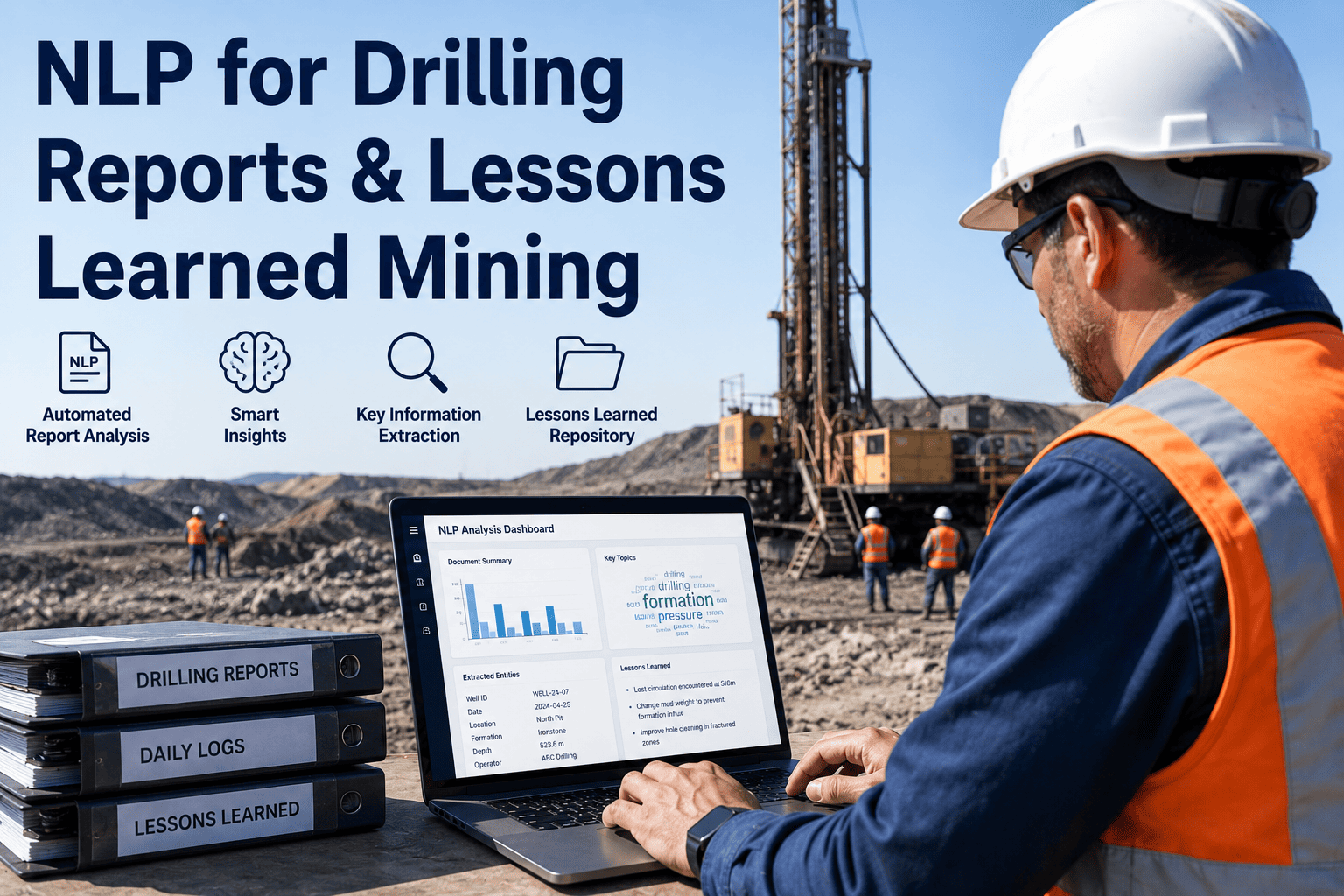
Operating companies have drilled millions of wells over the last century, and every single one generated a daily drilling report, an end-of-well report, a post-mortem, and a lessons-learned document. Those files exist — they sit in well file repositories, shared drives, and document management systems. But nobody reads ten thousand drilling reports before planning a new well. Engineers read the last three offset reports, maybe five if the well is complex, and whatever institutional knowledge the senior drilling engineer carries from personal experience. Everything else is invisible. NLP for drilling reports changes that by making every word in your report archive searchable, classifiable, and connectable to the well it came from. This blog covers what NLP actually extracts from drilling text, where manual review leaves the majority of insights buried, and how to turn your report archive into a decision-support system. See it running against your own well files when you book a demo.
NLP · DRILLING REPORTS · LESSONS LEARNED · KNOWLEDGE MINING · OFFSET WELL ANALYSIS
Your drilling reports hold the answers. NLP reads every single one.
Extract problems, solutions, formation behavior, and best practices from thousands of unstructured drilling documents — without a single human reading them end to end.
10,000+
Average reports in a mature operator archive
3-5
Reports an engineer actually reads before spudding
82%
Of lessons learned never reused on subsequent wells
Under 4 hrs
Time to mine a full report archive with NLP
The unstructured data problem in drilling operations
Drilling generates enormous volumes of text, but almost none of it feeds back into decision-making because it is locked in documents that are searchable only by title and date, not by content. The problem is not a lack of data — it is a lack of access to the knowledge inside the data.
Pages per end-of-well report
Narrative sections on trouble encountered, deviations from plan, equipment performance, and formation evaluation written in free-form text by the drilling engineer.
Daily drilling reports per well
Day-by-day operations log with activities, problems, mud data, casing runs, and engineering notes. Format varies by operator, by rig, and often by the individual filling out the form.
Lessons learned entries per well
Problem statements, root cause analysis, and corrective actions written after trouble events. Categorized inconsistently, if at all, and rarely linked to similar events on other wells.
Reports systematically mined for the next well
Without NLP, the actual number of historical reports that are content-searched and analyzed during well planning is effectively zero for most operators. The archive exists but is inaccessible.
Five insight categories NLP extracts from drilling text
Every drilling report contains multiple types of knowledge layered into the same narrative. NLP separates these layers and structures them so each insight type can be queried, filtered, and analyzed independently across the entire archive.
01
Problems Encountered
Stuck pipe events, lost circulation, kicks, equipment failures, borehole instability, cementing issues, and every other trouble category described in the report text. NLP identifies the problem type, severity, depth, and formation context from narrative descriptions that use different terminology across operators and eras.
02
Root Causes and Contributing Factors
Why did the problem happen? NLP extracts causal relationships from text — mud weight too low for the formation pressure, inadequate hole cleaning before casing run, BHA configuration unsuitable for the trajectory. These causal chains are the most valuable knowledge in the archive and the hardest to retrieve manually.
03
Corrective Actions and Solutions
What did the team do to resolve the problem? Increased mud weight by 0.5 ppg, switched to a different bit type, changed the tripping speed, pumped lost circulation material. NLP links each solution to its corresponding problem so you can search for "what worked when we had lost circulation in the Wilcox."
04
Formation Behavior Observations
Drilling response descriptions — ROP changes, torque trends, cavings observations, gas shows, mud loss indicators — that reveal formation properties not captured in logs. These qualitative observations are the first indicators of pore pressure transitions, fracture zones, and reactive shale intervals.
05
Operational Performance Benchmarks
Connection times, flat time breakdowns, NPT categories, and operational efficiency observations. NLP standardizes these across different report formats and terminology so you can compare actual performance across rigs, contractors, and time periods without manual data normalization.
Manual report review versus NLP knowledge mining
The gap between what an engineer can manually extract from reports and what NLP can extract is not just speed — it is the difference between sampling and census, between reading five reports and analyzing five thousand.
| Knowledge Task | Manual Review | NLP Mining | Scale Difference |
| Find all stuck pipe events in a field |
Read every report, highlight mentions, compile list |
Query returns all instances with depth, severity, and context in seconds |
Weeks versus seconds |
| Identify what solved lost circulation in a formation |
Read loss events, note treatments, cross-reference outcomes |
Structured table of problem-solution-outcome tuples filtered by formation |
Days versus seconds |
| Compare NPT across two rig contractors |
Manually extract NPT categories from reports for each rig |
Standardized NPT breakdown by category for any rig subset |
Hours versus seconds |
| Find wells with similar trajectory and problems |
Search by well name, read individually, judge similarity |
Similarity search by trajectory, formation, and problem profile |
Impossible at scale versus automated |
| Track how a problem pattern evolved over years |
No practical manual method |
Time-series analysis of problem frequency and resolution effectiveness |
Not possible versus instant |
| Extract lessons from a newly drilled well |
Engineer writes lessons learned document |
Automated extraction and classification against existing taxonomy |
Hours of writing versus minutes of validation |
The NLP processing pipeline from raw text to structured knowledge
Turning a thousand-page drilling report archive into a queryable knowledge base requires multiple processing stages. Each stage resolves a different challenge in understanding unstructured drilling text written by hundreds of different authors over decades.
01
Document Ingestion and Parsing
PDF reports, Word documents, plain text files, and scanned images are ingested and parsed into structured sections. OCR handles scanned legacy documents. Section boundaries are identified so daily reports, end-of-well summaries, and lessons learned are processed with context-aware models.
02
Entity and Term Recognition
Named entity recognition identifies well names, formation names, equipment types, depth references, mud weight values, pressure measurements, and operational terms. Custom entity models are trained on drilling vocabulary so "stuck pipe," "differential sticking," and "pack-off" are recognized as distinct problem types despite varying terminology.
03
Relation and Causal Extraction
The model identifies relationships between entities — which problem occurred at which depth in which formation, which cause led to which problem, which solution was applied to which problem. These relationships are the structured knowledge that makes the archive queryable by meaning rather than keyword.
04
Classification and Taxonomy Mapping
Extracted insights are classified into a drilling knowledge taxonomy — problem categories, severity levels, resolution status, formation intervals, and operational phases. The taxonomy is customizable to match your existing classification system so NLP output integrates directly into your knowledge management workflow.
05
Knowledge Graph Construction
All extracted entities, relations, and classifications are assembled into a knowledge graph where wells, formations, problems, causes, solutions, and outcomes are connected nodes. This graph is what enables questions like "show me every well where we had lost circulation in the Vicksburg and what treatment worked."
Offset well intelligence: finding the right wells, not just the nearest ones
Conventional offset well analysis starts with proximity — find the closest wells and read their reports. But the closest well may have been drilled with different equipment, a different mud system, or a different wellbore trajectory that makes the comparison misleading. NLP offset analysis finds wells by similarity of experience, not just similarity of location.
CONVENTIONAL OFFSET SELECTION
Select by proximity, read manually
Step 1
Pull wells within a 2-mile radius from the map. Result: 8-15 wells of varying relevance.
Step 2
Filter by formation and well type. Result: 4-6 wells that penetrated the same target.
Step 3
Download and read the top 3-5 reports. Result: 2-3 days of reading, notes on what seemed relevant.
Step 4
Missed: a well 5 miles away that had identical trouble in the same formation with the same BHA configuration, because it was outside the search radius.
NLP-POWERED OFFSET SELECTION
Select by experience similarity, ranked by relevance
Step 1
Define the planned well: trajectory, formations, mud program, BHA type, anticipated problems.
Step 2
NLP searches the full archive for wells with matching experience profiles — same formation troubles, similar trajectory challenges, comparable equipment. Result: ranked list across the entire basin.
Step 3
Structured comparison table shows what each offset well encountered, what caused it, and what resolved it — without reading a single report.
Step 4
The 5-mile-away well with identical trouble is ranked in the top 3 because experience similarity outweighs geographic distance.
Lessons learned that actually reach the next well
Most lessons-learned systems fail not because lessons are not captured, but because they are captured in unstructured text, categorized inconsistently, and stored in systems that nobody queries during well planning. NLP closes the loop from capture to reuse.
CAPTURE
Raw lesson written after trouble event
Engineer writes a narrative description of what happened, why, and what was done about it. Text varies in length, detail, and terminology depending on the author and time available.
EXTRACT
NLP identifies problem, cause, and action
The model parses the narrative into structured components: problem type, formation, depth, root cause, corrective action, and outcome. These components become the searchable attributes of the lesson.
CLASSIFY
Mapped to drilling knowledge taxonomy
The lesson is tagged with standardized categories that match the operator's classification system. A lesson about "pack-off while reaming" and one about "tight hole on connection" are both classified under borehole instability with different subcategories.
DELIVER
Surfaced automatically during well planning
When a new well plan enters the system, NLP matches the planned trajectory and formation against the classified lessons and surfaces only the relevant ones — not a list of 500 lessons, but the 8-12 that apply to this specific well at this specific depth.
Turn your drilling report archive into a queryable knowledge base
iFactory deploys custom NLP models trained on your report formats, drilling vocabulary, and knowledge taxonomy — so every extracted insight is structured the way your team actually thinks about drilling problems.
Frequently asked questions
What document formats does the NLP system accept for drilling reports?
The system ingests PDF files including scanned documents processed through OCR, Microsoft Word documents, plain text files, and structured data exports from document management systems like SharePoint, Livelink, or custom well file repositories. The parser handles multi-column layouts, tables within reports, appended daily drilling report sheets, and legacy documents with inconsistent formatting. During deployment, iFactory maps your existing document storage structure so ingestion runs as an automated pipeline rather than a manual upload process.
Book a demo to test your document formats against the ingestion pipeline.
How does NLP handle the inconsistent terminology used across different drilling engineers?
Terminology inconsistency is the primary reason keyword search fails on drilling reports. One engineer writes "stuck pipe," another writes "differentially stuck," and a third writes "could not move pipe." The NLP model is trained to recognize these as the same underlying event by learning the semantic meaning of the description rather than matching exact words. The model also normalizes extracted entities — different mud weight units, different depth references, different formation name spellings — into a standard vocabulary that makes cross-well comparison possible.
Contact our support team to understand how terminology normalization works for your reports.
Can the NLP model be trained on our specific drilling knowledge taxonomy?
Yes, and this is critical for adoption. The classification layer maps extracted insights to your existing problem categories, severity levels, and organizational structure rather than forcing you to adopt a generic taxonomy. If your company classifies stuck pipe into differential, mechanical, and wellbore geometry categories with specific subcodes, the NLP model learns to assign those codes directly from report text. The taxonomy mapping is configured during deployment and refined through validation cycles where your engineers review model classifications and correct any mismatches.
Book a demo to see how custom taxonomy mapping works.
How accurate is the NLP extraction compared to a human reading the same report?
On well-defined extraction tasks like identifying problem type, depth, and formation, the model achieves 90-95% accuracy against human-annotated benchmarks after training on your report corpus. On more subjective tasks like root cause classification, accuracy is typically 80-88% because even human annotators disagree on root cause assignments 15-20% of the time. The model is transparent about confidence — every extracted insight includes a confidence score, and low-confidence extractions are flagged for human review rather than forced into the knowledge base.
Contact our support team for accuracy benchmarks on report types similar to yours.
How long does it take to deploy NLP on an existing drilling report archive?
A typical deployment takes 8-12 weeks. The first two to three weeks cover document audit, format analysis, and ingestion pipeline setup. The next three to four weeks train custom NLP models on a representative sample of your reports, validate extraction accuracy, and tune the taxonomy mapping. The final two to four weeks process the full archive, build the knowledge graph, and deploy the query interface. The archive processing itself takes hours to days depending on volume — the timeline is driven by model training and validation, not by processing speed.
Book a demo to scope a deployment timeline for your archive.
Stop losing drilling knowledge in documents nobody reads
iFactory delivers document ingestion, custom NLP extraction, taxonomy mapping, and a queryable knowledge graph as a single on-premise stack. Book a demo and see what your report archive actually knows.