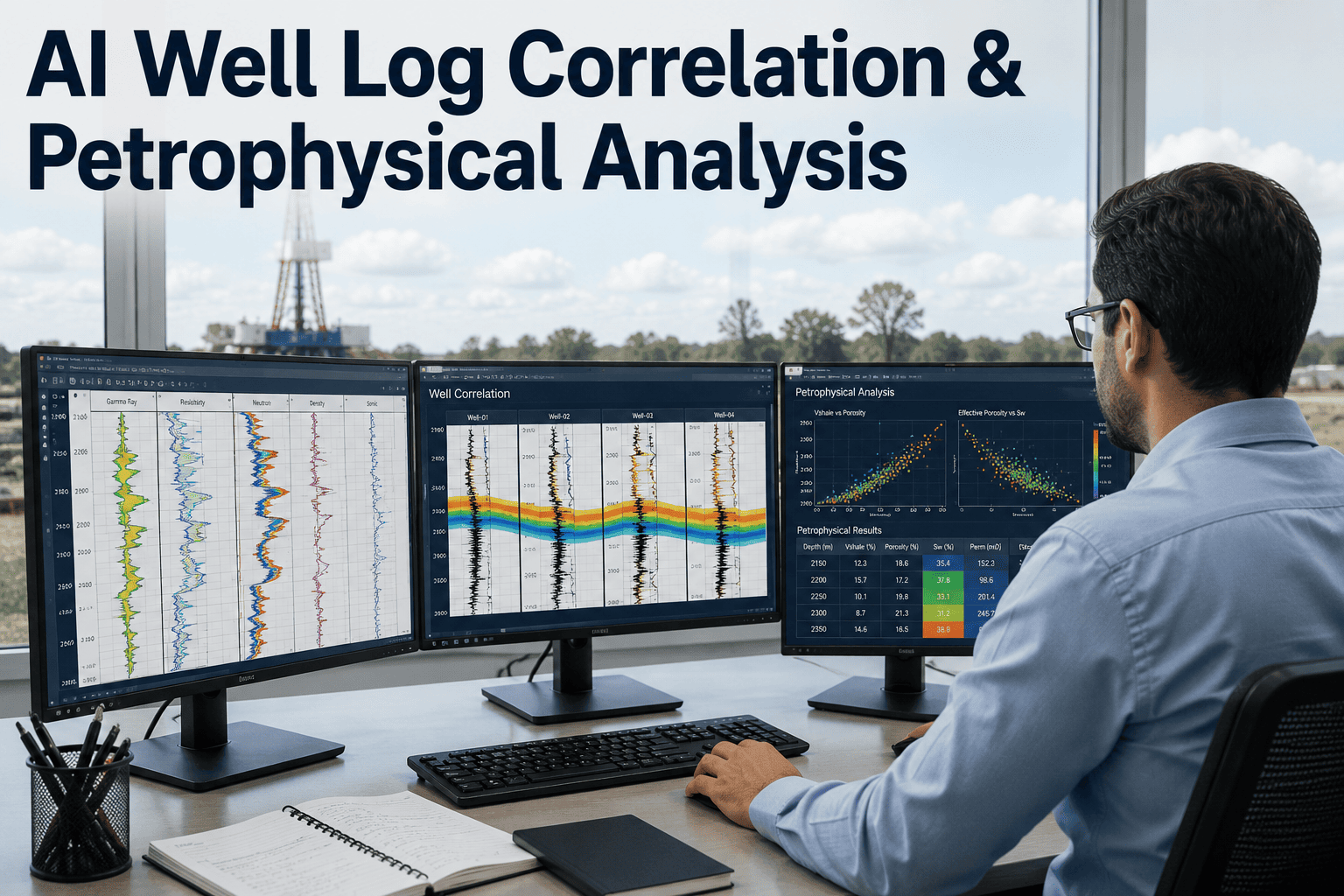
Well log correlation across a field development portfolio has always been a manual, iterative exercise that depends heavily on the experience of the senior petrophysicist assigned to the project. When a single field contains hundreds of wells drilled over decades with different tool generations, logging suites, and mud systems, the correlation process alone can consume months of senior technical time before any actual formation evaluation begins. AI-driven log correlation and petrophysical analysis platforms are eliminating this bottleneck by automatically normalizing disparate log suites, classifying electrofacies across all wells simultaneously, and mapping petrophysical properties to a consistent geological framework in hours rather than quarters. Book a demo to see how iFactory applies machine learning to your existing well log data without replacing the petrophysical models your team has already built and validated.
PETROPHYSICAL ANALYTICS · WELL LOG INTERPRETATION · OIL & GAS AI
AI Well Log Correlation and Petrophysical Analysis — From Months of Manual Picking to Hours of Automated Precision
iFactory ingests raw LAS and DLIS files from every well in your portfolio, normalizes tool responses across vintages and operators, correlates stratigraphic markers, classifies electrofacies, and estimates porosity, permeability, and saturation — delivering a field-wide petrophysical model that your geologists and engineers can trust from the first output.
100-500x
Speedup in Multi-Well Log Correlation
85-95%
Electrofacies Classification Accuracy
Less Than 5%
Mean Absolute Error on Porosity Estimates
Zero
Changes to Your Existing Petrophysical Model
THE CORRELATION BOTTLENECK
Six Problems That Make Manual Well Log Correlation Unscalable
Every petrophysicist recognizes these obstacles. They are not edge cases — they are the daily reality of correlating logs across any field with more than a handful of wells, and they are the exact problems that cause correlation projects to drag on for months while the reservoir model waits for petrophysical input.
01
Tool Response Drift Across Vintages
Wells drilled in 1985 with older generation tools produce gamma ray, resistivity, and density responses that do not directly compare to wells drilled in 2023 with modern arrays. Without normalization, correlation picks are biased by tool vintage rather than geology, creating artificial stratigraphic shifts that propagate into every downstream model.
02
Missing or Incomplete Log Curves
Older wells commonly lack density, neutron, or resistivity curves that are standard on modern logs. A well drilled in the 1970s may have only a gamma ray and spontaneous potential, making direct correlation with a modern triple-combo log impossible without estimating the missing curves from the available data — a task AI handles by learning the relationships between curve sets across your entire well population.
03
Facies-Dependent Log Response Variability
The same stratigraphic marker can produce entirely different log signatures in a sand-dominated channel versus a adjacent shale-prone overbank. Manual correlation picks made on a single curve like gamma ray routinely misplace formation tops in facies-variable intervals, and the error only becomes apparent when the reservoir model produces implausible sand body geometries months later.
04
Structural Complexity and Fault Displacement
In faulted fields, stratigraphic markers shift laterally across fault blocks, and correlating across faults without a structural framework leads to systematic mis-picks that stack section thickness errors. AI correlation algorithms incorporate structural dip and fault interpretations as constraints, ensuring that picks are geologically consistent with the known structural framework rather than force-fitting a simple vertical correlation.
05
Subjectivity Between Petrophysicists
Two experienced petrophysicists working the same well set will produce different correlation panels. The differences may be subtle — a few meters of shift here, a different interpretation of a condensed section there — but when multiplied across hundreds of wells, these subjective differences create internal inconsistencies in the petrophysical model that are impossible to trace back to a single decision or justify to a partner or regulator.
06
Scale Disconnect Between Logs and Core
Well logs sample the formation at decimeter resolution while core plugs represent centimeter-scale points. When log-based correlation does not account for this scale difference, the petrophysical model can assign properties derived from core-calibrated transforms to stratigraphic intervals that the logs have misplaced by half a meter or more — enough to put a perforation in the wrong zone or misallocate reserves between compartments.
AI PROCESSING PIPELINE
From Raw LAS Files to Field-Wide Petrophysical Model in Five Automated Stages
The pipeline below represents the complete sequence from data ingestion to deliverable output. Each stage produces an auditable intermediate product that your petrophysicists can inspect, override, or refine — the AI accelerates the workflow but never removes human judgment from the loop.
Data Ingestion and Quality Control
Automated, with human QC checkpoint
Raw LAS, DLIS, and CSV files from every well are parsed, curve names are mapped to a standard nomenclature, null values and spikes are flagged, and depth shifts between logging runs are detected and corrected. The system generates a data completeness matrix showing which curves are available in each well so the team knows exactly what the algorithm has to work with before processing begins.
Log Normalization and Curve Reconstruction
Machine learning, calibrated to key reference wells
Tool response offsets between vintages are quantified by comparing overlapping intervals in wells with both old and new log runs. A neural network then applies correction factors to bring all wells onto a consistent response scale. For wells missing critical curves, the network predicts the absent log from the available suite using relationships learned from wells where the full complement of curves exists.
Automated Stratigraphic Correlation
AI-driven, with geologist validation layer
Dynamic time warping and sequence-to-sequence neural networks compare multi-curve log signatures between well pairs, propagating correlation picks from key reference wells outward through the entire field. Structural dip, fault offsets, and thickness trends are incorporated as constraints so that the correlation honors the known geological framework rather than producing implausible thickness variations.
Electrofacies Classification and Lithology Prediction
Unsupervised and supervised ML, core-calibrated
A combination of clustering algorithms and convolutional neural networks classifies every depth sample into electrofacies based on the full available log suite. Where core data exists, the classification is calibrated to actual lithology descriptions and thin-section analyses. The result is a consistent, field-wide facies log in every well — including those with no core control — that can be directly mapped into the reservoir model.
Petrophysical Property Estimation
AI estimates, validated against core measurements
Porosity, permeability, water saturation, and clay volume are estimated at every depth sample using ensemble machine learning models trained on your core-plug measurements and conventional petrophysical calculations. The AI does not invent new transforms — it learns the nonlinear relationships between log responses and core-measured properties that linear regressions and conventional crossplots cannot capture, producing continuous property curves that match core data within your specified error tolerance.
MANUAL VS AI WORKFLOW
Side-by-Side Comparison of Traditional and AI-Driven Petrophysical Analysis
The two approaches are not competing philosophies — traditional analysis is the foundation that AI builds upon. The comparison below shows where AI introduces efficiency and consistency gains without altering the underlying petrophysical principles your team relies on for reserve estimation and completion design.
Individual well-by-well log editing and depth shifting over weeks per well
Visual correlation on paper or workstation with subjective pick consistency
Linear regressions and crossplot transforms for each property independently
Facies picked by eye on each well using different criteria from well to well
Missing curves either ignored or estimated by simple single-well regressions
Tool normalization applied as bulk shifts with limited vintage-specific calibration
Quality control performed at the end when errors are expensive to correct
Automated QC and depth shifting across all wells simultaneously in hours
Multi-curve neural correlation with quantified pick confidence at every horizon
Ensemble ML models capturing nonlinear log-to-property relationships field-wide
Consistent electrofacies classification using the same trained model on every well
Missing curves predicted from multi-well learned relationships with uncertainty bounds
Quantitative tool normalization calibrated per vintage, per tool type, per operator
Continuous QC metrics generated at every pipeline stage for immediate review
Stop Repeating the Same Petrophysical Calculations Well After Well — Let AI Correlate and Classify Your Entire Field at Once
iFactory processes your existing LAS and DLIS files, normalizes tool responses, correlates stratigraphy, classifies electrofacies, and estimates properties across every well in your portfolio without changing the petrophysical framework your reserves are based on.
CORE CAPABILITIES
What the AI Platform Actually Delivers to Your Petrophysical Workflow
Each capability below maps directly to a deliverable your team already produces — the difference is speed, consistency across all wells, and the ability to reprocess the entire field when new well data arrives without starting from scratch.
Multi-Well Log Normalization
Quantifies and corrects tool response offsets between logging runs, tool generations, and operators using overlapping interval analysis and neural network-based correction. Every well in the field is brought onto a common response scale so that correlation picks reflect geology rather than tool vintage. Correction factors are logged and auditable for regulatory submission.
Missing Curve Prediction
Neural networks trained on wells with complete logging suites predict absent curves — density, neutron, resistivity, or sonic — from the available data in wells where those curves were never acquired or were corrupted beyond use. Each prediction includes a confidence interval so your team knows where to trust the estimate and where to treat it with caution.
Automated Marker Correlation
Dynamic time warping and attention-based sequence models correlate formation tops, maximum flooding surfaces, and sequence boundaries across all wells simultaneously. Picks propagate from high-quality reference wells outward with quantified uncertainty that increases logically with distance from control — giving your geologists a first-pass correlation framework they can refine rather than build from nothing.
Electrofacies and Lithology Classification
Unsupervised clustering identifies natural groupings in the multi-dimensional log space, and supervised classification maps those groups to core-described lithologies. The output is a discrete facies log at the same vertical resolution as the input curves, consistent across every well in the field, with a confusion matrix showing classification accuracy against every cored interval.
Porosity, Permeability, and Saturation Estimation
Ensemble machine learning models trained on core-plug measurements estimate continuous property curves at every depth sample. The models capture nonlinear relationships — such as the porosity-permeability disconnect in diagenetically altered carbonates or the saturation-height behavior in heterogeneous sandstones — that conventional linear transforms systematically misrepresent.
Clay Volume and Shaliness Estimation
Multiple clay volume indicators — gamma ray, spontaneous potential, neutron-density separation, and resistivity-based methods — are combined using a learned weighting scheme that adapts to the local mineralogy rather than applying a single global transform. This produces clay volume curves that honor the actual mineral assemblage in each formation rather than assuming a uniform shale composition.
OUTPUT METRICS
Quantitative Benchmarks That Define a Production-Ready Petrophysical Model
These are the accuracy and consistency thresholds that separate a petrophysical model suitable for internal review from one that can support reserve booking, completion design, and partner reporting. The AI pipeline tracks each metric continuously and flags any well or zone that falls below the acceptable threshold for manual review.
Less Than 1.5
Porosity MAE (Porosity Units)
Mean absolute error between AI-estimated porosity and core-measured porosity, validated on a held-out set of cored wells not used in model training.
Half Decade
Permeability Prediction Accuracy
AI permeability estimates fall within half a decade of core-measured values on the held-out validation set, which is the practical tolerance for most reservoir engineering applications.
Greater Than 0.88
Electrofacies Classification F1 Score
Weighted F1 score against core-described lithologies, confirming that the facies classification is accurate enough to drive reservoir model property distribution without manual reclassification.
Less Than 3 m
Correlation Pick Deviation at Control Wells
Average deviation between AI correlation picks and expert-picked tops at validation wells, confirming that the automated correlation matches human-quality interpretation within engineering tolerance.
FIELD APPLICATIONS
Where AI Petrophysical Analysis Delivers the Highest Impact in Oil and Gas Operations
The value of automated well log analysis is not uniform across every operational context. The scenarios below represent the environments where the gap between manual and AI-assisted workflows is largest — where data volume, well count, and time pressure combine to make traditional approaches the actual bottleneck in the decision chain.
FIELD DEVELOPMENT
Brownfield Recorrelation After Infill Drilling
When a mature field receives 50 to 200 new infill wells over several years, the existing petrophysical model must be updated to incorporate the new data. Manually re-correlating the entire well set — old and new — is often deferred due to cost, leaving the reservoir model operating on an outdated stratigraphic framework. The AI pipeline reprocesses every well in the field in a single run, incorporating the new infill data without discarding the interpretive context of the original correlation.
MERGERS AND ACQUISITIONS
Rapid Portfolio Petrophysical Reconciliation
Acquired portfolios arrive with wells logged by different operators using different tool suites, different curve names, different depth references, and different petrophysical conventions. Reconciling this data into a single consistent petrophysical dataset is a prerequisite for any reserve assessment or development planning. The AI pipeline normalizes and correlates the entire acquired portfolio against the operator's existing standards in days rather than the months that manual reconciliation typically requires.
UNCONVENTIONAL RESOURCES
High-Density Log Facies Mapping for Completion Design
Unconventional completions in tight reservoirs require detailed rock quality characterization at foot-scale resolution across hundreds of horizontal well laterals. Manual petrophysical analysis cannot keep pace with the volume of data generated by modern logging-while-drilling campaigns. The AI pipeline processes every lateral in the field with the same facies classification model, producing consistent rock quality logs that completion engineers can use to design stage spacing and proppant loading without waiting for petrophysical turnaround.
CARBONATE RESERVOIRS
Complex Pore System Characterization and Property Estimation
Carbonate reservoirs with dual or triple porosity systems — matrix, fracture, and vug — exhibit porosity-permeability relationships that vary dramatically over short vertical distances. Conventional linear transforms fail to capture this variability, producing permeability estimates that can be wrong by orders of magnitude in the most productive intervals. The AI model learns the nonlinear mapping from log responses to core-measured permeability that respects the pore system heterogeneity, delivering permeability curves that honor the actual flow behavior of the rock.
FREQUENTLY ASKED QUESTIONS
Questions Petrophysicists and Asset Managers Ask About AI Well Log Analysis
Does the AI platform replace the petrophysical model our team has already built and validated?
No. The AI platform generates the input data and property estimates that feed into your existing petrophysical model — it does not replace the model itself. Your saturation-height function, your permeability transforms, your clay volume methodology, and your cutoff criteria all remain exactly as your team defined them. What changes is that the log data feeding those models is normalized, correlated, and consistently classified before it reaches your established workflow, eliminating the data quality inconsistencies that currently force your petrophysicists to apply ad-hoc corrections on a well-by-well basis.
Book a demo to see how the AI output integrates with your current petrophysical model structure.
What log curve combinations does the system require as minimum input to produce useful results?
The minimum viable input is a gamma ray curve and at least one porosity curve — either density, neutron, or sonic — combined with a resistivity curve. With this minimum suite, the system can perform basic correlation, facies classification, and property estimation, though accuracy improves substantially when a full triple-combo suite is available. For wells missing even these minimum curves, the system can predict the absent logs from neighboring wells using the spatial interpolation and curve reconstruction models, with confidence intervals that clearly indicate the uncertainty associated with predicted input data.
Contact our support team to review the input requirements for your specific logging suite and data availability.
How does the AI handle wells with different depth references or missing depth information?
The ingestion pipeline detects and reconciles differences between measured depth, total vertical depth, and true vertical depth references across the well set. When depth information is incomplete or ambiguous, the system uses known formation tops, marker beds, and correlation with neighboring wells to establish a consistent depth framework. Every depth correction is logged with the original and corrected values, the method used, and the confidence level so that your team can audit and override any correction that does not match their knowledge of the well or field. The system never silently shifts data — every change is transparent and reversible.
Book a demo to see the depth reconciliation workflow applied to wells with mixed depth references.
Can the electrofacies classification be calibrated to our existing core-based facies scheme rather than creating a new one?
Yes. The classification system can be trained in a fully supervised mode using your existing core-described facies as labels, which means the AI learns to reproduce your established facies scheme rather than generating an independent classification. This is critical for continuity in reservoir models that have been built and history-matched using a specific facies framework — switching to a new classification scheme mid-project would invalidate years of modeling work. The supervised approach maps the multi-dimensional log response space directly onto your existing facies definitions, producing consistent facies logs in every well that align with the scheme your geologists and reservoir engineers already use.
Contact our support team to discuss calibrating the classification to your core facies database.
What happens when the AI produces a correlation pick or property estimate that the petrophysicist knows is wrong?
Every AI-generated pick and property estimate is fully editable. The platform provides a visual interface where your petrophysicist can override any individual pick, adjust any property curve, or reclassify any facies interval — and the system records the override along with the original AI value and the reason provided. Over time, these overrides create a feedback loop that improves the underlying models for future runs, so the system learns from your team's expertise rather than competing with it. The AI is designed to produce a first-pass result that is good enough to refine, not a final answer that must be accepted.
Book a demo to see the override and feedback workflow in action.
Your Wells Already Hold the Data — AI Extracts the Petrophysical Story in Hours Instead of Months
Every LAS and DLIS file in your archive contains information your team has not had time to fully exploit. Book a session to see iFactory process your actual well log data, correlate your field, and deliver petrophysical properties you can validate against your core measurements.