Over 40% of plant incidents at U.S. oil and gas facilities occur during start-up, shutdown, and shift change periods — despite those windows accounting for less than 5% of total operational time. That statistic is not a coincidence. It is the direct consequence of treating shift handover as an informal transition rather than a safety-critical knowledge transfer event. The major industrial disasters that define process safety history — Piper Alpha, BP Texas City, Buncefield, Esso Longford — each share a common thread: shift handover communication failed to transfer the specific abnormal condition that became the initiating cause of the incident. In every case, the information existed. It existed in the outgoing operator's head, in an open maintenance request, in a valve status that didn't get verbalized. What failed was the system for capturing, structuring, and verifying that transfer of knowledge across the shift boundary. iFactory's digital shift logbook platform replaces unstructured paper logs and informal verbal handovers with mandatory structured templates, abnormal status flagging, digital acknowledgment, and searchable audit trails — giving U.S. refinery and process plant operators the tools to close the shift change gap before it becomes an incident report. Book a Demo to see how iFactory's shift handover platform deploys across your operations in days, not months.
Why Shift Handover Is a Safety-Critical Event — Not a Routine Transition
The UK Health and Safety Executive formally classifies shift handover as a category of safety-critical communication — a designation that reflects the documented role of handover failures in major industrial accidents. Post-incident investigations consistently reveal that the incoming crew lacked knowledge that the outgoing crew possessed: an inhibited safety system, an equipment defect deferred to the next shift, a process running at an abnormal parameter that had been manually managed throughout the previous eight hours. None of that information is automatically visible to an incoming operator walking onto the unit. It only exists if someone captured it, structured it, and verified that the incoming operator received and understood it.
The problem is structural. Paper logbooks and verbal walkarounds depend entirely on individual operator judgment about what constitutes critical information — and that judgment varies by experience level, fatigue state, and time pressure at the end of a shift. A structured handover system removes that variability by mandating what categories of information must be documented and verified at every handover, regardless of how routine the shift appeared. Book a Demo to see how iFactory enforces structured handover at every shift change.
What a Structured Shift Handover Logbook Must Capture — and What Most Don't
The difference between a logbook that prevents incidents and one that merely documents them is structure. Research conducted at the ENGEN Refinery by the Abnormal Situation Management Consortium found that a structured, checklist-integrated logbook produced significantly better situation awareness outcomes than a traditional unstructured logging approach — because structure forces operators to actively evaluate each category rather than relying on memory of what seemed important at the end of the shift. The following table defines what a safety-compliant shift handover logbook must capture across six mandatory categories, and maps the failure mode that occurs when each category is absent or incomplete.
| Logbook Category | What Must Be Documented | Failure Mode When Missing | iFactory Enforcement |
|---|---|---|---|
| Equipment Status | All equipment in abnormal state: bypassed, inhibited, isolated, running on manual, or operating outside normal envelope | Incoming operator assumes normal state; attempts normal operation of bypassed safety system or inhibited interlock | Mandatory equipment status section; abnormal conditions flagged red with required acknowledgment by incoming operator |
| Open Maintenance and PTW Status | All active permits to work, open isolation points, energy control lockouts, and deferred maintenance items with current status | Incoming crew disturbs an active isolation or issues a new permit conflicting with an open work order — classic Piper Alpha failure pattern | PTW records linked directly to logbook entries; incoming operator cannot acknowledge handover with unresolved permit conflicts flagged |
| Process Conditions and Deviations | Current operating conditions where parameters deviate from setpoint, manual overrides active, or trends requiring monitoring | Incoming operator unaware of manual control or drifting parameter; deviation becomes incident when outgoing operator's awareness leaves with the shift | DCS and historian integration surfaces live deviations automatically; operator adds context and monitoring instructions; incoming crew sees live values at handover |
| Safety Events and Near Misses | All safety events from the outgoing shift: near misses, injury reports, hazard observations, environmental exceedances, and SIF demands | Incident history not communicated; incoming crew repeats same exposure; pattern identification delayed across shifts | Mandatory safety event field; entries trigger automatic notification to safety manager; searchable across all shifts for pattern recognition |
| Production and Quality Status | Production targets vs. actuals, off-spec events, quality deviations, customer order status, and grade change instructions | Incoming operator unaware of grade change in progress or quality deviation that requires specific monitoring through transition | Production metrics pulled automatically from MES where integrated; manual entry with mandatory completion enforced before handover submission |
| Pending Tasks and Action Items | All tasks initiated but not completed by outgoing shift: monitoring requests, follow-up inspections, communication with maintenance, and regulatory checks | Deferred tasks fall through the shift gap; no incoming operator owns the action; task is lost until consequence surfaces | Task items carried forward with explicit acceptance by incoming operator; unacknowledged tasks escalate automatically to shift supervisor |
Abnormal Status Flags and Verbal Verification: The Two Controls That Close the Handover Gap
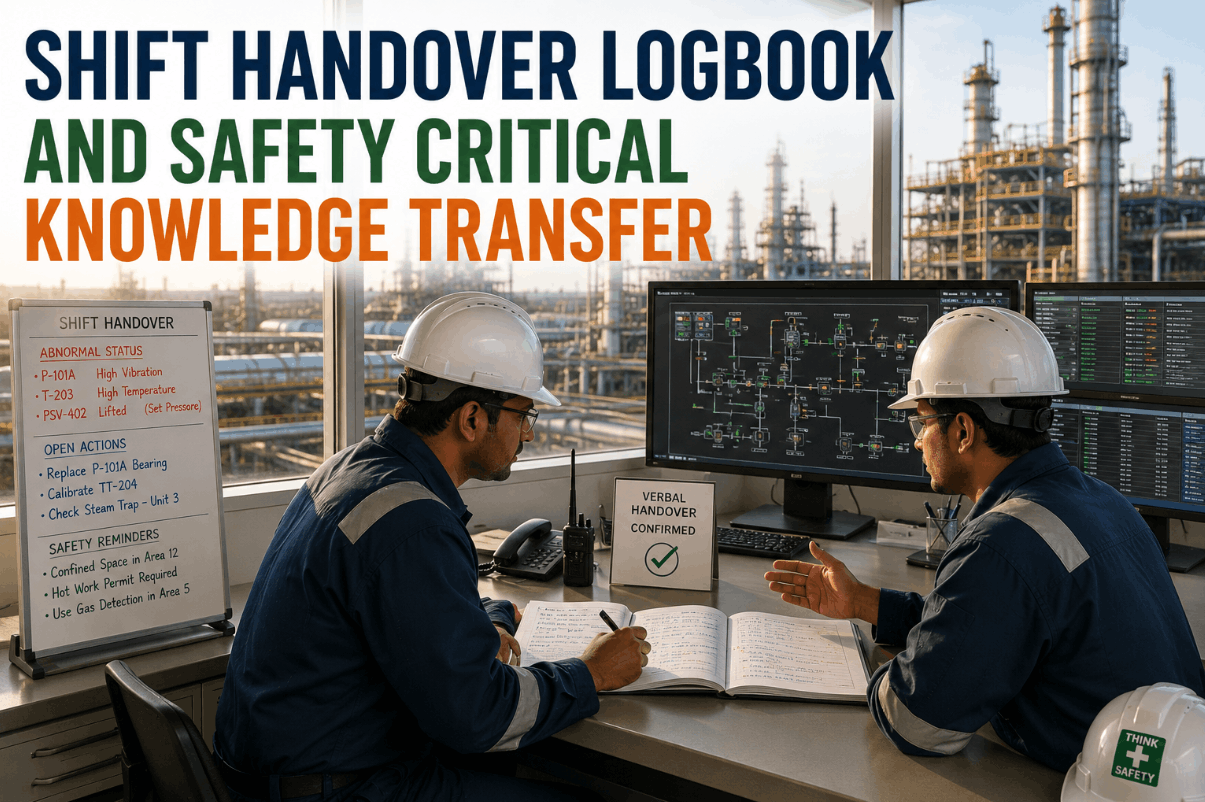
Documentation alone is not enough. A logbook that is completed but not read produces the same safety outcome as one that was never written. Effective shift handover requires two additional controls beyond documentation: abnormal status flagging that forces the incoming operator's attention to specific conditions requiring their awareness, and verbal verification that confirms the incoming operator has understood — not merely received — the critical information.
The Incident Cost of Poor Handover — and the ROI of Getting It Right
The financial case for structured shift handover is not theoretical. Every major refinery and process plant incident attributed in part to handover failure has produced a documented cost record that dwarfs the investment in any digital logbook platform. The BP Texas City refinery explosion in 2005 — in which handover failure was among the documented contributing causes — resulted in $1.5 billion in total costs. Piper Alpha, where an uncommunicated valve removal initiated a gas release that killed 167 people, resulted in $3.4 billion in insured losses at 1988 values. The cost components of a handover-related incident extend well beyond the immediate event.
- Emergency response, medical, and evacuation costs from the incident event
- Equipment damage and emergency repair at premium unplanned cost rates
- Production shutdown during investigation — $150,000–$400,000 per day for a mid-size refinery
- OSHA inspection, citation, and penalty exposure — willful violations up to $165,514 per citation
- Mandatory incident investigation costs including contractor specialist engagement
- Worker compensation claims for injuries: $380,000–$1.2M direct cost average per serious injury
- OSHA PSM citation for inadequate shift handover procedure under 29 CFR 1910.119 Mechanical Integrity
- State environmental agency penalties where process release occurred during shift change failure
- Civil litigation exposure — documented handover failures create strong plaintiff evidence of systemic negligence
- EPA reporting obligations for process releases — public disclosure triggers reputational consequence
- Deferred maintenance items lost in handover gaps compound into unplanned equipment failures
- Off-spec product events from uncommunicated grade changes or process deviations during shift transition
- Repeated defect exposure where near-miss information does not transfer across shifts — same hazard recurs
- Overtime and emergency procurement costs from failures that structured handover would have flagged for planned intervention
- Audit and accreditation failure risk when handover records cannot demonstrate PSM compliance
- Insurance premium increases of 15–35% for 3–5 years following a reported serious process incident
- Targeted OSHA inspection program — elevated oversight for 12–24 months after serious violation finding
- Workforce recruitment and retention cost increase at facilities with documented safety records
- Customer supply chain audit requirements increase materially after a public incident record
- Capital project approval delays when incident history triggers heightened corporate safety review requirements
Expert Review: What Process Safety Professionals Say About Shift Handover Failures
In 23 years of process safety work across U.S. and international refining, I have reviewed incident investigations where the root cause was unambiguously a shift handover failure — information that existed, was known to the outgoing operator, and was never transferred. What makes this particularly difficult is that the outgoing operator in almost every case did not intend to withhold the information. They simply did not have a system that told them this specific piece of information was critical, and their judgment about what needed to be communicated was made at the end of a twelve-hour shift under time pressure. The answer is not better operators. The answer is a system that removes judgment from the decision about what to document. When the handover platform tells you these six categories must be completed before you can submit the logbook, when it flags in red the three abnormal conditions that the incoming operator must individually acknowledge, when it cannot be marked complete until the incoming crew has digitally accepted it — you have closed the gap. You have not depended on memory and communication culture to carry safety-critical information across a shift boundary. You have enforced it. That is the difference between a program and a system.
Conclusion: Shift Handover Is Where Knowledge Continuity Lives — or Dies
Every shift change at a U.S. refinery or process plant represents a knowledge transfer event where the operational awareness built over eight or twelve hours by one crew must be reliably transmitted to the incoming crew before the outgoing crew leaves the site. When that transfer fails — when an abnormal condition is not flagged, when a deferred maintenance item is not communicated, when an open permit is not acknowledged — the incoming crew operates with a false picture of the plant's condition. The consequences range from a missed maintenance window to a process incident that triggers a multi-year legal and regulatory response.
Structured shift handover logbooks, mandatory abnormal status flagging, verbal verification protocols, and digital acknowledgment requirements are not administrative burdens — they are the operational controls that convert a shift change from a knowledge gap into a knowledge transfer. iFactory's digital shift logbook platform delivers all four controls in a system that requires no integration dependency to go live, enforces compliance without relying on operator discipline, and generates the searchable audit trail that PSM compliance programs and incident investigations require. The investment is measured in days to deploy. The risk it addresses is measured in nine figures. Book a Demo to see how iFactory's shift handover platform works in your operational environment.