An Emergency Shutdown System that fails to trip when a hazard demands it is not a safety layer — it is a liability. For U.S. process manufacturers, refineries, and chemical facilities operating under OSHA PSM (29 CFR 1910.119) and IEC 61511, maintaining a functional ESD and Safety Instrumented System (SIS) requires far more than installing the hardware and hoping for the best. It demands disciplined proof testing on intervals calculated against actual Probability of Failure on Demand (PFD) targets, rigorous bypass authorization tied to SIL ratings, and a complete digital audit trail of every override, test result, and corrective action logged against each Safety Instrumented Function (SIF). iFactory AI's industrial safety management platform digitizes this entire lifecycle — from SIF proof test scheduling and bypass logging to deviation tracking and compliance reporting — giving process safety engineers and plant managers the evidence they need to demonstrate that every safety layer works, every time it is called upon.
Why ESD Testing Is Not Optional — And Why Paper Logs Fail PSM Audits
Every Safety Instrumented Function in a process plant has a defined proof test interval — a maximum period between functional tests calculated to keep the system's PFD within its SIL-rated risk reduction boundary. The longer a SIF goes untested, the higher the probability that a hidden failure exists: a sensor that has drifted out of calibration, a solenoid valve that has mechanically seized, or a logic solver output that no longer drives the final element to its safe state. Under IEC 61511 and OSHA PSM, these intervals are not engineering guidelines — they are compliance obligations. Yet in most U.S. facilities, proof test scheduling is still managed through calendar reminders, spreadsheet trackers, and paper test records that cannot be verified, cross-referenced with bypass history, or automatically escalated when a test window lapses. Process safety engineers who Book a Demo of iFactory AI's SIS management module immediately identify gaps between their stated test intervals and actual test execution dates — gaps that represent both unacceptable process risk and significant regulatory exposure.
The Three ESD Testing Methods Every Process Safety Engineer Must Manage
Not all ESD testing is equivalent — the method used determines how much of the safety function is actually verified, and how much residual risk remains. Selecting the right testing approach for each SIF, and documenting that decision against the Safety Requirements Specification (SRS), is a core competency that iFactory AI's platform supports with structured test templates and SIL-aware scheduling logic. Safety engineers who Book a Demo can configure test method assignments directly within the SIF register, ensuring that no function defaults to a less rigorous test type than its risk rating demands.
Full Stroke Testing (FST)
The most comprehensive proof test — the SIF is taken to its fully safe state, exercising the complete loop from sensor initiation through logic solver to final element full travel. Provides the highest diagnostic coverage but requires a planned process shutdown or unit isolation to execute safely. Mandatory at defined intervals for all SIL-rated functions regardless of other test methods used.
Partial Stroke Testing (PST)
The final element — typically an ESD valve — is exercised through a defined partial travel range (commonly 10–30%) without triggering a full process shutdown. PST detects mechanical failures such as stiction, seat fouling, and actuator degradation that would prevent the valve from reaching its safe position on demand. Widely used between full stroke intervals to improve overall diagnostic coverage without production impact.
Functional Loop Testing
Individual SIF subsystems — transmitters, logic solver I/O cards, solenoid valves — are tested segment by segment against defined acceptance criteria without necessarily completing a full end-to-end trip test. Used when full stroke testing is impractical and PST does not cover the sensor or logic solver portions of the loop. Results are documented per element with pass/fail records and technician sign-off requirements.
ESD Bypass Management: The Most Audited Gap in U.S. Process Safety Programs
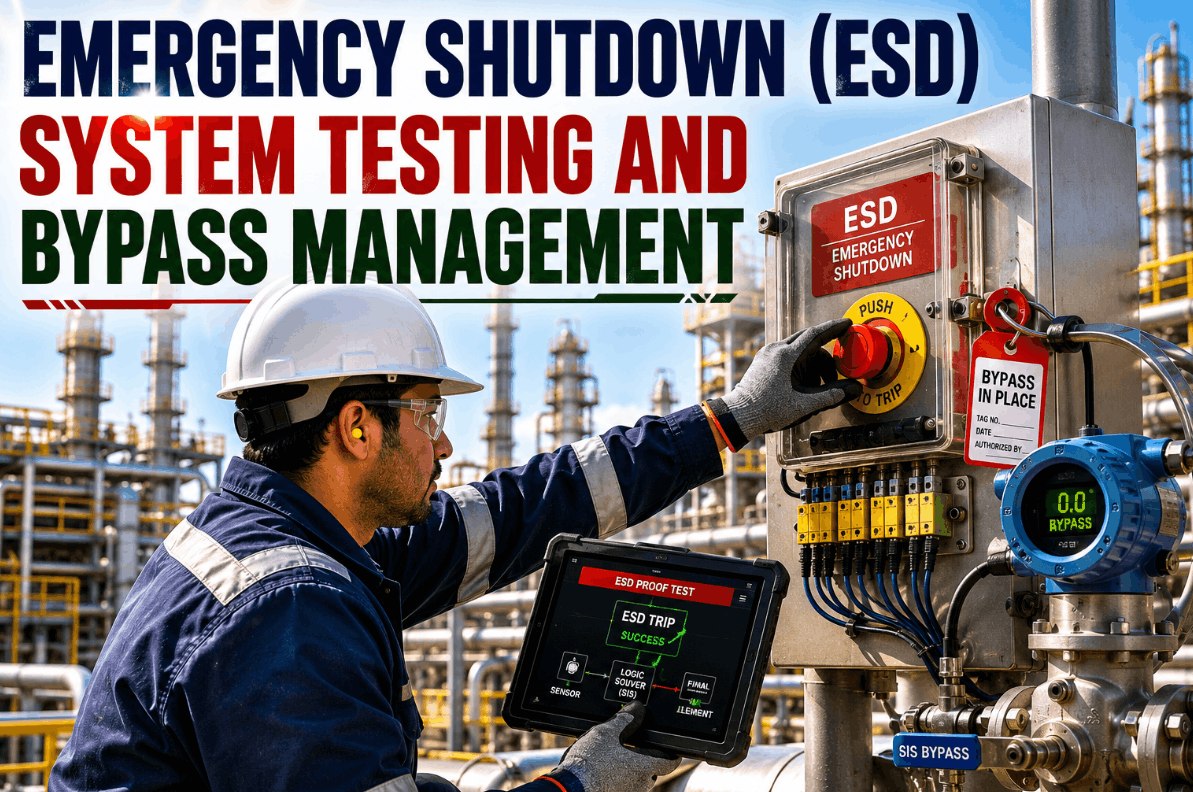
Bypassing a Safety Instrumented Function is sometimes necessary — during plant startup, sensor maintenance, or valve repair — but it is never risk-neutral. Every moment a SIF is in bypass, the safety layer it provides is absent. Under IEC 61511 and OSHA PSM requirements, every bypass must be formally authorized, time-limited, logged with the reason and compensating measure, and closed out when the SIF is restored to service. In practice, most U.S. facilities still manage bypasses through verbal communication, whiteboard tracking, or disconnected permit systems that provide no guarantee of escalation, visibility, or closure. iFactory AI enforces bypass governance digitally — requiring authorization against SIL tier, alerting supervisors and process safety staff in real time when a bypass is activated, and automatically flagging any bypass that exceeds its approved duration.
| SIL Rating | Risk Reduction Factor | Bypass Authorization Level | Max Uncompensated Duration | Required Compensating Measure |
|---|---|---|---|---|
| SIL 1 | 10 – 100× | Shift Supervisor | 8 hours | Increased operator surveillance |
| SIL 2 | 100 – 1,000× | Operations Manager + PSE Sign-Off | 4 hours | Continuous monitoring + standby isolation |
| SIL 3 | 1,000 – 10,000× | Plant Manager + Process Safety Engineer | Immediate corrective action required | Manual watch, process rate reduction, or shutdown |
| SIL 4 | > 10,000× | Site Director + Regulator Notification | Not permitted without redundant protection | Facility-level risk assessment required |
How iFactory AI Digitizes the ESD Testing and Bypass Lifecycle
iFactory AI's safety management platform covers the complete ESD and SIS operational lifecycle — from proof test scheduling through bypass authorization, deviation logging, and corrective action tracking. Every record is timestamped, role-authenticated, and stored in an immutable audit trail that satisfies OSHA PSM, IEC 61511, and BSEE 30 CFR 250 documentation requirements. Safety managers who Book a Demo gain full visibility into their SIF register, live bypass status, and overdue test alerts within a single unified platform.
SIF Register & Test Interval Configuration
Import your Safety Requirements Specification and build a structured SIF register with each function's SIL rating, test method assignment, proof test interval, and responsible engineer. The platform automatically calculates next-due test dates and sends escalating alerts as intervals approach.
Digital Proof Test Execution & Result Capture
Technicians execute proof tests using structured mobile checklists — capturing actuation times, setpoint values, pass/fail status, and photo evidence at every step. The platform enforces mandatory field completion and requires dual sign-off from the executing technician and authorizing engineer before a test record is closed.
Bypass Authorization & Real-Time Override Logging
Every bypass request is routed through a SIL-tiered authorization workflow. The platform records the requestor, authorizing authority, compensating measure, approved duration, and actual restoration time — creating a complete bypass log that satisfies IEC 61511 clause 16 override documentation requirements.
Deviation & Failure Tracking with Corrective Action Workflow
Test failures, out-of-specification readings, and repeated deviations automatically generate corrective action records with priority assignments and resolution deadlines. Historical failure trend data is displayed per SIF — enabling reliability engineers to identify systematic issues before they lead to a demand on a degraded function.
Compliance Reporting & Audit Package Generation
Generate on-demand OSHA PSM audit packages, IEC 61511 lifecycle records, and management of change documentation directly from the platform. Every test record, bypass log entry, and corrective action is exportable as a structured, date-stamped compliance report — eliminating the weeks of manual compilation that precede regulatory inspections.
"We had 47 SIFs in our facility and were managing proof test intervals in three separate spreadsheets with no automatic escalation when a test window lapsed. After deploying iFactory AI's SIS module, our bypass log went from a whiteboard in the control room to a fully authorized, time-stamped digital record that our PSM auditors could review in real time. We closed our last PSM audit with zero process safety findings for the first time in six years."
Expert Perspective: The Bypass Accumulation Problem in U.S. Process Plants
One of the most insidious risk patterns in SIS management is bypass accumulation — where individual, seemingly justified bypasses pile up across a facility until a significant portion of the safety layer is simultaneously inactive. Each bypass, taken in isolation, may be properly authorized and compensated. But without a platform that displays aggregate bypass status across all SIFs in real time, no single person in the facility can answer the question: how much of our safety instrumented system is currently bypassed? iFactory AI's safety dashboard provides exactly this visibility — a live risk posture display showing which SIFs are active, which are in bypass, which have overdue proof tests, and which have open corrective actions. This aggregate view is what separates a safety management program that satisfies the letter of IEC 61511 from one that genuinely maintains process risk at its design target.
The authorization level for a bypass must scale with the SIL rating of the function being defeated. A SIL 1 bypass carries fundamentally different risk than a SIL 3 bypass and must require correspondingly higher authority and compensating protection.
An unexecuted proof test does not reset the PFD clock — it compounds it. Every day past a missed interval, the probability of an undetected failure on demand increases, often invisibly. Automated interval tracking with escalating alerts is not a convenience, it is a safety requirement.
A single test failure may be a one-time anomaly. Repeated failures on the same SIF element — whether sensor, solenoid, or valve — are a leading indicator of systematic degradation that demands a formal SIF reliability review and potential SRS revision.
PST results credit diagnostic coverage but do not satisfy the full proof test interval obligation. Conflating the two in a shared log creates compliance confusion and misrepresents the actual PFD achieved — a common finding in PSM compliance audits.
Safety engineers building or upgrading their SIS management program can Book a Demo to see how iFactory AI maps SIL ratings, test methods, bypass rules, and corrective action workflows to their specific facility's SIF register — without requiring a rip-and-replace of existing logic solvers or DCS infrastructure.
Conclusion: A Functioning ESD System Needs Proof — Not Assumption
The process industry's most consequential safety failures have shared a common thread: safety systems that were assumed to be functional but had never been properly tested, or were bypassed without adequate compensating controls. Under the combined framework of OSHA PSM, IEC 61511, and API RP 14C, the burden of proof is on the plant operator — not on the system itself. Every SIF must have a documented proof test history, every bypass must have an authorized record, and every test failure must have a closed corrective action before the system is returned to service. iFactory AI provides the platform to meet that burden of proof — digitally, continuously, and in a format that satisfies every regulatory inspection standard U.S. manufacturing and process facilities face today.
Frequently Asked Questions: ESD Testing and Bypass Management
How does iFactory AI determine proof test intervals for each SIF?
Proof test intervals are configured per SIF based on the SIL rating, PFD target, and test method assigned in your Safety Requirements Specification — with the platform automatically scheduling and escalating as each interval window approaches.
Can the platform manage both partial stroke and full stroke test records for the same SIF?
Yes — PST results and full proof test records are maintained separately under the same SIF record, with distinct pass/fail criteria, coverage factors, and compliance obligations tracked independently to prevent conflation during audits.
How does the bypass log satisfy IEC 61511 clause 16 documentation requirements?
Every bypass record captures requestor identity, authorization authority, SIL rating of the bypassed function, compensating measure, approved duration, and restoration timestamp — exportable as a structured compliance document on demand.
Does the platform integrate with existing logic solvers or DCS systems?
iFactory AI integrates via standard OPC-UA and REST API protocols with major DCS and SIS platforms, pulling live bypass status and trip demand data into the dashboard without modifying or bypassing existing safety-rated control logic.
How are repeated SIF test failures handled within the platform?
Repeated failures on the same SIF element automatically trigger a formal corrective action record with escalated priority, and the SIF's failure trend history is surfaced in the reliability dashboard to support a structured SIS review or SRS revision workflow.