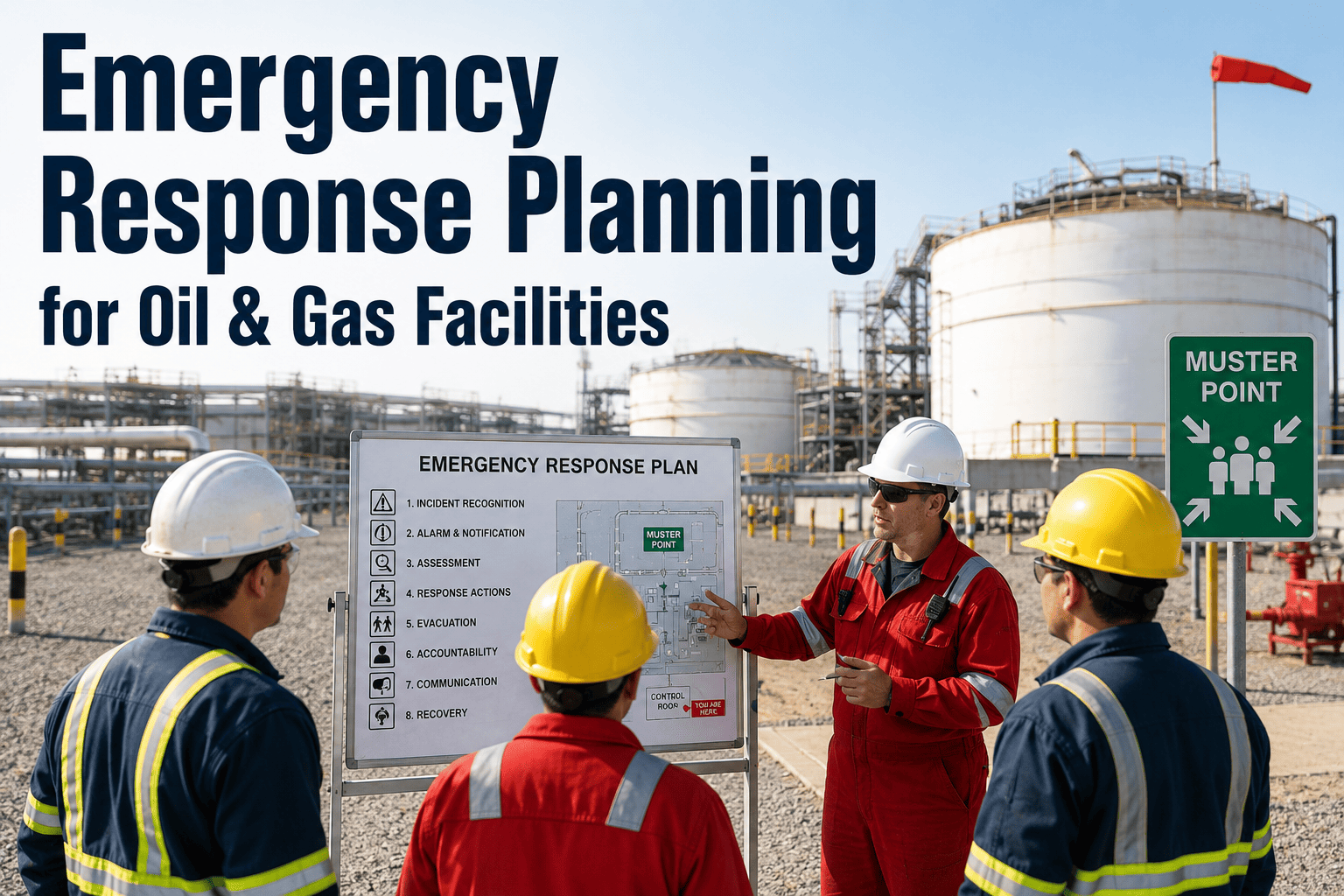
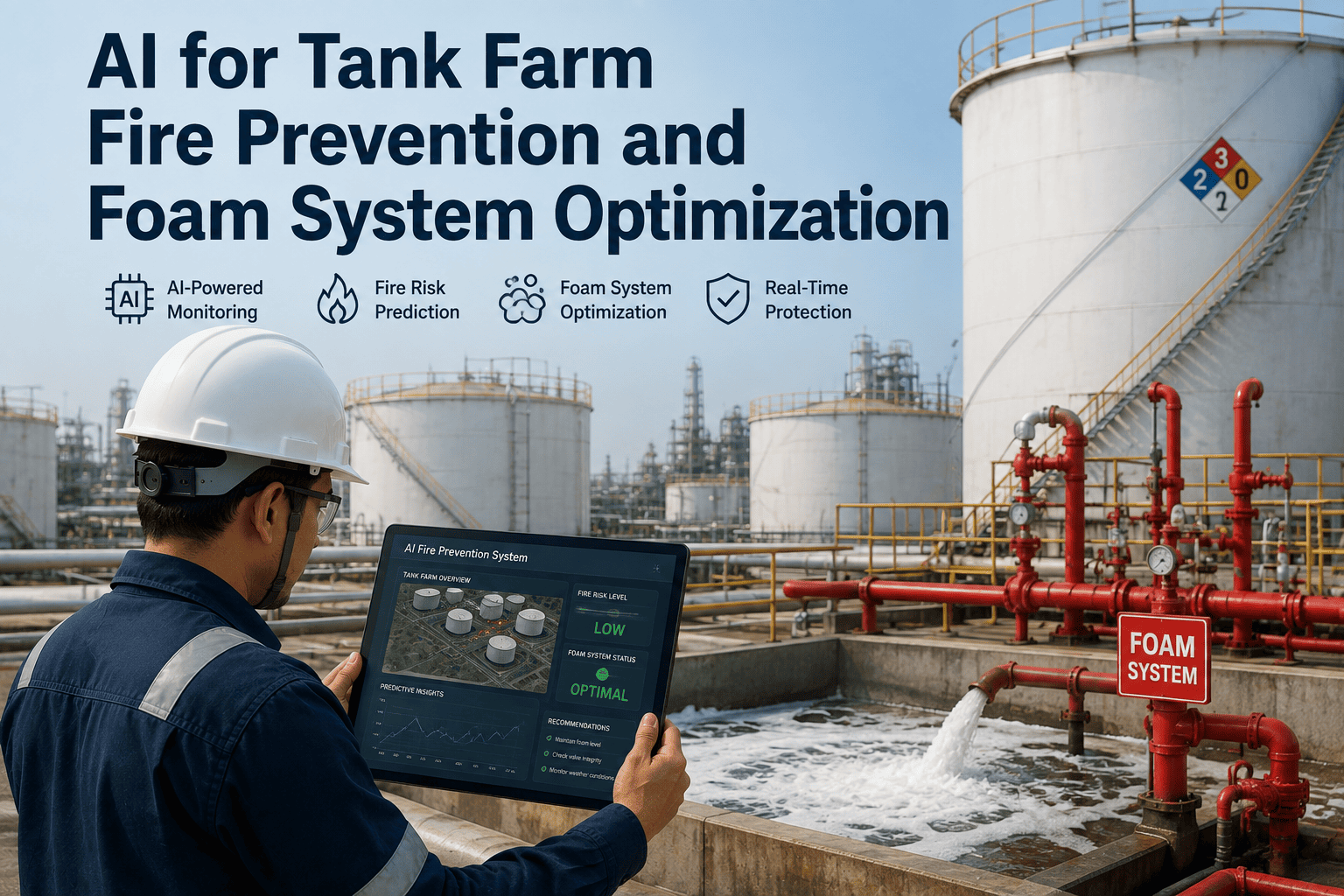
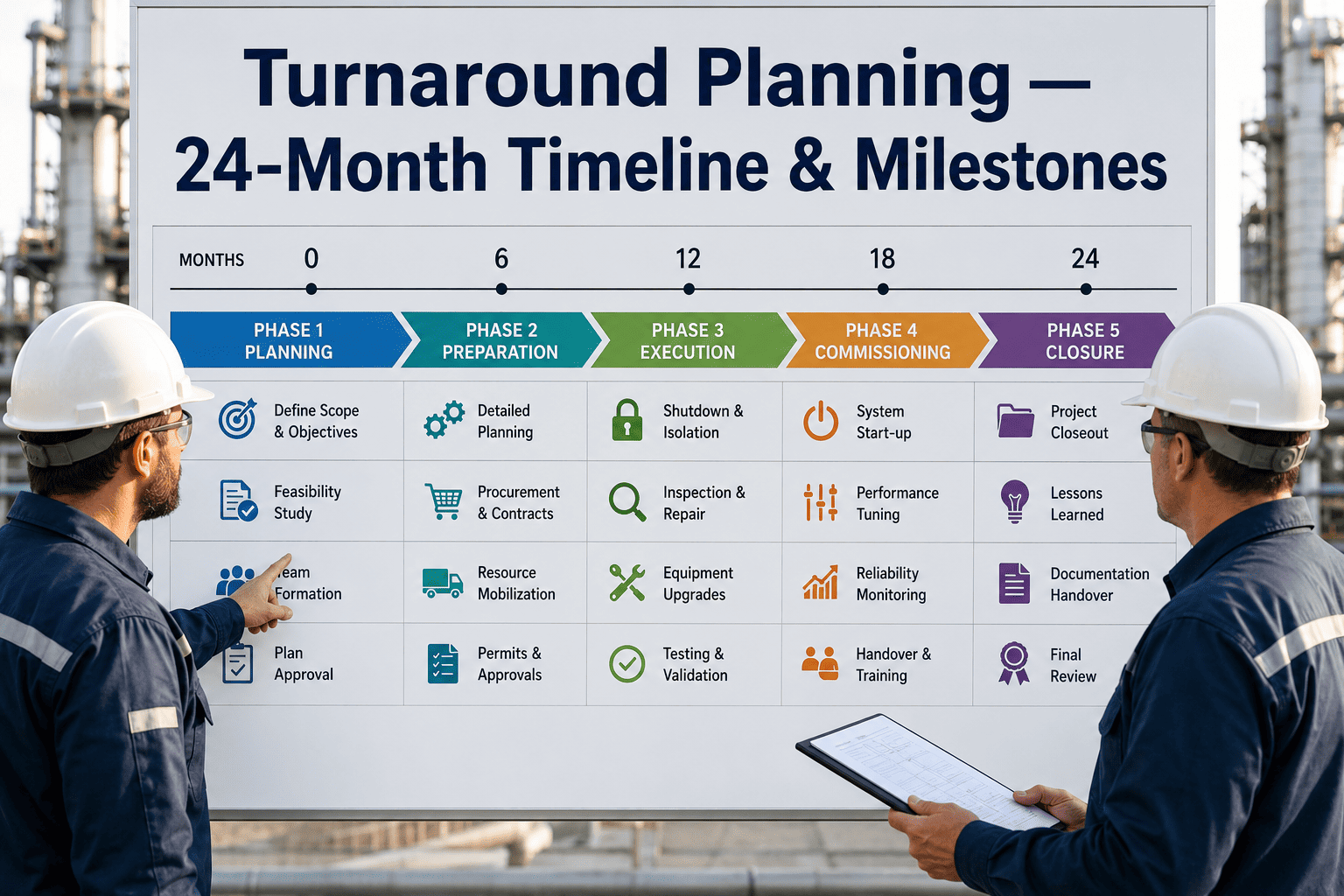
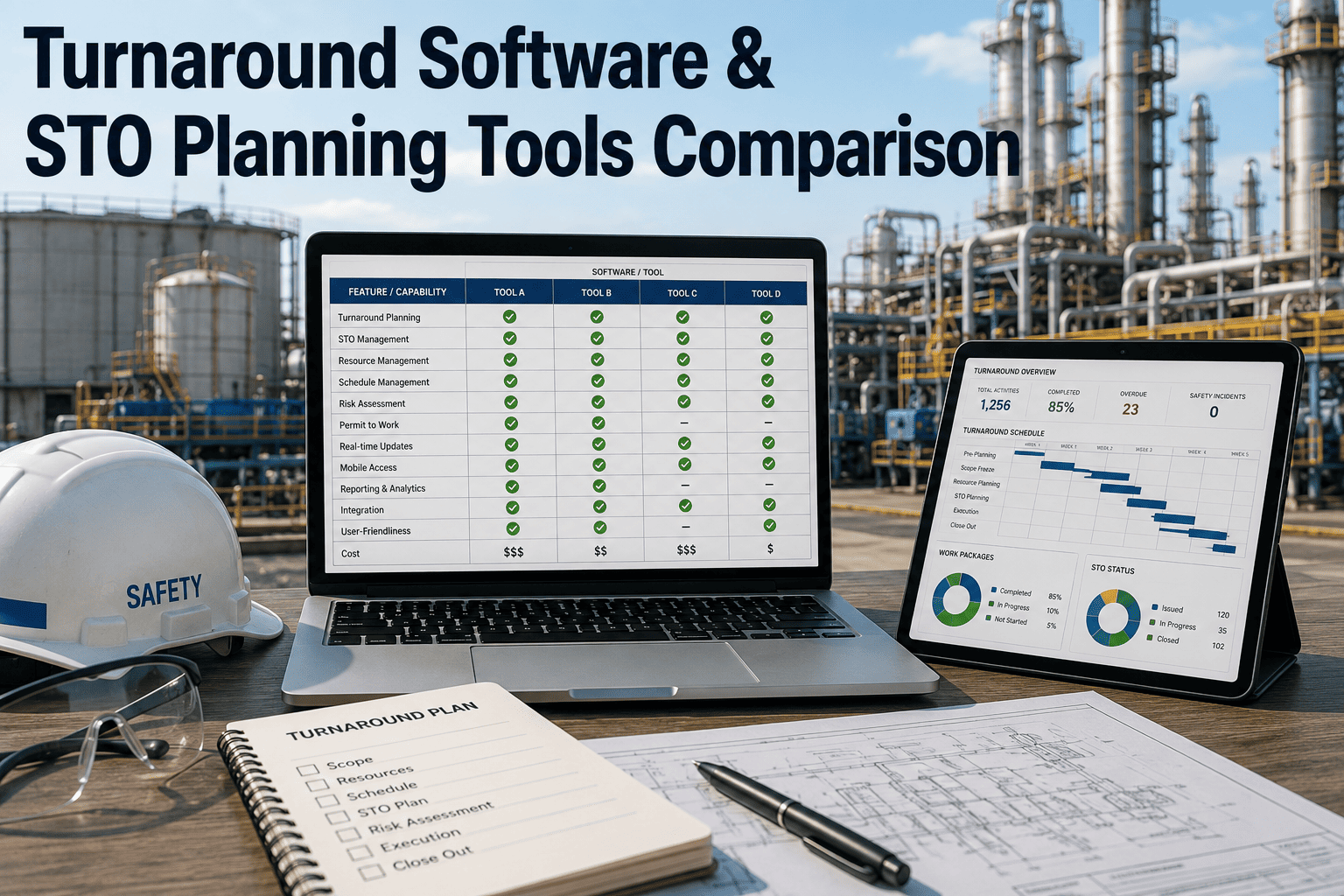
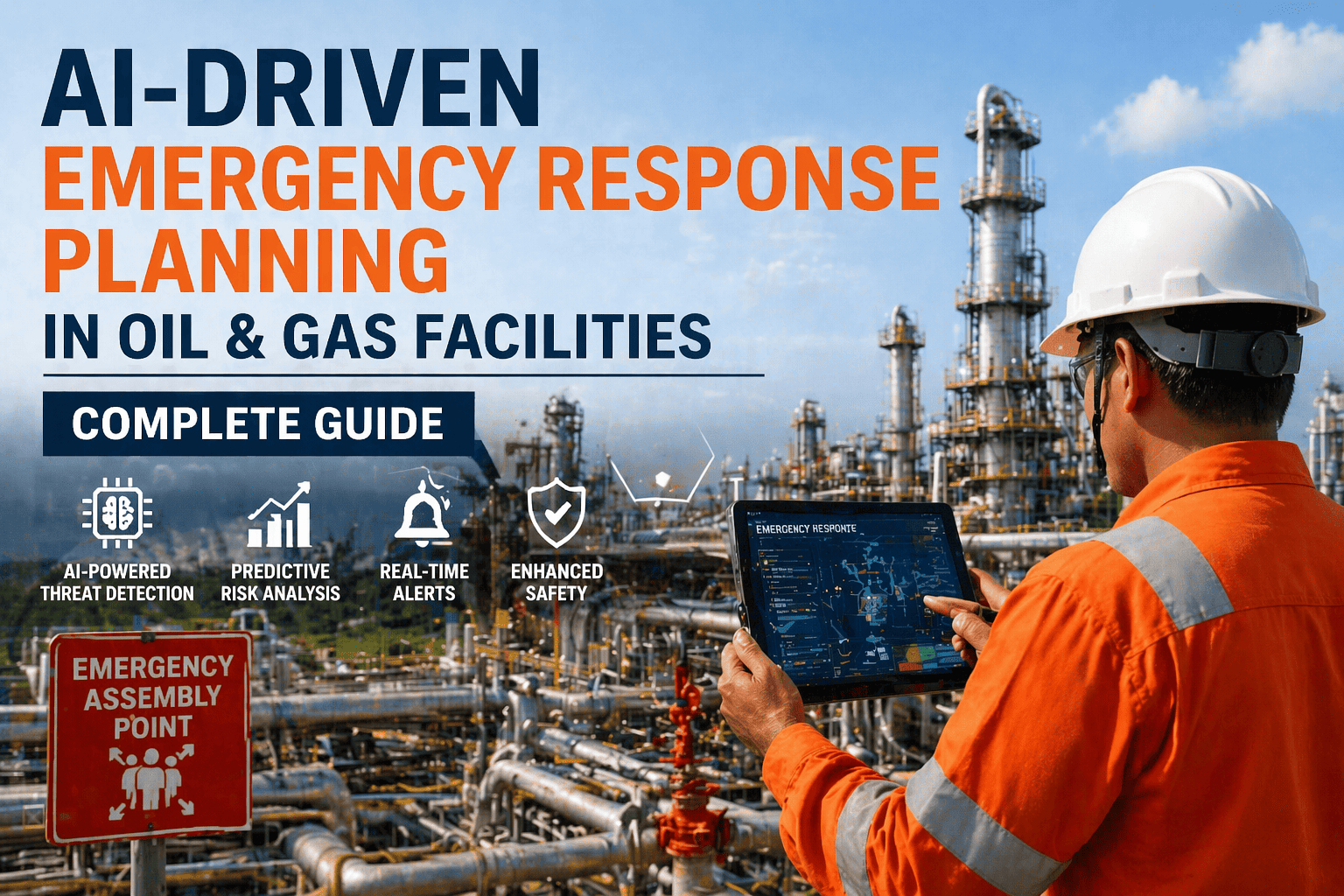
An emergency response plan for an oil and gas facility is only as reliable as the data it is built on and the drills that validate it. Most facilities develop their plans using consequence modeling results and hazard assessments that were completed during the design phase, but process conditions, surrounding development, and response capabilities have all shifted since those studies were done. When a real incident occurs, the gap between the plan on paper and the reality on the ground determines whether the response contains the event or escalates it. iFactory connects live process data, real-time weather, and personnel tracking to the emergency response framework so that plans activate based on current conditions rather than outdated assumptions — see the platform at iFactory support.
Emergency Preparedness · Oil and Gas Risk Reduction
Emergency Response Planning for Oil and Gas Facilities — From Paper Plan to Operational Reality
Build emergency response plans that account for current process conditions, real-time weather, and validated drill performance across fire, toxic release, explosion, and environmental spill scenarios.
Wind DirectionLive
NNW 12 kt
Shelter-in-place zone currently clear of offsite receptors
Personnel On-SiteAccounted
147
All personnel verified through mustering system within 8 minutes
Mutual Aid StatusStanding By
3 Agencies
County hazmat, fire district, and medical transport on 15-minute alert
Incident Classification
Four Emergency Scenarios Every Oil and Gas Facility Must Plan For — And What Each Demands From the Response System
Emergency response plans are not generic documents that can be copied from one facility to another. They must address the specific hazard profiles of the processes, materials, and geography at each location. The following four scenario categories represent the core emergency types that oil and gas facilities face, and each one imposes fundamentally different requirements on the response system in terms of speed, protective actions, notification chains, and external resource coordination.
Critical
Toxic Gas Release
Sour gas wells, H2S processing plants, natural gas pipelines with hydrogen sulfide, refineries handling hydrogen fluoride or other acute toxins
1Immediate shelter-in-place or evacuation based on real-time dispersion modeling and wind direction
2
2Downwind notification to offsite receptors within the ERPG-2 contour
3Activation of fixed gas detection system alarm thresholds and emergency shutdown if source isolation is required
4Coordination with local emergency management for extended shelter-in-place if release duration exceeds scrubber capacity
High
Fire Event
Process area fires from liquid hydrocarbon releases, tank farm pool fires, wellhead fires, compressor building fires, loading rack incidents
1Fire detection and notification with immediate fixed suppression system activation where available
2Emergency shutdown of feed and fuel sources to isolate the fire from additional hydrocarbon inventory
3Establishment of hot zone, warm zone, and cold zone per incident command boundaries based on thermal radiation contours
4Mutual aid fire suppression activation if fire exceeds on-site capability based on pre-planned resource thresholds
High
Explosion and Blast
Vapor cloud explosions in congested process areas, BLEVE events at pressurized storage, confined space detonations, dust explosions in handling systems
1Immediate facility-wide evacuation and accounting for all personnel including contractors and visitors
2Structural damage assessment of control rooms, shelters, and evacuation routes before permitting re-entry
3Secondary explosion prevention through isolation of remaining flammable inventory and ignition source control
4Mass casualty triage and medical transport coordination with regional hospitals through pre-established notification protocols
Moderate
Environmental Spill
Pipeline ruptures, tank overfills, offshore platform releases, produced water spills, drilling mud releases, offshore well blowouts with water impact
1Source isolation through emergency shutdown valves and containment system activation
2Spill trajectory modeling based on current water currents, wind, and tide conditions for offshore or riverine releases
3Notification to regulatory agencies within required timeframes with estimated volume and containment status
4Spill response contractor activation with pre-positioned equipment deployment based on spill trajectory and sensitive receptor mapping
Incident Command Structure
Incident Command System Architecture for Oil and Gas Emergency Response
The Incident Command System provides a standardized management structure that scales from a small single-resource response to a complex multi-agency operation. In oil and gas facilities, the ICS structure must be pre-defined with named incumbents for each role, clear delegation of authority protocols, and pre-established communication channels that activate the moment an emergency is declared. The following structure represents the core ICS positions that must be staffed and trained for any oil and gas facility emergency response, along with the specific responsibilities each role carries in the context of process-related incidents.
Incident Commander
Declares the emergency, establishes objectives, approves the incident action plan, authorizes resource requests, coordinates with external agencies and corporate management, and has ultimate authority over all response operations within the facility boundary.
Operations Section Chief
Directs all tactical field operations including firefighting, rescue, containment, and decontamination. Manages the deployment of response teams to the hot zone and ensures that tactical objectives from the incident action plan are being executed.
Planning Section Chief
Collects and analyzes situation information including dispersion model outputs, weather data, and process status. Prepares the incident action plan and maintains documentation of all response actions, resource allocations, and timeline of events.
Logistics Section Chief
Provides all support resources including personnel, equipment, supplies, and facilities. Activates mutual aid agreements, arranges contractor support, coordinates medical transport, and manages the staging area for incoming resources.
Safety Officer
Monitors all response operations for hazards to responders, has authority to halt any operation that presents imminent danger, ensures that personnel are operating within their training qualifications, and tracks responder exposure times and rehab requirements.
Public Information Officer
Manages all external communications including media inquiries, community notifications, regulatory notifications, and corporate communications. Ensures that all public information is accurate, consistent, and approved by the incident commander before release.
Response Activation Sequence
From Detection to Full Response Mobilization — The Critical First Thirty Minutes
The effectiveness of an emergency response is largely determined by what happens in the first thirty minutes after detection. Delays in notification, confusion about roles, missing information about process conditions, and uncertainty about weather-dependent hazard zones can all cascade into a response that fails to contain the incident. The following timeline represents the activation sequence that a well-prepared oil and gas facility should be able to execute from the moment an emergency is detected to the point where all ICS positions are staffed and tactical operations are underway.
0 to 2 min
Detection and Initial Alarm
Process alarm, fire detection, gas detection, or eyewitness report triggers the initial emergency alarm. Control room operator acknowledges and begins initial assessment of the alarm pattern to determine incident type and approximate location.
2 to 5 min
Emergency Declaration
Senior operator or shift supervisor declares the emergency level based on predefined criteria, activates the facility emergency alarm system, and initiates the personnel muster and accounting process for all on-site personnel.
5 to 10 min
ICS Activation
Incident commander assumes command, establishes the command post location, and begins activating section chiefs. Initial situation report is compiled including process status, known release details, and current weather conditions from on-site monitoring.
10 to 20 min
Protective Action Execution
Shelter-in-place or evacuation orders are issued to on-site and offsite populations based on real-time dispersion modeling or pre-established zone boundaries. Mutual aid notifications are sent to pre-agreed response partners.
20 to 30 min
Tactical Operations Begin
First response teams deploy to establish hot zone boundaries, initiate source isolation if it can be done safely, begin firefighting or containment operations, and provide situation updates to the planning section for incident action plan development.
Drill Program Assessment
Emergency Drill Design — What Separates a Compliance Exercise From a Test That Actually Reveals Gaps
Regulatory requirements mandate that oil and gas facilities conduct emergency drills at defined intervals, but the quality and realism of those drills varies enormously across the industry. A drill that follows a scripted scenario with predetermined outcomes and no injection of complicating factors will produce a clean after-action report but will not reveal the response gaps that will matter during a real incident. The following evaluation criteria distinguish drills that generate meaningful performance data from those that merely satisfy a regulatory checkbox.
Scenario Complexity
Scenario includes cascading effects such as a toxic release that also triggers a fire, requiring simultaneous management of two different hazard types with competing protective action requirements.
Scenario involves a single straightforward hazard with no complicating factors, allowing the response team to execute a rehearsed sequence without adaptation.
Unannounced Elements
At least one major scenario variable is not disclosed to participants in advance, such as a communication system failure, a blocked evacuation route, or an injured responder requiring medical evacuation.
Full scenario details are distributed to all participants days before the drill, allowing teams to pre-assign roles and rehearse responses rather than testing their actual decision-making under uncertainty.
Time Pressure
Response time expectations are enforced with actual time tracking at each decision point, and the drill evaluates whether the team meets the response timeline defined in the emergency plan.
No time benchmarks are enforced, and the drill proceeds at whatever pace the team is comfortable with, eliminating the time pressure that drives real-world decision-making.
External Coordination
Mutual aid partners, local emergency management, and hospitals are notified and participate in the drill at the level defined in the plan, testing actual communication channels and resource request procedures.
External coordination is simulated internally with facility personnel role-playing the external agencies, which never tests whether the actual communication systems, phone numbers, and protocols work.
Data Inputs
Dispersion models, weather data, and process status are provided to the ICS team in the same format and with the same latency they would experience during a real incident, testing whether the data systems support decision-making.
Scenario information is provided narratively by the drill controller rather than through the actual data systems, so the team never tests whether they can interpret and act on real-time information feeds.
After-Action Rigor
After-action review identifies specific gaps with assigned owners and closure dates, and gaps are tracked to completion with verification that corrective actions are implemented before the next drill.
After-action report lists general observations without specific gap assignments, and corrective actions from previous drills remain open and untracked across multiple drill cycles.
Your Emergency Response Plan Was Written for a Facility That No Longer Exists — But Your Regulatory Obligation and Your Personnel Safety Depend on It Being Current.
iFactory connects live process data, real-time weather feeds, and personnel mustering systems to your emergency response framework so that plans activate on current conditions, not design-basis assumptions from a decade ago.
Communication and Mutual Aid
Emergency Communication Chains and Mutual Aid Agreements — The Infrastructure That Holds the Response Together
When an oil and gas emergency exceeds on-site capability, the speed and reliability of external communication determines how quickly additional resources arrive. Communication failures during actual incidents are one of the most commonly identified gaps in after-action reviews, typically because the notification chains were designed on paper but never tested with the actual phone systems, radio frequencies, and contact lists that would be used at three in the morning when the primary contact is unavailable and the backup has changed jobs. Mutual aid agreements add another layer of complexity because they involve multiple organizations with different terminology, command structures, and capabilities that must integrate seamlessly under the ICS framework during an incident.
Internal Notification Chain
1Control room operator detects emergency and notifies shift supervisor within two minutes
2Shift supervisor declares emergency level and activates facility alarm system
3Facility emergency coordinator notified and assumes incident commander role
4Plant manager and corporate crisis management team notified with initial situation report
5All on-site personnel accounted for through mustering system with status reported to incident commander
External Notification Chain
ALocal fire department and emergency medical services notified per mutual aid agreement thresholds
BLocal emergency management agency notified for offsite protective action coordination
CState or provincial regulatory agency notified within required timeframe based on incident severity
DFederal agency notification if incident meets reportable quantity or threshold criteria
ECommunity notification through established alert systems if offsite protective actions are required
Common Plan Failures
Where Emergency Response Plans Fail When They Are Tested by Real Incidents
After-action reviews from oil and gas incidents consistently identify the same categories of planning failures that converted containable events into escalated emergencies. These failures are not random but are predictable consequences of specific planning gaps that can be identified and corrected before an incident occurs. The following failure modes represent the most frequently cited gaps in post-incident analyses across upstream, midstream, and downstream operations.
Stale Hazard Zones
Emergency planning zones based on consequence models that have not been updated to reflect current operating pressures, compositions, or surrounding development, resulting in protective actions that are either too large or too small for the actual hazard extent.
Untested Contact Lists
Notification phone trees and contact lists that have not been verified in months or years, with disconnected numbers, personnel who have left the organization, and backup contacts who are unaware they are listed as the secondary point of contact.
No Weather Integration
Emergency plans that define fixed evacuation or shelter-in-place zones without accounting for real-time wind direction and atmospheric stability, forcing the incident commander to make ad hoc zone adjustments without decision support tools during the incident.
Single-Scenario Planning
Plans that address only the worst-case catastrophic scenario while providing no guidance for the more frequent intermediate scenarios that actually trigger most emergency activations, leaving responders without a framework for events that do not meet the worst-case threshold.
Contractor Exclusion
Emergency plans that account for full-time employees but do not include contractors, visitors, or delivery drivers in the personnel accountability system, creating uncertainty about total personnel count during mustering that delays search and rescue decisions.
Drill Gaps Untracked
After-action findings from drills that are documented but never assigned to specific owners with closure dates, allowing the same gaps to appear in drill after-action reports year after year without corrective action.
Plan Maturity Assessment
Emergency Response Plan Maturity — Basic Compliance vs. Operational Readiness
Plan Element
Basic Compliance Level
Operational Readiness Level
Hazard Zone Definition
Fixed zones based on a single worst-case model run during design, with no mechanism to adjust for current conditions or weather
Dynamic zones derived from models that can be re-run with current process data and real-time weather, with pre-calculated zone sets for common wind scenarios
Personnel Accountability
Manual headcount at muster points with paper sign-in sheets, no real-time visibility into who is on-site or where they are located
Digital mustering system with real-time personnel location tracking, automated headcount comparison against expected on-site roster, and missing person alerting
Notification System
Phone tree activated manually by the shift supervisor, with no automated escalation if the primary contact does not answer
Automated notification system with parallel alerting to all required contacts, escalation timers, read-receipt tracking, and fallback communication channels
Mutual Aid Activation
Agreement exists on paper but resource request procedures have not been exercised with the actual mutual aid partner in a drill setting
Mutual aid partners participate in at least one full-scale drill per year, with actual resource deployment and unified command integration tested
Drill Program
Annual tabletop exercise with scripted scenario, no unannounced elements, no time pressure, and no external partner participation
Rotating drill schedule including tabletop, functional, and full-scale exercises with unannounced injects, time benchmarks, and external coordination
Plan Maintenance
Plan reviewed annually during a scheduled meeting, with updates based on general knowledge rather than systematic gap analysis or data-driven triggers
Plan continuously evaluated against operational data triggers such as process changes, MOC actions, and drill findings, with updates made incrementally as conditions change
Field Scenario
Real-Time Weather Integration Revealed That the Pre-Planned Evacuation Route Was Directly Downwind During an Actual H2S Release
A sour gas processing facility in a region with highly variable wind patterns had developed its emergency response plan with three fixed evacuation routes designated based on the predominant wind rose from historical meteorological data. During a scheduled full-scale drill that included an unannounced wind direction change inject, the drill controllers shifted the simulated wind direction ninety degrees from the predominant direction, which placed the primary evacuation route directly within the simulated ERPG-2 plume contour. The incident commander, operating without real-time weather-driven zone adjustment tools, followed the plan as written and directed personnel to evacuate via the primary route, which the evaluation team flagged as a critical gap because the same route would have exposed personnel to hazardous concentrations in a real incident. After the drill, the facility deployed iFactory to integrate on-site anemometer data with the pre-calculated dispersion zone sets, creating a system that automatically identifies which evacuation routes are viable and which are within the hazard zone based on current wind direction. The system now presents the incident commander with a route status display during any H2S-related emergency activation, eliminating the need for manual wind-to-zone comparison under time pressure. Book a Demo to see how real-time weather integration works with emergency response zone management.
90 degreesWind shift that placed primary evacuation route inside hazard zone
1 critical gapIdentified that would not have been found with a scripted drill
3 routesNow evaluated automatically for viability based on live wind data
0Route viability errors in subsequent drills after integration
Frequently Asked Questions
Emergency Response Planning for Oil and Gas — What Facility Managers and Emergency Coordinators Ask First
How does iFactory connect to our existing emergency notification and mustering systems?
iFactory integrates with facility mustering systems, access control platforms, and emergency notification tools through standard data connections, pulling real-time personnel counts, location data, and notification delivery status into a single operational view during an emergency activation. This means the incident commander does not need to log into three separate systems to determine how many people are on-site, whether the mustering is complete, and whether external notifications have been delivered and acknowledged. The integration is configured during deployment to map to the specific data fields and system APIs that your facility uses, so it works with your existing technology rather than requiring a replacement.
Book a Demo to review integration options for your emergency systems.
Can iFactory update emergency planning zones based on current weather and process conditions?
iFactory does not run consequence models in real time but can be configured with pre-calculated zone sets that correspond to different wind directions, stability classes, and operating scenarios. When an emergency is declared, the system pulls current wind data from on-site anemometers and current process data from the DCS, matches those conditions to the appropriate pre-calculated zone set, and presents the incident commander with the hazard zone boundaries that correspond to current conditions rather than a single fixed zone from the plan document. This approach provides real-time zone relevance without the computational delay of running a full dispersion model during an active incident when response time is critical.
Contact support to discuss pre-calculated zone set configuration for your facility.
How does the system track drill performance and after-action gap closure?
iFactory maintains a drill log that records each drill event including the scenario type, drill level whether tabletop, functional, or full-scale, participating personnel, time benchmarks achieved or missed, and all after-action findings. Each finding is assigned an owner, a priority, and a target closure date, and the system tracks these corrective actions alongside the same leading indicator tracking framework used for process safety management. This ensures that drill gaps receive the same systematic follow-up as any other process safety finding, preventing the common failure mode where drill after-action items remain open indefinitely. When a new drill is scheduled, the system provides a summary of all open gaps from previous drills so the planning team can verify whether those gaps have been addressed before designing the next scenario.
Does this replace our incident command system training and certification requirements?
No. iFactory provides decision support data and monitoring tools for the incident command team but does not replace ICS training, position-specific qualifications, or the organizational authority structure defined in your emergency response plan. The system is designed to give the incident commander and section chiefs better information faster, but the decisions about how to interpret that information and what tactical actions to take remain with the trained ICS personnel. What the system does change is that the ICS team no longer has to spend the first fifteen minutes of an incident gathering data from multiple disconnected sources before they can begin formulating an incident action plan, because the key data feeds are already consolidated in the emergency response view.
Book a Demo to see the emergency response decision support interface.
How long does it take to deploy emergency response monitoring across a multi-unit facility?
For a facility with existing weather monitoring, personnel mustering systems, and DCS integration, the emergency response decision support module typically deploys in four to six weeks. This includes configuration of pre-calculated zone sets for the facility's defined emergency scenarios, integration with the mustering and notification systems, setup of drill tracking and after-action workflows, and validation testing using a tabletop exercise. Facilities that need to add weather monitoring infrastructure or upgrade their mustering systems as part of the deployment typically require an additional two to four weeks depending on the scope of the infrastructure work.
Contact support to get a deployment timeline for your facility and existing systems.
Your Emergency Response Plan Is a Living Document That Has Been Dead for Years — Until You Connect It to the Data Systems That Can Keep It Alive.
Real-time process conditions, live weather feeds, and digital mustering integration turn your emergency plan from a regulatory binder into an operational tool that performs when your people need it most.