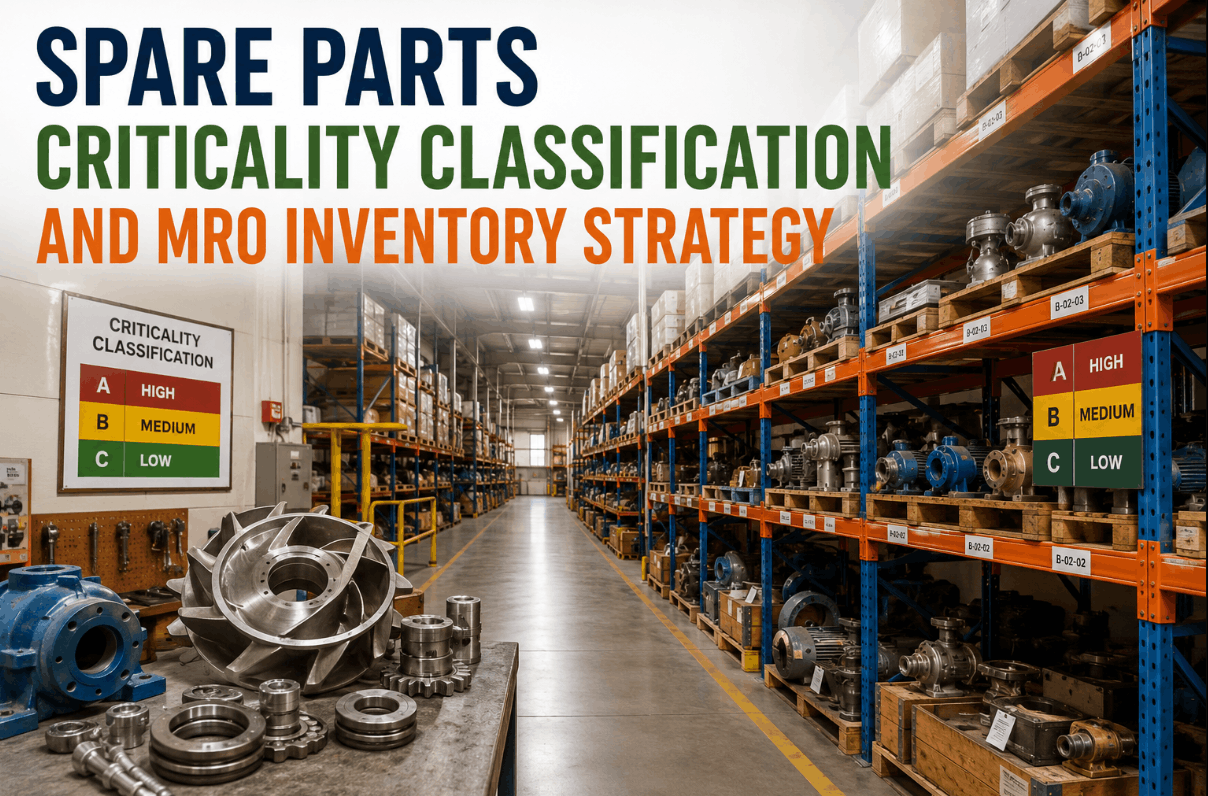
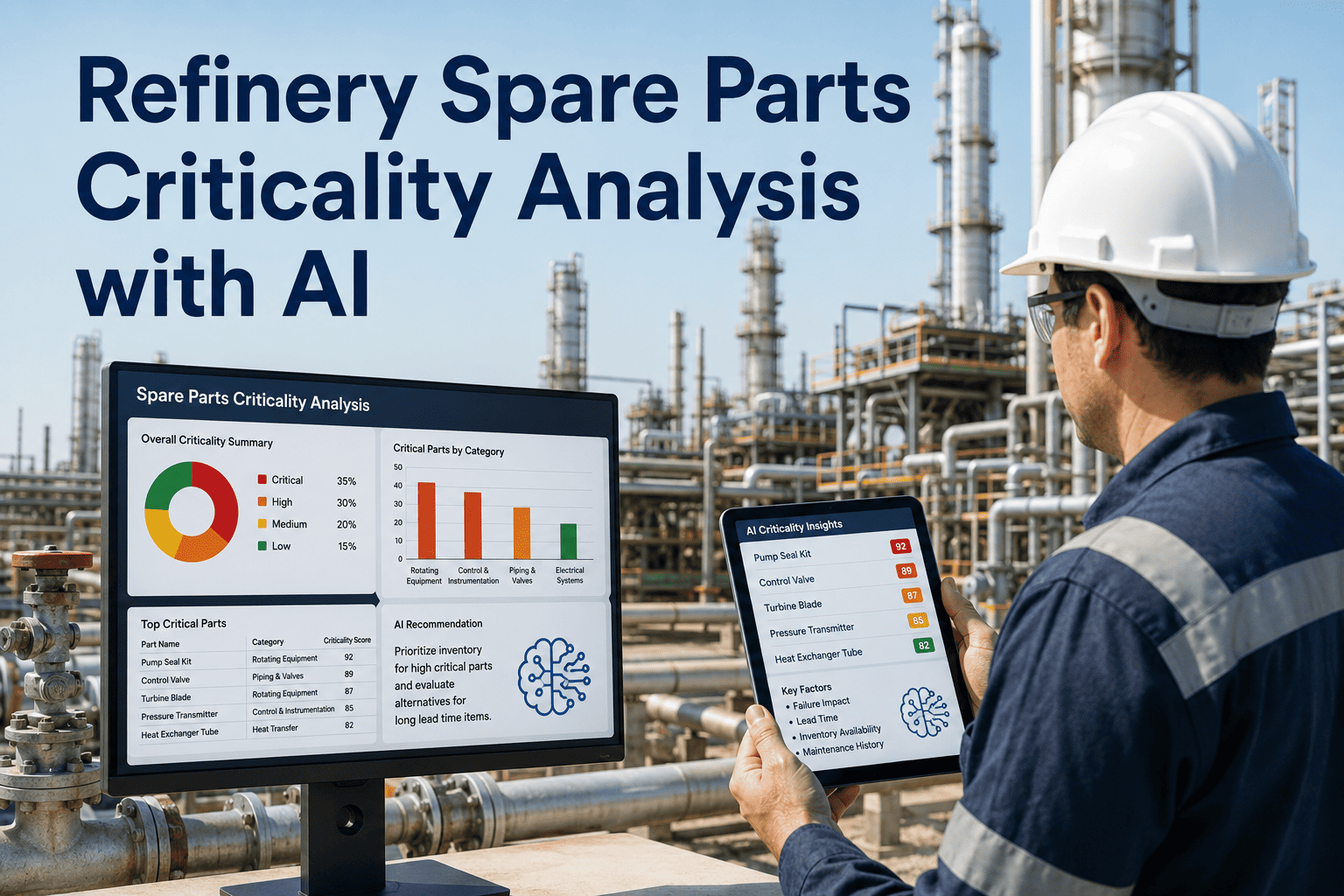
Spare Parts Criticality Classification and MRO Inventory Strategy
By Henry Green on June 22, 2026
Every U.S. manufacturing facility carries two inventory risks simultaneously — overstocking parts that never move and understocking the one component that triggers a $150,000-per-hour production halt. Neither risk is inevitable. The difference between a storeroom that bleeds working capital and one that protects production uptime comes down to a single discipline: spare parts criticality classification. When every SKU is ranked by operational impact, failure consequence, and supplier lead time — not by spend volume alone — maintenance teams can right-size MRO inventory across single sites and multi-plant networks with confidence. Book a Demo to see how iFactory's AI-driven MRO analytics platform automates criticality classification and inventory optimization across your entire asset fleet.
30–40%
Of total maintenance budgets tied up in MRO inventory at industrial facilities
$150K/hr
Production loss from a single stockout on a critical rotating asset
23%
Less inventory held by plants using risk-segmented criticality strategies
98%
Service level achieved when criticality drives stocking decisions
Why Standard ABC Classification Falls Short for MRO Inventory
Traditional ABC classification ranks parts by annual spend — A items represent the top 20% of expenditure, B items the middle tier, and C items the long tail of low-cost consumables. The logic works well for production materials where demand is relatively stable and predictable. It fails for MRO inventory because spend and criticality are not the same thing.
A $40 bearing that, if unavailable, stops a $2M press for 72 hours is not a C item — it is the highest-risk component in the storeroom regardless of its unit cost. A $15,000 custom motor winding that has a 12-month lead time and no backup equipment dependency may carry more financial weight in an ABC ranking but less operational urgency than the bearing. MRO criticality classification corrects this by layering operational consequence, failure rate, and supply chain risk into every stocking decision.
Spend-Based ABC Blind Spot
Low-cost parts with high failure consequences are systematically under-stocked when spend alone drives the classification. Production-stopping components end up in the C bucket with minimal reorder attention.
Static Reorder Points
Fixed reorder triggers calculated on historical consumption ignore real-time equipment degradation signals, seasonal demand spikes, and changing supplier lead times — all of which shift the risk profile of every SKU.
Ghost Stock and Data Failures
When parts are logged across disconnected ERP records, paper binders, and spreadsheets, the system shows stock that isn't physically on the shelf — triggering emergency procurement at premium cost during the worst possible moments.
No Learning Loop From Failures
Each stockout event contains data — equipment ID, failure mode, time to source, production impact — that should update stocking strategy automatically. Without AI-driven feedback loops, every stockout is treated as a one-time surprise.
The Multi-Dimensional Criticality Matrix: How to Classify Every MRO SKU
Effective spare parts criticality classification scores every item across at least three independent dimensions before assigning a stocking tier. The combination of these scores produces a criticality index that drives stocking level, reorder strategy, and procurement urgency — removing subjective judgment from inventory decisions and creating a defensible, auditable framework.
Dimension
What It Measures
Scoring Factors
MRO Implication
Economic Impact of Failure (EIF)
Revenue and cost exposure if the supported asset fails and the part is unavailable
Hourly production loss × mean repair duration + expedite cost premium
Sets minimum stocking level regardless of unit cost or consumption frequency
Difficulty of Replacement (DOR)
Supply chain risk: lead time, supplier concentration, OEM dependency, and substitutability
Supplier lead time, number of approved sources, interchangeability with standard catalog items
Long-lead, single-source parts require higher safety stock or vendor-managed inventory agreements
Equipment Criticality Tier
Asset-level operational classification — does the supported equipment have a redundant parallel, a bypass, or no backup?
Production routing, asset redundancy map, safety system dependency
Parts supporting Tier 1 (no redundancy, no bypass) assets carry the highest criticality floor
Failure Rate and Demand Variability
Historical failure frequency and demand intermittency — how often is the part actually consumed?
MTBF from CMMS records, demand history, coefficient of variation across demand periods
High-variability, low-frequency demand items (the classic MRO demand pattern) require probabilistic safety stock rather than fixed reorder multiples
VED Classification
Vital / Essential / Desirable — operational necessity of the part independent of cost
Whether the absence of the part immediately halts production (Vital), delays scheduled maintenance (Essential), or reduces convenience only (Desirable)
All Vital-class parts require guaranteed on-hand stock regardless of ABC tier
$50K–$200K
Cost of a single unplanned stoppage caused by a missing bearing or seal
18+ months
Lead time on custom-forged rolls and high-voltage transformers at U.S. plants
20–35%
Reduction in carrying costs when criticality-based stocking replaces flat-logic reorder rules
MRO Inventory Stocking Strategy by Criticality Tier
Once every SKU carries a criticality score, the stocking strategy for each tier becomes systematic rather than negotiated. The following framework maps criticality output to inventory positioning, reorder triggers, and procurement approach — applicable across refinery spares, rotating equipment in process plants, and electrical MRO at multi-site manufacturing networks.
T1
Tier 1 — Critical / Vital Parts (Stock On-Hand, Always)
High EIF, no equipment redundancy, long lead time. Examples: turbine bearings, custom pump impellers, sole-source transformer bushings. Strategy: maintain minimum on-hand quantity at all times. Reorder triggers fire automatically on issue, not on quantity threshold. Safety stock calculated from lead time distribution, not average lead time. Vendor-managed inventory or consignment agreements are preferred for long-lead items. iFactory connects predictive failure probability directly to reorder timing — when a bearing shows a 6-week failure window, the replacement is already on order.
T2
Tier 2 — Essential Parts (Stock to Demand Forecast, Monitor Closely)
Moderate EIF, some equipment redundancy or bypass available, medium lead time under 12 weeks. Examples: standard motor bearings, control valves, coupling assemblies stocked in regional distribution. Strategy: reorder point set dynamically based on rolling consumption history and current lead time. Safety stock sized to failure rate variability, not average demand. Multi-site networks can share Tier 2 inventory across plants with fast inter-facility transfer agreements in place.
Low EIF individually, high consumption frequency. Examples: gaskets, filter elements, standard fasteners, common lubricants. Strategy: vendor-managed inventory or scheduled blanket orders. Low safety stock justified by short lead times and broad supplier substitutability. Annual obsolescence review to identify slow-moving items that have drifted into the Tier 3 pool without moving.
T4
Tier 4 — Obsolete / Reclassify / Dispose
Parts with zero consumption in 24+ months, superseded OEM part numbers, or tied to decommissioned equipment. These represent trapped working capital. Strategy: quarterly identification using CMMS cross-reference against active asset register. Disposition via return-to-vendor, inter-plant transfer, or auction. iFactory's AI inventory module flags T4 candidates automatically from CMMS and ERP data — releasing an average of $340K in working capital per mid-size facility in the first 12 months.
Hold the Right Parts. Free the Capital. Stop the Stockouts.
iFactory's MRO analytics platform ingests your CMMS work orders, ERP inventory records, and equipment failure history — building criticality scores for every SKU and generating AI-driven stocking recommendations that reflect actual equipment risk, not historical spend alone.
For U.S. manufacturers operating multiple plants, refineries, or process facilities, criticality classification creates a second layer of strategic value: network-level inventory pooling. When every site classifies parts on the same scoring framework and feeds the same CMMS integration, the network can identify where Tier 1 items are duplicated unnecessarily across plants within the same sourcing region — and where a shared regional hub can serve multiple sites without increasing stockout risk for any of them.
Network Inventory Pooling
$340K
Average working capital released per mid-size facility when AI-driven obsolescence identification and consumption-pattern rightsizing replaces static reorder rules across a multi-site network.
Stockout Risk Reduction
Zero
Critical spare stockouts across iFactory-deployed facilities when AI-driven predictive analytics align inventory positioning with actual equipment failure mode probabilities from CMMS records.
Deployment Timeline
5 Wks
From CMMS data integration to live AI-driven reorder recommendations and obsolescence reporting — applicable to SAP PM, IBM Maximo, Infor EAM, and Oracle EBS environments.
iFactory's platform unifies MRO data across plant boundaries — normalizing part numbering, cross-referencing OEM and aftermarket equivalents, and surfacing inter-facility transfer opportunities before an emergency procurement order is placed at a 40% spot-buy premium. Book a Demo to see how multi-site inventory pooling deploys across your network.
How iFactory Automates Spare Parts Criticality Classification
Manual criticality scoring across storerooms holding tens of thousands of SKUs is not practical — the analytical workload exceeds what reliability engineers can sustain alongside day-to-day maintenance operations. iFactory automates the scoring pipeline by ingesting existing data sources your facility already maintains, applying ML models trained on failure histories, and generating continuously updated criticality scores without requiring manual re-classification cycles.
iFactory MRO Classification Capabilities
Automated EIF and DOR scoring from CMMS work orders, equipment hierarchy, and failure records
VED and ABC classification generated simultaneously — no double-entry across systems
Dynamic reorder point recalculation based on live lead time data, consumption variance, and failure probability from predictive models
Obsolescence flagging using active asset register cross-reference — Tier 4 candidates identified continuously, not in annual reviews
Multi-site inventory normalization — OEM and aftermarket equivalents cross-referenced across plant boundaries to identify pooling opportunities
Native integration with SAP PM, IBM Maximo, Infor EAM, and Oracle EBS — bidirectional work order and parts requisition sync
Expert Review: What U.S. Reliability Engineers Say About Data-Driven MRO Classification
We had roughly 42,000 SKUs in our SAP inventory across three plants, and our annual obsolescence review was taking three engineers four weeks to complete — and it was still wrong by the time it was done. iFactory ingested our full parts master, cross-referenced it against the active asset register and CMMS failure history, and scored every SKU in the system within the first two weeks of deployment. We identified $1.2M in Tier 4 obsolete stock we'd been carrying for years, reclassified 800 bearings and seals from ABC C-tier to Tier 1 criticality, and reduced our total storeroom inventory value by 28% while eliminating every stockout event in the following 12 months. The AI doesn't replace the reliability engineer — it gives the reliability engineer their time back to work on the decisions that actually require judgment.
Plant Reliability Manager
Multi-Site Chemical Processing Facility, Gulf Coast USA
Conclusion: Right-Size MRO by Letting Criticality Drive Every Stocking Decision
The two most expensive inventory positions a U.S. manufacturer can hold are a storeroom full of slow-moving parts that will never be consumed and a shelf with a missing $40 seal that shuts down a production line for three days. Both outcomes are preventable when spare parts criticality classification is treated as an analytical discipline rather than a one-time classification project.
Multi-dimensional criticality scoring — combining economic impact of failure, difficulty of replacement, equipment redundancy tier, failure rate, and VED classification — gives maintenance and supply chain teams a defensible, continuously updated framework for every stocking decision across the MRO portfolio. When that framework is automated by an AI platform connected to your CMMS, ERP, and historian data, it runs 24 hours a day without manual intervention — adapting stocking strategies as equipment ages, lead times shift, and new failure patterns emerge. Book a Demo with iFactory to see how AI-driven criticality classification deploys across your MRO inventory in five weeks.
Frequently Asked Questions
What is spare parts criticality classification in MRO inventory management?
It is the process of ranking every spare part SKU by its operational consequence, equipment dependency, supplier lead time, and failure rate — so stocking decisions are driven by actual production risk rather than spend volume or consumption frequency alone.
How does VED classification differ from ABC classification for MRO parts?
ABC ranks parts by spend value; VED (Vital / Essential / Desirable) ranks them by operational necessity. A low-cost bearing that halts production if unavailable is Vital under VED but a C item under ABC — the two frameworks must be used together, not interchangeably.
How often should spare parts criticality classifications be reviewed and updated?
Static annual reviews are inadequate — equipment condition, lead times, and failure rates change continuously. AI-driven platforms like iFactory update criticality scores dynamically as new CMMS failure data, consumption records, and supplier lead time changes flow into the model.
Can criticality classification work across a multi-site MRO network?
Yes — and network-level classification delivers additional value by identifying where Tier 1 inventory is duplicated unnecessarily across plants in the same region, enabling inventory pooling and inter-facility transfers that reduce total network carrying costs without increasing stockout risk.
Which CMMS and ERP systems does iFactory connect to for MRO classification data?
iFactory integrates natively with SAP PM, IBM Maximo, Infor EAM, and Oracle EBS via REST APIs and direct connectors — pulling parts master data, work order history, and failure records to automate criticality scoring without manual data export.
Stop Managing MRO Inventory by Spend. Start Managing It by Risk.
iFactory's AI-driven MRO analytics platform scores every spare part SKU by criticality, automates reorder recommendations, identifies obsolete stock, and right-sizes safety stock across multi-site networks — fully deployed in 5 weeks, connected to your existing CMMS and ERP.