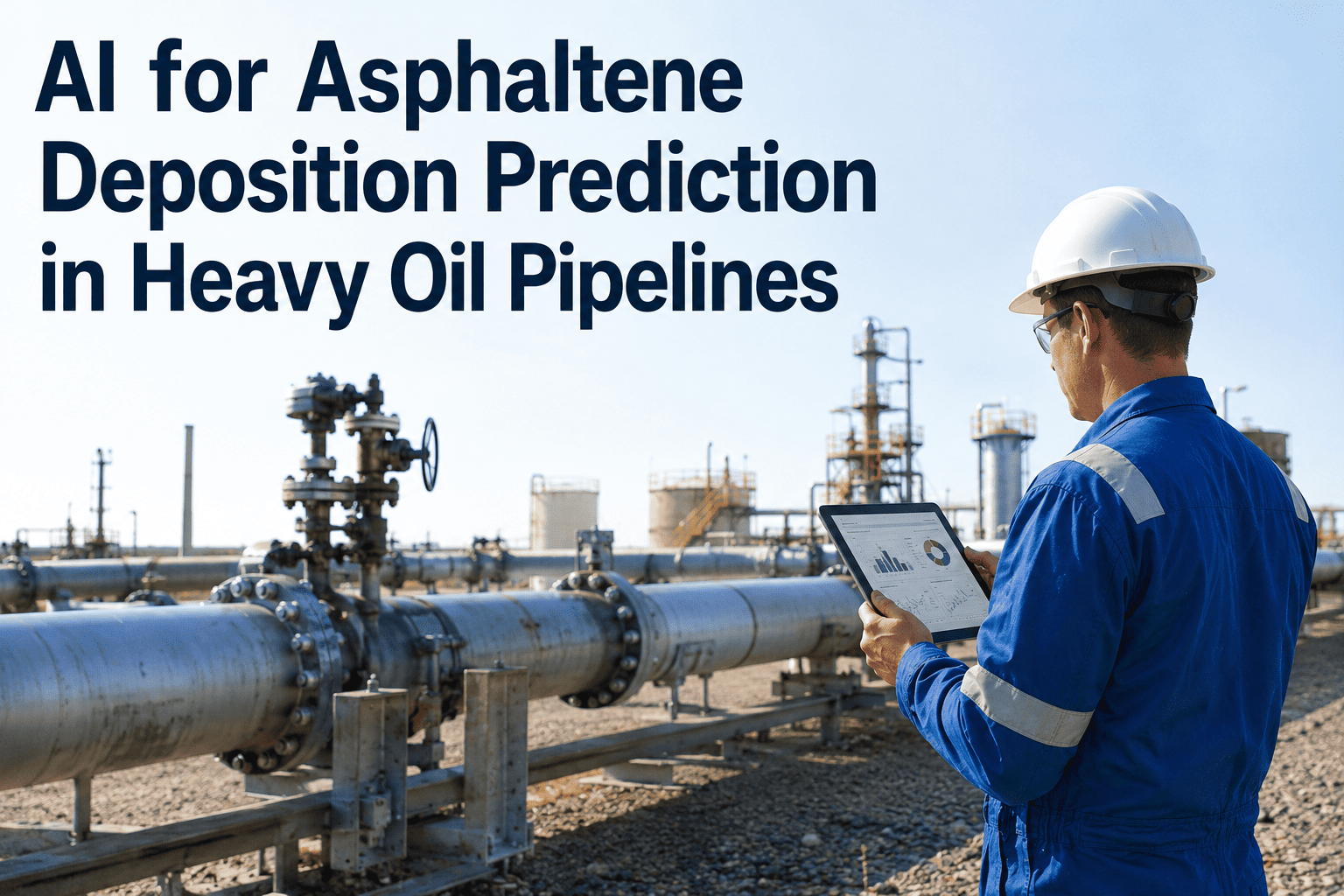
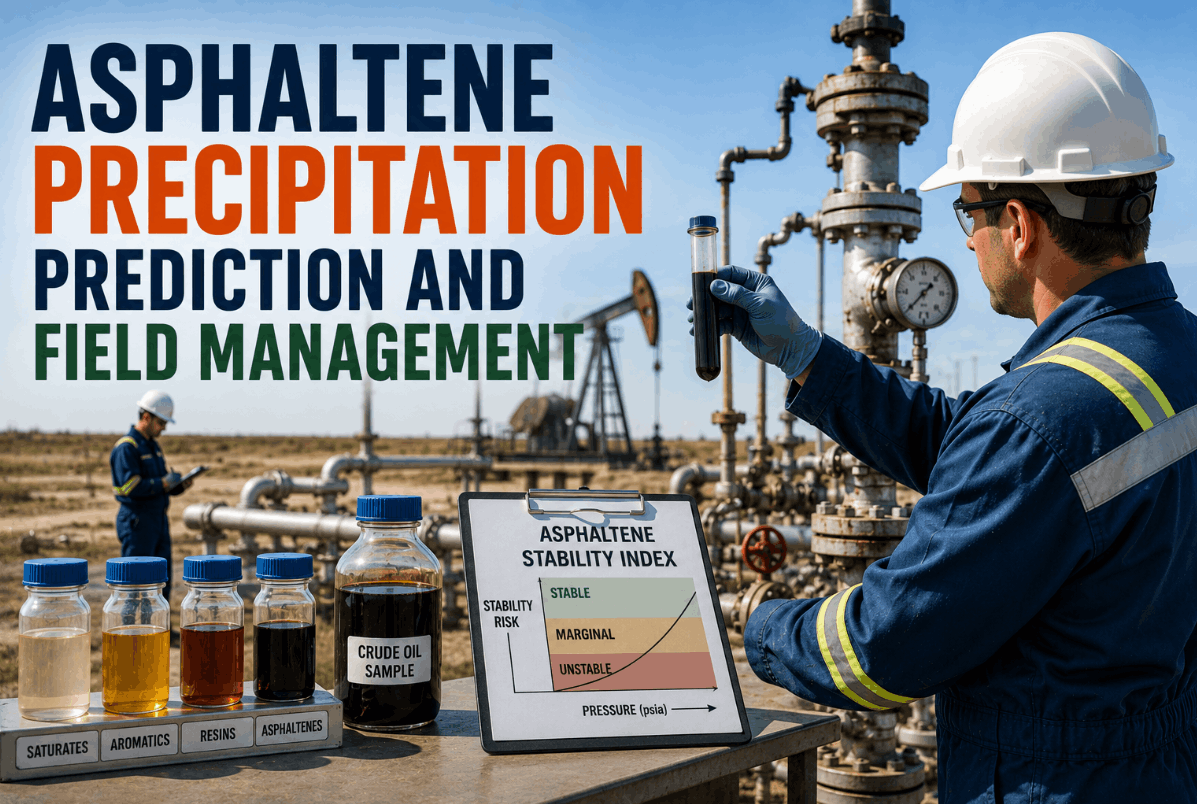
A heavy oil pipeline can run clean for months and then lose forty percent of its effective diameter in a matter of weeks once asphaltenes cross their onset pressure and begin flocculating out of solution. The chemistry behind that shift is well understood in a lab, but the lab is exactly the problem — a full SARA analysis takes days, costs real money per sample, and only describes the crude oil the way it looked the moment someone drew the sample, not the way it behaves an hour later once pressure, temperature, or blending ratio has moved. Operators are left managing a deposition risk that changes continuously with a data source that updates occasionally, which is how a flowline that tested stable in January ends up choked with a hardened asphaltene layer by summer. Predictive models that fuse SARA fractions, pressure-temperature profiles, and blending history let engineers see the onset threshold shifting in real time instead of finding out from a pressure drop alarm, and the underlying deposition mechanics and field data behind this approach are covered in more depth at iFactory's support resources.
Flow Assurance Intelligence · Heavy Oil Pipelines
Predict Asphaltene Deposition Before It Becomes A Pipeline Blockage
AI models fuse SARA fractions, colloidal instability index, pressure-temperature profiles, and blending ratios to flag when a heavy crude is approaching its asphaltene onset pressure, so dispersant dosing and pipeline heating can be adjusted before deposition starts rather than after flow drops.
The Hidden Cost
Why Asphaltene Deposition Is So Expensive To Get Wrong
Asphaltenes are the heaviest, most polar fraction of crude oil, held in solution by resins under a specific balance of pressure, temperature, and composition. Disturb that balance — through pressure depletion, gas injection, or blending with an incompatible crude — and asphaltenes flocculate out, aggregate, and deposit on the pipe wall as a hard, difficult-to-remove layer. The figures below describe why this particular flow assurance problem draws so much attention across heavy oil operations.
3,500-5,500 psi
Typical asphaltene onset pressure range where flocculation begins
Days
Time required for a full laboratory SARA analysis per sample
R2 0.95
Correlation strength achieved by density-based instability index models against lab SARA results
12% vs 7.5%
Average error range reported when comparing field correlation models against commercial simulator predictions
The Deposition Chain
How A Stable Crude Turns Into A Plugged Flowline
Deposition is never a single event — it is the last link in a chain of chemistry that starts well upstream of the pipeline itself. Each stage below has its own trigger, and by the time deposition is visible as a pressure drop, the crude has already moved through every earlier stage undetected.
1
Stable Colloidal Suspension
Asphaltenes remain dispersed as nanoaggregates, stabilized by resins adsorbed onto their surface, as long as pressure, temperature, and composition stay within the crude's native stability envelope.
below onset pressure crossed
2
Precipitation Onset
Pressure depletion, gas breakout, or blending with a lighter or chemically incompatible crude disrupts the resin-asphaltene balance, and asphaltenes begin dropping out of solution as fine particles.
particles collide and grow
3
Aggregation and Flocculation
Precipitated particles collide and bond into larger flocs. Flow shear at this stage can still keep flocs suspended in the bulk stream if velocity and turbulence remain high enough.
shear drops near the wall
4
Wall Deposition
Near the pipe wall, where flow velocity is lowest, flocs adhere and build a growing deposit layer. Once attached, this material hardens and becomes significantly harder to remove than it was to prevent.
diameter loss compounds
5
Restriction and Blockage
Effective pipe diameter shrinks, pressure drop rises, and throughput falls. Left unaddressed, the restriction narrows further until mechanical intervention or a full pipeline pig run becomes the only option.
Catch The Chain At Stage One
Every Later Stage Costs More To Fix Than The One Before It
iFactory tracks pressure, temperature, and blend composition continuously against each crude's stability envelope, flagging the approach to onset pressure while dispersant dosing and heating adjustments can still prevent deposition entirely.
Lab Testing vs Continuous Prediction
Where Periodic SARA Testing Falls Short In The Field
SARA analysis remains the chemical foundation for understanding a crude's asphaltene behavior, and no monitoring approach replaces it. The gap is not in the chemistry — it is in how infrequently that chemistry gets checked against conditions that change every day the well produces.
| Operating Question | Periodic Lab SARA Testing | Continuous AI Prediction |
| How current is the risk picture |
Accurate only as of the sample date, often weeks or months old |
Updates continuously against live pressure, temperature, and blend data |
| Cost per assessment |
High per-sample cost limits how often testing happens |
Marginal cost per additional data point is near zero once deployed |
| Detecting a blending-induced shift |
Requires a new sample and new test after the blend changes |
Flags a shift the moment blend ratio and CII inputs move |
| Lead time before deposition starts |
Depends entirely on testing cadence catching the shift in time |
Trend alerts as conditions approach the onset threshold |
| Supporting dispersant dosing decisions |
Static recommendation based on last known composition |
Dosing guidance adjusts as risk level changes |
From Prediction To Action
What Happens Once Risk Is Flagged
A prediction only has value if it changes what the field team does next. The capabilities below connect the deposition forecast to the two levers operators actually have available to prevent it — chemical treatment and thermal management — along with the monitoring loop that confirms whether those interventions are working.
01
Onset Pressure Tracking
Live pressure data is continuously compared against the modeled or lab-measured asphaltene onset pressure for the current blend, with alerts issued as the operating margin narrows.
02
Dispersant Injection Optimization
Dosing recommendations scale with predicted deposition risk rather than running on a fixed schedule, reducing chemical spend during low-risk periods while increasing protection as onset approaches.
03
Pipeline Heating Guidance
Where thermal management is available, heating setpoints are informed by how far current conditions sit from the onset envelope, avoiding both under-protection and unnecessary energy spend.
04
Blend Compatibility Screening
Before a new crude is introduced into a shared line, compositional data can be screened against the existing blend to flag compatibility risk before mixing occurs at scale.
05
Pigging Schedule Support
Deposition trend data helps justify pigging frequency with evidence rather than a calendar-based default, targeting intervention at the segments actually accumulating deposit.
Where This Risk Concentrates
Operations Where Asphaltene Deposition Is A Recurring Threat
Asphaltene deposition risk is not spread evenly across every heavy oil operation. It concentrates wherever pressure or composition changes fastest, which is why the following environments see this problem repeatedly rather than as an occasional surprise.
Deepwater Production
Extreme pressure and temperature swings between reservoir and seafloor conditions make deepwater asphaltic crude transport one of the highest-consequence deposition environments, where remediation cost is especially severe.
Pressure-Depleted Reservoirs
As reservoir pressure declines through natural depletion, wells can cross their asphaltene onset pressure gradually and without obvious warning until deposition is already established downhole.
Blending and Terminal Operations
Facilities that mix crudes from multiple sources to meet pipeline or refinery specifications carry compatibility risk every time the blend ratio changes.
Gas Injection and EOR Projects
CO2 or gas injection for enhanced recovery is a well-documented trigger for asphaltene instability, since injected gas composition directly shifts the resin-asphaltene balance.
Long-Distance Heavy Crude Pipelines
Extended transport distances mean more opportunity for temperature loss and pressure change along the route, widening the window where deposition conditions can develop.
Refinery Feedstock Switching
Changing crude slates to match market pricing introduces compatibility risk at the feed system and preheat train that mirrors the blending risk seen upstream.
Common Questions
Frequently Asked Questions
Does AI prediction replace the need for laboratory SARA analysis entirely?
No, and treating it as a replacement is a common early mistake. Laboratory SARA analysis remains the ground-truth chemical characterization of a crude's saturate, aromatic, resin, and asphaltene composition, and periodic testing is still needed to calibrate and validate the model. What AI prediction adds is the ability to extrapolate that lab foundation across continuous pressure, temperature, and blend data between test dates, catching shifts that would otherwise go unnoticed until the next scheduled sample. The two approaches work together rather than as substitutes for one another, and details on integrating both into an existing testing cadence are available through
iFactory support.
How accurate are non-SARA, density and viscosity based correlation models compared to full lab testing?
Published correlation studies using crude oil density and viscosity as proxies for colloidal instability index and refractive index have reported strong agreement with laboratory SARA-derived values, with correlation coefficients in the range of 0.95 or higher in controlled validation sets. These models are best used as continuous screening tools that flag when a fuller lab workup is warranted, rather than as a permanent substitute for direct compositional testing on a given crude. Accuracy generally improves further once a model is calibrated against field-specific historical data rather than relying on generic published correlations alone.
What operating changes most commonly trigger asphaltene deposition in a pipeline that was previously stable?
The most frequent triggers are pressure depletion as a reservoir ages, blending with a compositionally incompatible crude, and gas injection during enhanced recovery operations, all of which shift the resin-to-asphaltene balance that keeps asphaltenes dissolved. Temperature drop along a long transport route can compound any of these by reducing solubility further. Because these triggers often develop gradually rather than as a single dramatic event, continuous monitoring is what catches the crossing point before deposition becomes visible as a pressure drop.
Once deposition has already started, can dispersant injection reverse it or only slow further buildup?
Dispersants are most effective at keeping asphaltene particles suspended before they aggregate and adhere to the pipe wall, which is why early detection matters more than dosing strength after the fact. Once a hardened deposit layer has formed, dispersant treatment typically slows further accumulation and can assist mechanical or chemical remediation, but it rarely dissolves an established deposit on its own. This is the core argument for prediction-driven dosing over reactive treatment — the same chemical program is far more effective applied before onset than after a restriction is already measurable.
How long does it take to get a deposition prediction model running against an existing pipeline?
Initial deployment typically involves compiling available SARA history, pressure-temperature data, and any prior pigging or deposition records for the specific flowline, followed by model calibration against that field-specific baseline. Most operations see an initial risk model producing usable alerts within a few weeks, with accuracy improving as more live operating data accumulates. A specific timeline based on available field history can be worked through by booking a walkthrough at
this scheduling link.
Stop Finding Out Through A Pressure Drop
See The Onset Threshold Before The Flowline Does
iFactory turns SARA data, pressure-temperature trends, and blend history into a continuously updated deposition risk picture, so dispersant dosing and heating decisions happen ahead of the restriction instead of in response to it.