-in-oil-&-gas-a-practical-guide.png)
Traditional inspection programs in oil and gas facilities operate on a simple but costly logic: inspect everything on a fixed schedule, regardless of actual condition or risk. The result is a maintenance organization that spends significant resources re-inspecting low-risk assets that haven't changed while genuinely high-risk equipment approaches failure undetected between scheduled visits. AI risk-based inspection in oil and gas replaces this averaging model with a dynamic, data-driven framework — one that continuously recalculates the probability and consequence of failure for every asset in the fleet, redirects inspection resources toward the equipment that actually carries the highest current risk, and generates the regulatory documentation required for API 510, API 570, and OSHA PSM compliance automatically. This guide is a practical deployment reference for U.S. oil and gas reliability and integrity professionals evaluating AI-powered RBI platforms in 2025. Book a Demo to see how iFactory AI delivers continuous RBI intelligence across your asset base.
What AI Actually Changes About Risk-Based Inspection
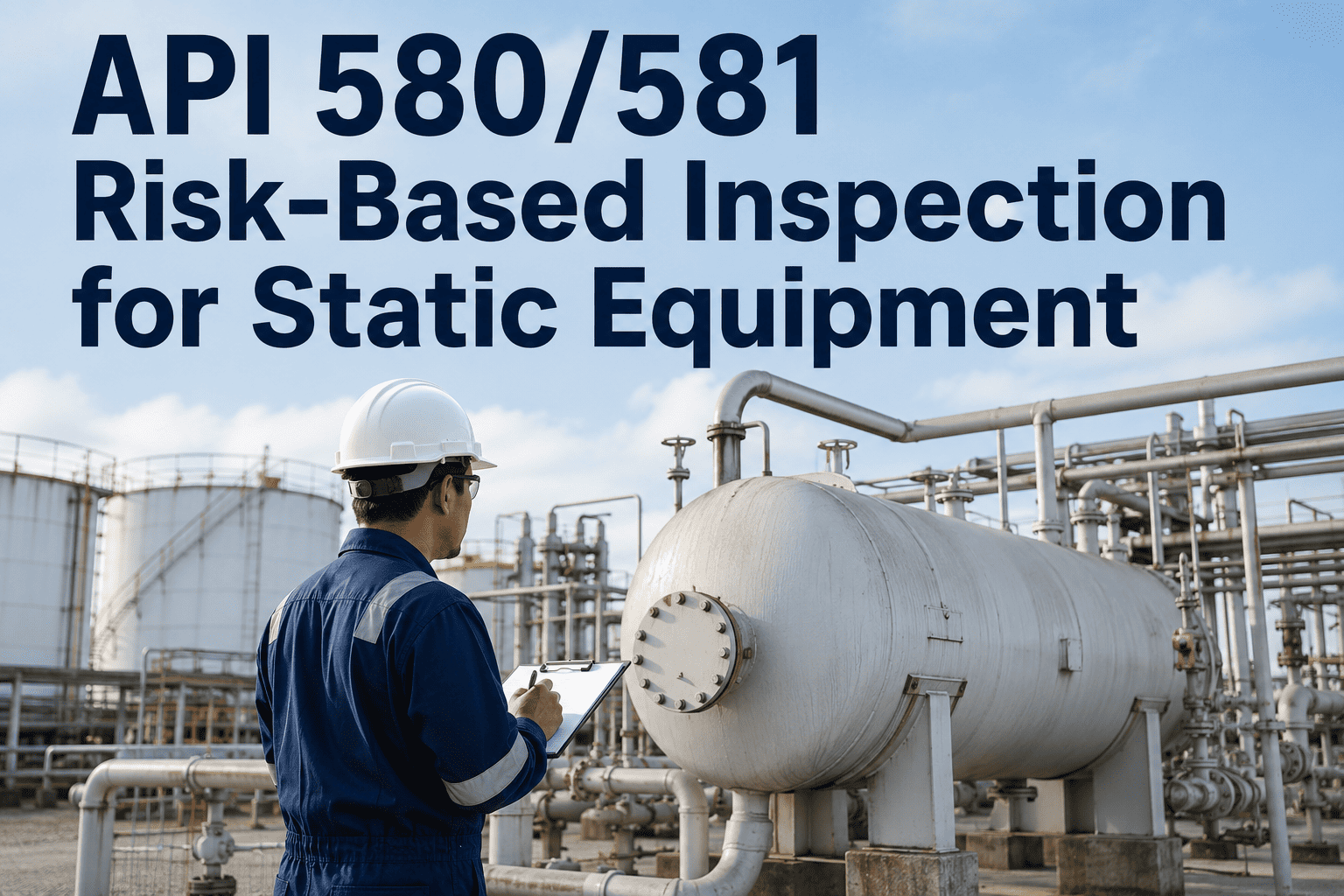
Risk-based inspection as a methodology has existed since the late 1990s. API RBI 581 provides a quantitative framework for calculating Probability of Failure (PoF) and Consequence of Failure (CoF) for pressure equipment — and the approach is sound. The problem is not the methodology. It's the frequency at which risk scores are updated and the data quality that feeds them.
In most facilities, RBI assessments are conducted annually or at turnaround intervals. The risk scores that drive inspection scheduling reflect equipment condition and operating data from the last formal review — which may be 12 to 18 months old by the time the next inspection is actually planned. In that window, process chemistry can change, operating envelopes can shift, and degradation rates can accelerate well beyond what the static assessment captured. Book a Demo to see how iFactory AI closes this gap with continuously updated risk scores.
The Five-Stage AI RBI Data Flow: From Sensor to Inspection Decision
Understanding how AI transforms raw condition data into actionable inspection prioritization is essential for evaluating deployment readiness. iFactory AI's RBI engine runs a five-stage data pipeline that converts sensor readings into inspection schedule updates within minutes — not months.
Failure Mechanisms AI RBI Covers — and What Each Requires
Different damage mechanisms require different data inputs to model accurately. iFactory AI's RBI engine handles the full range of failure mechanisms encountered in oil and gas pressure equipment, piping, and rotating machinery. The following table maps each mechanism to its detection method and the specific data inputs the AI model requires.
| Damage Mechanism | Affected Equipment | AI Detection Method | Required Data Inputs |
|---|---|---|---|
| General / Uniform Corrosion | Vessels, piping, tanks | Continuous UT thickness trending, corrosion rate projection | UT thickness readings, process fluid chemistry, temperature, inhibitor injection data |
| Corrosion Under Insulation (CUI) | Insulated piping and vessels | CUI probability scoring from temperature cycling and insulation condition records | Operating temperature history, insulation inspection records, moisture exposure index |
| High-Temperature Hydrogen Attack (HTHA) | Refinery vessels and piping in H₂ service | Nelson Curve operating point tracking, excursion accumulation modeling | H₂ partial pressure, operating temperature, material specification, excursion history |
| Erosion / Erosion-Corrosion | Elbows, reducers, control valve bodies | Process velocity-based erosion rate modeling, UT spot monitoring | Flow velocity, fluid density, particle size/content, UT readings at high-erosion geometries |
| Stress Corrosion Cracking (SCC) | Vessels, piping in sour or caustic service | Environmental severity scoring correlated with residual stress estimates | Process fluid H₂S / caustic concentration, temperature, material hardness records |
| Fatigue / Vibration-Induced Cracking | Reciprocating compressor piping, structural connections | Vibration signature analysis, fatigue cycle accumulation modeling | Vibration transmitter data, operating cycle history, support condition inspection records |
RBI Deployment Tiers: From Advisory Dashboard to Autonomous Risk Management
AI-driven RBI can be deployed across four maturity tiers depending on your facility's existing data infrastructure, process control environment, and organizational readiness for autonomous risk-based scheduling. Book a Demo to identify which deployment tier fits your current program.
Expert Perspective: What Integrity Engineers Say About AI-Driven RBI
Regulatory Standards iFactory AI RBI Supports
iFactory AI's RBI module is aligned with the documentation, risk assessment, and inspection interval requirements of all major U.S. and international oil and gas integrity standards — generating compliant audit trails automatically rather than through manual report compilation.
| Standard | Requirement | iFactory AI Compliance Capability |
|---|---|---|
| API 510 | Pressure vessel inspection intervals and fitness-for-service | Dynamic inspection interval calculation from live PoF scores; automated API 579 FFS workflow triggers with data pre-population |
| API 570 | Piping inspection planning and corrosion rate tracking | Continuous corrosion rate modeling across all piping circuits; automated next-inspection date recalculation on each new thickness reading |
| API RBI 581 | Quantitative risk-based inspection methodology | Full API 581 PoF / CoF calculation engine with real-time condition data integration and audit-ready risk matrix documentation |
| OSHA PSM 29 CFR 1910.119 | Mechanical integrity program documentation | Complete audit trail of inspection activities, equipment deficiencies, and corrective action closure — formatted for PSM mechanical integrity audits |
| ISO 55001 | Asset management system requirements | Asset lifecycle data management, risk register maintenance, and performance KPI tracking aligned with ISO 55001 framework requirements |
Conclusion: AI Doesn't Replace RBI — It Makes RBI Work the Way It Was Always Supposed To
API RBI 581 methodology is sound. The problem has always been execution: the data quality, the update frequency, and the engineering hours required to keep risk assessments current across a large, dynamic asset population. AI doesn't introduce a new methodology — it removes the execution barriers that have prevented organizations from applying the methodology with the rigor and frequency it was designed for.
Facilities deploying iFactory AI's RBI platform achieve what manual programs can only approximate: a risk register that reflects actual current conditions, inspection schedules driven by real risk rather than conservative defaults, and compliance documentation generated automatically rather than assembled by hand before every audit. The integrity programs achieving best-in-class equipment availability and lowest inspection cost per unit are not doing so with more inspectors or more conservative intervals — they are doing so with better data and smarter risk decisions. Book a Demo to see what a continuously updated, AI-driven RBI program looks like for your facility.
Frequently Asked Questions
Conventional RBI updates risk scores annually from static operating data; AI RBI recalculates PoF and CoF continuously from live sensor feeds, process historians, and inspection results — so risk rankings reflect actual current conditions, not last year's assessment snapshot.
No. iFactory integrates with SAP PM, IBM Maximo, Meridium APM, and other CMMS platforms via REST API or direct database connectors — adding AI risk intelligence above your existing systems without replacing them.
Yes. iFactory generates documented degradation rate histories and API 581-aligned PoF calculations that provide the engineering evidence base required to support risk-based interval extensions under API 510, API 570, and OSHA PSM 1910.119 mechanical integrity frameworks.
Initial degradation baselines are established within two weeks using API 581 generic damage factors; plant-specific model accuracy of 94%+ is typically achieved within 60 days, or under 14 days if 12–24 months of historical DCS and inspection data is available for pre-training.
iFactory integrates with any OPC-UA or Modbus-compatible device — including existing UT thickness sensors, corrosion probes, vibration transmitters, and process historians — with no proprietary sensor hardware required.
-rollout.png)