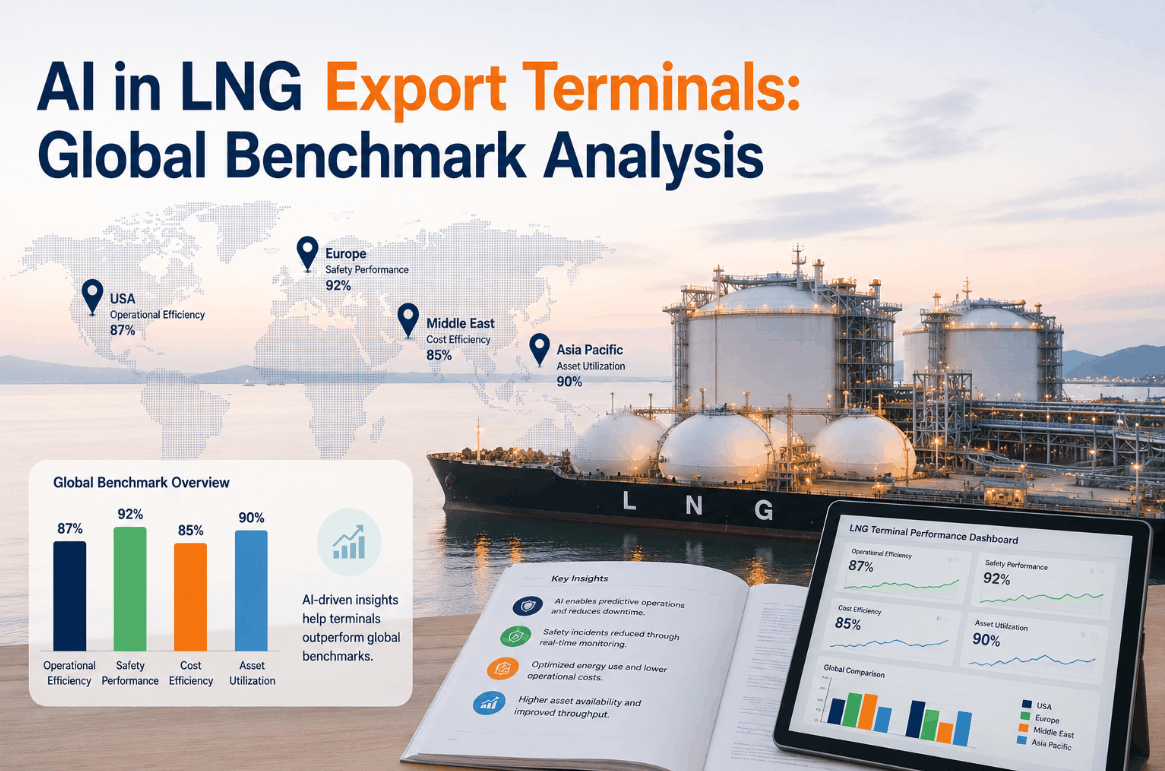
AI in LNG Export Terminals: Global Benchmark Analysis
By Henry Green on May 27, 2026
The global LNG export terminal industry is in the middle of a structural transformation that goes beyond new liquefaction capacity additions — it is a fundamental shift in how these facilities are operated, maintained, and optimized. The LNG terminals market, valued at $7.01 billion in 2024, is projected to reach $13.15 billion by 2030 at a compound annual growth rate of 10.9%, driven by expanding LNG trade and accelerating investment in terminal modernization across the United States, Australia, Qatar, and Southeast Asia. What is changing most significantly inside these numbers is not the scale of the terminals being built, but the intelligence being embedded into every operational layer of the facilities already running. Artificial intelligence is now at the center of how leading terminal operators worldwide are closing the performance gap between design capacity and actual throughput — through predictive maintenance on compressors and cryogenic heat exchangers, AI-optimized boil-off gas management, intelligent vessel scheduling, and digital twin-enabled remote operations that allow engineers onshore to manage complex multi-train facilities in real time. The operators setting the global performance benchmark in 2025 are not the ones with the newest facilities. They are the ones who have most systematically deployed AI across the operational domains where it produces the largest and most measurable impact.
$13.15B
Global LNG terminals market projected by 2030 — from $7.01B in 2024
10.9%
CAGR driving terminal modernization and AI adoption investment globally
60%+
Improvement in berth utilization rates reported by AI-driven intelligent dispatch deployments
31.57%
Average downtime reduction in LNG supply chain using digital twin and ML-based monitoring frameworks
iFactory AI for LNG Terminal Operations
iFactory's industrial AI platform — built on predictive analytics, digital twin technology, and conversational AI interfaces — is designed for the asset complexity and operational demands of LNG export terminals. See how it performs against your specific equipment environment and operational context.
Why AI Adoption at LNG Export Terminals Is Accelerating Now
Three converging pressures are making AI adoption at LNG export terminals less a strategic option and more an operational necessity in 2025. The first is the scale of new capacity entering service: the United States alone has eight operational LNG export terminals and expects export capacity to nearly double by 2031, with Plaquemines LNG coming online in late 2024, the Corpus Christi Stage 3 expansion shipping its first cargo in March 2025, and Golden Pass LNG expected to follow in early 2026. Managing this volume of concurrent liquefaction trains — each running complex rotating machinery at cryogenic temperatures under continuous production pressure — at acceptable maintenance cost and availability levels requires AI-driven surveillance that human inspection programs cannot deliver at the necessary frequency. The second pressure is the economics: a single unplanned compressor failure on a liquefaction train can cost $1–2 million per day in lost throughput, and the capital spare requirements for major cryogenic equipment create inventory cost exposure that predictive avoidance makes a compelling ROI case. The third pressure is competitive — the operators deploying AI are documenting measurable efficiency gains that are widening the performance gap with facilities still relying on conventional maintenance and scheduling approaches. Book a Demo to see how iFactory's platform addresses all three pressures for LNG terminal operators.
Capacity Expansion Pressure
U.S. LNG export capacity expected to nearly double by 2031. New trains mean more compressors, more cryogenic equipment, and more failure modes to monitor — exceeding what conventional inspection programs can manage at acceptable cost.
Failure Cost Economics
Unplanned liquefaction train shutdowns cost $1–2M per day in lost throughput. The ROI case for AI predictive maintenance is clear: one prevented compressor failure annually often covers the full platform investment at a mid-size terminal.
Competitive Performance Gap
Early AI adopters — Vopak, Argent LNG, QatarEnergy — are documenting 60%+ improvements in berth utilization and 30%+ reductions in downtime, creating a widening operational performance differential vs. non-adopters.
Regulatory and ESG Pressure
Tightening methane emissions regulations and ESG reporting requirements create demand for AI-powered continuous monitoring of boil-off gas, fugitive emissions, and flaring events that manual reporting programs cannot deliver at regulatory frequency.
Five AI Application Domains Defining the Global LNG Terminal Benchmark
The performance gap between leading and lagging LNG export terminals in 2025 is driven by AI deployment across five specific operational domains. Each represents a category of work where conventional approaches — fixed maintenance schedules, manual vessel scheduling, periodic sensor checks — are generating measurable cost, availability, and safety gaps that AI is systematically closing. Book a Demo to see how iFactory addresses each domain for terminal operators.
01
Liquefaction Train Predictive Maintenance
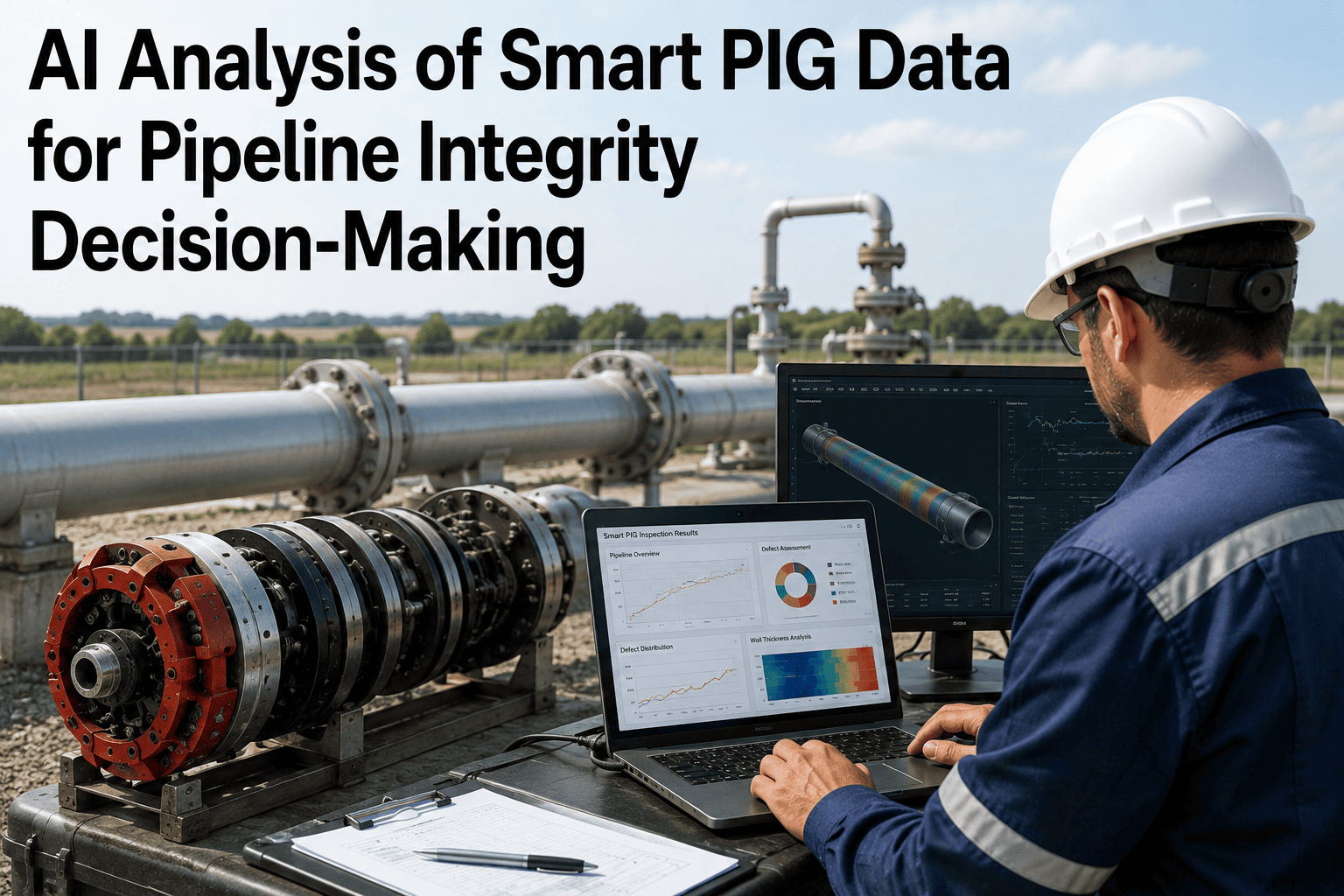
Compressors, turbines, cryogenic heat exchangers, and refrigerant circuits in LNG liquefaction trains operate at extreme temperatures and pressures where failure consequences are severe and inspection windows are narrow. AI-powered predictive maintenance continuously analyzes sensor streams — vibration, temperature, pressure differential, current signature — comparing live readings against failure mode libraries to surface anomalies weeks before they become unplanned shutdowns. Digital twin frameworks integrating machine learning with physics-based process simulation have demonstrated early failure detection rates averaging 57.21% and downtime reductions of 31.57% compared to corrective maintenance strategies in validated LNG supply chain studies.
Compressor health monitoringCryogenic HX surveillanceFailure mode classification
02
Boil-Off Gas (BOG) Optimization
Boil-off gas — LNG that naturally vaporizes during storage and handling — represents both a product loss and a process management challenge that directly affects terminal efficiency and emissions compliance. AI optimization systems model BOG generation rates continuously against ambient conditions, storage inventory levels, ship loading operations, and send-out demand to minimize flaring events, optimize BOG compressor loading, and maximize re-liquefaction efficiency. Advanced systems achieve near-zero gas loss by capturing and re-liquefying BOG that would otherwise be lost to flare or atmosphere, improving both overall efficiency and emissions performance against tightening regulatory standards.
BOG generation modelingCompressor load optimizationFlaring event reduction
03
Intelligent Vessel Scheduling and Berth Management
LNG export terminal berth utilization is one of the highest-leverage efficiency variables available to terminal operators — and one that AI has demonstrated the most dramatic measurable improvements. Vopak's deployment of an AI-powered Intelligent Dispatch System integrating AIS ship positioning data, berth availability, weather conditions, and inventory levels produced a 60% improvement in ship scheduling efficiency, 62% increase in terminal utilization, and 20% reduction in vessel demurrage costs since launch. The system replaces manual berth scheduling with AI algorithms based on genetic and ant colony optimization — transforming scattered data into real-time scheduling decisions that consistently outperform human planners managing the same complexity.
Digital twin technology — real-time virtual replicas of physical terminal assets synchronized with live sensor data — is reshaping how LNG operators manage geographically distributed facility portfolios from centralized operations centers. For terminals with multiple trains running identical equipment, digital twins enable cross-unit comparison that identifies individual train performance deviations and prioritizes maintenance interventions with the statistical power of fleet-level analysis. Siemens and NVIDIA's expanded industrial AI partnership in 2026 specifically targets digital twin and AI tools for lifecycle efficiency across energy and infrastructure assets — reflecting the degree to which this capability has become a standard feature of the competitive technology landscape for LNG terminal operators.
Post-incident regulatory requirements and ESG reporting obligations at LNG export terminals demand continuous monitoring of safety systems — emergency shutdown devices, gas detection networks, pressure relief systems, cryogenic containment integrity — at a rigor level that conventional inspection schedules cannot deliver cost-effectively. AI-powered continuous surveillance automates the assessment of these critical safety systems against regulatory thresholds, generating the audit-ready event records that PHMSA and FERC compliance requirements demand. Methane leak detection — an area of intense regulatory focus in 2025 — is now being addressed through AI-powered sensor networks and satellite data integration that provide the continuous fugitive emissions monitoring that manual inspection programs cannot achieve at required frequency.
ESD and gas detection monitoringMethane leak detection AIAutomated compliance records
Global Benchmark Comparison: Leading LNG Export Terminals and AI Adoption Maturity
Understanding which terminal operators and technology platforms are setting the global performance benchmark — and what AI capability maturity level characterizes each — helps U.S. terminal operators frame their own investment priorities accurately. The table below maps leading global LNG export terminals against their documented AI adoption maturity across the five operational domains where AI is generating the largest measured impact.
Terminal / Operator
Region
AI Domain
Documented Outcome
Maturity Level
Vopak (66 Yunlian)
Asia-Pacific
Intelligent vessel scheduling and berth management
Leading low-cost production benchmark; advanced carbon capture and AI-assisted renewable integration
Advanced
Argent LNG (Port Fourchon)
U.S. Gulf Coast
AI and robotics — full facility integration
Targeting new benchmark for U.S. LNG facilities; AI embedded from development through operations at 25 MMtpa scale
Deployment Phase
Cheniere (Sabine Pass / Corpus Christi)
U.S. Gulf Coast
Multi-train operations; process optimization
50+ mtpa combined capacity; 9 trains completed ahead of schedule; digital operations integration ongoing
Deployment Phase
Woodside Energy
Australia
Digital transformation; modular operations
Largest independent Australian LNG producer; push for digital transformation and next-generation floating solutions
Deployment Phase
The iFactory Platform for LNG Terminal Operations: What It Covers and How It Connects
iFactory's industrial AI platform addresses the specific operational demands of LNG export terminals through four connected capability layers — each designed to work with the data environment that terminal operators already have rather than requiring parallel data infrastructure buildout. Book a Demo to see how the platform connects to your historian and CMMS environment and what the first output looks like for your terminal's specific equipment profile.
Swipe to see platform layers
Layer 1
Asset Health & Predictive Analytics
Continuous multi-sensor surveillance of liquefaction trains, compressors, cryogenic heat exchangers, turbines, and BOG systems. AI failure mode classification with probability scoring and CMMS-linked work order generation for detected anomalies.
Connected: Historian + Sensors
Layer 2
Digital Twin Operations
Real-time virtual replica of terminal assets synchronized with live process data. Cross-train performance comparison, what-if scenario modeling, and remote diagnostics from onshore operations centers without requiring offshore or site personnel mobilization for every assessment event.
Connected: SCADA + DCS
Layer 3
AI Analytics Copilot
Conversational interface that gives terminal engineers natural-language access to the platform's full data environment — historian trends, CMMS maintenance history, failure mode libraries, and fleet benchmark comparisons — returning fully assembled analytical context in under 60 seconds without manual data extraction.
Interface: Natural Language Query
Layer 4
Safety & Compliance Monitoring
Automated continuous assessment of ESD systems, gas detection networks, pressure relief systems, and cryogenic containment integrity against regulatory thresholds. Audit-ready event logs for PHMSA and FERC compliance and AI-assisted methane and fugitive emissions monitoring against ESG reporting requirements.
Output: Compliance-Ready Records
A
CMMS Integration Depth
iFactory connects to SAP Plant Maintenance, IBM Maximo, and Infor EAM through native integrations — accessing work order text, technician findings, PM completion status, and parts cost records rather than just equipment identifiers. This depth is what enables failure mode consistency analysis and root cause identification, not just anomaly detection.
B
Historian Connectivity
Direct connection to OSIsoft PI, Aspen InfoPlus.21, and other process historians without requiring intermediate data lakes or custom ETL pipelines. Tag resolution through natural language — engineers query by equipment description, not by tag syntax — eliminating the data preparation burden that consumes hours before analysis can begin.
C
LNG-Specific Failure Mode Library
Pre-built failure mode taxonomy covering the equipment classes specific to LNG liquefaction terminals — centrifugal and reciprocating compressors, Main Cryogenic Heat Exchangers (MCHEs), refrigerant circuits, BOG compressors, loading arms, and cryogenic storage tank instrumentation — with failure signatures tuned for LNG operating ranges.
D
Data Security and Perimeter
The iFactory platform operates entirely within the customer's data security perimeter — no plant data is routed to external AI services or third-party model providers. Cloud deployment occurs within the customer's dedicated tenant. Access to the analytics interface respects the terminal's existing role-based permission architecture, with full audit logging for compliance documentation.
Expert Perspective: What LNG Terminal Engineers Say About AI-Driven Operations
"When you are managing a multi-train LNG facility, the data complexity is unlike almost any other industrial environment. Every train is generating thousands of sensor points, and the critical failure modes — compressor surge, MCHE fouling, refrigerant circuit imbalance — each have distinct signatures that look different depending on ambient conditions, feed gas composition, and where the train is in its maintenance cycle. What I found after deploying AI-driven analytics is that the platform does not just surface the anomaly — it assembles the full context that tells you whether the anomaly means something. It correlates the vibration deviation against the maintenance history, checks whether we are in a period where this failure mode is historically more likely, and returns a classified finding rather than a raw alert. That is the shift that changes how you manage the facility. Before, we were managing alerts. After, we were managing findings with full analytical backing. For a terminal our size, eliminating even one unplanned train shutdown per year — which predictive maintenance has delivered — covers the platform cost many times over. The harder value to quantify, but equally real, is what happens when your experienced compressor engineer retires and the institutional knowledge about that specific train's behavior history is available to the team through the AI system's historical event record rather than walking out the door with him."
— Senior Reliability Engineer, U.S. Gulf Coast LNG Export Terminal — 14 Years Rotating Equipment and Cryogenic Systems — CMRP Certified
1 train
unplanned shutdown prevented annually covers platform investment many times over
Full context
assembled in seconds vs. hours of manual historian and CMMS extraction before analysis
Day 14
average time from historian connection to engineers using AI copilot for active reliability decisions
Conclusion
The global benchmark for LNG export terminal operations in 2025 is being set by operators who have moved beyond viewing AI as a technology experiment and are treating it as core operational infrastructure — as essential to running a multi-train liquefaction facility at competitive throughput and availability as the control systems and process instrumentation that have always been part of the terminal's foundation. The five operational domains where AI is delivering the largest measured impact — predictive maintenance on liquefaction trains, BOG optimization, intelligent vessel scheduling, digital twin remote operations, and automated safety monitoring — represent categories of work where the performance gap between AI-enabled and conventional operations is already wide and widening every operating cycle.
For U.S. terminal operators — managing existing capacity while preparing for the nearly doubling of export capacity expected by 2031 — the strategic question is no longer whether AI-driven operations platforms deliver value in LNG export environments. That question is answered by documented outcomes from Vopak, Shell, and the emerging Argent LNG benchmark project. The current question is which platform architecture connects to your existing data environment most completely, which failure mode library covers your specific equipment classes with the granularity that produces actionable findings rather than generic alerts, and how quickly the deployment can move from pilot to production workflow integration across your full terminal operation. Book a Demo with the iFactory team to work through that evaluation against your terminal's specific equipment profile and data environment.
Frequently Asked Questions
How does AI predictive maintenance specifically handle the cryogenic operating conditions unique to LNG liquefaction trains?
AI failure mode libraries for LNG equipment are trained on sensor signatures and failure patterns specific to cryogenic operating ranges — including MCHE fouling, refrigerant circuit imbalance, and cold-end compressor surge — where conventional vibration thresholds calibrated for ambient-temperature rotating equipment are inadequate detection tools.
What CMMS and historian systems does iFactory integrate with for LNG terminal deployments?
iFactory integrates natively with SAP Plant Maintenance, IBM Maximo, and Infor EAM for CMMS connectivity, and directly with OSIsoft PI and Aspen InfoPlus.21 historian systems — covering the data environment of the large majority of U.S. and global LNG export terminals without requiring custom integration development.
Can AI optimize boil-off gas management at terminals where BOG compressor capacity is a bottleneck?
Yes — AI BOG optimization models load-sharing across BOG compressor trains based on real-time inventory, ambient conditions, and vessel loading schedules, reducing flaring events and maximizing re-liquefaction efficiency even under constrained compressor capacity constraints.
How does the AI analytics copilot handle multi-train terminals where engineers need cross-train comparisons?
The copilot maintains fleet-level context across all connected trains, enabling direct comparison queries — "how does Train 3 compressor vibration compare to Trains 1 and 2 over the last 90 days" — that identify individual unit deviations against fleet norms as evidence for targeted maintenance prioritization.
What does a realistic AI deployment timeline look like for an operating LNG export terminal with existing historian and CMMS infrastructure?
With historian and CMMS connections in place, most terminals begin generating actionable predictive maintenance findings within two to four weeks, with full failure mode library tuning and digital twin deployment typically completed within 60 to 90 days of platform onboarding.
See iFactory AI Running Against Your LNG Terminal's Data Environment
iFactory's industrial AI platform — predictive maintenance, digital twin integration, AI analytics copilot, and compliance monitoring — is built for the asset complexity and operational demands of LNG export terminals. Book a 30-minute demonstration with our oil and gas analytics team.