The relationship between OPEC+ production policy and artificial intelligence is no longer a future-looking conversation — it is happening now, and its implications for global oil markets are material and accelerating. On one side of this equation, OPEC+ continues to coordinate output decisions among member states controlling roughly 41% of global oil supply, with Saudi Arabia and Russia leading a bloc that now meets monthly to adjust quotas, manage compliance, and respond to shifting demand signals. On the other side, the same national oil companies at the heart of OPEC+ — Saudi Aramco, ADNOC, Iraqi state producers — are simultaneously deploying artificial intelligence at industrial scale across their upstream operations, achieving production cost reductions, efficiency improvements, and reserve recovery rates that are changing the economics of every barrel they produce. The intersection of these two dynamics — AI-driven cost reduction inside OPEC+ member operations, and OPEC+'s ability to use that cost advantage strategically in global market competition — is what makes the digital transformation story inside OPEC+ countries directly relevant to oil and gas operators, reliability engineers, and plant managers evaluating their own AI investment decisions in 2025. Talk to our support team to see how iFactory's AI platform applies to your upstream operations.
OPEC+ · AI Policy Impact · Digital Oilfield Transformation 2025
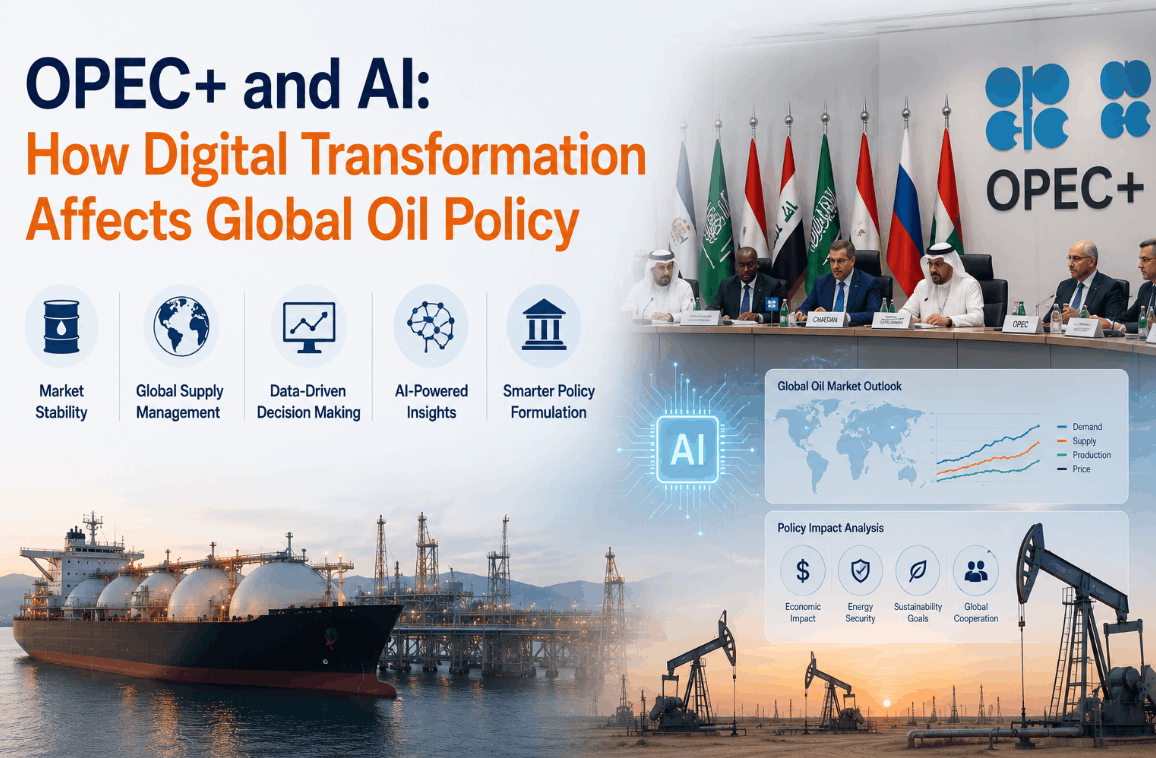
OPEC+ and AI: How Digital Transformation Affects Global Oil Policy
AI is reshaping how OPEC+ member NOCs produce oil — lowering costs, improving recovery, and changing the strategic calculus behind every production quota decision. Here is what that means for global oil markets and for operators evaluating AI-driven platforms for their own assets.
$3–5B
Saudi Aramco projected AI-driven Technology Realized Value in 2025 — savings in drilling, maintenance, and well productivity
442
AI use cases identified by Aramco — 200+ solutions already deployed across upstream operations as of late 2025
$3.50
Per barrel production cost at Saudi Aramco — the lowest in the world, sustained partly by AI-driven operational efficiency
2×
Potential oil well productivity increase through AI and digitalization, per Aramco CEO at the 2025 Future Investment Initiative conference
The Policy-Technology Intersection
Why AI Inside OPEC+ Operations Changes the Strategic Calculus of Production Quotas
OPEC+ production decisions have always been made against a backdrop of member state production economics — the cost of producing each barrel, the fiscal breakeven price each government requires, and the opportunity cost of holding spare capacity off the market. AI is changing all three variables simultaneously for the most technologically advanced OPEC+ members, and the strategic consequences are playing out in real time.
Pre-AI Era (Pre-2020)
Fixed Cost Structures
OPEC+ member production costs largely fixed by reservoir geology, workforce size, and capital equipment. AI-driven efficiency gains not yet material to quota calculations.
Transition Phase (2021–2023)
Pilot AI Deployments
Major NOCs begin deploying AI for predictive maintenance, seismic interpretation, and drilling optimization. Aramco records $1.8B in AI-driven Technology Realized Value in 2024 alone.
Now (2025)
AI at Industrial Scale
AI deployed across full upstream portfolios. Saudi Arabia and UAE investing $130B+ in AI. Production cost advantage widens vs. high-cost producers. Quota strategy increasingly reflects AI-driven cost floor.
Emerging (2026–2028)
AI-Native Policy Intelligence
AI-powered demand forecasting and market modeling integrated into OPEC+ decision frameworks. Digital cost advantages drive more aggressive market share strategies among AI-advanced members.
5 Impact Domains
How AI Is Transforming OPEC+ Member Operations — and Why It Matters for Global Policy
The AI transformation inside OPEC+ member national oil companies operates across five distinct domains. Each represents a category where AI-driven efficiency gains translate directly into lower production costs, higher reserve recovery, or improved market positioning — and each changes the economic foundation on which OPEC+ production decisions are made. Book a Demo to see how iFactory's platform delivers these capabilities for oil and gas operators.
Domain 01
Drilling Optimization and Well Productivity
AI-driven adaptive drilling systems continuously adjust drilling parameters in real time — weight on bit, rotations per minute, fluid flow — based on downhole sensor data. Aramco's CEO stated at the 2025 Future Investment Initiative that AI and digitalization can double oil well productivity. AI-driven systems have achieved 20% reductions in drilling time, and Aramco projects AI will reduce drilling costs materially as part of its $3–5 billion Technology Realized Value program for 2025.
20% Drilling Time Reduction
AI-optimized drilling parameters vs. conventional fixed-program approach
Domain 02
Predictive Maintenance on Production Assets
AI predictive maintenance programs continuously analyze sensor data from compressors, separators, pumping systems, and pipeline infrastructure — surfacing failure mode deviations weeks before they become unplanned shutdowns. Aramco has reported a 30% improvement in equipment reliability from AI-driven predictive analytics. BCG estimates full AI adoption can deliver 30–70% EBIT uplift within five years for oil and gas operators, with predictive maintenance as the highest-ROI initial deployment.
30% Equipment Reliability Gain
AI predictive analytics deployed across Aramco upstream and processing assets
Domain 03
Market Forecasting and Demand Intelligence
AI models analyzing multivariate price and demand datasets are giving OPEC+ member NOCs — Aramco in particular — a more sophisticated understanding of price and demand drivers than the historical trend analysis that previously informed quota strategy. AI-enhanced strategic forecasting allows operators to anticipate market downturns or price spikes, adjust production or trading positions accordingly, and smooth revenue impact across volatile pricing environments — directly informing the fiscal modeling that underlies each production quota decision.
Enhanced Policy Intelligence
AI demand models improving OPEC+ market timing and quota strategy accuracy
Domain 04
Reservoir Management and Recovery Optimization
AI and machine learning applied to reservoir characterization are enabling OPEC+ member operators to improve recovery factors from existing fields — extending productive life, reducing the per-barrel capital cost of reserve monetization, and improving the economics of spare capacity maintenance. Aramco Digital Company is projected to process over 1 petabyte of oilfield operational data annually by 2026, with AI-driven reservoir intelligence a central application. Better reservoir management directly affects how much spare capacity members can economically maintain and deploy on policy direction.
1 Petabyte/Year
Aramco Digital projected annual oilfield data processing volume by 2026
Domain 05
Emissions Monitoring and ESG Compliance
Tightening global ESG reporting requirements and methane regulations are creating demand for AI-powered continuous emissions monitoring across OPEC+ member upstream operations. Aramco is investing in AI-driven emissions monitoring across its operational facilities, with reported potential for up to 15% emissions intensity reduction by 2026 through CCUS and digitized monitoring. For the UAE, AI and digital infrastructure are directly linked to energy security and environmental compliance as part of its broader ambition to diversify beyond oil while maximizing the economic value of current production.
Up to 15% Emissions Intensity Reduction
Aramco AI-assisted CCUS and monitoring programs targeting 2026 milestone
iFactory AI Delivers These Capabilities for Oil & Gas Operators — Not Just for NOCs.
iFactory's predictive maintenance, digital twin, and AI analytics copilot platform is built for the asset complexity and operational demands of upstream oil and gas — from production platforms to onshore processing facilities. See how it performs against your specific equipment environment and data infrastructure.
OPEC+ AI Adoption Landscape
How Leading OPEC+ Member NOCs Compare on AI and Digital Transformation Maturity
AI adoption is not uniform across OPEC+ member states. The gap between leading and lagging NOCs in digital transformation maturity is creating a performance divergence that is increasingly visible in production cost, reliability, and market positioning data.
Advanced AI Adopters
Saudi Arabia · UAE · Kuwait
Saudi Aramco: $3–5B AI-driven Technology Realized Value projected for 2025; 442 AI use cases identified; 200+ deployed
UAE investing AED 13 billion ($3.54B) in Digital Strategy 2025–2027; ADNOC deploying AI across upstream and LNG assets
Production cost at $3.50/bbl at Aramco — world's lowest, partially sustained by AI-driven operational efficiency
AI enables strategic flexibility: lower cost floors allow aggressive market share moves without fiscal breakeven pressure
Digital twin deployment and remote operations centers managing upstream assets with reduced headcount requirements
AI demand forecasting models integrated into NOC market strategy and informing OPEC+ policy position development
Developing AI Adoption
Iraq · Nigeria · Venezuela · Algeria
Iraq: significant production potential but infrastructure constraints limiting AI deployment pace and data integration completeness
Nigeria: aging upstream infrastructure and IOC-dominated production creating fragmented digital transformation landscape
Venezuela: production at fraction of reserve potential; infrastructure deterioration limiting AI deployment to targeted IOC-managed assets
Higher production cost structures — without AI efficiency gains — create greater fiscal pressure at lower oil price levels
Quota compliance monitoring dependent on legacy reporting; compliance verification gaps affecting OPEC+ cohesion
Dependent on higher sustained oil prices for fiscal stability — creating different incentives in OPEC+ quota discussions vs. AI-advanced members
Digital Transformation Market Context
The Numbers Behind OPEC+ Digital Transformation — What the Investment Scale Means
Saudi Arabia + UAE Combined AI Investment Target (2025–2027)$130B+
Global Oil & Gas Digital Transformation Market Growth (2025–2029)$56.4B
Potential EBIT Uplift from Full AI Adoption (BCG Estimate)30–70%
Unplanned Downtime Reduction from AI Predictive Maintenance35%+
Upstream Value Unlockable by AI Digitization Through 2030$250B
Aramco Production Cost vs. Global Average ($3.50 vs. $15–20/bbl)$3.50/bbl
Expert Perspective
What Oil & Gas Reliability Engineers Say About AI Adoption in the Context of Global Competition
The strategic context of OPEC+ AI adoption has direct operational implications for U.S. and international independent oil and gas operators who compete on cost with NOC-produced barrels. The performance gap is measurable and growing.
"I spent eight years working for an independent upstream operator before moving into an advisory role covering both IOC and NOC asset performance benchmarking. The thing that changed my view on AI urgency was not a technology conference — it was looking at cost-per-barrel data across different producer categories and seeing what had happened to the gap between Aramco's production cost and the global average over the decade during which their digital transformation program matured. That gap is not accidental and it is not geological. It is operational. Their maintenance cost discipline, their well productivity, their equipment reliability — these are all measurably better than industry average, and AI is a significant part of why. For independent operators managing legacy infrastructure and lean maintenance teams, the case for AI-driven predictive maintenance and digital analytics is not primarily about keeping up with technology trends. It is about the fact that your cost of production is competing with producers who are running AI at industrial scale, and every dollar of unnecessary maintenance spend or unplanned downtime is coming out of the margin that determines whether your barrels stay economic at the prices OPEC+ is increasingly comfortable with. The operators I see making the fastest progress on cost discipline are the ones who deployed AI analytics early — not because they saw OPEC+ strategy coming, but because they wanted to understand what was happening in their own equipment populations before it showed up as a budget problem."
— Senior Reliability & Operations Advisor, Independent Oil & Gas — 16 Years Upstream Asset Performance — CMRP Certified, SPE Member
$3.50Aramco production cost vs. $15–20 global average
30–70%EBIT uplift from full AI adoption (BCG)
200+AI solutions already deployed at Aramco
How iFactory Responds to This Context
Enterprise AI for Oil & Gas Operators Competing on Cost
iFactory's industrial AI platform — predictive maintenance, digital twin integration, CMMS analytics, and conversational AI copilot — delivers the operational efficiency gains that OPEC+ member NOCs are achieving at scale, through a deployment model designed for independent and mid-size operators who need production-grade AI without a dedicated AI development organization. The platform connects to your existing historian and CMMS data infrastructure, generates actionable findings within weeks of onboarding, and delivers the cost discipline improvements that matter when competing against AI-advanced producers.
Book a Demo to see the platform in your operational context.
Gap detected → Root cause identified → Action triggered — same day
Conclusion
The OPEC+ AI Story Is Also an Operator AI Story
The digital transformation happening inside OPEC+ member national oil companies is not a story about geopolitical strategy — it is a story about production economics, and production economics determine which barrels are viable at which price levels. Saudi Aramco's $3.50 per barrel production cost is not a geological gift that other operators cannot compete with. It is partly the result of a decade of systematic AI-driven operational improvement that has lowered maintenance costs, improved equipment reliability, reduced drilling time, and increased well productivity across their asset base. The gap between that cost structure and the average independent operator's cost of production is widening as Aramco's AI program matures — and every unplanned equipment failure, every reactive maintenance cycle, and every hour of engineering time spent on data assembly rather than reliability analysis is a cost that does not need to exist.
iFactory's AI-driven analytics platform is built to close that gap for operators who cannot build a Aramco-scale digital transformation program from scratch — by delivering predictive maintenance, bad actor identification, CMMS analytics, and conversational AI interfaces that work with the data environment operators already have, and produce measurable operational results within weeks of deployment. Book a Demo to see your operational cost structure analyzed against what AI-driven maintenance discipline actually delivers for an asset profile like yours.
Frequently Asked Questions
OPEC+ AI and Digital Transformation — What Operations Teams Ask First
How directly does AI adoption inside OPEC+ member NOCs affect oil prices that independent operators have to plan around?
AI lowers OPEC+ member production costs, making lower sustained oil prices economically viable for Saudi Arabia and the UAE — which directly expands the price range in which they can pursue market share strategies without fiscal distress, creating a more competitive price environment for all producers.
What specific AI applications are producing the largest cost reductions at OPEC+ member NOCs in 2025?
Drilling optimization (20% drilling time reduction), predictive maintenance (30% equipment reliability improvement at Aramco), and reservoir management AI are the three highest-value applications, contributing to Aramco's $3–5 billion projected Technology Realized Value for 2025.
Can the same AI platforms that OPEC+ NOCs use be deployed by independent oil and gas operators at smaller scale?
Yes — iFactory's platform delivers predictive maintenance, digital twin integration, CMMS analytics, and AI copilot capabilities through a deployment model scaled for independent and mid-size operators, connecting to existing historian and CMMS data without requiring a dedicated AI development team.
Book a Demo to see a deployment scoped for your asset profile.
How is the UAE's exit from OPEC+ in May 2026 connected to its AI and digital infrastructure investment strategy?
The UAE's OPEC exit unlocks over $61 billion per year in additional oil revenue (from producing at 4.8M bpd vs. the 3.2M bpd OPEC cap) while simultaneously funding AI data center infrastructure — with expanded gas production from associated oil providing electricity for AI facilities being built with $15.2B in Microsoft commitments.
How quickly can an independent oil and gas operator begin realizing AI-driven operational benefits comparable to what OPEC+ NOCs are documenting?
With historian and CMMS connections in place, most operators begin generating actionable predictive maintenance findings within two to four weeks; full production workflow deployment with trained failure mode models typically occurs within 60–90 days of platform onboarding.
The AI Advantage OPEC+ Is Building Is Available to Every Oil & Gas Operator — Now.
iFactory's industrial AI platform delivers the predictive maintenance, digital twin integration, CMMS analytics, and conversational AI copilot that OPEC+ member NOCs are deploying at industrial scale — through a deployment model built for operators who need production-grade AI without a dedicated development organization. Book a 30-minute demonstration.