Inline inspection (ILI) using smart pigs is the cornerstone of modern pipeline integrity management in the oil and gas industry. Selecting the appropriate inspection technology between Magnetic Flux Leakage (MFL) and Ultrasonic Testing (UT) directly impacts defect detection accuracy, operational costs, and safety compliance. This comprehensive technical guide provides an enterprise-level comparison of MFL and UT smart pig technologies, covering fundamental physics, defect detection capabilities, data quality metrics, and selection criteria tailored to pipeline product type, defect orientation, accuracy requirements, and pipeline configuration. Whether you are a plant manager overseeing cross-country pipelines or a maintenance director responsible for facility piping, understanding these nuances is critical for optimizing inspection programs. Book a Demo with iFactory to explore how our AI-driven analytics can enhance your ILI data interpretation and decision-making.
Transform Your Pipeline Inspection Strategy
Leverage AI-driven analytics to maximize ILI data value. Achieve higher accuracy and lower operational risk.
MFL Technology Overview
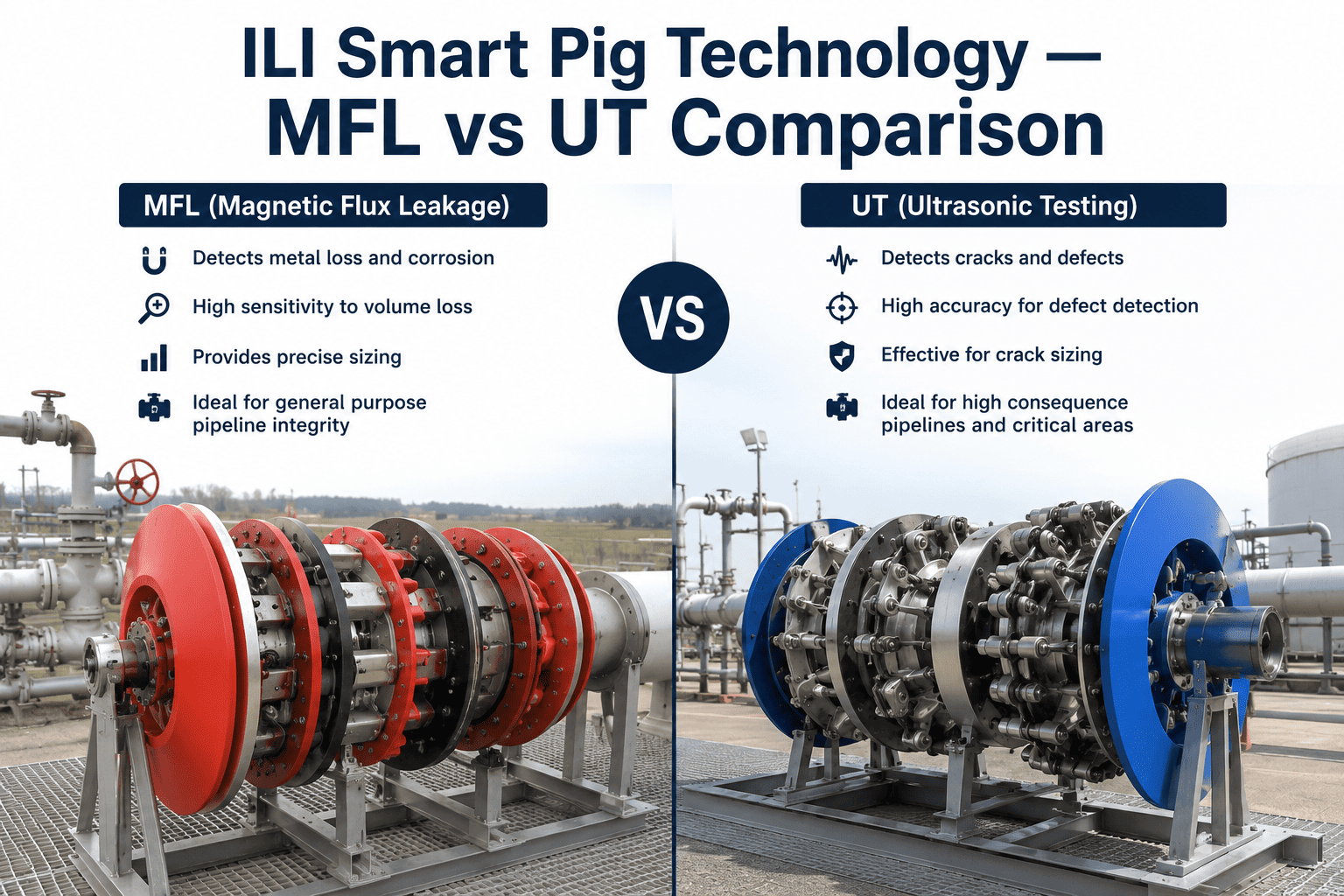
MFL inspection tools magnetize the pipe wall and measure leakage fields caused by defects. They are highly effective for detecting metal loss from corrosion, especially in gas pipelines where liquid couplant is not required. MFL tools are robust, handle high pressures, and provide rapid scanning speeds, making them ideal for long-distance transmission lines. The technology excels at identifying general corrosion, pitting, and axial defects. However, MFL has lower sensitivity to narrow axial cracks and cannot directly measure wall thickness; it requires calibration to estimate defect depth.
UT Technology Overview
Ultrasonic ILI tools use piezoelectric transducers to emit sound waves that reflect off inner and outer pipe walls, providing direct wall thickness measurements. UT is superior for detecting laminations, hydrogen-induced cracking, and narrow axial defects. It offers high accuracy for depth sizing, essential for critical defect assessments. However, UT requires a liquid couplant (usually the product itself), limiting its use to liquid pipelines or gas lines with condensate. UT tools are more sensitive to pipeline cleanliness and travel speed, and they are generally more expensive to operate.
Key Selection Criteria
Choosing between MFL and UT depends on pipeline product (gas vs liquid), defect orientation (axial vs circumferential), required accuracy (depth sizing vs detection), pipeline configuration (diameter, bends, wall thickness), and operational constraints (speed, pressure, temperature). For gas pipelines with primarily corrosion metal loss, MFL is cost-effective. For liquid pipelines requiring high-fidelity crack detection, UT is preferred. Hybrid tools combining both technologies are emerging for comprehensive inspection.
Technical Comparison: MFL vs UT Smart Pigs
| Parameter | MFL | UT |
|---|---|---|
| Physical Principle | Magnetic flux leakage | Ultrasonic pulse-echo |
| Couplant Requirement | None (dry contact) | Liquid required |
| Best Suited Product | Gas, multiphase | Liquid, condensate |
| Defect Detection | Metal loss, pitting, axial grooves | Cracks, laminations, wall thinning |
| Depth Sizing Accuracy | Moderate (±10-15% wall) | High (±2-5% wall) |
| Minimum Detectable Defect | ~5% wall loss | ~1% wall loss |
| Inspection Speed | Up to 5 m/s | Up to 2 m/s |
| Pipeline Cleanliness | Moderate tolerance | High cleanliness required |
| Operational Cost | Lower | Higher |
| Data Interpretation | Requires calibration | Direct measurement |
Step-by-Step ILI Smart Pig Selection Process
Define Inspection Objectives
Identify primary defects of concern: general corrosion, pitting, cracking, or laminations. Determine required detection sensitivity and depth sizing accuracy. For fitness-for-service assessments, UT is often mandatory.
Analyze Pipeline Characteristics
Review product type (gas/liquid), diameter, wall thickness, bend radius, and operating conditions. MFL is more flexible for gas lines and tight bends, while UT requires straight sections and liquid couplant.
Evaluate Defect Orientation
Axial defects (e.g., longitudinal cracks) are better detected by UT, whereas circumferential defects (e.g., pitting) are captured by MFL. For mixed orientation, consider hybrid tools.
Assess Data Quality Requirements
High-accuracy depth sizing for critical defects demands UT. For screening and general corrosion mapping, MFL provides sufficient data at lower cost.
Review Operational Constraints
Consider inspection speed, pressure, temperature, and pigging history. MFL tools can run faster and tolerate higher pressures, reducing operational downtime.
Deep Dive: MFL Technology for Gas Pipelines
MFL smart pigs magnetize the pipe wall using powerful permanent magnets or electromagnets. When a defect disrupts the magnetic field, flux leaks out and is detected by Hall effect sensors or coils. The leakage signal amplitude correlates with defect depth, but is also influenced by defect shape, orientation, and sensor lift-off. Advanced MFL tools use multiple magnetizing directions (axial and circumferential) to improve detection of both axial and circumferential defects. Data interpretation relies on sophisticated algorithms and calibration runs on known defects. MFL is particularly effective for detecting general corrosion, pitting, and axial grooving in gas pipelines where no liquid couplant is available. However, MFL cannot distinguish between inner and outer wall defects without additional sensors (e.g., eddy current). For pipelines transporting dry gas, MFL remains the most cost-effective and widely adopted ILI technology.
Deep Dive: UT Technology for Liquid Pipelines
Ultrasonic ILI tools employ an array of piezoelectric transducers that emit short ultrasonic pulses perpendicular to the pipe wall. The time-of-flight of echoes from the inner and outer surfaces directly measures wall thickness. UT provides high-resolution thickness mapping, enabling detection of localized corrosion, pitting, and cracking. The technology excels at identifying laminations, hydrogen-induced cracking, and other planar defects that are invisible to MFL. UT is the preferred choice for liquid pipelines where the product itself serves as couplant. Modern UT tools operate at speeds up to 2 m/s and can inspect wall thicknesses from 5 mm to 50 mm. Data quality is superior, with depth sizing accuracy within ±2-5% of wall thickness. However, UT requires clean pipelines free of debris and wax, and cannot be used in gas lines without a liquid medium. For critical pipelines requiring high-integrity assessments, UT is the gold standard.
Optimize Your ILI Program with AI
iFactory's predictive analytics enhance defect characterization and reduce false positives. Transform raw ILI data into actionable insights.
Advanced Considerations for ILI Technology Selection
Hybrid ILI Tools
Emerging smart pigs combine MFL and UT in a single tool, providing comprehensive defect detection in one run. These tools are ideal for pipelines with mixed defect types, reducing operational costs and data fusion complexity. However, they are heavier and require more power.
Data Analytics Integration
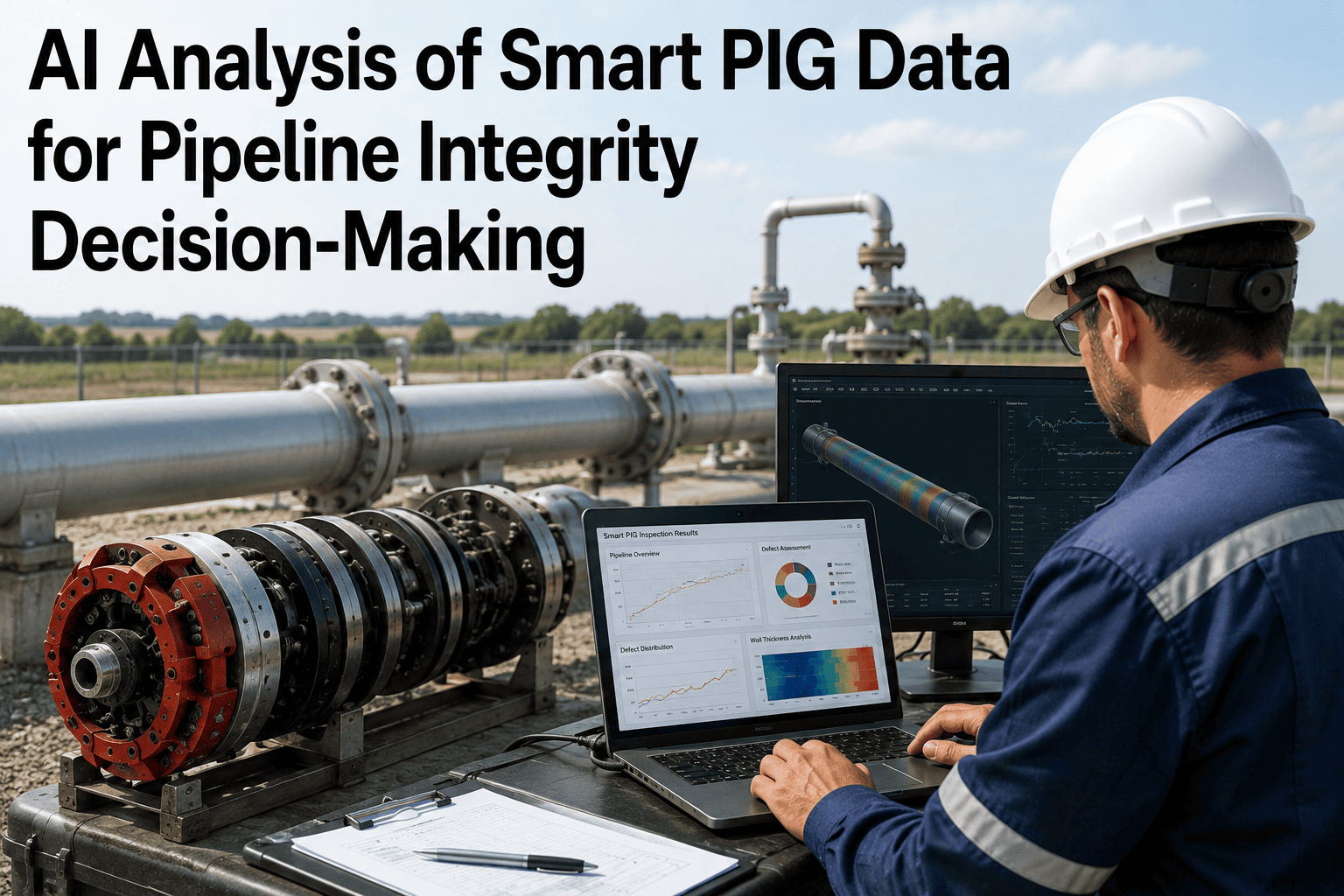
Modern ILI data is analyzed using machine learning algorithms to classify defects and predict growth rates. iFactory's platform integrates with any ILI vendor's data, providing a unified dashboard for integrity engineers.
Regulatory Compliance
Pipeline safety regulations (e.g., PHMSA, API 1163) require periodic ILI runs with documented tool performance. Selecting the right technology ensures compliance and avoids costly re-inspections.
Cost-Benefit Analysis
While UT tools have higher upfront costs, their superior accuracy can reduce unnecessary excavations and repairs. A lifecycle cost analysis often favors UT for critical pipelines with high consequence of failure.
Frequently Asked Questions
What is the main difference between MFL and UT smart pigs?
The fundamental difference lies in the physical principle: MFL detects magnetic flux leakage caused by defects, while UT measures wall thickness directly using ultrasonic waves. MFL is best for gas pipelines and general corrosion detection, whereas UT excels in liquid pipelines and provides higher accuracy for crack detection and depth sizing. Book a Demo to see how iFactory integrates both data types for comprehensive analysis.
Can MFL detect cracks in pipelines?
Standard MFL tools are not optimized for crack detection; they are designed for metal loss defects. However, advanced MFL tools with circumferential magnetization can detect axial cracks to some extent, but sensitivity is lower compared to UT. For crack detection, especially narrow axial cracks, ultrasonic ILI tools are strongly recommended. Contact iFactory Support for guidance on selecting the right tool for your defect profile.
Which ILI technology is better for gas pipelines?
MFL is the dominant technology for gas pipelines because it does not require a liquid couplant and can operate at higher speeds. It effectively detects corrosion and pitting, which are the primary threats in gas transmission lines. UT is rarely used in dry gas pipelines unless a liquid slug is introduced, which is operationally challenging. Book a Demo to explore AI-driven ILI data analytics tailored for gas pipeline operators.
How accurate is depth sizing with MFL vs UT?
UT provides superior depth sizing accuracy, typically within ±2-5% of wall thickness, whereas MFL accuracy ranges from ±10-15% depending on calibration and defect geometry. For fitness-for-service assessments requiring precise remaining strength calculations, UT is preferred. MFL is adequate for screening and general corrosion mapping. Contact iFactory to learn how our analytics improve MFL depth sizing using machine learning.
What factors should I consider when choosing between MFL and UT?
Key factors include pipeline product (gas vs liquid), defect orientation (axial vs circumferential), required depth sizing accuracy, pipeline cleanliness, operating speed, and budget. For liquid pipelines with high crack risk, UT is mandatory. For gas pipelines with general corrosion, MFL is cost-effective. Hybrid tools offer a compromise. Book a Demo with iFactory to discuss your specific pipeline integrity challenges.
Ready to Elevate Your Pipeline Integrity Program?
iFactory's AI-powered platform transforms ILI data into predictive insights. Reduce downtime, prevent failures, and optimize maintenance spend.