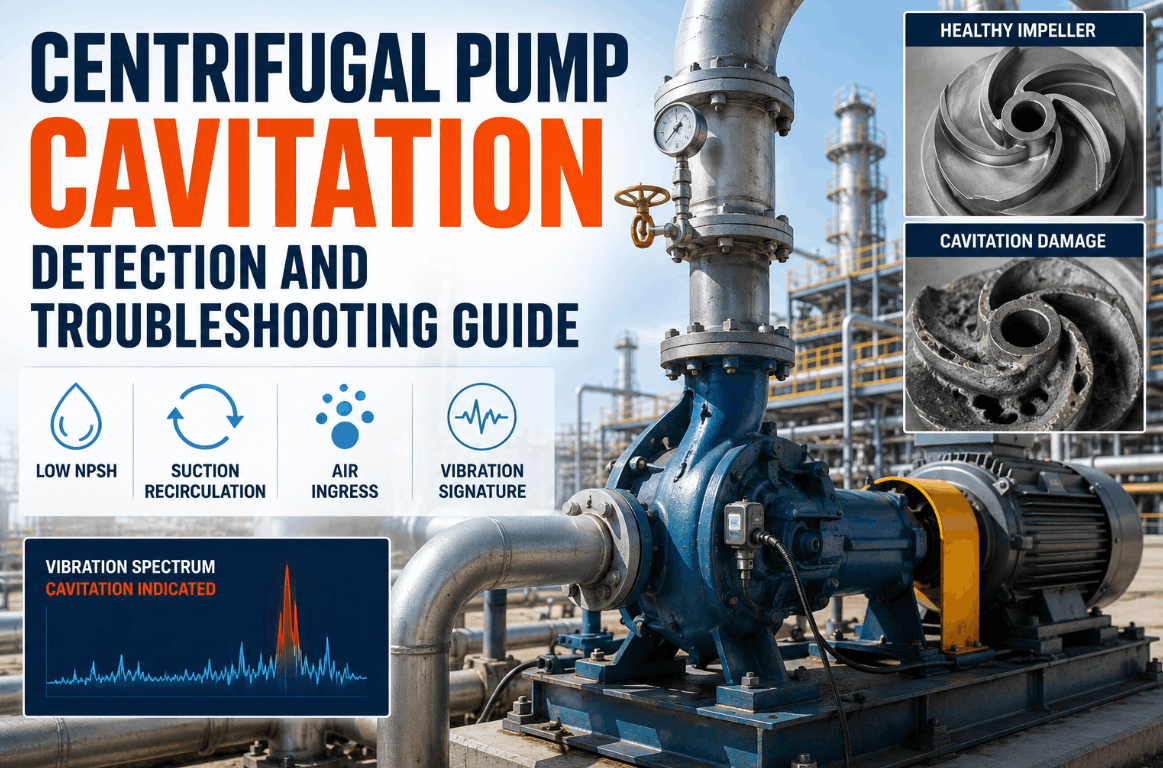
Centrifugal pump cavitation does not announce itself with a single, unmistakable failure. It announces itself with a sound like gravel in the casing, a vibration signature that drifts upward over days, a suction pressure that drops a few PSI below where it used to sit, and a discharge flow that has quietly declined 8% from last quarter's baseline. In oil and gas, petrochemical, and heavy process operations, the assets most vulnerable to this progression — crude charge pumps, boiler feed pumps, cooling water circulators, pipeline injection pumps — are also the ones where an undetected cavitation event translates directly into impeller replacement, mechanical seal failure, bearing damage, and in worst cases a forced unit shutdown during a production run that cannot afford one. The physics of the failure is well understood: when the Net Positive Suction Head available at the pump inlet falls below the NPSH required by the impeller, liquid vaporizes at the eye of the impeller, vapor bubbles form and then collapse violently on the pressure side of the vane, and the micro-jet energy released at each collapse is sufficient to pit and erode hardened metal impeller surfaces within weeks of sustained exposure. What is less well understood, in most facilities, is that the conditions producing that NPSH deficit are detectable in the operating data hours to days before the damage accumulates to a failure threshold. iFactory AI's predictive analytics platform continuously monitors suction pressure, differential pressure, vibration spectra, flow rate deviations, and NPSHa margin against real-time operating conditions — delivering actionable cavitation alerts to process engineers before the impeller has reached the point of no return. Facilities that have deployed iFactory's pump health monitoring report 61% reductions in cavitation-related unplanned pump outages within the first operating year.
Why Cavitation Destroys Pumps Faster in Oil & Gas Than Any Other Industry
In a refinery or upstream facility, the conditions that drive cavitation are structurally more severe than in general industrial pumping. Crude charge pumps handle fluids at elevated temperatures — closer to the vapor pressure boundary. High-pressure injection pumps are sized at or near their best efficiency point during design, but operated across a wide flow range as production rates vary. Boiler feed pumps are subject to suction header pressure drops during rapid load changes. Each of these operating realities compresses the NPSHa margin that stands between normal pump operation and the onset of vapor bubble formation at the impeller eye.
The consequence is accelerated damage. A pump operating with an NPSHa margin of less than 2 feet below NPSHr — a condition that can exist for hours before a single control room alarm fires — accumulates impeller erosion at a rate that would consume a new impeller's service life in 60 to 90 days of sustained exposure. When that pump is a crude charge pump or a boiler feed pump on the critical path, the unplanned outage cost is not the cost of an impeller. It is the cost of a unit shutdown.
The Four Cavitation Mechanisms Most Likely to Fail Your Process Pumps — and How to Detect Each
Cavitation is not a single failure mode. It is a family of related hydraulic phenomena that share the same outcome — vapor bubble formation and violent collapse at the impeller — but originate from different root causes, each requiring distinct detection logic and corrective action. Misdiagnosing the mechanism means applying the wrong fix and watching the pump fail again on the next run.
Classical NPSH Deficit Cavitation
The most common mechanism: NPSHa drops below NPSHr because suction line pressure falls — from a plugged strainer, a partially closed suction valve, excessive suction lift, elevated fluid temperature, or a drop in suction vessel pressure. The impeller eye sees fluid at or below vapor pressure and vaporization begins at the leading edge of the vane. Detection relies on trending NPSHa margin, not just absolute suction pressure alarm.
Suction Recirculation
Suction recirculation occurs when flow rate drops below the minimum continuous stable flow for the impeller design — typically below 60–70% of the pump's best efficiency point flow. At low flow, fluid reverses direction at the impeller eye, creating localized low-pressure zones and vapor formation independent of suction line NPSH conditions. Common in pumps running on bypass or with reduced production demand.
Air and Gas Ingress
Gas or air entering the suction stream reduces the effective NPSHa by introducing a compressible phase that the impeller cannot pump efficiently. Sources include suction flange leaks under partial vacuum, vortex formation in suction vessels drawing down low, dissolved gas break-out from process fluid temperature increases, and inadequately purged suction systems after maintenance. Gas ingress cavitation produces the most violent vibration signature of the four mechanisms.
Discharge Recirculation
Discharge recirculation occurs at the impeller exit when flow rate exceeds the pump's best efficiency point significantly — fluid reverses at the outer vane tips, creating turbulent low-pressure zones at the discharge side of the impeller. Less common than suction-side mechanisms but more likely to go undetected because suction pressure and NPSHa appear normal while the failure mechanism is progressing on the discharge side of the impeller.
The Cavitation Damage Timeline: What Happens Inside Your Pump if the Signal Goes Unacted On
Post-teardown inspections at oil and gas facilities that experienced unplanned pump failures consistently reveal the same progression — damage that escalated from minor surface pitting to catastrophic impeller failure across a timeline that spanned days to weeks, with detectable operating signals present throughout. The table below maps that progression against the monitoring parameters iFactory tracks and the intervention window available at each stage.
| Damage Stage | What's Happening Inside | Observable Signal | iFactory Detection Method | Intervention Window | If Missed — Consequence |
|---|---|---|---|---|---|
| Stage 1: Incipient | Vapor bubbles forming at impeller eye; collapsing at vane pressure face; micro-pitting begins | NPSHa margin narrowing; faint broadband vibration increase; occasional noise event | NPSHa trending alert; vibration baseline deviation flag | 24–72 hours | Progression to Stage 2 within 48–96 hours of sustained operation |
| Stage 2: Progressive | Pitting extends across vane leading edges; hydraulic efficiency begins measurable decline | 3–8% discharge pressure loss at constant speed; vibration +15–25% above baseline; audible gravel sound | dP efficiency loss alert; vibration amplitude threshold; compound NPSHa + vibration flag | 12–36 hours | Mechanical seal wear begins; bearing load increases; risk of seal flush contamination |
| Stage 3: Severe | Impeller vane material loss measurable; sponge-textured erosion on suction face; seal faces compromised | Flow rate decline 10–18% at constant head; vibration +40–60% above baseline; seal flush pressure anomaly | Flow efficiency trend; seal API flush parameter deviation; vibration severity threshold | 4–12 hours | Bearing failure imminent; seal replacement required; impeller replacement mandatory at next outage |
| Stage 4: Failure | Vane fracture or separation; impeller structural failure; casing erosion; complete hydraulic breakdown | Catastrophic flow/pressure loss; motor overcurrent or trip; bearing temperature spike to failure | Real-time trip signal integration; post-event root cause data package | Emergency shutdown only | Unplanned shutdown, full pump replacement, process unit impact, $280K–$1.8M total incident cost |
How iFactory AI Connects Pump Condition Signals to Prevented Outages
Standard DCS alarm systems monitor individual pump parameters against fixed setpoints. When suction pressure falls below a set value, an alarm fires — regardless of whether the fluid temperature has changed, the strainer differential has been rising for three days, or the vibration baseline has been drifting upward for a week. iFactory's pump health analytics integrates all of these signals into a unified consequence-weighted risk score that tells your process engineer what is actually happening — not just which parameter crossed a line.
Process engineers at facilities using iFactory pump analytics report that the NPSHa margin trending view alone — replacing the single-point suction pressure alarm — eliminates the majority of false alarm fatigue that previously caused cavitation early-warning alerts to be dismissed during normal operations. Book a Demo to see how your existing DCS historian data can be connected in a pump health analytics pilot in under four weeks.
NPSH Troubleshooting Decision Framework: Where to Look First When Your Pump Is Cavitating
When a cavitation event is confirmed — by noise, vibration, or process alarm — the sequence of investigation determines how quickly the correct root cause is identified and corrected. The checklist below reflects the diagnostic sequence used by reliability engineers at U.S. oil and gas facilities, ordered from most-common to least-common root cause for each operating scenario.
- Check suction strainer differential pressure — fouling is the single most common sudden-onset cause
- Verify suction block valve fully open — partial closure during maintenance line-up is frequently missed
- Check suction vessel level — drawdown below vortex formation threshold or below pump minimum level
- Confirm fluid temperature at suction has not risen — reduced vapor pressure margin at elevated temperatures
- Check for suction line air ingress — flange leak or open vent left from prior maintenance
- Verify pump speed has not changed — VFD fault condition or control loop reset to higher setpoint
- Review NPSHa trend over 30–90 days — gradual suction pressure decline indicates developing system restriction
- Check impeller wear — degraded hydraulic geometry increases NPSHr over service life, closing the margin from both sides
- Review discharge system changes — increased system resistance shifts operating point toward low-flow recirculation zone
- Inspect suction piping for scale or debris buildup at reducers, elbows, and strainer baskets
- Confirm pump is operating close to its hydraulic BEP — gradual shift in process demand can push below minimum flow
- Review seal flush system performance — degraded seal flush indicates the cavitation has been ongoing long enough to affect seals
- Correlate cavitation onset with process throughput rate — suction recirculation at low flow, discharge recirculation at high flow
- Check for occurrence during startup — incomplete warm-up or gas purging from suction line is common in cold-start events
- Review occurrence during high-temperature process periods — summer ambient or feed temperature increase compressing vapor pressure margin
- Correlate with parallel pump operating status — one pump offline shifts system curve and changes single-pump operating point
- Review control valve positioner performance — hunting or oscillation can briefly drive flow into cavitation range
- Book a Demo to see iFactory's operating condition correlation view for process-dependent cavitation patterns
Expert Review: What 25 Years of Process Pump Failures Taught a Rotating Equipment Engineer
In 25 years of rotating equipment work across Gulf Coast refineries and offshore platforms, I have investigated more pump failures than I care to count — and the one thing that appears in almost every post-mortem for a cavitation-related failure is that the NPSHa margin data was available in the historian the whole time. It was trending down for days. Nobody looked at it because the suction pressure alarm never fired. That is the diagnostic gap that has cost the process industry hundreds of millions of dollars in preventable pump damage. The suction pressure alarm setpoint was set against a design-point absolute pressure, not against a real-time calculated NPSHa margin that accounts for fluid temperature and vapor pressure. So the alarm that was supposed to catch cavitation was constitutionally incapable of catching it under the conditions that actually produce it. What iFactory does — continuous NPSHa margin computation and trending, not absolute pressure alarm — is the correct technical answer to this problem. Add compound detection that correlates that margin with vibration and flow efficiency, and you have a system that catches all four cavitation mechanisms, not just the textbook case. The economics are not subtle. One impeller replacement at current labor and materials rates is $40,000 to $120,000. One unplanned unit shutdown on the critical path is $280,000 to well over a million. The monitoring system that prevents those events costs a fraction of either. The only reason not to deploy it is not knowing it exists.
Conclusion: The NPSHa Margin Your Historian Already Has Is Enough to Prevent the Next Pump Failure
Centrifugal pump cavitation is not an unpredictable event. It is the predictable result of an NPSHa margin that was allowed to erode — through strainer fouling, temperature rise, minimum flow violation, or suction line air ingress — without triggering a meaningful, consequence-weighted response in the plant's monitoring system. The suction pressure data that would have caught it was in the historian. The vibration trend that confirmed progressive damage was in the condition monitoring system. What was absent was the analytics layer that combined those signals, computed NPSHa margin in real time, and delivered an actionable alert with enough lead time to correct the root cause before the impeller reached Stage 3 damage.
iFactory AI provides exactly that capability for centrifugal pumps across oil and gas, petrochemical, power generation, and heavy process applications — continuous NPSHa margin monitoring, four-mechanism cavitation detection, vibration-correlated severity classification, and automated inspection work orders that convert condition alerts into accountable maintenance actions. The investment recovers on the first prevented impeller replacement. The ROI is locked in on the first prevented unit shutdown. Book a Demo and see your existing pump data connected to iFactory's cavitation analytics in a live demonstration against your own operating history.
Frequently Asked Questions
The most reliable early warning is a narrowing NPSHa margin — computed from live suction pressure, fluid temperature, and vapor pressure — trending toward the pump's NPSHr, combined with a baseline deviation in broadband vibration amplitude. Absolute suction pressure alone misses the majority of real-world cavitation onset conditions.
In high-temperature, high-pressure process pump applications, sustained operation with an NPSHa deficit of 2 feet or more can consume a new impeller's service life in 60 to 90 days. Stage 3 erosion visible at teardown begins within days of continuous cavitation at typical oil and gas operating conditions.
Yes. iFactory monitors flow rate against each pump's stored hydraulic curve data to detect sub-minimum flow suction recirculation and above-BEP discharge recirculation, using pump-specific BEP and minimum continuous stable flow thresholds held in the asset configuration — not generic industry defaults.
iFactory connects to existing DCS historian data via OPC-UA or PI integration — suction pressure, discharge pressure, flow, speed, and temperature tags already being collected are sufficient for NPSHa margin monitoring and most cavitation detection logic without additional instrumentation in the majority of installations.
Vibration-only systems detect cavitation after it has been generating mechanical damage for long enough to appear in the vibration spectrum — typically Stage 2 or Stage 3. iFactory's NPSHa margin trending detects the hydraulic precondition of cavitation before mechanical damage begins, providing 24–72 additional hours of intervention lead time.