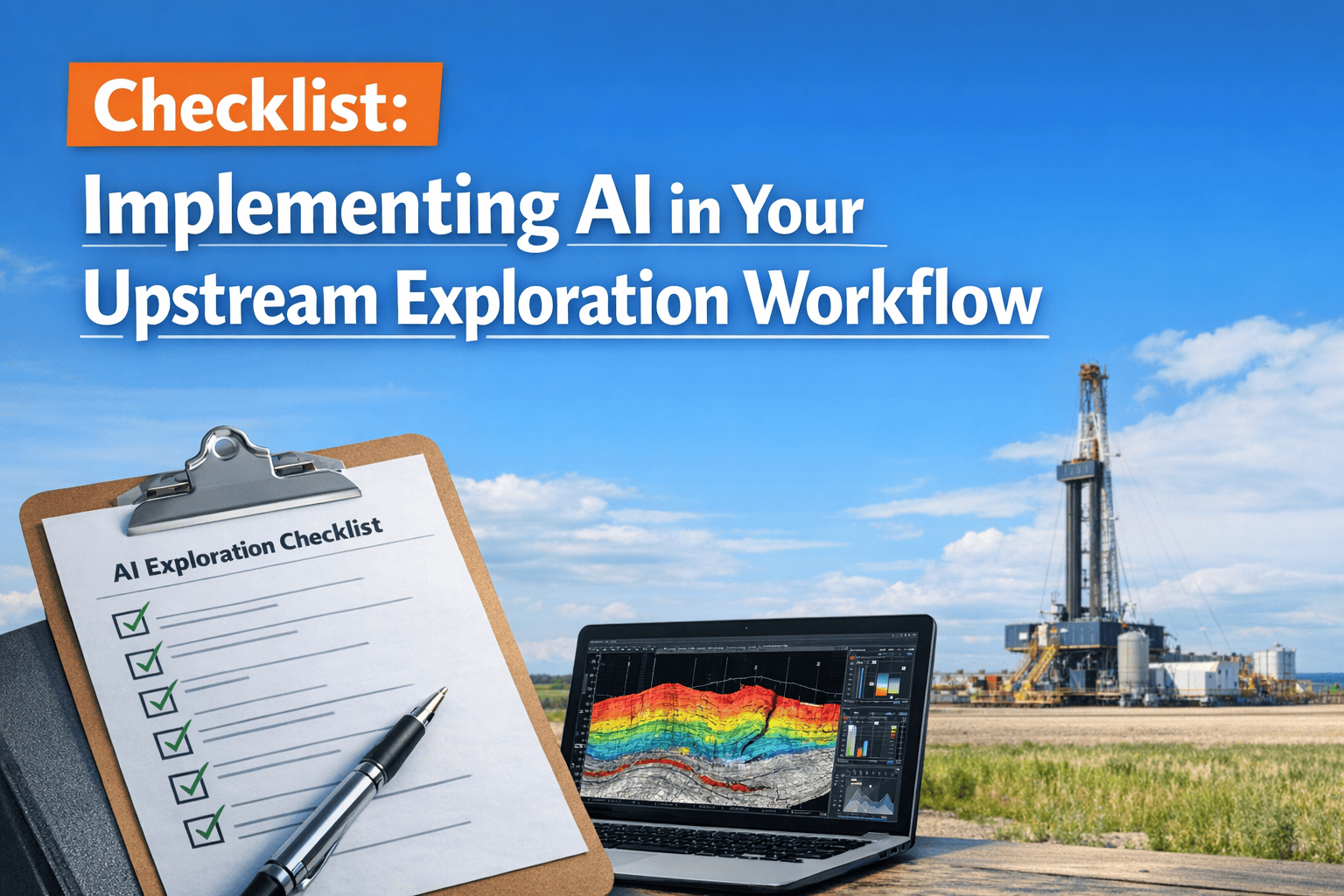
Checklist: Implementing AI in Your Upstream Exploration Workflow
By John Polus on April 10, 2026
Deploying AI in upstream exploration without structured implementation fails because data sits in incompatible formats, legacy systems cannot connect to ML models, and teams resist predictions they don't understand. Result: $200K AI software unused, drilling tools disconnected from LWD feeds, reservoir models clashing with workflows. iFactory provides step-by-step framework integrating with current systems, training on basin data, delivering results from seismic processing through drilling optimization. Book a demo to review implementation readiness.
Implementation Guide
Five critical phases: data readiness assessment, AI model training, system integration, pilot deployment, production rollout. Each includes requirements, timeline, metrics, and pitfalls to avoid. Reduces implementation from 9-12 months to 12-16 weeks with measurable exploration improvements from first deployment.
Phase 1: Data Readiness Assessment
AI requires structured data. Evaluate current inventory and identify gaps before model training.
Data Assessment
Verify Data AI-Ready Before Training
iFactory audits data identifying gaps, quality issues, integration needs. Receive readiness report with timeline and resource estimates.
QHow much historical data is required to train iFactory AI models for a new basin?
Minimum 15-20 wells with full log suites and production history, plus 3D seismic coverage. More data improves accuracy, but system generates useful predictions with limited datasets by leveraging global analogues. Optimal: 40+ wells, 5+ years production. Book a demo to assess readiness.
QCan iFactory integrate with existing seismic interpretation software like Petrel?
Yes, iFactory imports SEGY seismic, LAS well logs, interpretation projects from all major platforms via standard formats. AI processing happens in iFactory, results export back to existing tools. Teams can also perform all interpretation in iFactory and retire legacy licenses.
QWhat happens if AI prediction is wrong and well results differ significantly?
Prediction errors become training data for improvement. System analyzes why prediction missed actual result, identifies incorrect correlations, updates algorithm to avoid repeating error. Typical accuracy after 5-8 well learning cycle: 85-92% within tolerance. Early predictions have wider uncertainty that narrows as AI learns.
QDoes iFactory AI replace geologists and geophysicists?
AI augments human expertise by processing data volume impossible for manual analysis and flagging patterns experts might miss, but does not replace geological judgment. Geoscientists review recommendations, validate against regional knowledge, make final decisions. Platform increases productivity by eliminating repetitive tasks.
QHow long does typical deployment take from contract to first AI recommendations?
Most operators see first AI-generated drilling recommendations within 12-16 weeks: 3-4 weeks data integration, 4-5 weeks model training and validation, 3-4 weeks system integration and testing, 2-3 weeks pilot setup. Timeline varies based on data readiness and infrastructure complexity. Book a demo for timeline estimate.
Deploy AI in Upstream Exploration with Proven Implementation Framework
iFactory provides step-by-step guidance from data assessment through production rollout. Proven framework reduces implementation time from 9-12 months to 12-16 weeks with measurable results at each phase.