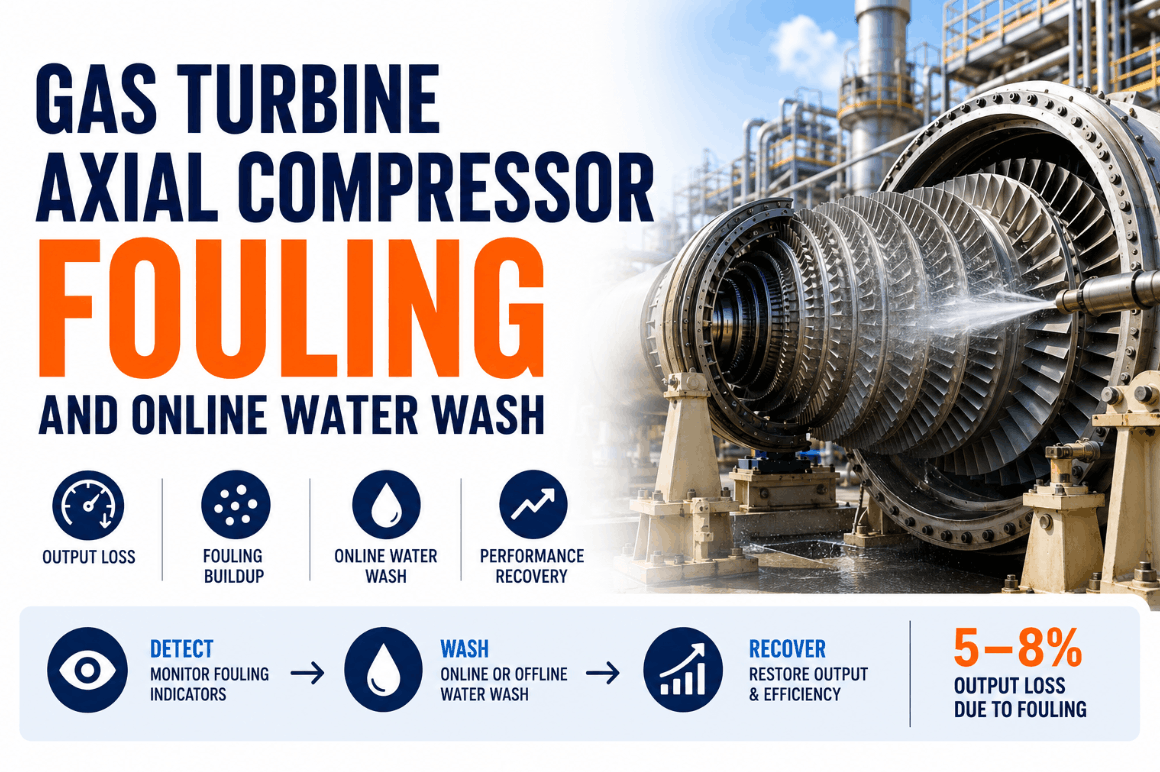
Axial compressor fouling is one of the most financially consequential and routinely underestimated performance losses in gas turbine operations. A fouled compressor section can silently strip 5–8% of rated turbine output over weeks of continuous service — costing U.S. power generators and industrial operators millions in lost generation capacity and excess fuel spend before a single alarm fires. The contamination accumulates progressively on inlet guide vanes and compressor airfoils through airborne particulates, hydrocarbon aerosols, salt, and humidity-borne deposits — each layer degrading the aerodynamic profile that the original design depended on. Understanding how fouling develops, how to detect it early, and how to execute both online and offline water wash protocols effectively is the difference between a gas turbine program that runs at design output and one that quietly bleeds EBITDA every operating hour. Book a Demo to see how iFactory's AI monitoring platform tracks fouling accumulation in real time.
How Axial Compressor Fouling Develops — and Why It Costs More Than You Think
Axial compressor fouling is not a single event — it is a continuous, cumulative process driven by the gas turbine's own intake airflow. Every cubic foot of inlet air carries a fraction of the ambient contaminant load into the compressor, where particulates smaller than 2 microns bypass even well-maintained inlet filtration systems and adhere to the leading edges and suction surfaces of rotating and stationary airfoils. Sticky fouling — caused by hydrocarbon aerosols, oil mist, pollen, and salt — is the most performance-damaging category because it actively captures additional dry particulates and accelerates deposit build-up over time.
The thermodynamic consequence is straightforward: as blade surface roughness increases and the effective airfoil profile shifts away from design geometry, the compressor's mass flow rate and isentropic efficiency both decline. For a 100 MW class gas turbine, a 3% efficiency loss in the axial compressor translates to approximately 2–3 MW of lost output capacity and a measurable increase in heat rate — compounding fuel cost penalties on top of generation shortfall. Industry data consistently places axial compressor fouling as the single largest contributor to recoverable gas turbine performance degradation, accounting for 70–85% of total field performance losses in service.
Fouling Indicators: How to Detect Compressor Degradation Before It Becomes Costly
Early fouling detection depends on continuous performance trending, not periodic manual inspection. The following key performance indicators — when trended against a corrected baseline — provide a reliable, quantitative picture of compressor fouling severity. Turbine operators who Book a Demo with iFactory typically discover that their existing sensor infrastructure already captures all the data points needed for AI-driven fouling monitoring — it simply is not yet connected to a platform capable of delivering the insights.
| Fouling Indicator | What It Measures | Fouling Signal | Detection Method | Severity Level |
|---|---|---|---|---|
| Compressor Inlet Depression | Pressure drop across inlet filter | Rising differential pressure trend | Differential pressure transmitter | Critical |
| Compressor Discharge Pressure | Pressure ratio vs. corrected speed | Below-baseline pressure ratio | Compressor discharge PT | Critical |
| Exhaust Temperature Spread | Combustor exit temperature profile | Elevated average exhaust temp | Thermocouple array | High |
| Corrected Mass Flow Rate | Airflow normalized to ISO conditions | Declining corrected flow vs. baseline | Inlet flow calculation / AI trending | Critical |
| Output Power at Constant Fuel | MW output vs. fuel flow | Declining MW at same heat input | Power meter + fuel flow meter | High |
| Compressor Isentropic Efficiency | Thermodynamic efficiency index | Deviation from design efficiency curve | Calculated from P, T sensors + AI | High |
| Vibration Signature (Airfoil) | Blade resonance and mass imbalance | Frequency shift from deposit mass | Proximity probes / accelerometers | Monitor |
Online vs. Offline Water Wash: Protocols, Conditions, and When to Use Each
Water wash is the primary and most cost-effective method for recovering gas turbine output lost to axial compressor fouling. Two distinct protocols serve different operational objectives — and selecting the wrong approach at the wrong time can result in incomplete fouling removal, thermal shock risk, or unnecessary production loss. Understanding the technical basis of each protocol is essential for any turbine reliability or operations team.
The Fouling Recovery Curve: Understanding Performance Before and After Water Wash
The fouling recovery curve describes the relationship between compressor fouling accumulation over time and the performance recovery achieved through online and offline wash cycles. Understanding this curve is essential for optimizing wash frequency and justifying maintenance intervals to plant management and asset owners.
Baseline Performance (Clean Compressor)
Following an offline crank wash with detergent, the compressor operates at or near design isentropic efficiency. This is the reference point against which all subsequent performance trending is measured. Establishing a clean-compressor baseline in iFactory's platform is the first step in AI-driven fouling management.
Initial Fouling Phase (0–500 Hours)
Performance degrades most rapidly in the first hours after a clean wash as the freshly cleaned surfaces develop their initial contamination layer. Output loss of 1–2% is common within the first week of continuous operation in dusty or humid environments. Online water wash, when started early in this phase, is most effective at limiting deposit adhesion.
Progressive Accumulation Phase (500–2,000 Hours)
Fouling accumulates at a more gradual rate as the initial layer acts as a base for additional deposits. Online washing during this phase maintains performance within 2–3% of baseline. Without online washing, output losses reach 4–6% and hardened deposit layers begin forming that online wash alone cannot fully remove.
Severe Fouling Threshold (>2,000 Hours Without Offline Wash)
Beyond 2,000 fired hours without an offline crank wash, baked-on deposits resist online washing entirely. Output losses reach 5–8% of rated capacity. Heat rate penalties compound fuel costs. At this stage, only an offline detergent crank wash can recover the lost performance — and even then, irreversible fouling pitting may limit full recovery.
Post-Offline Wash Recovery
A well-executed offline crank wash with OEM-approved detergent and proper soak cycles recovers 80–95% of fouling-induced losses, returning the compressor close to its baseline performance curve. AI-monitored post-wash performance trending in iFactory confirms wash effectiveness and resets the fouling accumulation clock for the next monitoring cycle.
Operational Gaps That Allow Fouling to Become a Financial Problem
Most gas turbine sites experiencing chronic output losses from compressor fouling share a consistent set of monitoring and process gaps. Identifying and closing these gaps — with AI-driven diagnostics support from iFactory — is the most direct path to sustained performance recovery. Operations teams that Book a Demo regularly uncover at least three of these gaps actively contributing to below-baseline turbine output.
"We were scheduling offline crank washes every 2,000 fired hours regardless of actual compressor condition. After deploying iFactory's performance trending module, we discovered that two of our GTs were losing 4% output by hour 900 due to high-humidity inlet conditions — while a third unit in a drier bay stayed clean past 2,500 hours. Condition-based wash scheduling, guided by real-time fouling indicators, reduced our total water wash costs by 28% and recovered an average of 3.2 MW per unit per year that we were previously losing silently."
— Gas Turbine Reliability Engineer, U.S. Combined-Cycle Power Plant
How iFactory AI Monitors and Manages Gas Turbine Compressor Fouling
iFactory's industrial AI platform provides the continuous performance monitoring, fouling indicator trending, and wash effectiveness verification that gas turbine operators need to manage compressor health proactively. By connecting compressor inlet, discharge, and exhaust sensor data into a unified analytics layer, iFactory automatically calculates corrected performance deviations and generates fouling accumulation alerts with sufficient lead time for planned wash scheduling — before output loss becomes financially material.
Real-Time Fouling Index Calculation
iFactory continuously calculates a corrected compressor performance index from pressure ratio, inlet temperature, and mass flow data — generating a live fouling severity score that eliminates ambient condition noise and reflects true compressor health at any operating point.
Condition-Based Wash Scheduling
Replace fixed-interval wash schedules with AI-driven recommendations based on actual fouling accumulation rate. iFactory generates wash recommendations with enough lead time to plan shutdown windows and procure wash fluids — eliminating both premature washing and costly over-fouling events.
Post-Wash Recovery Verification
Every offline and online wash cycle is automatically evaluated against the pre-wash performance baseline. iFactory quantifies MW recovery achieved, identifies incomplete washes, and documents wash effectiveness in a permanent digital record linked to the unit ID and fired hours.
Inlet Condition Correlation
iFactory correlates fouling accumulation rate with ambient humidity, ambient temperature, and inlet air quality data — allowing operators to adjust online wash frequency dynamically based on environmental conditions rather than fixed calendar intervals.
Conclusion: From Reactive Washing to Predictive Compressor Health Management
Axial compressor fouling will always be a feature of gas turbine operation — but the 5–8% output loss and chronic fuel efficiency penalties it causes are not. The technical tools to monitor fouling accumulation continuously, execute online water wash precisely, and verify offline crank wash effectiveness completely are available and proven. What has historically been missing is the unified analytics platform to connect compressor sensor data, fouling indicators, wash records, and performance trending into a single, actionable intelligence layer.
iFactory provides exactly that infrastructure — purpose-built for the monitoring complexity and operational demands of gas turbine reliability programs. Sites that adopt AI-driven fouling management consistently recover 2–4 MW per unit per year in previously invisible output losses, reduce total water wash costs through condition-based scheduling, and build the documented performance history needed to support major maintenance planning decisions with real data. The path to sustained compressor performance begins with visibility. Book a Demo with iFactory today and benchmark your current fouling management program against a proven industrial AI architecture.
Frequently Asked Questions: Gas Turbine Axial Compressor Fouling
How much output does axial compressor fouling typically cause a gas turbine to lose?
Fouling typically causes 5–8% output loss in continuously operating gas turbines, with the highest degradation rates seen in humid, coastal, or industrially contaminated inlet environments where sticky hydrocarbon and salt aerosols accelerate deposit formation.
What is the difference between online water wash and offline crank wash?
Online washing injects atomized demineralized water at full operating speed to slow fouling accumulation without shutdown, while offline crank wash uses water and detergent at motoring speed after shutdown to fully remove hardened deposits and restore near-baseline compressor performance.
How does iFactory detect compressor fouling before it becomes a significant performance loss?
iFactory continuously calculates a corrected performance index from compressor inlet, discharge, and exhaust sensor data, automatically detecting deviation from the clean-compressor baseline and generating fouling alerts with lead time sufficient for planned wash scheduling.
Can iFactory integrate with existing gas turbine control systems and historians?
Yes — iFactory connects to OPC-UA, Modbus, and standard process historians to pull existing GT sensor data, requiring no new instrumentation in most cases and allowing fouling monitoring deployment within days of platform activation.
How does condition-based wash scheduling reduce maintenance cost compared to fixed-interval washing?
By triggering offline washes based on actual fouling severity rather than calendar dates, condition-based scheduling eliminates premature washes on clean units and prevents over-fouling on high-rate units — reducing total wash events and water consumption by an average of 20–30% across a turbine fleet.