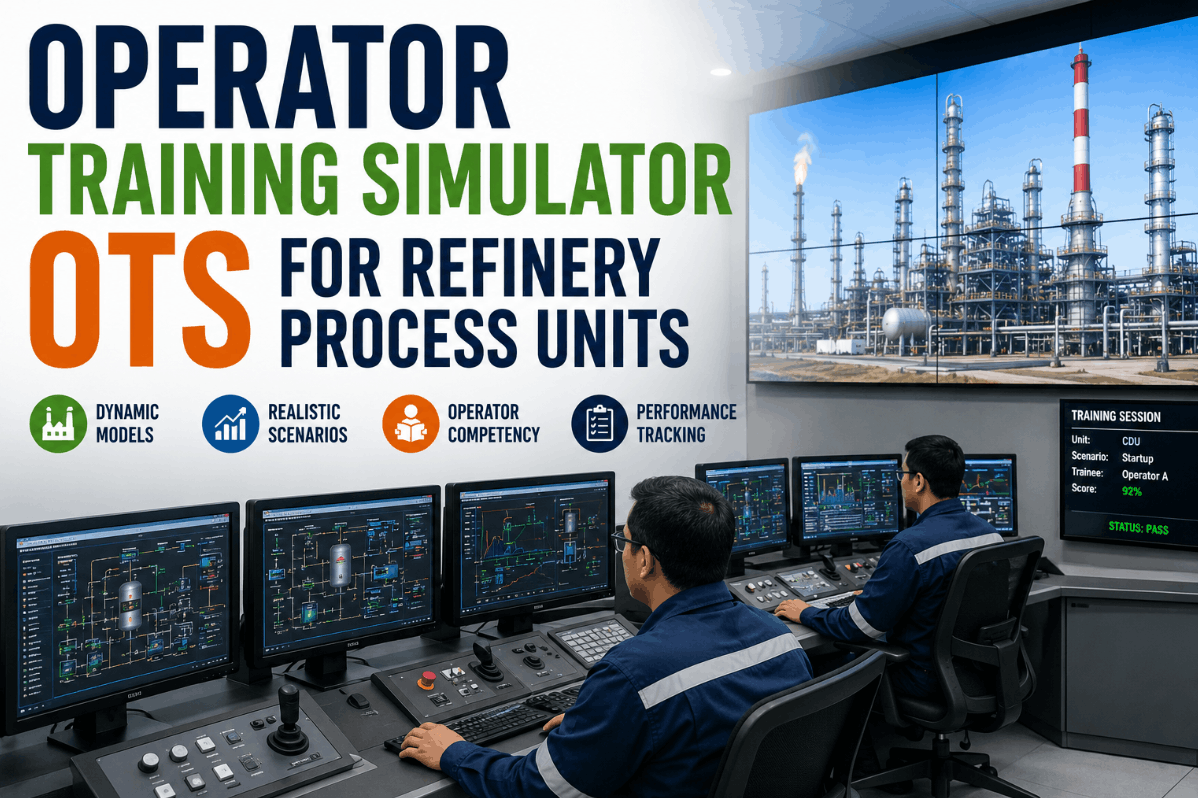
Operator training simulator (OTS) programs for refinery process units are redefining how U.S. facilities close the gap between classroom theory and live-console readiness. In an industry where 90–95% of plant accidents trace back to human factors, the cost of putting an undertrained operator in front of a CDU, FCC, or hydrocracker console is measured in unplanned shutdowns, flaring events, and — at worst — catastrophic incidents. As workforce demographics shift and experienced board operators retire, maintenance and operations leaders who Book a Demo with iFactory are finding that AI-augmented OTS platforms can compress operator qualification timelines by 40% while building verifiable, scenario-tested competency records for every process unit.
Build Verified Operator Competency Before a Live Unit Pays the Price
iFactory delivers dynamic OTS modeling, curated scenario libraries, and real-time competency tracking — purpose-built for CDU, FCC, hydrocracker, and reformer operations.
Why Refinery Process Units Can No Longer Rely on On-the-Job Learning
The traditional model of training new board operators through observation, shadowing, and incremental live-console exposure worked when tenured operators were the majority of a shift crew. That model is breaking down. As experienced personnel retire, refineries face a structural knowledge gap — one that calendar-based refresher programs and static procedure manuals cannot adequately fill. An OTS resolves this by replicating the exact dynamic behavior of a CDU, FCC unit, or delayed coker, including the nonlinear process responses that only emerge during startup, feed-rate transitions, or off-spec upsets. Operations leads building formal competency programs often begin by scheduling time to Book a Demo and map their current training gaps against what an AI-integrated OTS platform can close.
The financial stakes are significant. Industry estimates place startup-related savings from OTS-trained operators at $300,000 to $400,000 per event — a figure driven by eliminating delayed startups, reducing flaring, and avoiding the quality giveaway that comes with operators making slow decisions on a live unit. Beyond economics, regulatory pressure from OSHA PSM, EPA RMP, and API RP 755 increasingly expects facilities to demonstrate that operators have been formally evaluated on abnormal operating conditions — not just trained on paper.
Knowledge Transfer Gap
Retiring operators carry 20–30 years of implicit process knowledge. OTS captures and transfers that knowledge through scenario libraries built from real historical upsets, not generic templates.
Slow Upset Recovery
Without practiced responses, operators take longer to stabilize abnormal situations — extending flaring events, risking product quality exceedances, and increasing equipment stress on critical rotating assets.
No Competency Measurement
Traditional programs lack objective scoring. An OTS tracks every trainee action — decision timing, valve sequencing, alarm acknowledgment — to produce a defensible competency record that satisfies PSM audits.
Startup & Shutdown Risk
Startup and shutdown are the highest-risk operating phases. ARC research confirms startup training is the single greatest benefit operators derive from OTS, with measurable reductions in flaring and equipment stress.
What a High-Fidelity Process Unit OTS Must Deliver
An effective OTS for refinery process units goes well beyond a basic screen emulation. It must replicate thermodynamic behavior, control system response, and process dynamics with enough fidelity that operators develop genuine muscle memory for transitions and upsets. iFactory's OTS platform is built around three interconnected modules that address the full training lifecycle — from initial qualification to ongoing recertification. Reliability teams building out this infrastructure frequently Book a Demo to review how the platform maps to their unit-specific P&IDs and existing DCS environment.
Module 1 — High-Fidelity Dynamic Process Modeling
iFactory builds first-principles dynamic models using rigorous thermodynamic and fluid flow calculations — not simplified approximations. The simulation captures the actual transient behavior of crude distillation overhead systems, FCC main fractionators, and reformer charge heaters. When an operator adjusts a setpoint or opens a bypass, the model responds the way the real unit would, with the same lag, the same feed-forward interactions, and the same potential to cascade into a broader upset if not corrected promptly.
Module 2 — Scenario Library and Malfunction Injection
The scenario library covers the full operational envelope: cold startup from turnaround, hot restart after emergency shutdown, planned shutdown sequencing, and a curated set of process upsets drawn from actual refinery incident reports. Instructors can inject malfunctions — a fouled heat exchanger, a failing level transmitter, a compressor surge — at any point in the simulation without interrupting the trainee's session. Every scenario is logged with time-stamped operator actions, enabling post-exercise debriefs that are specific and evidence-based rather than subjective.
Module 3 — Operator Competency Tracking and Certification
iFactory's competency engine scores every training session against a defined performance matrix: response time to alarms, correct sequencing of startup steps, adherence to safe operating limits, and recovery time from injected upsets. Scores are aggregated into individual operator profiles that maintenance supervisors and training coordinators can review at any time. This creates an auditable competency trail that satisfies PSM audit requirements and provides the factual basis for determining when an operator is ready for independent console qualification.
How OTS-Based Training Compares to Conventional Operator Development
The difference between OTS-trained and conventionally trained operators becomes most apparent during non-routine events. Traditional programs build declarative knowledge — operators know what to do in theory. OTS programs build procedural competency — operators have practiced doing it, under realistic time pressure, enough times that the correct response is instinctive. Operations managers who have evaluated this transition can connect with the iFactory team to Book a Demo and review side-by-side outcome data from comparable refinery units.
| Training Dimension | Traditional Approach | OTS-Integrated Approach | Operational Impact |
|---|---|---|---|
| Startup Preparation | Procedure review + shadowing on live unit | Repeated full startup simulations with timed scoring | 30–40% faster first independent startup |
| Upset Response | Classroom case study; no hands-on practice | Live malfunction injection; real-time decision pressure | Faster recovery; reduced flaring duration |
| Shutdown Sequencing | Paper walkthrough; minimal repetition | Instructor-led dynamic shutdown with deviation injection | Zero missed isolation steps in post-OTS audits |
| Competency Measurement | Supervisor judgment; no objective data | Automated scoring; timestamped action records | Defensible PSM audit trail per operator |
| Knowledge Retention | Decays rapidly without live-unit repetition | Scheduled recertification scenarios maintain recall | Sustained competency across shift rotations |
| New Unit Commissioning | Operators train on a live unit at first feed | Full commissioning rehearsal months before first feed | Documented flawless startup outcomes at multiple sites |
Deploying an OTS Program Across Refinery Process Units
A structured OTS deployment moves through four phases — from model development and DCS integration to active training delivery and continuous improvement. The timeline varies with unit complexity, but most CDU-level deployments reach full training operation within 12–16 weeks. Organizations finalizing their phase plan often Book a Demo to align the iFactory implementation approach with their existing CMMS and training management systems.
Dynamic Model Development
iFactory engineers build the process model from P&IDs, equipment datasheets, and heat and material balances. The model is validated against steady-state plant data and tuned for transient accuracy before any training begins.
DCS Integration & Control Logic Mapping
The simulation interfaces with an emulation of the site's DCS — supporting Honeywell Experion, Yokogawa CENTUM, Emerson DeltaV, and ABB 800xA environments — so trainees interact with the exact control graphics and alarm structures they will use on the live unit.
Scenario Library Build & Instructor Qualification
Site-specific scenarios covering startup, shutdown, emergency shutdowns, and a minimum of 15 documented process upsets are built into the instructor station. Training coordinators complete instructor qualification before the operator cohort begins sessions.
Operator Training Delivery & Competency Certification
Operators complete structured training sessions with iFactory's competency engine scoring each run. Supervisors access the live dashboard to track qualification status, identify skill gaps, and schedule recertification for experienced personnel on an annual or event-driven basis.
Measurable Results from OTS-Trained Refinery Operator Programs
Refineries that shift from conventional training to structured OTS programs report measurable improvements across the metrics that operations and HSE leadership track most closely. The results below reflect 90-day post-certification outcomes across iFactory-supported process unit deployments.
"Before we deployed iFactory's OTS on our crude unit, new board operators were spending 12–18 months on observation before we were comfortable giving them independent console time. The dynamic model let us run 40 startup scenarios in 8 weeks. By the time our operators qualified, they had handled more upsets in simulation than most experienced operators see in two years of live operation. Our first post-OTS startup was the cleanest we've had in over a decade."
Operator Training Simulator OTS — Frequently Asked Questions
What process units can iFactory's OTS model for refinery training?
iFactory supports CDU/VDU, FCC, hydrocracker, catalytic reformer, delayed coker, amine treating, and associated utility systems — built from your actual P&IDs and heat and material balances for unit-specific accuracy.
How does the OTS connect to our existing DCS?
iFactory integrates with emulations of all major DCS platforms — Honeywell Experion, Yokogawa CENTUM, Emerson DeltaV, and ABB 800xA — via OPC-UA, so operators train on the exact console graphics and alarm management interface they use in the control room.
Can the OTS be used for experienced operator recertification, not just new hires?
Yes — experienced operators use the OTS for periodic recertification on startup, emergency shutdown, and major upset scenarios, maintaining proficiency on situations that may occur infrequently on the live unit.
How does iFactory's competency tracking satisfy PSM audit requirements?
The platform produces time-stamped action logs, scenario scores, and qualification certificates for each operator — providing the objective, auditable training records that OSHA PSM and API RP 755 compliance reviews expect.
What is the typical deployment timeline for a CDU-level OTS?
Most CDU deployments reach full training operation in 12–16 weeks, covering dynamic model validation, DCS integration, scenario library build, and instructor qualification before the first operator cohort begins sessions.
Qualify Your Operators Before the Live Unit Tests Them
iFactory's OTS platform delivers high-fidelity process unit simulations, curated upset scenario libraries, and automated competency scoring — built for refineries that cannot afford undertrained console operators.