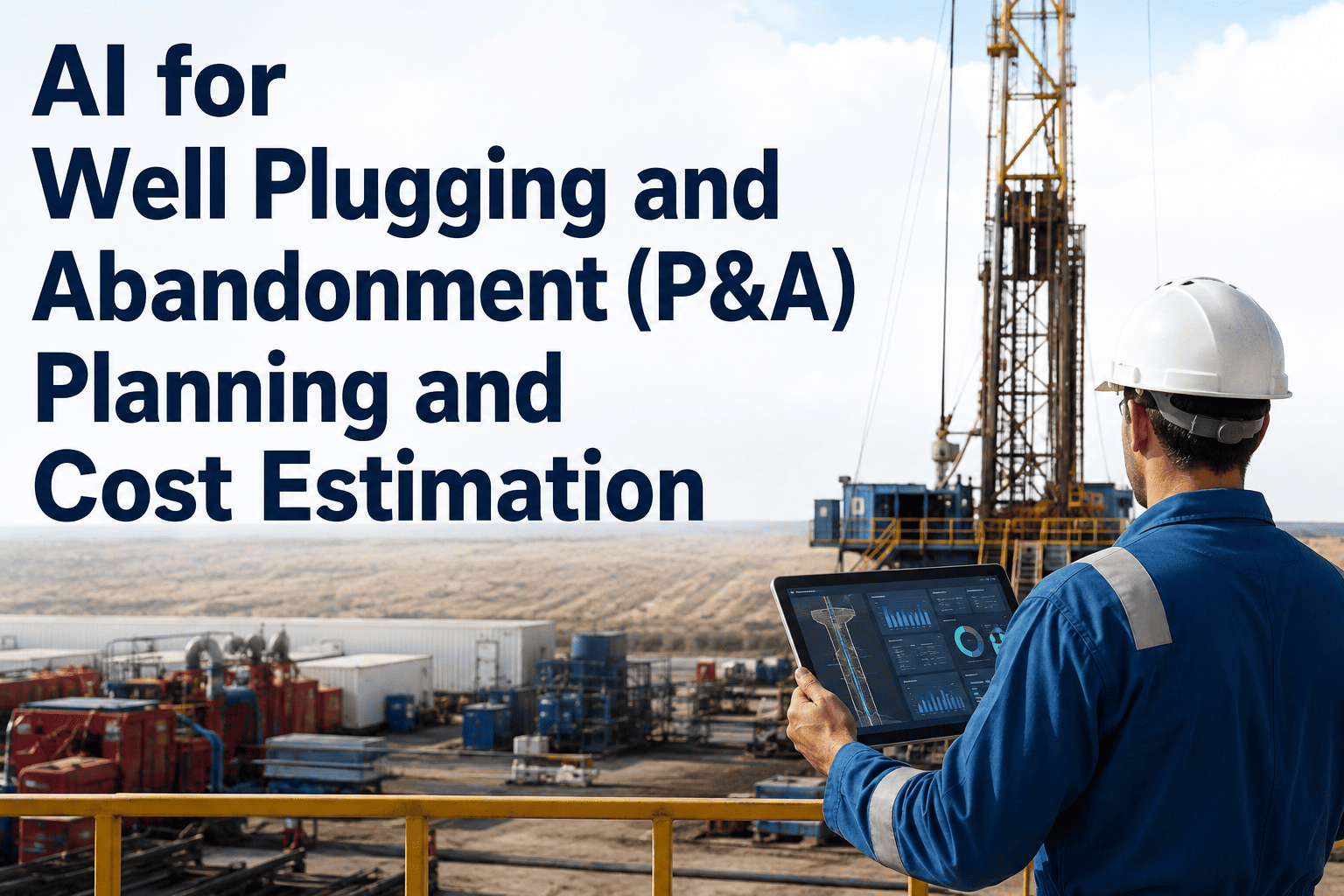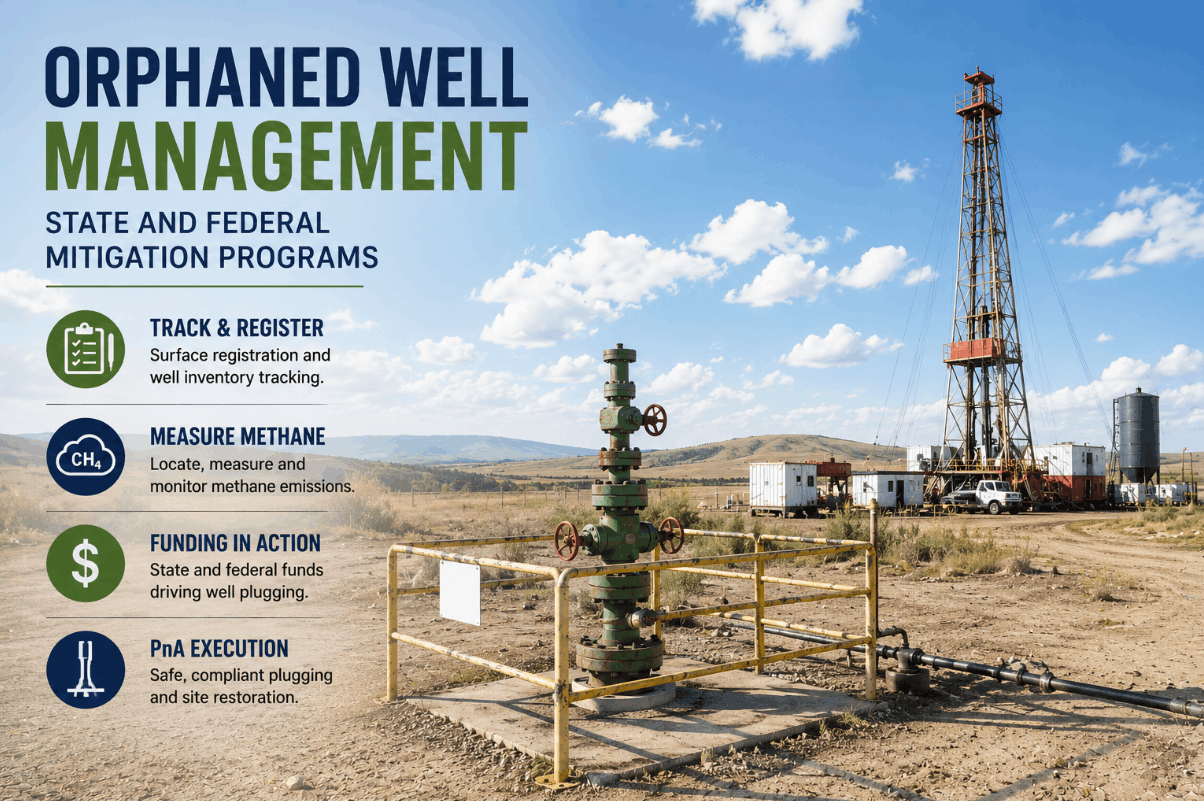
Three million abandoned oil and gas wells are scattered across the United States — from century-old Appalachian fields to depleted Gulf Coast formations — leaking methane, contaminating aquifers, and creating liability exposure that no active operator will ever shoulder. The scale of this challenge reshaped federal energy policy in 2021 when the Bipartisan Infrastructure Law directed $4.7 billion toward plugging, remediating, and restoring orphaned well sites across state, tribal, and federal lands. For oil and gas operators, environmental compliance teams, and state regulators now managing well inventory under tightening federal grant requirements, the operational challenge has shifted from securing funding to executing at scale — tracking surface registration, coordinating methane measurement protocols, sequencing plug and abandonment work, and documenting every step in a way that satisfies federal reporting requirements and positions states for continued grant access. This guide covers the full operational framework for orphaned well management and mitigation under current state and federal programs.
The Scale of the Problem: Why Orphaned Well Management Has Become a Federal Priority
An orphaned well is a well whose operator is unknown, insolvent, or otherwise unable to fulfill plugging and reclamation obligations. The Interstate Oil and Gas Compact Commission estimates the U.S. orphaned well population at between 310,000 and 800,000 wells, with the total abandoned well inventory — plugged and unplugged — approaching 3.7 million sites. These wells are not evenly distributed: the highest concentrations are in Texas, Pennsylvania, Kansas, and West Virginia, with significant clusters across the Gulf Coast, Appalachian basin, and Rocky Mountain states. The methane exposure from this inventory is material. In 2021, the EPA estimated that fugitive methane emissions from abandoned U.S. wells reached 295 kilotons — equivalent to approximately 8.2 million metric tons of CO₂, the highest uncertainty range of any major methane source in the national inventory. The IIJA's $4.7 billion investment represents the federal government's recognition that voluntary market mechanisms and state-level bonding frameworks alone have been insufficient to address the liability accumulation from decades of under-bonded oil and gas development.
Federal and State Program Structure: How the Funding Flows
The IIJA's orphaned well funding is administered through the Department of Interior's Orphaned Wells Program Office (OWPO) and distributed across three distinct program tiers — each with different eligibility criteria, reporting requirements, and grant performance conditions. Understanding the structure matters operationally because grant compliance documentation requirements differ by program tier, and operators and state agencies managing multi-source funding need tracking systems that can distinguish and report against each funding stream separately. Book a Demo to see how iFactory AI structures multi-source compliance tracking for orphaned well programs.
Operational Execution: Surface Registration, Methane Measurement, and PnA Sequencing
For state agencies and operators executing plugging programs under IIJA grants, the operational challenge is not funding — it is execution management at scale. A state with an inventory of 5,000 high-priority wells and a multi-year grant commitment needs to coordinate surface registration, methane pre-measurement, contractor mobilization, PnA execution, post-plug verification, and site reclamation across hundreds of concurrent work orders. Each stage generates documentation that must satisfy BIL Section 40601 reporting requirements and feed into the OWPO grant performance database. Without structured workflow tracking, the compliance documentation burden alone consumes resources that should be directed at field execution. Book a Demo to see iFactory AI's orphaned well workflow management in detail.
Methane Measurement Compliance: What Federal Guidelines Actually Require
The DOI-DOE joint methane measurement guidelines — released in 2023 and subject to ongoing revision under BIL requirements — establish the specific protocols that state programs must follow to document methane emission reductions for grant performance reporting. These guidelines are more operationally demanding than many state programs initially anticipated, and gaps in measurement documentation have become a common source of grant performance risk for states managing large plugging portfolios. Understanding what compliance actually requires at the field level is essential for any operator or state agency that wants to access Performance Grant funding beyond the initial formula allocation.
- Pre-plug measurements conducted without documenting atmospheric conditions required by DOI guidelines
- Measurement data stored in disconnected spreadsheets not linked to well registration records
- Post-plug verification delayed or skipped on wells showing low pre-plug emission rates
- Methane reduction calculations not following EPA Subpart W methodology where required
- No systematic tracking of undocumented wells discovered during field campaigns — creating inventory gaps in grant reporting
- Pre-plug measurement checklists enforced per well before PnA work order release — no gaps in the sequence
- Measurement data linked directly to well registration record — no disconnected data stores
- Post-plug verification scheduled automatically for every plugged well, regardless of pre-plug emission classification
- CO₂-equivalent reduction calculations follow applicable protocol per well type and state — traceable to source data
- Newly discovered undocumented wells entered into inventory in real time — grant reporting always reflects actual field inventory
State Program Performance Benchmarks: Who Is Leading and What the Data Shows
State program performance varies considerably across the OWPO grant portfolio. Texas, Pennsylvania, Oklahoma, and Utah have emerged as high-volume plugging states with strong execution records. As of early 2025, Texas had plugged approximately 650 wells using state funds plus 64 additional wells under Phase 1 Formula Grant money in FY2025 alone — and was the first state to have the Inspector General confirm full compliance with Initial Grant expenditure requirements. Oklahoma had plugged more than 40 wells under the federal program while estimating a remaining remediation liability of $574 million to clear its full orphan inventory. Pennsylvania plugged its 300th well in March 2025. The data emerging from the OWPO state reporting system reveals an important pattern: plugging velocity is limited less by funding and more by the administrative throughput of individual state programs — the speed at which wells can be registered, measured, contracted, and closed out through grant reporting systems.
| State | Program Status (Early 2025) | Key Performance Metric | Remaining Estimated Liability | Primary Funding Source |
|---|---|---|---|---|
| Texas | Phase 1 Formula Grant active; Inspector General compliance confirmed | 650+ wells plugged (state funds) + 64 federal grant wells FY2025 | Large inventory; ongoing multi-year program | State fund + $79.67M Phase 1 Formula Grant |
| Pennsylvania | Active plugging under Initial and Formula grants | 300th well plugged March 2025; 14 additional wells planned H1 2025 | Century-old Appalachian inventory; estimated 200,000+ legacy wells | IIJA Initial Grant + Formula Grant tranches |
| Oklahoma | Active; post-grant funding options under review | 40+ wells plugged under federal program as of Q1 2025 | $574 million estimated to clear full state orphan inventory | IIJA grants + Environmental Liability Tax consideration |
| Utah | Active plugging program | 64 wells plugged under BIL program as of early 2025 | Active inventory; Rocky Mountain cluster | IIJA Formula Grant |
| Kansas | Near inventory clearance — program model | Plugged nearly all documented orphan wells in state inventory | Minimal remaining documented inventory | State fund + IIJA supplemental |
Expert Perspective: What Execution Bottlenecks Actually Look Like at Scale
We had the grant funding approved and the contractor pool under IDIQ. What we did not have was a system that could tell us, at any point in time, exactly how many wells in our priority inventory had completed pre-plug methane measurement, how many had pending work orders, and how many had completed plugging but were still waiting on post-plug verification before we could count them in our quarterly federal report. That gap — between wells physically plugged and wells fully documented for reporting — was running at about 18 percent of our completed work at any given time. That 18 percent was sitting in someone's spreadsheet, not in the grant performance system, and it was creating a persistent lag between our actual plugging rate and our reported rate that we could never fully explain to the program office. When we implemented a centralized workflow tracking platform, that backlog cleared in the first reporting cycle and stayed cleared. The documentation compliance is actually the harder operational challenge than the field work itself.
Frequently Asked Questions: Orphaned Well Management Programs
An orphaned well's operator is unknown or insolvent with no responsible party available to fund plugging, while an abandoned well may have a known operator who has ceased production. Federal IIJA grant eligibility is specifically tied to the orphaned classification — documented operator insolvency or absence is required for well sites to qualify for BIL plugging funds.
DOI methane measurement guidelines under BIL Section 40601 require pre-plug measurements to document emission reductions across the program — not only for confirmed high-emitters. States that skip measurements on low-priority sites risk compliance gaps in grant performance reporting, since the OWPO tracks verified methane reduction as a core program outcome metric.
iFactory AI connects to existing state oil and gas commission databases, GIS well location systems, and L2/L3 data environments via standard API integrations — ingesting well inventory data without requiring states to migrate away from their existing regulatory platforms. Integration timelines are typically two to four weeks, and a data readiness assessment is available at no cost before any commitment.
States with strong internal program infrastructure — documented well inventories, contractor IDIQ vehicles, and established measurement protocols — are better positioned to continue plugging activity using state fund appropriations, operator bond pools, and Environmental Liability Tax revenues while federal funding uncertainty resolves. Program continuity depends on operational readiness, not just funding access.
Yes — ACR has published a first-of-kind methodology for quantifying GHG emission reductions from orphaned well plugging, enabling carbon credit generation that can finance plugging activity beyond BIL grant allocations. For this pathway to be credible, methane measurement pre- and post-plug must follow a verifiable, auditable protocol — which requires exactly the data infrastructure that platforms like iFactory AI provide.
Conclusion: Execution Infrastructure Determines Program Outcomes
The United States has committed a historic level of public investment to address the orphaned well liability that accumulated across more than a century of oil and gas development. The funding architecture is in place. The regulatory framework for methane measurement and grant performance reporting is established. What determines whether states and operators actually close the gap between the documented inventory and a plugged, reclaimed well site is execution infrastructure — the systems, workflows, and data disciplines that convert grant dollars into documented methane reductions and cleared well sites at the pace required to meet OWPO performance milestones and access subsequent funding tranches.
iFactory AI's orphaned well management platform provides the operational visibility layer that state agencies and operators need to manage plugging programs at scale without losing compliance documentation integrity. From the first surface registration record to the final grant closeout package, every stage of the PnA workflow is tracked, linked, and reportable against federal grant performance requirements. The wells are out there. The money is allocated. The bottleneck is operational — and that is a solvable problem. Book a Demo to see how iFactory AI eliminates the documentation gaps that are limiting your program's reported throughput.