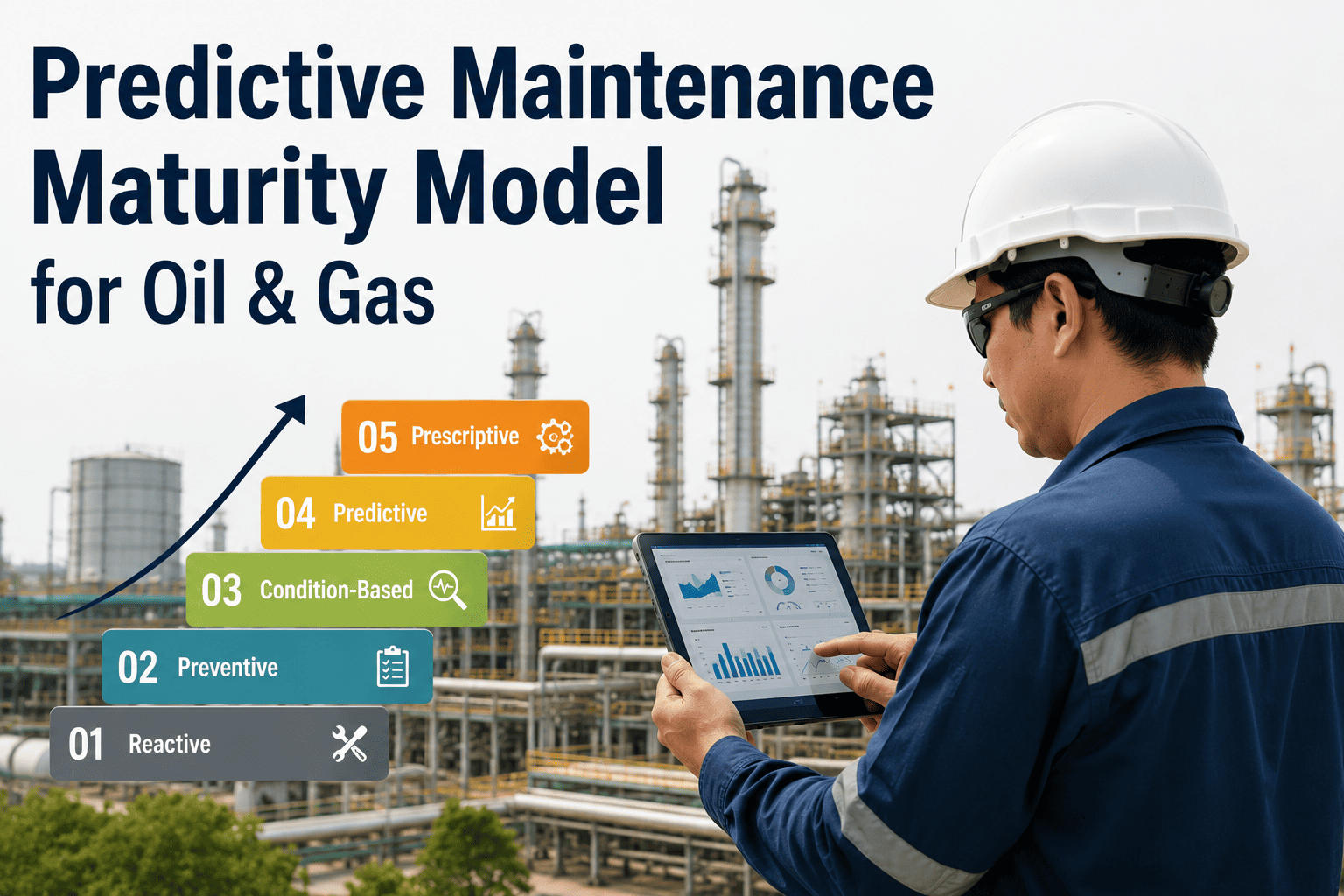
Ask three people at the same plant to describe their maintenance program's maturity and you'll often get three different answers, one based on the technology they've bought, one based on what's written in the procedures, and one based on how maintenance actually gets done on a Tuesday afternoon. A maturity model gives everyone a shared reference point: five defined levels, from purely reactive to fully prescriptive, that make it possible to honestly assess where a program actually sits today, and if you want an outside read on your current level, a short assessment call is a useful starting point.
The Predictive Maintenance Maturity Model for Oil & Gas
Five levels separate a plant that fixes things after they break from one that predicts and prevents failure before it happens. Here's how to find your organization's real position on that ladder.
The Five Levels of Maintenance Maturity
Reactive
Equipment runs until it fails, then gets repaired. There's no scheduled maintenance program to speak of, and unplanned downtime is treated as an unavoidable cost of doing business rather than a preventable pattern.
Preventive
Maintenance happens on fixed time or usage intervals regardless of actual equipment condition. This reduces surprise failures compared to purely reactive work but often means replacing parts that still had useful life left.
Condition-Based
Sensors and inspections monitor actual equipment condition, vibration, temperature, oil analysis, and maintenance triggers when a measured parameter crosses a defined threshold rather than on a fixed calendar.
Predictive
Machine learning models analyze condition data trends to forecast when a failure is likely to occur, giving maintenance teams a genuine time window to plan repairs before the equipment actually fails.
Prescriptive
The system doesn't just predict failure, it recommends specific corrective actions, optimal timing, and resource allocation, integrating maintenance planning directly with production scheduling and spare parts availability.
Why Most Plants Sit Between Levels
Very few plants cleanly occupy a single level across their entire asset base. It's common to find critical rotating equipment monitored at a condition-based or even predictive level, while balance-of-plant assets like conveyors, tanks, or utility systems remain firmly preventive or reactive. This unevenness isn't necessarily a problem, it often reflects a reasonable prioritization of monitoring investment toward the equipment where failure consequences are highest. The maturity model is most useful as a diagnostic tool for identifying where that prioritization does and doesn't match actual risk, rather than as a target to uniformly max out across every asset.
Find Out Where Your Program Actually Stands
A short assessment maps your current maintenance practices against the five maturity levels and identifies the highest-value next step for your specific asset mix.
What Changes at Each Level
| Level | Trigger for Maintenance | Typical Downtime Pattern |
|---|---|---|
| Reactive | Equipment failure | Frequent, unplanned, high severity |
| Preventive | Fixed time or usage interval | Reduced surprises, some unnecessary work |
| Condition-Based | Measured parameter threshold | Fewer unplanned events, targeted work |
| Predictive | Forecasted failure probability | Mostly planned, scheduled around production |
| Prescriptive | Optimized recommendation | Fully integrated with operations planning |
Questions That Reveal Your Real Level
Data Availability
Do you have continuous condition data on critical assets, or does anyone have to physically walk the floor to know equipment health?
Planning Horizon
When maintenance happens, is it scheduled weeks in advance, or is it a same-day response to something that just broke?
Decision Basis
Are maintenance decisions based on calendar intervals, measured condition, or a forecasted probability of failure?
Cross-Functional Integration
Does maintenance planning connect to production scheduling and spare parts availability, or does each function operate independently?
Building a Roadmap From Your Current Level
The path from reactive to predictive isn't a single leap, and trying to skip levels usually creates more problems than it solves. A plant with no condition monitoring infrastructure that jumps straight to buying predictive analytics software often finds the models have nothing reliable to learn from, since there's no clean historical condition data to train against. Moving through condition-based monitoring first, even briefly, builds both the data foundation and the organizational trust in sensor data that predictive analytics depends on.
A realistic roadmap typically starts by identifying the highest-consequence assets still sitting at reactive or preventive levels, since that's where advancing maturity delivers the fastest, most defensible return. From there, condition monitoring gets deployed, a data history accumulates, and predictive models get layered on once there's enough historical data to train against with confidence.
A Realistic Scenario
Consider a midstream operator running a mixed maintenance program, with compressors monitored at a solid condition-based level while a significant share of balance-of-plant equipment remained on fixed preventive schedules. A maturity assessment revealed that several pump assets with meaningful failure consequences had never been prioritized for condition monitoring, largely because attention had concentrated on the compressors as the most visibly critical equipment.
Extending condition monitoring to the identified pump assets, and building six months of clean baseline data before attempting predictive modeling, moved that equipment category from preventive to condition-based within a single budget cycle, with a predictive pilot beginning the following year once sufficient historical data existed. The maturity model gave the reliability team a concrete way to communicate this plan to leadership, rather than presenting a vague request for more monitoring technology without a clear justification tied to actual asset risk.
Frequently Asked Questions
How do we determine which maturity level we're actually at?
A structured assessment typically reviews maintenance trigger criteria, data availability, and planning practices across major asset categories, since maturity often varies significantly between critical and non-critical equipment. Rather than assigning a single plant-wide score, a useful assessment maps maturity per asset class, which reveals where the biggest gaps between risk and current practice actually sit.
Is it possible to skip levels and go straight to predictive maintenance?
Technically possible but rarely advisable, since predictive models depend on clean historical condition data that condition-based monitoring naturally generates as a byproduct. Attempting predictive analytics without that data foundation usually produces unreliable forecasts, which damages organizational trust in the approach before it's had a fair chance to prove itself.
How long does it typically take to advance one full maturity level?
This varies significantly by asset count and existing infrastructure, but moving a meaningful share of critical assets from preventive to condition-based typically takes six months to a year, factoring in sensor deployment, data validation, and building operator trust in the new triggers. Advancing further to predictive maturity usually requires at least six to twelve months of accumulated condition data before models can forecast reliably.
Does higher maturity always mean better ROI?
Not universally, since the cost of monitoring and analytics infrastructure needs to be weighed against the actual consequence of failure for each asset category. A low-criticality asset with minimal failure impact may never justify the investment required to reach predictive maturity, and staying at a preventive level for such equipment can be the economically sound choice. You can review your specific asset prioritization through support.
What's the most common mistake plants make when advancing maturity?
Underinvesting in data quality and organizational change management while overinvesting in analytics software. A sophisticated predictive model delivers little value if the underlying sensor data is unreliable, or if maintenance planners don't trust or act on its recommendations. Discussing your specific starting point on a scoping call can help avoid this common pitfall.
Map Your Path to Predictive Maturity
Get a clear, asset-by-asset picture of where your maintenance program actually stands, and what the highest-value next step looks like.