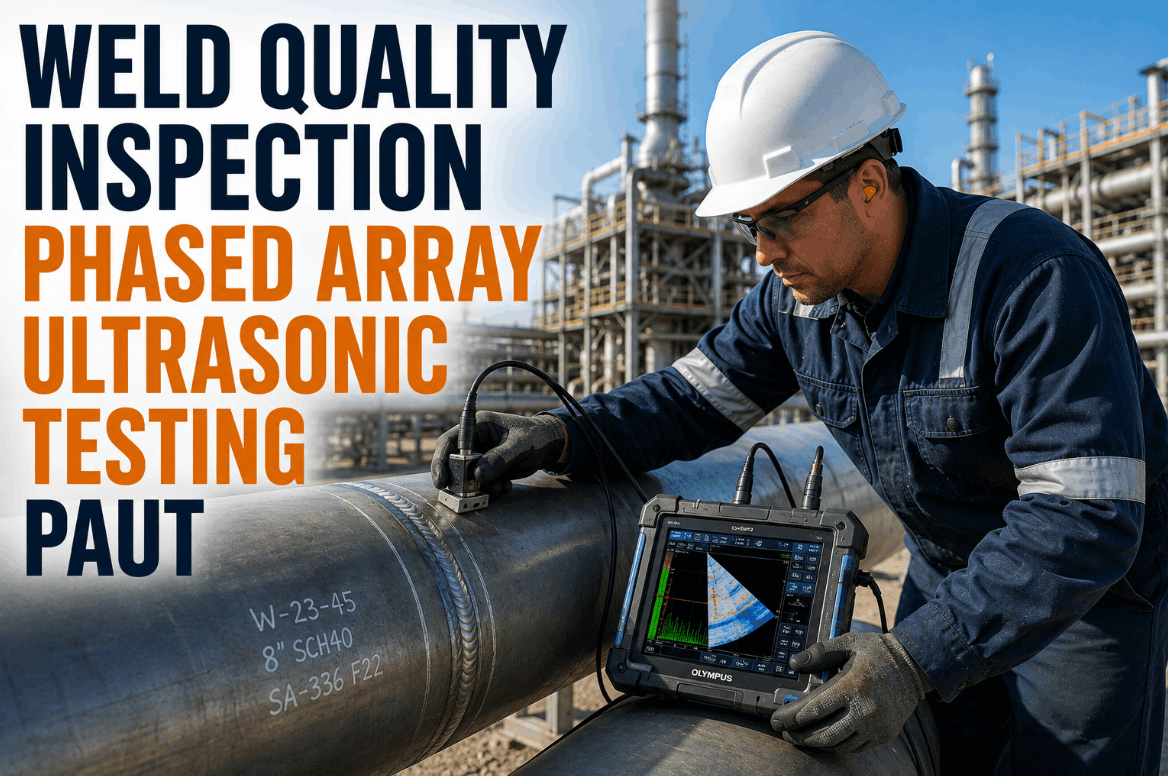
In critical manufacturing and refinery environments, a missed weld defect isn't a quality statistic—it's a structural failure waiting to happen. Phased Array Ultrasonic Testing (PAUT) and Time-of-Flight Diffraction (TOFD) have fundamentally replaced radiography as the volumetric NDE method of choice for pressure vessels, structural welds, and in-service piping. Yet most quality teams still operate with inspection data that lives in PDF reports, manually reviewed hours after a scan, with no connection to production schedules, heat records, or maintenance systems. If your weld inspection program cannot correlate scan results to a specific weld joint, heat number, or process stage in real time, you're not running a quality system—you're running a paperwork system. To see how iFactory AI connects PAUT/TOFD inspection data to live production intelligence, Book a Demo with our NDE integration team today.
WELD INSPECTION INTELLIGENCE
Is Your PAUT Data Connected to Your Production System?
iFactory AI bridges phased array ultrasonic inspection results with your live MES, quality, and maintenance workflows—turning scan data into actionable production intelligence.
30%
Higher defect detection probability with PAUT vs. conventional single-crystal UT
60%
Reduction in inspection time when PAUT and TOFD are run concurrently
Zero
Radiation hazard compared to legacy RT—no exclusion zones, no film handling
4–6 wks
Earlier detection of subsurface weld flaws when connected to AI-powered trend analysis
Why PAUT and TOFD Have Replaced Radiography for Critical Welds
The Shift from Film to Digital Volumetric Inspection
Radiographic testing (RT) defined weld inspection for decades, but its limitations in refinery, structural steel, and heavy fabrication environments are well established: radiation exclusion zones halt surrounding production, film processing introduces delays, and flaw sizing accuracy is inherently limited in the through-wall direction. Phased Array Ultrasonic Testing addresses all three constraints. A PAUT probe uses an array of small piezoelectric elements with programmable time delays that electronically steer and focus ultrasonic beams across multiple angles simultaneously—what conventional UT achieves only with repeated manual probe repositioning. The result is a full volumetric S-scan of the weld cross section from a single encoded pass. Time-of-Flight Diffraction (TOFD) complements PAUT by using diffracted signals from flaw tips rather than reflected signals, delivering precise through-wall height sizing that amplitude-based methods cannot match. Together, PAUT and TOFD provide the detection coverage and sizing accuracy required by ASME Section V, API 1104, and ISO 13588 for new fabrication and in-service inspection programs.
PAUT vs. TOFD vs. Conventional RT: A Structured Comparison
Choosing the Right NDE Method for Your Weld Application
| Attribute |
Conventional RT (Film) |
Phased Array UT (PAUT) |
Time-of-Flight Diffraction (TOFD) |
| Detection Mode |
Density contrast (2D projection) |
Amplitude-based volumetric S-scan |
Diffraction-based tip detection |
| Through-Wall Sizing |
Poor — shadow-only estimation |
Good — lateral resolution |
Excellent — tip-to-tip height accuracy |
| Flaw Orientation Sensitivity |
Misses planar flaws parallel to beam |
Multi-angle coverage detects all orientations |
Detects regardless of orientation |
| Radiation Hazard |
Yes — exclusion zones required |
None |
None |
| Real-Time Results |
No — film development delay |
Yes — immediate digital display |
Yes — immediate digital display |
| Code Acceptance |
ASME V, AWS D1.1 |
ASME V, API 1104, ISO 13588, AWS D1.5 |
ASME V, ISO 10863, API 1104 |
| Best Application |
Porosity mapping, simple geometry |
Complex geometries, pipe welds, pressure vessels |
Precise flaw height sizing, in-service inspection |
Probe Selection and Scan Plan Fundamentals
Getting the Inspection Architecture Right Before the First Scan
A PAUT inspection is only as reliable as its scan plan. The scan plan is the documented proof—required by most governing codes—that the selected probe, wedge angle, and beam paths will achieve full coverage of the weld volume and heat-affected zone (HAZ) before production scanning begins. For quality engineers and NDE supervisors, the scan plan is also the primary audit trail that separates a defensible inspection from an undocumented one.
Probe Frequency & Aperture
Select frequency based on material thickness and grain structure. Higher frequencies (5–10 MHz) suit fine-grain carbon steel; lower frequencies (2–5 MHz) are required for coarse-grain austenitic welds. Aperture determines near-surface dead zone depth—critical for cap and root zone coverage.
Wedge Angle & Beam Steering
Wedge geometry sets the entry angle range for the steered beam. For a V-groove weld, the scan plan must verify that at least 45°, 60°, and 70° beams achieve bevel face coverage. Electronic steering replaces the manual raster movement required by conventional single-angle probes.
TOFD Probe Center Spacing (PCS)
For TOFD, the Probe Center Spacing must be calculated so the depth of intersection covers the full acceptance zone. For thick-section welds (above 50mm), multiple TOFD pairs at different PCS values are required to eliminate near-surface dead zones at both the OD and ID surfaces.
Examination Volume & HAZ Coverage
The scan plan must document the full weld cross section plus the heat-affected zone on both sides. Most codes specify HAZ coverage of at least 10mm beyond the weld toe. Blind zones at the cap and root must be addressed with supplemental creeping wave or TOFD techniques.
Calibration & Reference Blocks
All PAUT systems must be calibrated on qualified reference blocks with known side-drilled holes (SDH) or notches matching the material and geometry. Calibration documents sensitivity settings and ensures amplitude fidelity is validated before and after each inspection sequence per code requirements.
Scan Encoding & Data Traceability
Encoded scanning links every scan position to a weld coordinate, creating a fully traceable inspection record. Encoding is mandatory for ASME and API code compliance and enables post-scan analysis, fitness-for-service (FFS) assessments, and future re-inspection comparisons on in-service welds.
Acceptance Criteria: New Fabrication vs. In-Service Welds
Understanding the Code Framework That Governs PAUT Dispositions
Acceptance criteria define the threshold at which a detected flaw requires rejection, repair, or further engineering evaluation. For quality engineers, applying the wrong code criteria is as damaging as missing the flaw entirely. The governing standard depends on the application, service environment, and governing jurisdiction—and PAUT results must be dispositioned against the correct acceptance basis.
ASME Section V / VIII
Pressure Vessel & Boiler Fabrication
Requires recordable UT for all Category A and B butt welds. PAUT is accepted under Code Case 2235 as an alternative to RT. Acceptance criteria are amplitude-based with specific depth and length thresholds for indications at the root, mid-wall, and cap zones. Fitness-for-service re-evaluation follows API 579 for in-service vessels.
API 1104
Pipeline & Refinery Girth Welds
Governs inspection of hydrocarbon transport pipelines. PAUT and AUT are explicitly accepted as alternatives to RT. Acceptance criteria are workmanship-based for new construction and ECA (Engineering Critical Assessment) based for in-service welds—allowing larger flaws to remain in service where fracture mechanics confirm structural adequacy.
AWS D1.1 / D1.5
Structural Steel & Bridge Fabrication
AWS D1.5 (2015 edition and later) formally recognizes PAUT as an accepted inspection method for complete joint penetration (CJP) butt welds on bridges. D1.1 governs structural steel. Acceptance is based on indication class (Class A through D) derived from amplitude and location within the weld cross section.
ISO 13588 / EN ISO 17640
International & Offshore Applications
Define the procedural framework for applying PAUT in international projects, including offshore wind tower monopile welds, pressure piping, and structural fabrication. Mandate scan plan documentation, procedure qualification, and operator certification to Level 2 or Level 3 under ISO 9712 or equivalent schemes.
How iFactory AI Connects PAUT Inspection Data to Production Intelligence
Closing the Gap Between NDE Results and Manufacturing Decisions
Advanced PAUT hardware generates rich volumetric data—but in most plants, that data ends at the NDE technician's laptop. Quality dispositions are recorded in PDF reports, defect trends are never analyzed against production variables, and weld repair rates are reviewed monthly rather than in real time. iFactory AI provides the integration layer that connects encoded PAUT and TOFD inspection data to your manufacturing execution, quality, and maintenance systems. When a PAUT scan flags a cluster of linear indications on a specific heat's pressure nozzle welds, iFactory correlates that result with the welder ID, preheat records, filler batch, and production shift—surfacing the root cause pattern before the next heat reaches the inspection station. Book a Demo to see the inspection integration architecture in action.
01
PAUT / TOFD Scan Data Ingestion
iFactory connects to major PAUT acquisition platforms (OmniScan, EMERALD, TomoScan) via standardized data formats. Encoded scan files are automatically indexed against weld joint IDs, component serial numbers, and inspection procedures—no manual data entry required.
02
Indication Classification & Code Disposition
AI-assisted indication review flags recorded indications, applies configurable acceptance criteria (ASME, API, AWS, ISO), and routes borderline indications to Level 2/3 reviewer queues. Accept/reject dispositions are logged with the reviewing engineer's credentials for full code traceability.
03
Production Variable Correlation
Defect type and location are correlated with upstream production data—welder qualification records, preheat and interpass temperatures, filler material heats, fit-up dimensional data—to identify systemic causes before they generate a repair backlog.
04
In-Service Trend Monitoring & FFS Tracking
For in-service weld inspection programs, iFactory overlays successive PAUT scans on a common weld coordinate map, tracking flaw growth rate against API 579 or BS 7910 fitness-for-service limits. Automated alerts notify integrity engineers when a flaw's growth trend approaches the re-inspection trigger threshold.
05
Regulatory Reporting & Audit Trail
Generate timestamped inspection reports with embedded S-scan images, disposition summaries, and code compliance checklists. Reports are formatted for ASME, API, and ISO submittal requirements—eliminating the manual compilation that typically consumes 20–30% of NDE project hours.
Book a Demo to review a sample report package.
"We were managing PAUT data from three inspection vendors across two fabrication facilities with no common indexing system—every disposition review was a manual reconciliation exercise. After deploying iFactory's inspection data integration, our weld repair rate trending visibility went from monthly to daily, and we identified a systematic root-fusion issue tied to a specific filler batch within 48 hours of the first rejections appearing. That single catch saved us an estimated $180,000 in downstream rework on a pressure vessel fabrication package."
Senior Quality Assurance Manager
Heavy Industrial Fabrication, U.S. Gulf Coast
NDE DATA INTEGRATION
Connect Your PAUT Results to Your Production System
iFactory's weld inspection integration module works with your existing PAUT hardware and NDE procedures—no rip-and-replace. Request a scope review with our quality engineering team.
Frequently Asked Questions
What is the primary advantage of PAUT over conventional single-crystal UT?
PAUT electronically steers beams across multiple angles simultaneously from a single probe position, providing full weld volume coverage in one encoded pass without the manual raster scanning required by conventional single-angle transducers.
When should TOFD be used alongside PAUT rather than independently?
TOFD excels at precise through-wall flaw height sizing while PAUT provides superior detection and lateral positioning—running them concurrently on the same scanner pass delivers both capabilities without the positioning errors introduced by sequential scanning.
Which codes accept PAUT as an alternative to radiography for pressure vessel welds?
ASME Code Case 2235 (for Section I and VIII vessels), API 1104 for pipelines, AWS D1.5 for bridge welds, and ISO 13588 for international applications all formally accept PAUT as a qualified alternative to RT.
What are the most common PAUT-detectable defects in refinery weld inspection?
Lack of fusion (LOF), lack of sidewall fusion (LOSWF), porosity clusters, hydrogen-induced cracking (HIC), and stress corrosion cracking (SCC) are the primary targets—all detectable volumetrically without radiation exposure or production area clearance.
How does iFactory AI integrate with existing PAUT acquisition hardware?
iFactory ingests encoded scan files from major PAUT platforms via standardized data formats, linking scan results directly to weld joint IDs, production records, and quality disposition workflows without requiring hardware replacement.
WELD QUALITY INTELLIGENCE
Get a PAUT Data Integration Assessment for Your Facility
Our quality engineering team will review your current PAUT/TOFD inspection workflow, identify the data integration gaps between NDE results and production decisions, and deliver a structured roadmap for connecting your inspection program to iFactory's live manufacturing intelligence platform.