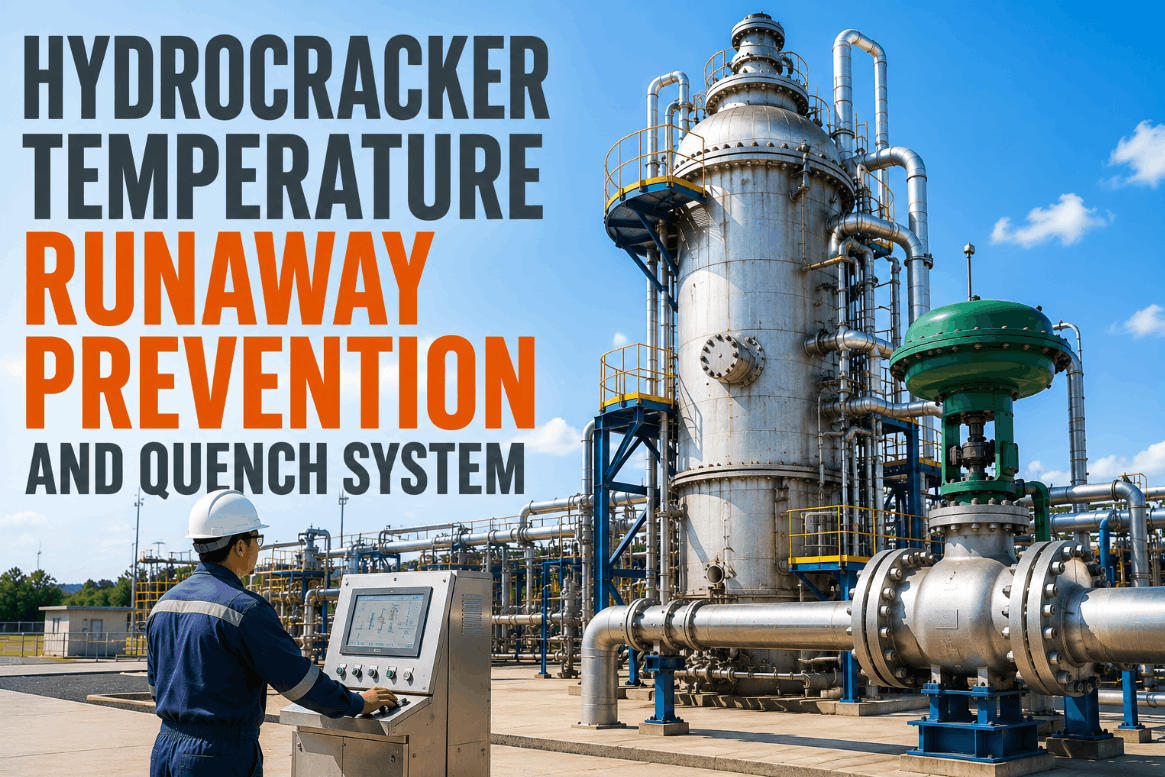
A hydrocracker temperature runaway is not a gradual failure — it is a cascading exothermic event that can escalate from a 20°F bed deviation to a full reactor breach in less than seven minutes. Operators managing fixed-bed hydrocracking units face simultaneous pressure to maintain conversion targets, control delta-T across multiple catalyst beds, and respond to quench valve anomalies before the automatic depressuring system (ADS) is the only card left to play. Digital monitoring infrastructure that correlates real-time bed temperature data, quench flow response, and recycle compressor status — all within a unified process safety dashboard — is what separates proactive intervention from reactive damage control. Refineries that Book a Demo with iFactory AI are closing the gap between first temperature deviation and operator response before any threshold is permanently breached.
Real-Time Delta-T Monitoring, Quench Override & Depressuring Intelligence — One Unified Dashboard
iFactory AI connects multipoint thermocouple data, quench valve position, recycle gas flow, and ADS logic into a single process safety dashboard — so your operations team acts on data, not alarms.
Why Hydrocracker Runaways Are Different from Every Other Refinery Upset
Hydrocracking reactions are inherently exothermic. As feed and recycle gas pass through each catalyst bed, heat is generated continuously — and the delta-T across each bed must be controlled at all times. The problem is a self-reinforcing feedback loop: rising temperature accelerates the cracking reaction, which generates more heat, which raises the temperature further. Unlike a simple feed upset, a temperature runaway can generate enough heat within the reactor to exceed the vessel's design limits before any conventional alarm-response cycle can complete.
The consequences are not theoretical. The 1997 Tosco Avon incident demonstrated that reactor temperatures can reach 998°F in a bed within minutes of feed interruption — and that operators without real-time bed-level delta-T visibility will not respond in time. Loss of recycle compressor flow is the single leading cause of runaway incidents; without recycle gas flow, quench capacity collapses and the hydrogen partial pressure that moderates reaction rate disappears simultaneously. Understanding these mechanics is the prerequisite for building a digital monitoring architecture that can intervene before the ADS is the only remaining option.
| Deviation Stage | Bed Delta-T Signal | Runaway Risk Level | Required Operator Action | iFactory AI Trigger |
|---|---|---|---|---|
| Stage 1 — Early Warning | +5°F above baseline | Low — Monitor | Adjust quench H2 to affected bed; reduce trim heater setpoint | Automated delta-T deviation alert to board operator |
| Stage 2 — Action Required | +15–25°F above baseline | Moderate — Intervene | Reduce feed rate; increase quench to all downstream beds | Multi-bed correlation alert + quench override recommendation |
| Stage 3 — Excursion | +40–60°F above baseline | High — Emergency Action | Cut oil feed; reduce furnace firing; evaluate manual depressuring | Supervisor escalation + ADS pre-arm notification |
| Stage 4 — Runaway | >60°F or accelerating rate | Critical — ADS Activation | Initiate emergency depressuring; trip feed pumps; isolate make-up H2 | ADS trigger log + post-event root cause data package |
| Stage 5 — Post-Event | Declining but unstable | Recovery — Controlled | Hold pressure per restart procedure; monitor bed delta-T until stable | Continuous recovery trend with restart readiness indicator |
The Quench System: First Line of Defense Against Thermal Escalation
Cold hydrogen quench injected between catalyst beds is the primary thermal control mechanism in every fixed-bed hydrocracker. Bed inlet temperatures for all beds downstream of the first are set by quench flow rate, making quench valve reliability and response time the most operationally critical variables in daily temperature management. When a bed temperature indicator crosses the 5°F deviation threshold, the first corrective action is always quench adjustment — either increasing quench H2 to the specific bed or reducing the trim heater inlet temperature feeding the reactor section. Book a Demo to see how iFactory AI monitors quench valve position and flow in real time.
Quench Control Valve Failure
Controller failure or valve stiction results in low or zero quench flow. Bed temperatures rise at a moderate but continuous rate. Recovery is possible via manual control room override or field hand-jacking before temperatures escalate further.
Loss of Recycle Compressor
The leading cause of runaway incidents. Recycle compressor failure simultaneously eliminates quench supply and reduces hydrogen partial pressure — removing both thermal control mechanisms at once. ADS activation is typically mandatory.
Bed Plugging & Channeling
Coking and contamination cause flow maldistribution within catalyst beds, creating hot spots that standard thermocouple grids may not detect early. Multipoint thermocouple arrays at multiple radial positions are essential for early detection.
Feed Redistribution Events
Feed diversion between reactor trains — such as the Tosco incident where feed was redirected from Reactor A to B and C — concentrates heat load on an already-warm system. Cutting feed rate without quench adjustment can paradoxically accelerate local reaction rates.
Depressuring Sequence: The Last Line of Defense and How to Execute It Correctly
Emergency depressuring works by rapidly reducing hydrogen partial pressure inside the reactor circuit, which immediately suppresses the hydrocracking reaction rate. API 521 mandates that all hydroprocessing units be capable of reducing system pressure to 50% of normal operating pressure within 15 minutes. The ADS achieves this by opening emergency depressuring valves to the flare system — but ADS activation is a last resort, not a routine response tool. Regulatory, community, and operational efficiency pressures all favor reducing unnecessary flaring, which means operators should ideally initiate manual depressuring before the ADS auto-triggers on preset temperature or compressor trip logic.
How iFactory AI Converts Reactor Data into Runaway Prevention
The failure mode in most hydrocracker runaway incidents is not missing instrumentation — it is disconnected instrumentation. Bed thermocouples generate data. Quench flow transmitters generate data. Recycle compressor discharge indicators generate data. But when these data streams sit in separate historian archives reviewed by different teams on different timescales, the one question that matters — is this delta-T trend on a runaway trajectory? — cannot be answered in real time. iFactory AI integrates every data stream into a unified process safety dashboard with AI-powered delta-T trend analysis that identifies accelerating deviation before any single alarm threshold is breached. Book a Demo to see the delta-T correlation engine in action.
iFactory aggregates multipoint thermocouple data from every catalyst bed at 1-minute or sub-minute intervals, computing live delta-T values across each bed and comparing them against learned baseline models that account for feed rate, feed quality, and catalyst age. When any delta-T deviates from its predicted value by more than the configured threshold, a targeted alert is sent to the board operator — not a generic high-temperature alarm, but a specific bed-level deviation notice with trend direction and rate of change.
- Per-bed delta-T baseline modeling with load-variable regression correction
- Rate-of-change alerting that detects accelerating deviations before absolute limits are reached
- Multi-bed correlation to identify whether an excursion is localized or propagating downstream
- Historical delta-T trend storage with shift-level and campaign-level comparison views
- Thermocouple health monitoring to flag degraded sensors before they create blind spots
Quench override strategies — automatically increasing quench flow to a specific bed when its inlet temperature approaches the action threshold — have demonstrated over 99% utilization rates in controlling temperature excursions without requiring ADS activation. iFactory AI implements and monitors quench override logic by integrating with existing quench control valve position signals and flow transmitters, confirming that override commands result in actual flow response within the expected time window.
- Quench valve position and actual flow rate comparison to detect stiction or control failure
- Override activation log with timestamp, bed number, delta-T trigger value, and operator acknowledgment
- Response-time tracking from alert generation to confirmed quench flow increase
- Quench effectiveness scoring — did the override arrest the temperature rise within the expected period?
- Automatic escalation if quench override fails to control deviation within 2 minutes
iFactory AI does not replace the ADS — it provides the intelligence layer that ensures operators have every opportunity to manually intervene before the ADS activates, and ensures that when ADS does fire, the event is fully documented for regulatory review and restart procedure validation. The platform continuously monitors ADS arm/disarm status, emergency depressuring valve position, and flare header flow to confirm system readiness at all times.
- Continuous ADS readiness monitoring — valve position, instrument loop health, and logic controller status
- Manual vs. auto depressuring event classification with root cause data package generation
- Depressuring rate tracking vs. API 521 50%-in-15-minutes compliance requirement
- Post-event reactor recovery monitoring with restart readiness criteria tracking
- Incident documentation package generation for process safety management (PSM) record requirements
The most powerful capability in iFactory's hydrocracker safety module links specific process events — feed quality changes, recycle ratio shifts, catalyst age milestones, and operating pressure modifications — to documented delta-T excursion records. By identifying which operating conditions generate the highest thermal risk, the platform enables EHS and operations teams to adjust operating envelopes proactively rather than responding to excursions after they begin.
- Feed quality correlation — API gravity, nitrogen content, and poly-aromatic concentration vs. historical delta-T excursion frequency
- Catalyst cycle position tracking with age-adjusted delta-T baseline recalibration
- Recycle ratio monitoring with risk-score adjustment as H2/oil ratio declines toward minimum
- Automatic identification of operating conditions that historically precede excursions
- Shift-level risk scoring that quantifies current thermal vulnerability before each operating change
Unified vs. Fragmented: Why Disconnected Reactor Data Is a Safety Gap
Most hydrocracking units are instrumented with state-of-the-art sensors — but those sensors report into historian systems, DCS displays, and safety logic controllers that do not communicate with each other in any analytically meaningful way. A board operator sees a bed temperature. A process engineer reviews weekly delta-T trends in a separate tool. The process safety manager reviews ADS event logs quarterly. No one is watching the rate of change across all three data streams simultaneously in real time. iFactory AI solves this by consolidating every relevant data stream into a single reactor safety dashboard where deviation rate, quench response status, and compressor health are visible on one screen.
Replace Disconnected DCS Alarms with One Unified Hydrocracker Safety Platform
iFactory AI connects delta-T monitoring, quench override logic, recycle compressor health, and ADS status into a single real-time process safety dashboard — built for refinery operations teams managing hydrocracking units under PSM.
Hydrocracker Safety Is a Data Integration Problem — Solved Before the Quench Valve Fails
The prevention of hydrocracker temperature runaways depends on a clear operational hierarchy: quench adjustment before feed reduction, feed reduction before manual depressuring, manual depressuring before ADS auto-activation. That hierarchy only works when operators receive the right signal — delta-T rate of change at the bed level, quench valve response confirmation, compressor health status — fast enough to act within the two-to-four-minute intervention window that separates a managed excursion from an ADS event and its days of lost production. The instrumentation already exists in virtually every modern hydrocracking unit. The gap is the integration layer that turns isolated sensor readings into a unified safety decision surface. iFactory AI provides exactly that integration — connecting every existing data stream into a real-time reactor safety dashboard that gives operations teams and process safety engineers the context they need to prevent the next runaway, not document it.
Hydrocracker Runaway Prevention — Frequently Asked Questions
Build a Unified, Real-Time Hydrocracker Safety Platform with iFactory AI
iFactory AI connects every hydrocracker safety data stream — multipoint bed temperatures, quench valve response, recycle compressor status, and ADS readiness — into a single real-time dashboard that gives your operations team the context to intervene before the ADS is the only option remaining.