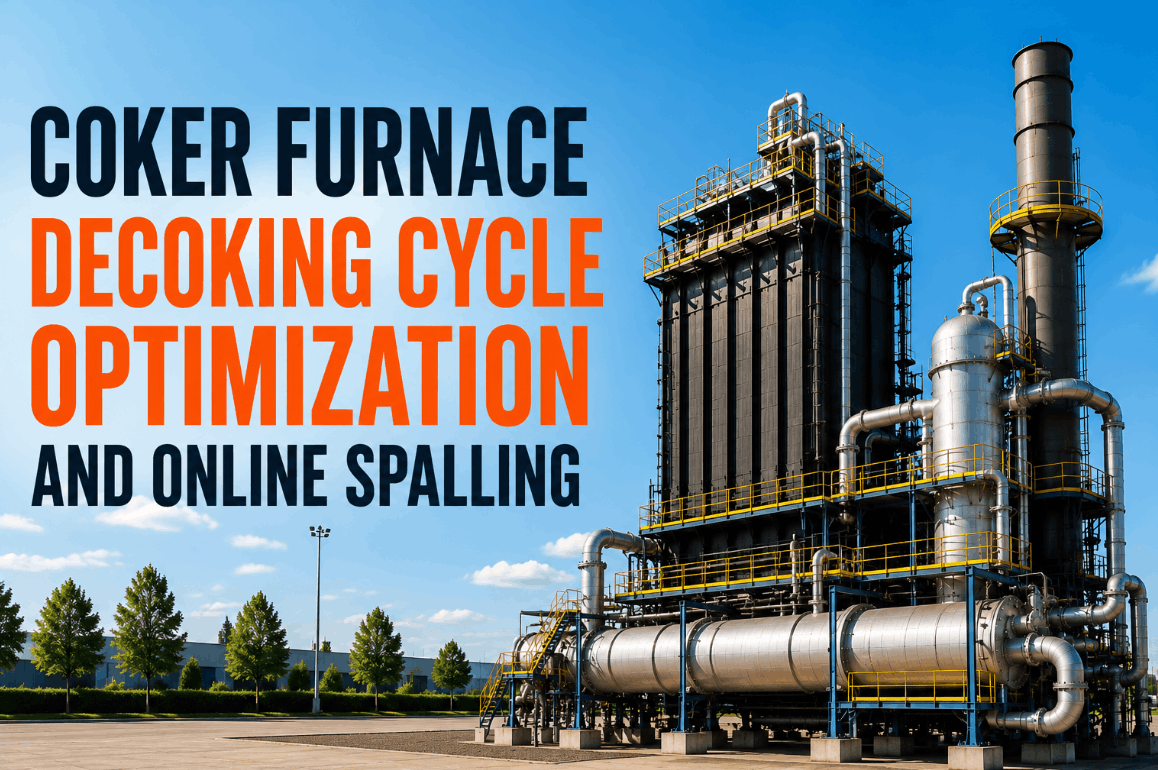
Coker furnace tubes foul on a predictable schedule — coke deposits accumulate on tube walls from the first day of operation, forcing outlet firing to increase steadily to maintain target throughput temperatures, until tube skin thermocouple (TMT) readings approach the mechanical limit for the alloy. For standard 9% chrome tubes, that ceiling is 1,250°F. How a refinery manages the interval between that start-of-run (SOR) clean state and end-of-run (EOR) limit — through online spalling cycles, steam-air decoking campaigns, or hydraulic pigging — determines run length, tube life, unit reliability, and ultimately the economics of every barrel processed through the delayed coker. Yet most U.S. refineries still make decoking timing decisions based on calendar schedules and individual operator experience rather than real-time tube skin data and AI-driven fouling rate models. iFactory AI changes that equation by integrating multipoint TMT data, pass pressure drop trends, and firing rate history into a single coker furnace intelligence dashboard that tells operations teams exactly when to spall — and exactly how clean the spall was. Book a Demo to see how iFactory extends coker furnace run length with real-time tube monitoring.
Real-Time TMT Monitoring, Spalling Cycle Optimization & Decoking Decision Support — One Unified Dashboard
iFactory AI integrates tube skin temperatures, pass pressure drop, firing rate trends, and spall completion indicators into a single coker furnace platform — so your operations team makes decoking decisions on data, not calendars.
Coker Furnace Decoking Cycle Optimization
A technical framework for deploying AI-driven tube skin monitoring and spalling cycle intelligence to protect delayed coker furnace tubes, maximize run length, and reduce unplanned decoking shutdowns in U.S. refinery operations.
Why Coker Tube Fouling Is Inevitable — and How You Manage the Rate
Coke deposition on delayed coker furnace tube walls is not a failure mode — it is an intrinsic characteristic of processing vacuum residue at temperatures above 850°F. As the coke layer thickens, it acts as an insulator, reducing heat transfer efficiency and forcing operators to increase firing to maintain the required heater outlet temperature. That increased firing raises the outer tube metal wall temperature (TMT) along a predictable trajectory toward the alloy's mechanical limit. The operational challenge is not preventing fouling — it is managing the fouling rate precisely enough to maximize the interval between decoking events while keeping every tube skin thermocouple reading safely inside design limits. Book a Demo to see how iFactory tracks fouling rate progression in real time.
Coke Layer Thermal Resistance
As coke accumulates on tube walls, heat transfer resistance increases, forcing higher firing rates to maintain outlet temperature. iFactory tracks the firing rate increase rate as a direct proxy for coke thickness and fouling progression — visible in real time across every pass.
TMT Approach to Mechanical Limit
For 9% chrome alloy tubes, the maximum allowable TMT is 1,250°F. iFactory plots every skin thermocouple reading on a projected trajectory curve, calculating the remaining days to the mechanical limit based on current fouling rate — eliminating the guesswork from decoking scheduling.
Pass Pressure Drop Progression
As coke deposits narrow the tube bore, hydraulic resistance increases and pass pressure drop rises measurably. Pass ΔP is one of the most reliable indicators of coke buildup and spall completion quality — and iFactory logs every trend automatically across all passes at every shift.
Feed Property Variability Impact
Heavier, higher-sulfur vacuum residue feeds accelerate the fouling rate. iFactory correlates feed API gravity and Conradson Carbon Residue (CCR) data with TMT rise rates, providing an early warning when a feed change is pushing the furnace toward a premature spalling cycle.
Recirculation Ratio & Velocity Effects
Low tube velocity increases residence time and accelerates coke deposition. iFactory monitors pass flow rates and recirculation ratios against coking rate indicators, flagging conditions where velocity is drifting below the minimum threshold required to maintain the target run length.
Uneven Pass-to-Pass TMT Distribution
Unequal flow distribution across furnace passes creates hot passes that hit the TMT limit before colder passes, forcing premature decoking on the entire furnace. iFactory's per-pass analytics identify flow imbalances before they compress run length, enabling corrective adjustments during normal operation.
Decoking Method Comparison: Online Spalling, Steam-Air, and Pigging
Each of the three accepted delayed coker furnace decoking methods delivers different cleanliness levels, operational impacts, and run-length contributions. Selecting the right method — and sequencing them correctly — is central to maximizing furnace availability.
| Method | Unit Shutdown Required | Tube Cleanliness Level | Duration | Best Application | Key Limitation |
|---|---|---|---|---|---|
| Online Steam Spalling | No — single pass at a time | Moderate — coke fractured, not fully removed | Hours per pass; full furnace in <1 shift | Routine between-campaign maintenance on 4+ pass heaters | Single-fired heaters may show ratcheting TMT after each spall |
| Steam-Air Decoking | Yes — furnace taken offline | High — residual coke burned off after spall | 24–72 hours typical | Campaign reset after multiple spalls or TMT limit approach | Inorganic residues remain; can seed future coking sites |
| Hydraulic Pigging | Yes — furnace offline; U-bend configuration required | Highest — mechanical scraping to bare metal | 48–96 hours typical | Full-life reset; best SOR TMT recovery of all three methods | Only applicable to straight-tube heaters; highest operational disruption |
Online Spalling: How the Procedure Works and What Makes It Succeed
Online steam spalling is performed by replacing the oil feed in one furnace pass with high-velocity steam or boiler feed water while the remaining passes continue processing normally. Steam is heated to approximately 1,200°F, held at temperature for a predetermined period to thermally stress the coke layer, and then firing is reduced rapidly to cool the tube metal. The thermal contraction differential between the steel tube wall and the brittle coke layer fractures the deposit and spalls it off — the steam carries the spalled coke pieces to the active coke drum. The entire furnace can typically be spalled pass by pass within a single operating shift without a unit shutdown. Proper spalling procedure design, however, is critical: the heating rate, hold time, and cooling rate must be optimized for each heater design to achieve the maximum coke removal without causing thermal fatigue damage to the tube alloy itself.
Pass Isolation & Steam Introduction
The selected pass is isolated from oil feed. High-velocity steam or BFW is introduced to displace residue from the tube. Flow rate is increased to achieve turbulent conditions that maximize thermal contact with the coke layer and promote uniform heating.
High-Temperature Hold — Thermal Stress Application
Firing on the spalling pass is increased to raise tube metal temperature to approximately 1,200°F, then held for a defined period. The thermal gradient between tube wall and coke layer generates tensile stress in the coke deposit, initiating fracture. Hold duration is pass-specific and based on historical spall response for that heater.
Rapid Cool-Down — Coke Fracture & Spalling
Firing is cut back sharply to cool the tube metal rapidly. The tube wall contracts faster than the coke layer, generating the shear stress that fractures and dislodges the deposit. Steam velocity carries spalled coke pieces to the coke drum. Multiple heat-cool cycles may be applied to maximize removal.
Pass Return to Service & Spall Completion Verification
Oil feed is reintroduced to the pass. Spall completion quality is evaluated by comparing post-spall TMT readings and pass pressure drop against the pre-spall baseline and against the clean tube (SOR) reference values. A successful spall on a double-fired heater should restore TMT to near-SOR levels.
How iFactory AI Monitors Coker Furnace Health Across the Full Decoking Cycle
From SOR clean state through EOR limit approach, spalling cycle execution, and post-spall quality verification — iFactory provides continuous intelligence at every stage of coker furnace operation.
iFactory plots every skin thermocouple reading against a fouling-rate model that projects the remaining days to the 1,250°F mechanical limit under current operating conditions. When a feed property change or firing adjustment shifts the trajectory, the model recalculates automatically.
Continuous pass ΔP logging provides a direct hydraulic indicator of coke buildup rate and spall effectiveness. iFactory compares every post-spall ΔP reading against the SOR clean baseline, quantifying spall quality and flagging passes that did not respond as expected.
Rather than scheduling spalls on fixed calendar intervals, iFactory's AI recommends the optimal spalling window based on current TMT trajectory, projected days to EOR, planned crude slate changes, and downstream coke drum availability — maximizing the interval between spalls while protecting tube integrity.
On single-fired heaters, each spall cycle may leave the post-spall "clean TMT" slightly higher than the previous one — a ratcheting pattern that compresses run length over time. iFactory tracks this ratcheting trend and identifies when a steam-air decoke or pigging campaign is needed to reset the tube to true SOR condition.
Traditional Decoking Management vs. iFactory AI: A Direct Comparison
Most U.S. delayed coker operations manage furnace decoking through a combination of fixed scheduling, individual operator experience, and manual skin thermocouple reviews — an approach that consistently leaves run length on the table and exposes furnaces to TMT exceedances that compound tube fatigue over successive campaigns. Book a Demo to see the full iFactory coker furnace monitoring capability demonstrated on live process data.
| Management Element | Traditional Approach | iFactory AI Approach | Operational Impact |
|---|---|---|---|
| Spall Timing Decision | Fixed calendar interval or operator judgment | AI-driven TMT trajectory + ΔP trend recommendation | 10–25% longer average run length per campaign |
| Tube Skin Temperature Monitoring | Operator rounds or shift-end DCS review | Continuous per-pass TMT with mechanical limit projection | Elimination of undetected TMT exceedances |
| Spall Completion Verification | Post-spall operator check; qualitative assessment | Quantified post-spall TMT and ΔP vs. SOR baseline | Objective spall quality scoring per pass, per event |
| Ratcheting TMT Trend Detection | Not tracked; recognized only when run length shortens | Automated per-spall clean-TMT tracking with campaign trend | Early identification of pigging or steam-air decoke need |
| Feed Property Impact Assessment | Not integrated with furnace monitoring | CCR and API gravity correlated to fouling rate in real time | Proactive spall scheduling ahead of heavy feed campaigns |
| Decoking Event Documentation | Operator log entries; not standardized | Automated event record with pre/post TMT and ΔP package | Audit-ready decoking history for every campaign |
"The coker furnace is the one piece of equipment in a delayed coking unit where the operational data is richest and the decision-support tools have historically been the weakest. Every pass has skin thermocouples. Every pass has pressure drop. Firing rate data is continuous. The fouling mechanism is well-understood. What we have lacked is the ability to synthesize all of that data into a single trajectory model that tells operators not just where the furnace is today, but when the next spall needs to happen and whether the last one actually worked. A platform that closes that gap — that compares post-spall TMT readings to the SOR baseline automatically and flags a ratcheting pattern before it costs you two months of run length — is not a luxury instrument. It is the most operationally logical investment a coker reliability team can make."
Coker Furnace Run Length Is a Data Problem — Solved Before the Next TMT Alarm
Delayed coker furnace decoking cycle management is one of the highest-leverage reliability opportunities in any U.S. refinery. Every additional month of run length between spalling or decoking events represents direct throughput value — and every unnecessary shutdown represents avoidable lost production. The tube skin temperature data, pass pressure drop trends, and firing rate histories required to make better decoking decisions already exist in every modern delayed coker's DCS historian. What has been missing is the integration layer that synthesizes those streams into a real-time fouling rate model with a clear, quantified projection of time to the mechanical limit. That is precisely what iFactory AI delivers: a unified coker furnace intelligence platform that replaces calendar-based spalling schedules with data-driven decoking decisions, objectively measures spall quality against the SOR baseline, and identifies the ratcheting TMT patterns that signal it is time to step up from online spalling to a full steam-air campaign. Book a Demo to see the full platform applied to delayed coker furnace operations.
Coker Furnace Decoking — Frequently Asked Questions
Build a Unified, Real-Time Coker Furnace Decoking Intelligence Platform with iFactory AI
iFactory AI integrates every delayed coker furnace data stream — tube skin temperatures, pass pressure drop, firing rate trends, and spall completion records — into a single real-time dashboard that extends run length, protects tube integrity, and eliminates calendar-based decoking guesswork.