Every minute a falsified batch record goes undetected, your organization absorbs the compounding cost of regulatory exposure, product liability, and patient safety failure—risks that a single FDA warning letter can transform into a nine-figure remediation crisis. Data integrity failures in pharma are not procedural inconveniences; they are operational hemorrhages that destroy shareholder value, halt production lines, and end careers. The question is no longer whether your audit trail can survive a GMP inspection—it is whether you can afford to find out it cannot.
Is Your Audit Trail FDA-Inspection Ready?
iFactory's Tamper-Proof Audit Trail eliminates ALCOA violations, prevents data falsification, and creates an immutable compliance record across every GMP workflow.
The Financial & Clinical Cost of Pharma Data Integrity Failures
Data integrity violations represent the single largest catalyst for FDA warning letters, import alerts, and consent decrees in the pharmaceutical sector. The downstream financial impact is severe and well-documented.
Regulatory Exposure
- Warning letters triggering market withdrawal
- Import alerts halting $MM product shipments
- Consent decrees with multi-year remediation costs
- Criminal referrals for deliberate falsification
Revenue Leakage
- Batch failures from incomplete audit evidence
- Production halts pending data reconstruction
- Contract loss due to failed partner audits
- Re-validation costs averaging $2M–$8M per site
Patient Safety Risk
- Undetected out-of-spec releases reaching market
- Falsified stability data masking degradation
- Incomplete deviation records hiding repeat failures
- Mislabeled product from broken chain of custody
Primary Causes of Data Integrity Failures in Pharma
Understanding the structural causes behind ALCOA violations is the first step toward building a compliant, audit-ready operation. Most failures trace to four systemic failure points:
Manual Paper-Based Workflows
- Backdated entries with no timestamp validation
- Illegible or altered batch records
- Missing signatures on critical process steps
- No version control on SOPs or forms
Fragmented Digital Systems
- Disconnected LIMS, ERP, and QMS platforms
- Manual data transfers creating transcription errors
- No single source of truth for batch release
- Uncontrolled spreadsheets in GMP environments
Inadequate Access Controls
- Shared login credentials on critical systems
- No role-based permission architecture
- Audit trails deletable by standard users
- Unmonitored admin-level access
Cultural & Behavioral Pressures
- Production pressure incentivizing record manipulation
- Inadequate data integrity training programs
- No whistleblower protection or reporting pathway
- Leadership tolerance of "minor" documentation gaps
Real-World FDA Warning Letter Patterns: What Inspectors Find
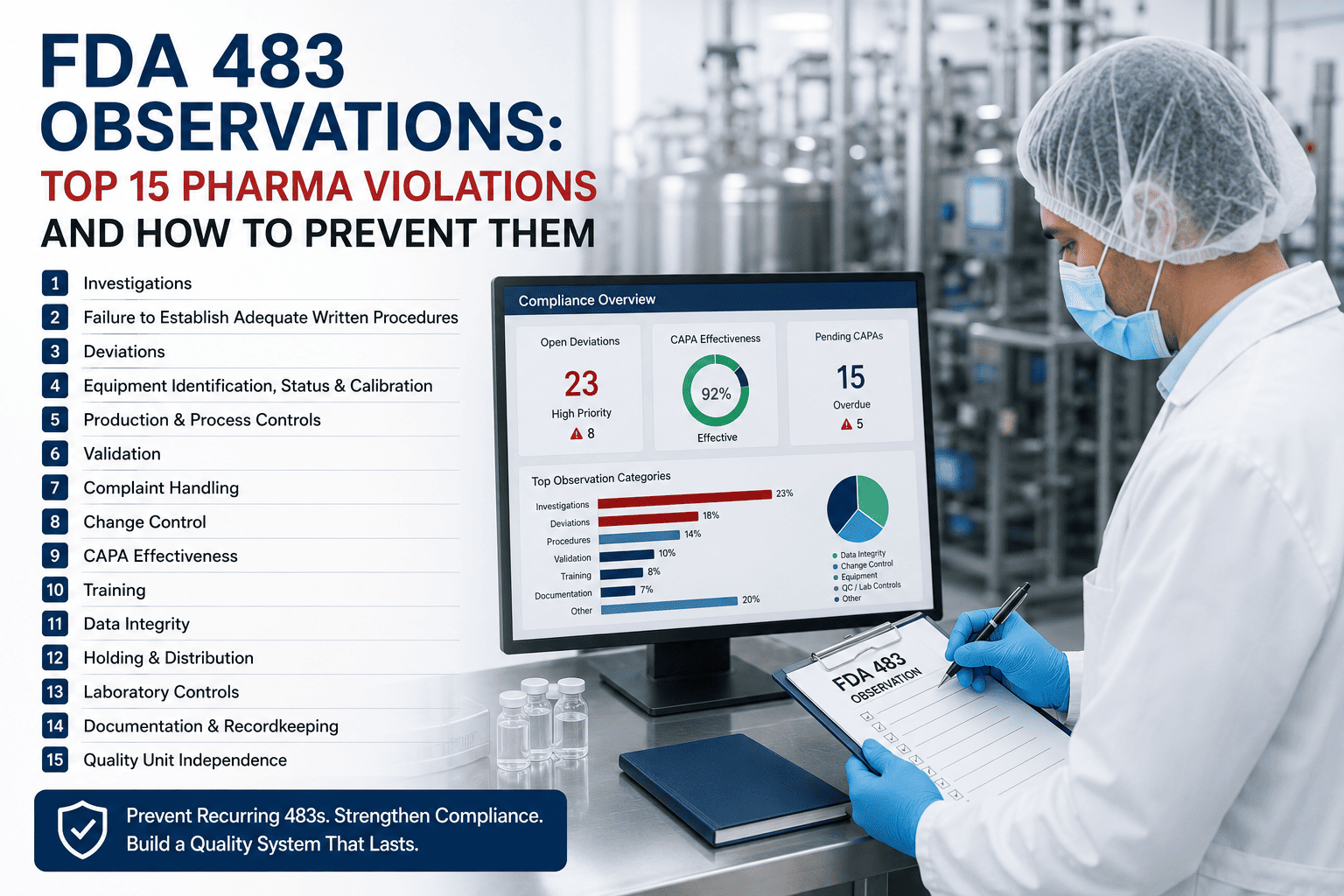
FDA 483 observations and warning letters consistently cite the same categories of data integrity failures. The following patterns represent the most frequently cited violations in pharmaceutical manufacturing inspections:
| Violation Category | Specific Finding | Regulatory Citation | Business Impact | Risk Level |
|---|---|---|---|---|
| Audit Trail Manipulation | Electronic records deleted or overwritten | 21 CFR 211.68(b) | Consent decree trigger | Critical |
| Backdated Entries | Records created after critical events | 21 CFR 211.100 | Batch invalidation | Critical |
| Shared Credentials | Multiple users on single login | 21 CFR Part 11 | Full system re-validation | Critical |
| Uncontrolled Spreadsheets | GMP data in unvalidated Excel files | 21 CFR 211.68 | Data reliability challenge | High |
| Missing CAPA Documentation | Deviation closed without root cause | 21 CFR 211.192 | Repeat defect liability | High |
| Incomplete Batch Records | Missing process step signatures | 21 CFR 211.188 | Product release delay | Moderate |
Comparison Matrix: Legacy Friction vs. iFactory Optimized Excellence
The operational gap between a paper-reliant compliance environment and an iFactory-powered platform is not incremental—it is categorical. The matrix below quantifies the transformation across every mission-critical workflow dimension.
| Compliance Dimension | Legacy Friction State | iFactory Optimized Excellence | ROI Outcome |
|---|---|---|---|
| Audit Trail Integrity | Manually maintained; deletable records | Immutable, timestamped, role-locked entries | Zero falsification exposure |
| Data Entry Validation | No real-time field validation | Automated ALCOA-C compliance checks at input | 95% reduction in entry errors |
| Access Control | Shared logins, no permission tiers | Granular role-based access with 21 CFR Part 11 e-sig | Full individual accountability |
| Deviation Management | Paper forms, manual CAPA tracking | Automated deviation routing with deadline enforcement | 60% faster CAPA closure |
| Inspection Readiness | Days of record assembly pre-inspection | One-click audit package generation | Inspection prep from days to hours |
| Data Sovereignty | Unencrypted local or generic cloud storage | GxP-validated, encrypted, geo-compliant cloud | Eliminated sovereignty risk |
See How iFactory Eliminates Every Warning Letter Risk Category
Our tamper-proof audit trail has been designed specifically for pharmaceutical GMP environments—addressing every ALCOA violation pattern FDA inspectors actively target.
Clinical Impact Grid: How iFactory Resolves Operational Burnout & Throughput Loss
Staff Burnout Reduction
- Eliminates manual record assembly tasks
- Automated reminders replace manual follow-ups
- Pre-populated forms reduce duplicate data entry
- QA staff redirected from admin to high-value work
Batch Release Acceleration
- Parallel review workflows replace sequential queues
- Real-time batch record completeness scoring
- Electronic signatures with instant timestamping
- Release decisions backed by complete data packages
Inspection Confidence
- Full traceability from raw material to finished product
- Pre-built inspection query response templates
- Automated gap detection against current GMP standards
- Historical trend data instantly accessible to auditors
How to Prevent Data Integrity Failures: The iFactory 5-Layer Framework
Immutable Record Architecture
Every data entry is cryptographically timestamped and locked. No user—including administrators—can modify or delete a record after submission without generating a traceable audit event.
Role-Based Access with 21 CFR Part 11 E-Signatures
Granular permissions ensure each user can only access and approve records within their validated role. Every critical action requires a compliant electronic signature tied to a unique identity.
Real-Time ALCOA-C Validation Engine
Automated field-level checks enforce Attributable, Legible, Contemporaneous, Original, and Accurate standards at the point of data entry—before errors can propagate downstream.
Integrated Deviation & CAPA Workflow
Every deviation automatically triggers a CAPA workflow with assigned ownership, deadline tracking, and effectiveness verification—eliminating the open-ended investigations that attract inspector scrutiny.
GxP-Validated Cloud with Sovereign Data Controls
All data resides in a validated, encrypted cloud environment with jurisdiction-specific data residency options—meeting FDA, EMA, and PMDA data governance requirements simultaneously.
Data Integrity in Pharma — Frequently Asked Questions
What does ALCOA stand for and why does it matter for pharma compliance?
ALCOA stands for Attributable, Legible, Contemporaneous, Original, and Accurate. The FDA, EMA, and WHO use ALCOA (extended to ALCOA-C with Complete and Consistent) as the gold standard framework for evaluating whether pharmaceutical data records are trustworthy. Failure to meet any ALCOA attribute is citable as a data integrity violation.
What is the most common data integrity violation cited in FDA warning letters?
The most frequently cited violations involve audit trail manipulation, including deletion of electronic records, backdated entries, and use of shared login credentials that prevent individual attribution of data entries. iFactory's tamper-proof audit trail eliminates all three risk categories by design.
Can iFactory integrate with our existing LIMS and ERP systems?
Yes. iFactory uses validated, vendor-neutral APIs to connect with major LIMS, ERP, and QMS platforms. This eliminates the manual data transfer points that create transcription errors and uncontrolled data flows between systems. Book a Demo to review our integration architecture.
How quickly can iFactory be deployed in a GMP manufacturing environment?
Deployment timelines vary by site complexity, but most customers achieve a validated, fully operational environment within 8–16 weeks. iFactory provides full IQ/OQ/PQ documentation packages to support your internal validation team and reduce time-to-compliance. Book a Demo for a site-specific deployment estimate.
What is the estimated ROI for implementing a tamper-proof audit trail platform?
Organizations typically recover platform investment within the first year through avoided re-validation costs, reduced inspection preparation labor, and faster batch release cycles. The prevention of a single consent decree—which can cost $50M+ in remediation—represents ROI that dwarfs any software investment. Request an Operational Gap Audit for a site-specific ROI projection.
Eliminate Data Integrity Risk Across Every GMP Workflow
iFactory's tamper-proof audit trail is purpose-built for pharmaceutical compliance—designed to survive FDA inspections, prevent falsification, and protect your organization from warning letter exposure.