Every hour your API manufacturing facility operates without a fully integrated ICH Q7 compliance framework, you are absorbing unquantified financial exposure — from rejected batches and regulatory warning letters to delayed product launches and irreversible supplier qualification failures. The question for your leadership team is no longer whether to modernize your Good Manufacturing Practice infrastructure, but how much longer you can afford to defer it.
Is Your API Batch Management Audit-Ready?
iFactory centralizes batch records, change control, and supplier qualification into a single GMP-compliant dashboard built for pharmaceutical-scale API operations.
ICH Q7: What GMP Compliance Actually Demands of API Manufacturers
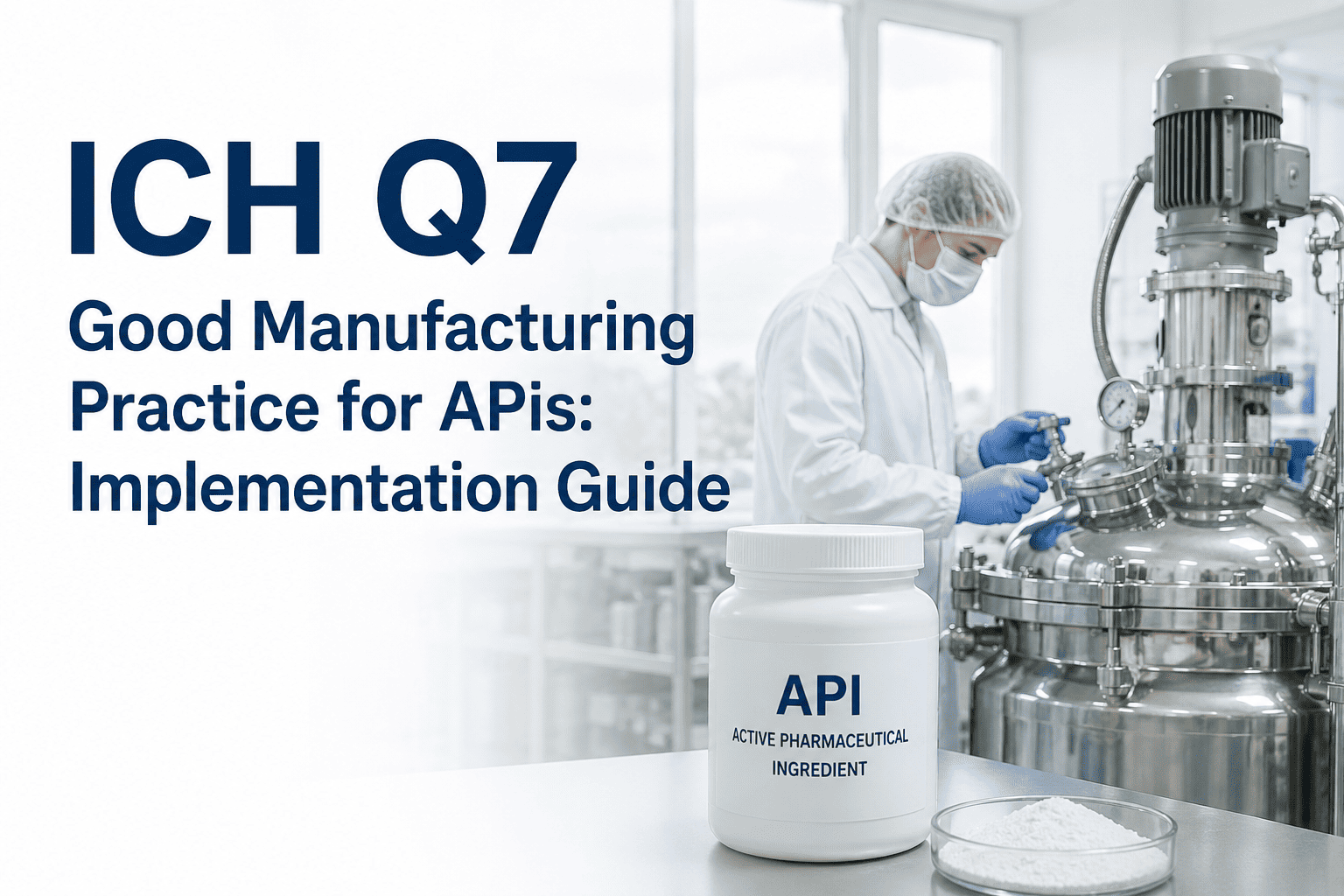
ICH Q7 establishes the international benchmark for Good Manufacturing Practice in active pharmaceutical ingredient production. Adopted across FDA, EMA, and PMDA jurisdictions, non-compliance carries consequences that extend far beyond Form 483 observations — they trigger import alerts, consent decrees, and in the worst cases, facility shutdowns.
Quality Management
- Written quality policies at every production level
- Designated QA authority independent of production
- Documented internal audit cycles with CAPA closure
Batch Record Control
- Complete master batch records for every API process
- Real-time production data capture with e-signatures
- Version-controlled records with deviation linkage
Change Control
- Formal impact assessment for every process change
- Cross-functional approval workflows pre-implementation
- Regulatory notification tracking by jurisdiction
Supplier Qualification
- Approved vendor list with qualification evidence
- Periodic re-qualification against quality agreements
- Material traceability from vendor to finished batch
The Real Cost of ICH Q7 Non-Compliance
Executives frequently underestimate the downstream financial cascade triggered by a single ICH Q7 compliance gap. A rejected API batch is not just a manufacturing loss — it is a contractual breach, a supply disruption, and a reputational liability that compounds across quarters.
- Average API batch rejection: $250K–$2M per incident
- Rework cycles add 30–60 days to delivery timelines
- Customer penalty clauses triggered on missed SLAs
- FDA Warning Letter remediation: $5M–$30M average
- Consent decrees freeze production for 12–36 months
- Import alerts eliminate entire market channels overnight
- Paper-based batch records: 4–8 hours per batch reconciliation
- Change control backlogs delay launches by 3–6 months
- QA staff burnout from redundant data entry and re-review
Legacy GMP Friction vs. iFactory Optimized Excellence
The operational gap between paper-based ICH Q7 compliance and a fully integrated API Batch Management platform is measurable in dollars, days, and inspection outcomes. The comparison below reflects what iFactory clients experience within the first 90 days of deployment.
| Compliance Area | Legacy Friction State | iFactory Optimized Excellence | Operational Impact |
|---|---|---|---|
| Batch Record Management | Paper forms, manual reconciliation, frequent transcription errors | Electronic batch records with real-time capture and e-signature | 85% faster closure |
| Change Control Workflow | Email chains, disconnected approvals, missed regulatory notifications | Structured workflows with impact assessment templates and auto-routing | 60% cycle reduction |
| Supplier Qualification | Spreadsheet-based AVL, expired qualifications, no traceability | Automated re-qualification alerts, quality agreement linkage, material trace | Zero qualification gaps |
| Deviation & CAPA | Standalone investigation reports, no trend analysis | Linked deviation-CAPA-batch records with cross-batch trend dashboards | 3× faster root cause |
| Audit Readiness | Days of manual retrieval, inconsistent data formats across systems | Instant audit package generation with complete data lineage | Inspection-ready always |
How iFactory API Batch Management Transforms Your QA Operation
Beyond regulatory compliance, iFactory's API Batch Management platform delivers measurable gains across three critical dimensions of pharmaceutical manufacturing performance — staff efficiency, product throughput, and supply chain resilience.
Staff Efficiency
- Eliminate manual batch record transcription entirely
- Auto-populate fields from upstream equipment integration
- Role-based task queues replace email-driven coordination
- QA review time reduced by up to 70% per batch
Product Throughput
- Parallel batch review workflows replace sequential bottlenecks
- Electronic release cuts batch disposition time from days to hours
- Change control automation compresses launch timelines
- Real-time yield tracking flags deviations before batch close
Supply Chain Resilience
- Approved Vendor List maintained with automatic expiry alerts
- Full material genealogy from raw material COA to finished API
- Supplier audit scheduling integrated with qualification status
- Rapid response to material recalls with affected batch mapping
Five Steps to Full ICH Q7 Digital Compliance with iFactory
Operational Gap Assessment
Map current batch record, change control, and supplier qualification workflows against ICH Q7 section requirements. Quantify compliance gaps with financial risk scoring.
Master Batch Record Migration
Convert existing paper or legacy-system MBRs into structured electronic templates with field-level validation, mandatory deviation flags, and e-signature workflows.
Change Control & CAPA Activation
Deploy structured change request forms with automated impact assessments, regulatory notification matrices, and CAPA linkage across all API production lines.
Supplier Qualification Integration
Onboard the Approved Vendor List with qualification evidence repositories, quality agreement templates, and automated re-qualification scheduling per ICH Q7 Section 7.
Inspection Readiness Validation
Conduct a simulated FDA/EMA inspection using iFactory's audit package generator. Validate data integrity, audit trail completeness, and cross-system traceability before go-live.
Close Your ICH Q7 Compliance Gaps Before Your Next Inspection
iFactory's API Batch Management platform delivers electronic batch records, structured change control, and supplier qualification in a single validated environment — purpose-built for pharmaceutical GMP operations.
ICH Q7 API GMP Compliance — Frequently Asked Questions
Which API manufacturing stages does ICH Q7 govern?
ICH Q7 applies from the introduction of starting materials through final API packaging. The guideline defines the "starting point" for GMP applicability based on API type — chemical synthesis, biological, or fermentation-derived — and governs all subsequent manufacturing steps through qualified person release.
How does iFactory's platform support 21 CFR Part 11 compliance alongside ICH Q7?
iFactory is validated against 21 CFR Part 11 requirements for electronic records and signatures. Every batch record action, change control approval, and supplier qualification update is time-stamped, user-attributed, and stored in an immutable audit trail that satisfies both FDA electronic record requirements and ICH Q7 documentation standards.
What is the typical implementation timeline for API Batch Management?
Most mid-scale API facilities complete core deployment — electronic batch records, change control, and supplier qualification — within 12 to 16 weeks. The iFactory team conducts an Operational Gap Audit in Week 1 to prioritize the highest-risk compliance areas and sequence deployment to match your inspection calendar. Book a Demo to receive a facility-specific deployment estimate.
Can the platform integrate with existing ERP and LIMS systems?
Yes. iFactory provides pre-built connectors for SAP, Oracle, and major LIMS platforms. This eliminates dual data entry between production planning, laboratory results, and batch record systems — a common source of ICH Q7 data integrity findings during FDA inspections.
How does iFactory handle multi-site API operations across different regulatory jurisdictions?
The platform supports jurisdiction-specific change control templates and regulatory notification matrices. A single change request can automatically route approvals and generate jurisdiction-specific documentation for FDA, EMA, PMDA, and other regulatory bodies simultaneously — eliminating the manual coordination burden that causes missed submission deadlines.
Launch Your ICH Q7 API Compliance Transformation Today
Join pharmaceutical manufacturers already operating inspection-ready API facilities with iFactory's integrated batch management, change control, and supplier qualification platform.