Every day your manufacturing floor operates without Revised Schedule M compliance is a day closer to a CDSCO show-cause notice, a product recall, or a facility shutdown that costs ₹2–10 crore in lost output, market penalties, and remediation fees — a risk no CFO or Quality Head can afford to ignore in 2024.
Is Your Pharma Plant Ready for India's New GMP Mandate?
iFactory's Schedule M Workflow Pack aligns your PQS, batch records, and audit trails to Revised Schedule M — before the inspector arrives.
What Revised Schedule M Means for Your Bottom Line
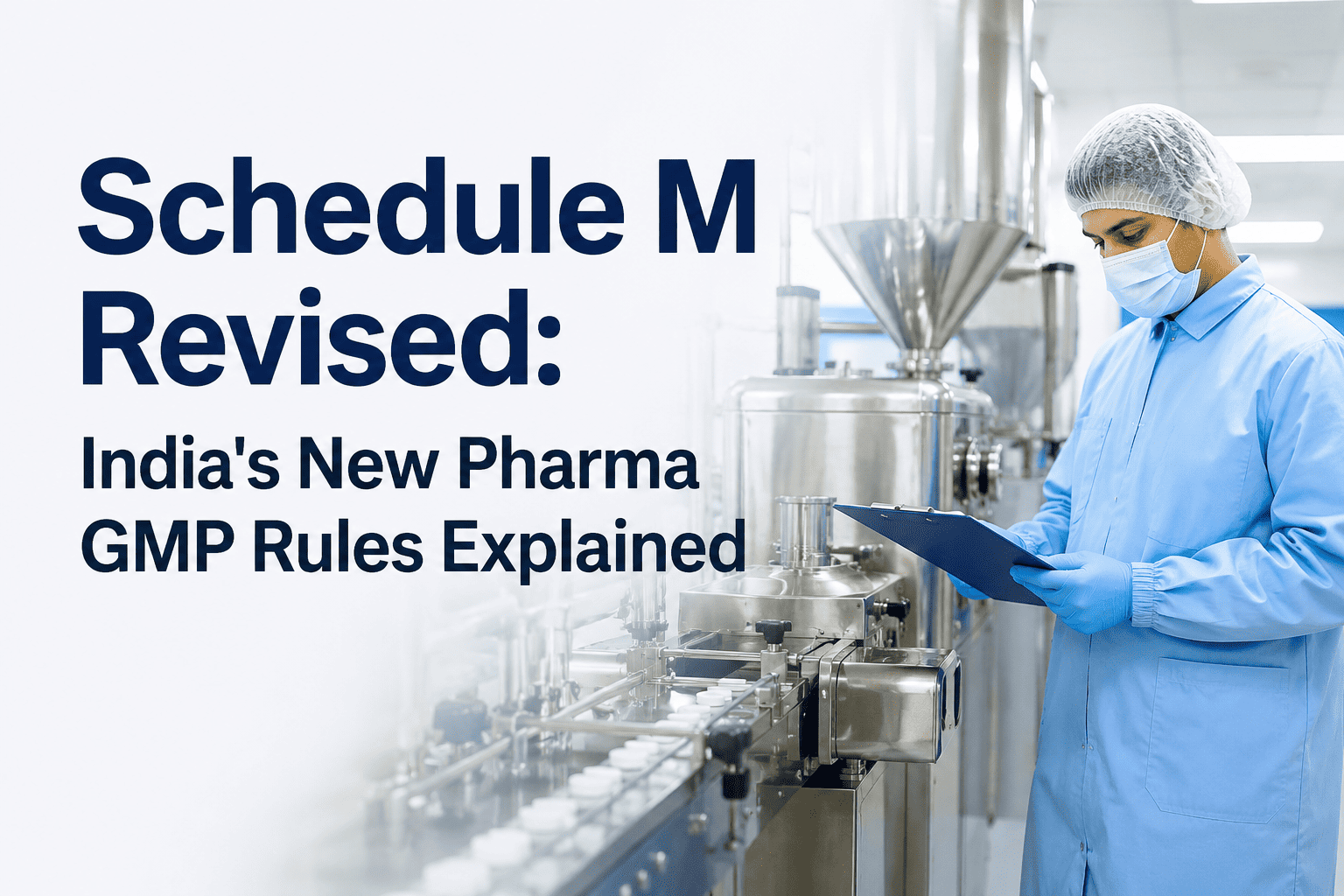
India's Revised Schedule M (2023–2024) is not an incremental update — it is a structural overhaul of Good Manufacturing Practice norms, bringing Indian standards within striking distance of EU GMP and US FDA expectations. For mid-to-large manufacturers, the financial and operational stakes are unprecedented.
Regulatory Risk
- CDSCO inspections now include unannounced audits
- Non-compliance triggers license suspension within 30 days
- Export bans for WHO-PQ certified plants on violations
Financial Exposure
- Recall costs average ₹3–8 crore per product line
- Manual batch re-verification adds 40+ labour hours per lot
- Delayed market release locks ₹1–5 crore in working capital
Competitive Opportunity
- Early adopters gain CDSCO "preferred vendor" positioning
- Compliant PQS unlocks EU/US export market access
- Automated audit trails reduce pre-inspection prep by 70%
5 Critical Requirements in Revised Schedule M You Must Implement
Pharmaceutical Quality System (PQS)
- Mandatory documented PQS aligned to ICH Q10 framework
- Management review cycles must be recorded and traceable
- CAPA system with defined timelines and effectiveness checks
Electronic Batch Manufacturing Records (eBMR)
- Paper BMRs no longer sufficient for Class A & B inspections
- Data integrity controls: 21 CFR Part 11-aligned e-signatures
- Audit trail must be tamper-proof and retrievable within 24 hours
Contamination Control Strategy (CCS)
- Written CCS document required for every product family
- Environmental monitoring linked directly to batch release logic
- Cross-contamination risk assessments must be digitally logged
Supplier Qualification & APR
- Annual Product Reviews (APR) now mandatory with trend analysis
- Raw material supplier audits must follow a documented schedule
- Certificate of Analysis (CoA) verification workflows are auditable
Personnel Competency & Training Records
- Role-based training matrices mandatory for all GMP functions
- Effectiveness assessments required post every SOP change
- Operator sign-off on critical steps must be electronically captured
Legacy Operations vs. iFactory Optimized Compliance
The gap between legacy manual operations and a digitally orchestrated compliance ecosystem is not incremental — it is existential. The table below maps precisely where your risk is concentrated today.
| Compliance Area | Legacy Friction State | iFactory Optimized Excellence | Risk Eliminated |
|---|---|---|---|
| Batch Records | Paper BMRs, manual sign-off, prone to transcription errors | eBMR with e-signatures, auto-calculated fields, tamper-proof logs | Data Integrity |
| CAPA Management | Excel trackers, missed deadlines, no effectiveness review | Workflow-driven CAPA with SLA alerts and closure validation | Audit Failure |
| PQS Documentation | Disconnected SOPs, version conflicts, no management review trail | Centralized PQS module with ICH Q10-aligned review cycles | License Risk |
| Environmental Monitoring | Manual logs, delayed entry, no batch-release linkage | Real-time EM data feeds linked to batch disposition logic | Recall Risk |
| Training Records | Paper-based matrices, unverified competencies | Digital training matrix with effectiveness scores per role | Inspector Gap |
| APR / Trend Analysis | Annual manual compilation — 3–6 weeks of analyst time | Auto-generated APR dashboards with statistical trend alerts | Delay Cost |
How iFactory Solves the Three Operational Pain Points
Staff Burnout & Manual Load
- Eliminates repetitive paper-based documentation cycles
- Auto-populates batch fields from equipment sensor data
- SOP change alerts notify only affected role-holders
- Reduces QA overtime by estimated 35% in Year 1
Batch Release & Product Throughput
- Parallel review workflows cut batch release time by 40%
- Exception-based QC reviews replace 100% manual checking
- Automated CoA generation removes 6–10 hours per lot
- Faster release = ₹50L–₹2Cr more working capital per quarter
Audit Readiness & CDSCO Confidence
- One-click audit pack generation for any inspection scope
- Immutable audit trail satisfies data integrity requirements
- Pre-mapped Schedule M checklist flags open gaps in real time
- Inspection simulation mode tests readiness before CDSCO visit
Close Your Compliance Gap Before the Next Inspection
iFactory deploys your Schedule M Workflow Pack in under 6 weeks — covering PQS, eBMR, CAPA, and audit trail infrastructure for mid-to-large Indian pharma manufacturers.
Revised Schedule M — Frequently Asked Questions
When does Revised Schedule M compliance become mandatory?
CDSCO has issued a phased compliance timeline. Large manufacturers (turnover above ₹250 crore) were required to comply by December 2024. Medium manufacturers have a 12-month extension window. However, CDSCO has signalled that inspections will not wait for the deadline — early implementation is strongly advised.
Does iFactory's platform replace our existing QMS?
No — iFactory's Schedule M Workflow Pack is designed to layer over or integrate with your existing QMS via API. It adds the Schedule M-specific workflows, eBMR modules, and CDSCO-aligned checklist engine that most legacy QMS platforms lack without a full replacement project.
How does iFactory handle data integrity requirements under Schedule M?
The platform enforces ALCOA+ principles at every data entry point — records are Attributable, Legible, Contemporaneous, Original, and Accurate. All entries carry a timestamp, user ID, and are stored in an immutable log. Book a Demo to see the data integrity architecture in action.
Can the platform generate the Annual Product Review automatically?
Yes. iFactory aggregates batch data, OOS events, CAPA records, and stability trends throughout the year. At APR time, the system generates a pre-structured report that typically reduces analyst effort from 3–6 weeks to under 5 business days. Book a Demo to preview an APR output.
What is the ROI timeline for Schedule M compliance investment?
Most plants recover implementation costs within 8–14 months through reduced labour hours, faster batch release, and elimination of penalty-driven remediation costs. The avoided cost of a single CDSCO warning letter (₹1–3 crore in legal, remediation, and market loss) alone justifies the investment.
Start Your Schedule M Compliance Journey with iFactory
Book a 30-minute Strategic Workflow Audit. Our pharma compliance architects will map your current gaps against Revised Schedule M requirements and deliver a prioritised action plan.