Every hour a paper batch record sits in a reviewer's inbox, your facility hemorrhages compliance risk, release cycle time, and revenue. The average pharma site loses 18–34 hours per batch to manual transcription, exception chasing, and audit-trail reconstruction — a silent operational bleed that compounds with every product line you scale.
Is Your Batch Record Process a Compliance Liability?
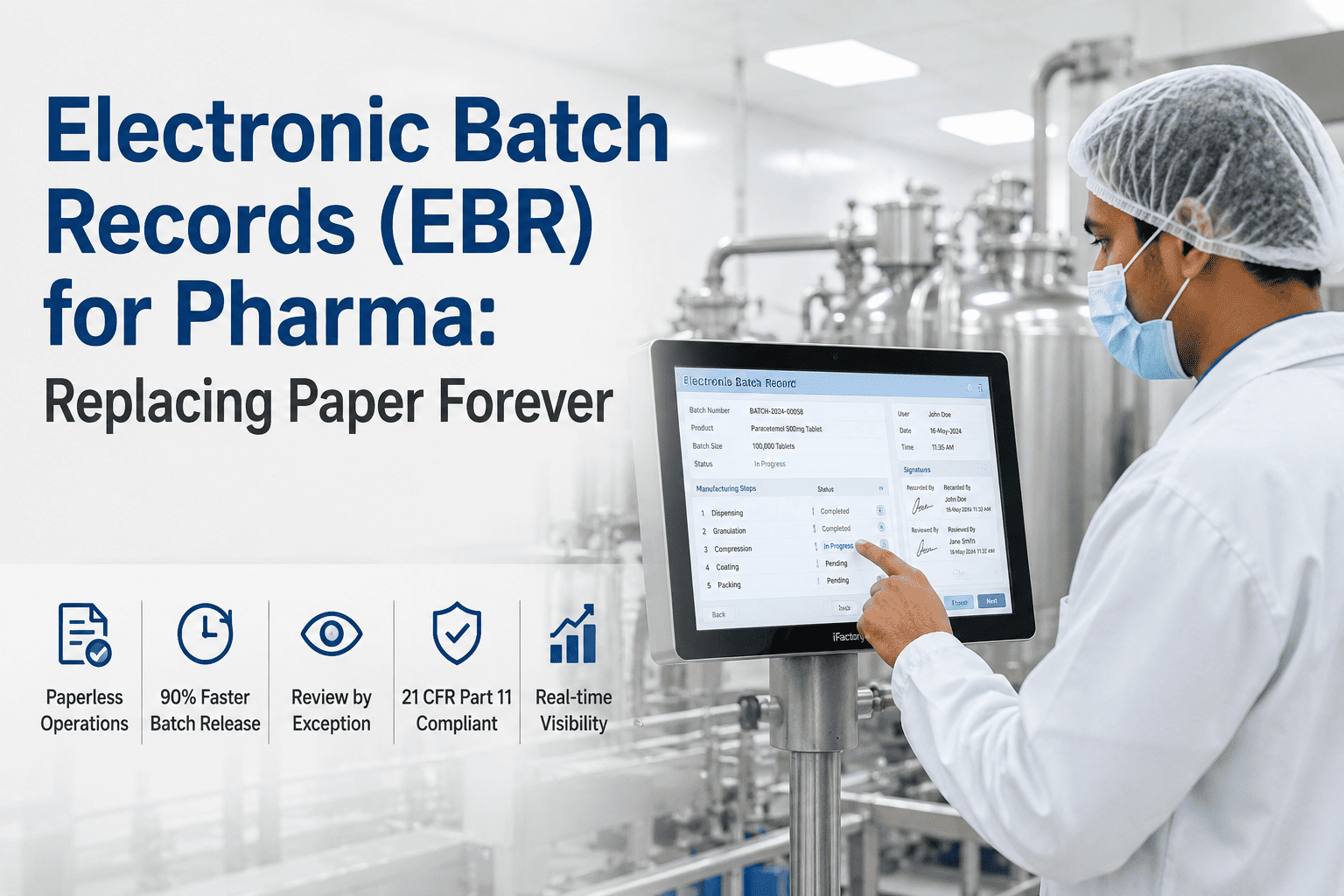
iFactory EBR delivers real-time review-by-exception, 21 CFR Part 11 compliance, and 90% faster batch release — built for regulated pharma manufacturing at scale.
What EBR Means for Your Financial and Clinical Operations
Paper-based batch records are not a process inefficiency — they are a structural liability that touches quality, revenue velocity, and workforce capacity simultaneously. iFactory's Electronic Batch Record system converts that liability into a measurable competitive advantage.
Revenue Impact
- Up to 90% reduction in batch release cycle time
- Eliminate $200K–$800K annual rework costs from paper errors
- Faster release = accelerated cash conversion per lot
- Reduce deviation handling cost by 60–70%
Compliance ROI
- Full 21 CFR Part 11 and EU Annex 11 compliance built-in
- Immutable audit trails eliminate inspection risk
- Zero-gap electronic signatures with role-based access
- Audit-ready data packages generated automatically
Scalability
- One platform scales across all product lines and sites
- Templatized master batch records deploy in hours
- Real-time visibility across multi-site networks
- MES-native integration with ERP and LIMS systems
What iFactory EBR Delivers — Feature by Clinical Outcome
Each EBR capability is engineered to eliminate a specific operational failure point. Below is a direct translation from platform feature to measurable outcome for quality, operations, and finance leaders.
| EBR Feature | Operational Outcome | Compliance Value | Financial Impact | Priority |
|---|---|---|---|---|
| Review-by-Exception | QA reviews only flagged deviations | Structured exception taxonomy | 80% faster QA cycle time | Critical |
| Electronic Signatures | Real-time step sign-off on shop floor | 21 CFR Part 11 compliant | Zero transcription errors | Critical |
| Automated Audit Trail | Immutable timestamped event log | FDA/EMA inspection-ready | Eliminate costly re-audits | Critical |
| eBMR Templating | Standardized master record deployment | Version-controlled records | 60% faster product launches | High |
| Real-Time Dashboards | Live batch status across all lines | Proactive deviation detection | Reduce batch failure rate | High |
| ERP / LIMS Integration | Bi-directional data synchronization | Single source of truth | Eliminate dual data entry costs | Standard |
The Operational Gap: Paper Friction vs. EBR Excellence
Leadership teams consistently underestimate the compounding cost of paper-based systems. This matrix maps the structural gap between legacy friction and iFactory-optimized operations across every critical quality dimension.
| Dimension | Legacy Paper Process | iFactory EBR |
|---|---|---|
| Batch Release Time | 5–15 days manual review cycle | Same-day automated review-by-exception |
| Error Detection | Post-production QA catch — often too late | In-process real-time deviation alerts |
| Audit Preparation | 2–4 weeks manual file assembly | Instant auto-generated audit packages |
| Regulatory Compliance | Risk of 483 observations and warning letters | Built-in 21 CFR Part 11 and Annex 11 |
| Data Integrity | Transcription errors average 3–5% per record | Zero-error electronic capture at source |
| Staff Utilization | 30–40% QA time spent on paper chasing | QA focused only on exception resolution |
| Scalability | Linear headcount growth per product line | Scale products without scaling headcount |
| Multi-Site Visibility | Zero real-time cross-site insight | Unified dashboard across all facilities |
Solving the Three Root Failures in GMP Manufacturing
Staff Burnout
- Eliminate manual transcription from operator workflows
- Guided step-by-step digital instructions reduce cognitive load
- Exception-only QA model cuts review backlog by 80%
- Electronic sign-off from any device — no paper queues
Patient Safety Risk
- In-process deviation alerts prevent out-of-spec lots
- Version-controlled eBMR eliminates wrong-version execution
- Real-time yield tracking flags process drift early
- Complete traceability from raw material to finished batch
Throughput Bottlenecks
- Parallel review workflows eliminate sequential delays
- Automated material reconciliation at batch close
- Same-day lot disposition for non-deviated batches
- Template reuse cuts new product record setup by 70%
Five Phases to a Fully Paperless GMP Environment
Operational Gap Audit
- Map current paper record touchpoints and error injection points
- Quantify release cycle time and deviation handling costs
- Identify top 3 compliance exposure areas for immediate EBR priority
eBMR Template Design
- Convert master batch records into validated digital templates
- Configure role-based access, e-signature rules, and exception logic
- Align record structure with 21 CFR Part 11 and ICH Q10 requirements
System Integration
- Connect EBR to ERP for material issuance and BOM reconciliation
- Integrate LIMS for automatic in-process test result population
- Configure real-time dashboard feeds for QA and operations leadership
Validation and Qualification
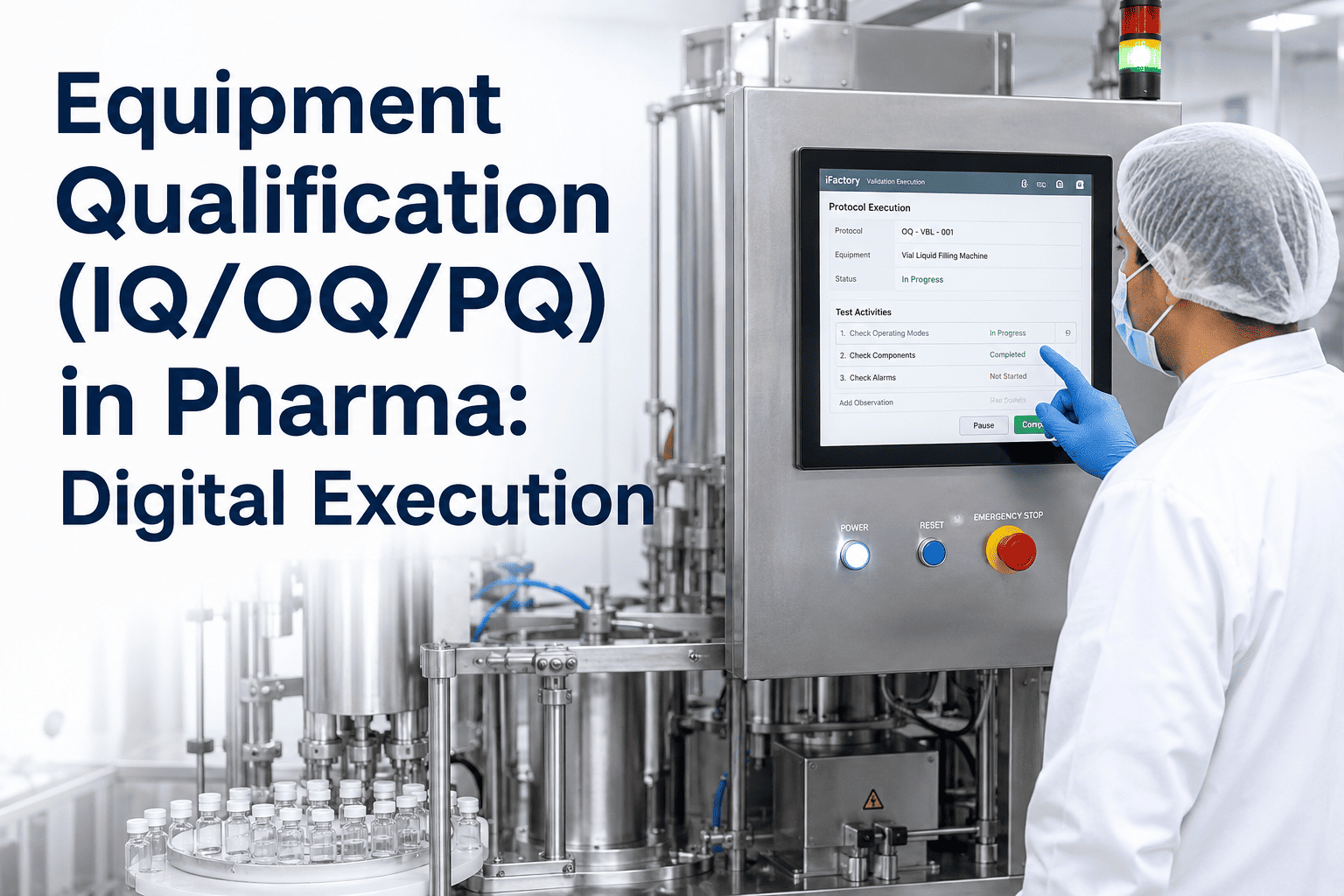
- Execute IQ, OQ, PQ protocols with pre-built validation packages
- Complete 21 CFR Part 11 risk assessment and traceability matrix
- Operator training and competency certification before go-live
Continuous Optimization
- Monitor KPIs: release time, deviation rate, and first-pass yield
- Expand EBR to additional product lines using proven template library
- Leverage batch analytics for process capability improvement (CPK)
Six Compliance Failures iFactory EBR Eliminates
Paper records allow backdating, erasure, and transcription errors that trigger FDA 483 observations and ALCOA+ violations during inspections.
Operators executing outdated master batch record versions due to manual distribution — a direct patient safety and regulatory risk.
Incomplete or missing paper records during regulatory inspections result in warning letters, import alerts, and consent decrees.
Sequential paper review queues prevent parallel QA processing, locking finished goods inventory and delaying revenue recognition for weeks.
Paper-based processes surface deviations only at batch close — when corrective action is expensive and product rejection risk is highest.
Paper systems require linear QA headcount growth per product line added — making portfolio expansion operationally and financially unsustainable.
Replace Paper Batch Records with iFactory EBR Today
Join regulated pharma manufacturers who have cut batch release time by 90%, eliminated transcription errors, and achieved full FDA and EMA compliance with iFactory's Electronic Batch Record system.
Electronic Batch Records — Frequently Asked Questions
How long does EBR validation and go-live take?
Most implementations complete IQ/OQ/PQ in 8–12 weeks. iFactory provides pre-built validation packages, reducing protocol authoring time by 60% compared to custom development approaches.
Can iFactory EBR integrate with our existing SAP or Oracle ERP?
Yes. iFactory EBR includes native connectors for SAP, Oracle, and JDE for material issuance, BOM management, and lot traceability. Book a Demo to review your integration architecture.
What does review-by-exception mean for our QA team?
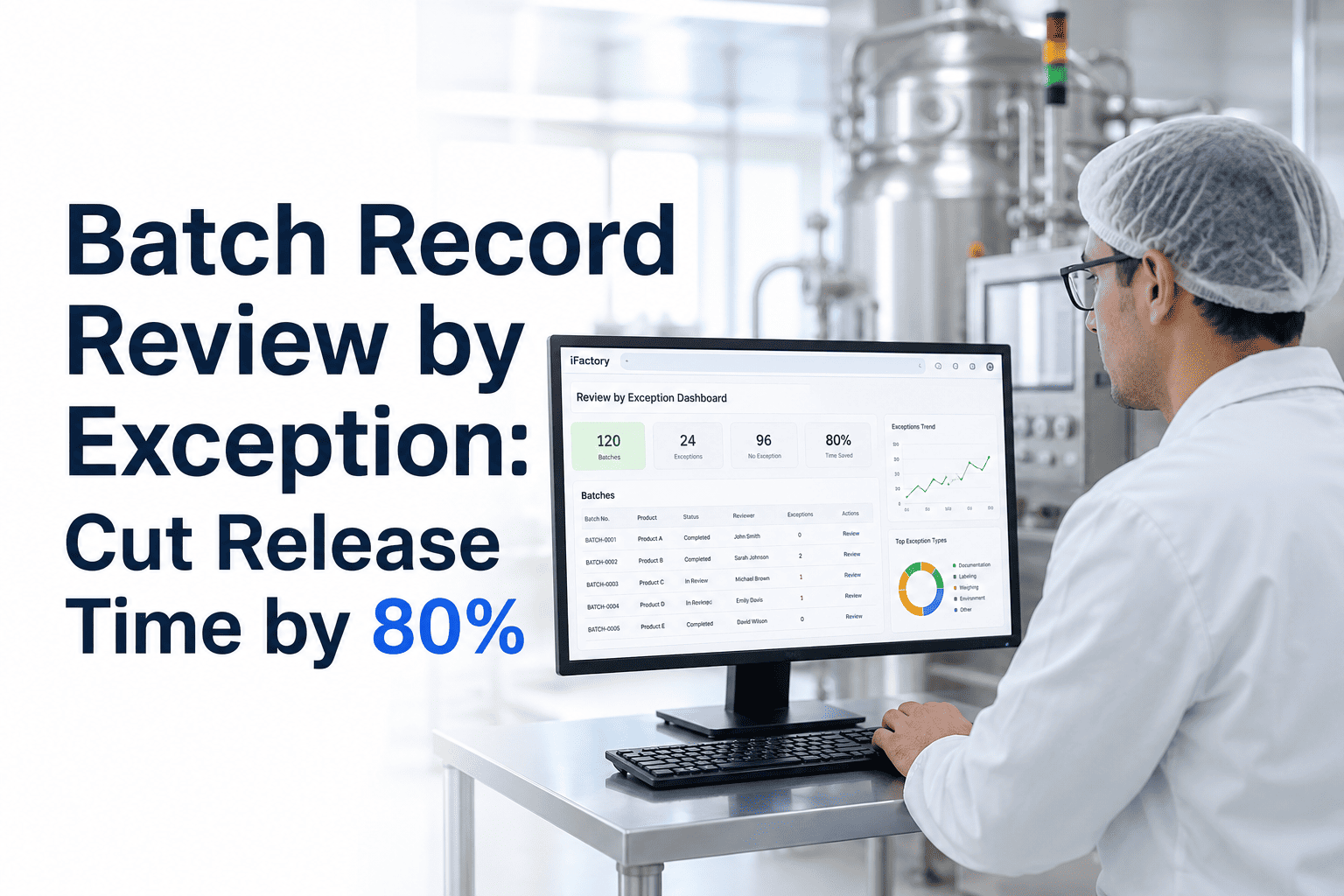
QA reviewers only see steps where the system detected a deviation or anomaly. All in-spec steps are auto-approved, eliminating the line-by-line paper review and reducing QA review time by up to 80%.
How does iFactory EBR handle hybrid paper-to-digital transitions?
iFactory supports phased rollouts where high-risk product lines go digital first. Paper and EBR records coexist during transition with unified audit trail management. Book a Demo to see our transition roadmap.
Is iFactory EBR suitable for clinical and commercial manufacturing?
Yes. The platform is purpose-built for both Phase II/III clinical supply and full commercial GMP operations, with configurable record complexity, approval workflows, and regulatory submission support.
Start Your EBR Pilot with iFactory — Zero Paper, Full Compliance
Book your demo today and see how iFactory EBR eliminates release cycle drag, closes compliance gaps, and scales across your entire manufacturing network.