In a pharma plant, a preventive maintenance checklist isn't a housekeeping document — it's a regulatory obligation and a batch-protection system at once. 21 CFR Part 211.68 requires that every piece of equipment used in drug production has written maintenance procedures and dated, signed logs, and the single most common GMP finding in FDA inspections isn't broken equipment — it's a calibration record past its due date or a maintenance task with no signature. Meanwhile the equipment itself is unforgiving: a tablet press drifting 2% out of spec never stops the line, a vacuum pump with one overdue oil change can destroy a $3M lyophilizer batch, and a blister machine's degrading seals trigger rejection an entire shift later. This checklist maps daily, weekly, monthly, quarterly, and annual PM tasks across the equipment a pharma maintenance team actually lives with — HVAC, tablet presses, blister lines, fillers, and lyophilizers. To turn these tasks into scheduled, auto-documented, audit-ready work orders, book a demo.
MAINTENANCE RELIABILITY · PHARMA PM CHECKLIST
The Pharma PM Checklist That Protects Both the Batch and the Audit.
A daily, weekly, monthly, quarterly, and annual PM cycle for HVAC, tablet presses, blister lines, fillers, and lyophilizers — mapped to GMP documentation requirements. Because in pharma, a missed PM isn't just downtime; it's a rejected batch, a QA investigation, and a 483 finding waiting to happen.
211.68
The CFR rule mandating written PM procedures and signed logs
$3M+
A single lyophilizer batch loss in biologics
±0.5%
Tablet weight spec a worn punch pushes a batch past
#1 finding
Overdue calibration — the most common GMP inspection citation
Why a Pharma PM Checklist Is Different From Everyone Else's
In most industries, a missed PM means a machine runs a little rougher until someone gets to it. In pharma, the same missed PM can mean a discarded batch, a QA investigation, and a six-figure compliance incident — because the equipment produces a regulated product and the maintenance record is itself part of the compliance evidence. A pharma PM checklist has to do two jobs at once: keep the equipment reliable, and generate the contemporaneous, signed, traceable documentation that FDA, EMA, and WHO auditors expect to see. Get the first right and miss the second, and you still have a finding.
This dual burden is what separates pharma maintenance from every other kind. A commercial-building maintenance team optimizes for uptime and cost. A pharma team optimizes for uptime, cost, and provable compliance simultaneously — and the compliance dimension is unforgiving in a way the others aren't, because it's judged after the fact by an inspector reading records, not by whether the plant ran. An auditor who finds a world-class machine with a gap in its maintenance log will write up the gap, not credit the machine. That reality shapes every choice in a pharma PM program, from how tasks are scheduled to how their completion is recorded.
The Documentation Is the Deliverable
A filter change with no lot number, a calibration with no reference standard, a PM task with no technician signature — each is a GMP deviation regardless of whether the equipment functioned perfectly. Under 21 CFR Part 211.68, the record isn't proof the work happened; the record is the work, and paper logs are exactly where those signatures and references go missing.
Failures Are Silent and Expensive
A tablet press running 2% out of spec doesn't stop the line — it just quietly produces out-of-spec tablets until a weight check catches it. A vacuum leak on a lyophilizer isn't obvious until the batch collapses. The failures that matter most in pharma are precisely the ones that give no dramatic warning, which is why interval-based PM matters so much.
Calibration Is on the Clock
Temperature sensors, pressure gauges, speed encoders, and force sensors all carry a calibration due date, and an instrument past that date is an automatic finding — the most common one auditors write up. A PM program that doesn't track calibration currency as rigorously as it tracks mechanical tasks is leaving its most-cited exposure unmanaged.
Frequency Follows Risk, Not the Calendar
The right PM interval isn't a flat monthly rule — it's daily cleaning where residue builds, hours-based oil changes where a pump logs runtime, and condition-based checks where wear is visible. A good pharma checklist maps each task to the frequency its failure mode actually demands, so critical tasks aren't diluted by trivial ones.
The costliest pharma maintenance events almost always trace to a preventable, scheduled task that slipped — an overdue oil change, a deferred HEPA test, an uncalibrated sensor. None of them were unknowable, and none of them were beyond the team's skill to prevent. They were simply not tracked in a system that made the deadline unmissable. That's what a real PM checklist, executed digitally, changes.
The PM Cycle by Frequency
Preventive maintenance in a pharma plant runs on nested cycles — quick daily checks that catch fast-moving issues, deeper interventions that follow as wear accumulates, and major overhauls timed to validated intervals. This is the frequency backbone every equipment checklist below hangs on, from a two-minute daily wipe-down to an annual qualification review.
DAILY
Autonomous & Point-of-Use Checks
Short operator-led tasks at the start or end of each shift: punch face and contact-part cleaning, HVAC differential-pressure logging, visual inspection for leaks or abnormal noise, and confirmation that alarms are clear. These take minutes but catch the fast-moving problems — residue buildup, a drifting pressure reading — before they compound into a batch issue.
WEEKLY
Technician Inspection & Measurement
Structured technician PM: lubrication of designated points, sensor calibration checks, cup-depth and tooling measurement, belt tension and seal inspection. This is where geometric wear gets caught with an instrument rather than an eye — trended over weeks so a slow drift toward an out-of-spec condition is visible before it crosses the line.
MONTHLY
Component & Wear-Part Review
Deeper component inspection: wear-part condition assessment, filter differential-pressure review against replacement thresholds, gasket and seal integrity, drive-system condition. Monthly is the cadence where consumables get evaluated for replacement based on measured condition rather than assumption, and where trends from weekly readings get acted on.
QUARTERLY
Deep PM & Vibration Analysis
Resource-intensive interventions requiring planned downtime: platen and seal servicing, vibration analysis on fans and drives, full lubrication of high-count points, and deep cleaning of internal assemblies. These are the tasks too disruptive for weekly cadence but too important to defer to annual — the ones scheduling pressure most often pushes back at real risk.
ANNUAL
Overhaul, Requalification & Calibration
Major scheduled work tied to validated intervals: pump rebuilds, full instrument recalibration traceable to standards, requalification review, and comprehensive overhaul of critical assemblies. Annual PM is where qualification status is renewed and the equipment's compliance clock is reset — the interval a deferral turns into overdue-qualification non-compliance.
Turn This Checklist Into Scheduled, Signed Work Orders
Bring your equipment list and current PM intervals to the call. iFactory engineers will show how each task below becomes an auto-scheduled work order with SOP steps, mandatory sign-off, and calibration tracking — so nothing slips and every record is audit-ready.
Equipment-Specific PM Checklists
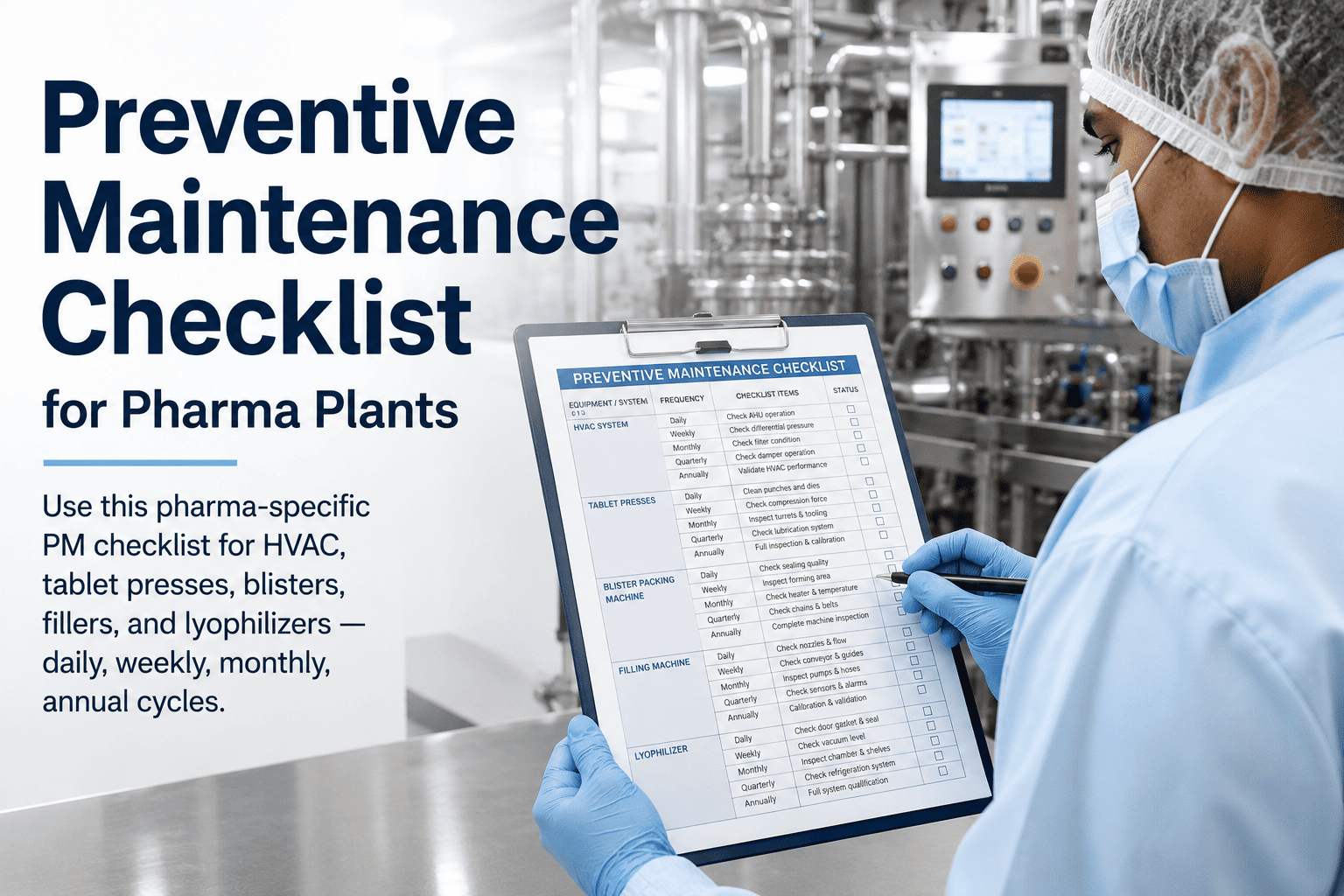
The frequency cycle above applies differently to each machine, because each has its own failure modes and its own regulatory-critical parameters. Below is the PM task set for the five equipment types a pharma maintenance team deals with most, mapped to the interval each task actually demands. Treat these as a starting framework to adapt to your OEM manuals and validated procedures — the intervals reflect common pharma practice, but your specific products, solvents, and duty cycles will refine them.
Cleanroom HVAC & AHUs
Contamination control
DailyLog zone differential pressures against setpoint; confirm cascade direction; check for alarms.
WeeklyInspect belt tension and condition; check fan bearing vibration; verify damper actuator response.
MonthlyReview filter differential pressure against replacement threshold; inspect drain pans and coils.
QuarterlyVibration analysis on fans and motors; damper stroke test through full travel; deep coil cleaning.
Semi-annual / AnnualHEPA integrity testing by aerosol challenge; full sensor recalibration; airflow requalification.
Tablet Presses
Weight & content uniformity
DailyClean punch faces to remove residue; verify compression force monitoring; check weight against spec.
WeeklyMeasure cup depth for geometric wear; apply zone-specific lubrication; inspect cam tracks and fill shoe.
MonthlyInspect punches and dies for wear beyond tolerance; check compression rollers; review force-sensor trend.
QuarterlyDeep-clean turret; inspect drive and gearbox; verify anti-vibration and tooling alignment.
AnnualRecalibrate force sensors and weight-check instruments traceable to standards; overhaul as required.
Blister Packaging Machines
Seal integrity & throughput
DailyOperator autonomous maintenance (10–15 min): clean forming area, check web feed, verify seal appearance.
WeeklyTechnician PM (45–60 min): lubricate designated points; calibrate sensors; check heating-station temps.
MonthlyInspect forming and sealing tooling for wear; verify vision-inspection and rejection function.
QuarterlyDeep PM (4–8 hr): vibration analysis, platen and seal servicing, full lubrication of 200+ points.
AnnualRecalibrate temperature, pressure, and speed controls; vacuum leak test; requalification review.
Liquid & Powder Fillers
Fill accuracy & sterility
DailyVerify fill-weight accuracy and checkweigher rejection; inspect nozzles for drip or blockage.
WeeklyClean contact parts per SOP (CIP where applicable); inspect seals and gaskets; check degassing.
MonthlyInspect pumps and dosing systems for wear; verify reject-mechanism reliability; check drive condition.
QuarterlyService filling pumps; inspect fill-path integrity; deep-clean and sanitize per validated procedure.
AnnualRecalibrate checkweigher and dosing instruments; overhaul dosing assemblies; requalify fill accuracy.
Lyophilizers (Freeze Dryers)
Vacuum, condenser & shelf temp
Per batch / DailyClean chamber and condenser; check vacuum pump oil level; review alarm history before critical batches.
WeeklyInspect door and manifold gaskets for leaks; verify condenser performance; check drain lines are clear.
MonthlyVacuum integrity leak test; inspect valves and seals; defrost condenser per recommended schedule.
Runtime-basedChange wet vacuum pump oil every 2,000–3,000 operating hours (sooner with non-water solvents).
AnnualRebuild vacuum pump; calibrate shelf and product temperature sensors (±0.5°C); service refrigeration.
Paper Checklist vs Digital PM Execution
A checklist on paper documents what happened; it doesn't ensure it happens, and it doesn't stop a task from slipping. The same checklist executed through a digital CMMS becomes a schedule that enforces itself and a record that assembles itself. The difference is what stands between a maintenance team and a 483 finding.
Every one of the top GMP maintenance findings — overdue calibration, unsigned records, undocumented changes — is a documentation failure, not a mechanical one. A digital PM system closes them not by doing the maintenance differently, but by making the record a mandatory, automatic byproduct of the work rather than a separate task that competes with it.
What Digital PM Changes for the Maintenance Team
Moving this checklist from paper to a CMMS doesn't add work — it removes the administrative burden that surrounds the work, and gives the team the enforcement and documentation that a pharma environment demands. The four changes below are what a maintenance team notices first once the checklist is executing digitally rather than sitting in a binder.
01
No Task Slips Silently
Every PM is auto-scheduled by its interval — calendar, runtime hours, or batch count — and an overdue task escalates the moment it passes due rather than surfacing during an audit. The failures that cost the most in pharma are the ones that slipped unnoticed, and this is the mechanism that makes slipping visible.
02
The Record Writes Itself
Documentation is captured at the point of work with mandatory sign-off, lot numbers, calibration references, and photos — so the contemporaneous, signed record GMP requires is a byproduct of doing the task, not a separate paperwork exercise that competes for the technician's time and gets shortcut under pressure.
03
Out-of-Range Is Caught at Entry
When a technician records a cup-depth measurement, a filter ΔP, or a shelf-temperature reading, the system validates it against spec instantly and flags an out-of-range value on the spot — turning a routine data-entry step into an early-warning check that catches drift before it becomes a deviation.
04
Audit Prep Becomes a Search, Not a Scramble
Because every task, signature, and calibration reference is captured as it happens and tied to its asset, showing an inspector a complete, trended maintenance history is a query rather than a week of reconstruction. Inspection readiness stops being an event you prepare for and becomes a state you're always in.
How iFactory Deploys This Checklist
The checklist above becomes a live PM program in days rather than months, because the tasks are standard pharma practice — the work is mapping them to your specific assets, intervals, and SOPs.
1
Register Assets & Qualification Status
Every tablet press, blister line, filler, lyophilizer, and AHU is registered with its qualification status, calibration currency, and linked SOPs, so PM tasks attach to a compliance-aware asset record from the start rather than a bare equipment list.
2
Map Tasks to Intervals
Each PM task is set to its correct trigger — daily, weekly, monthly, quarterly, annual, or runtime-based for items like vacuum-pump oil — so a batch-count or hours-based task fires on actual usage, not just a calendar the equipment doesn't follow.
3
Build SOP Steps & Sign-Off
Approved SOP steps, required measurements with spec limits, and mandatory technician sign-off are built into each work order, so execution and documentation happen together and out-of-range readings are flagged at the moment of entry.
4
Go Live With Mobile Execution
Technicians receive and close PM work orders on mobile at the point of work, capturing readings, photos, and signatures in real time — while calibration due dates and overdue tasks surface automatically to keep the program continuously audit-ready.
Frequently Asked Questions
The questions pharma maintenance and reliability teams ask most often when building or digitizing their preventive maintenance program.
How do we set the right PM frequency for each piece of equipment?
Frequency should follow the failure mode, not a flat calendar rule. Fast-building issues like tablet-press residue or HVAC pressure drift need daily checks; geometric wear like punch cup depth suits weekly measurement; consumables like filters and vacuum-pump oil are best triggered by measured condition or runtime hours rather than a date. The checklist above maps each task to the interval its failure mode actually demands, and a digital system lets you mix calendar, runtime, and batch-count triggers on the same asset. To tune intervals to your specific equipment and usage,
book a demo.
Will a digital PM checklist actually satisfy 21 CFR Part 211 and Part 11?
That's the core reason to move off paper. 21 CFR Part 211.68 requires written maintenance procedures and dated, signed logs, and Part 11 governs electronic records and signatures — so a compliant system captures each task against its SOP with a timestamped, attributable electronic signature that can't be altered or removed. Filter changes record lot numbers, calibrations record their reference standard, and every entry ties to the asset and its qualification status. The result is exactly the contemporaneous, traceable record auditors expect, generated automatically rather than reconstructed, which closes the documentation gaps that produce most findings.
What happens if a PM task is missed or a calibration goes overdue?
In a paper system, a missed task or overdue calibration is typically discovered during an audit — the worst possible moment. In a digital system, an overdue PM escalates automatically the moment it passes its due date, and calibration due dates surface with lead time before they lapse, so the team can act before the equipment falls out of qualified status. This matters because overdue calibration is the single most common GMP inspection finding, and it's almost always a tracking failure rather than a technical one — the instrument was fine, but nobody flagged the date. Automated tracking removes that failure mode entirely.
Should we run predictive maintenance instead of this preventive checklist?
The best pharma strategy is a validated hybrid, not one or the other. Preventive maintenance satisfies the regulatory obligation and produces the audit-ready completion records GMP requires, while predictive monitoring sits on top to catch failures that develop between PM intervals. You keep the compliance the checklist provides and add the reliability that continuous monitoring provides. Starting with a solid, digitally executed PM program is the right foundation — it gives you the documentation and discipline first, and predictive layers on cleanly once the asset records and intervals are established. Contact
iFactory support to discuss where predictive fits your equipment.
How long does it take to move our paper checklist into a CMMS?
Setup is typically measured in days rather than months, because the PM tasks themselves are standard pharma practice — the work is mapping them to your specific assets, intervals, and SOPs, and migrating existing asset data from legacy systems. Assets are registered with qualification and calibration status, each task is set to its correct trigger, SOP steps and sign-off are built in, and technicians go live on mobile execution. Because the checklist content is already well understood, the effort concentrates on configuration and data migration rather than reinventing procedures, which is why pharma teams see a working program quickly rather than after a long implementation.
MAKE EVERY PM UNMISSABLE AND EVERY RECORD AUDIT-READY
Turn Your Pharma PM Checklist Into a System That Enforces Itself.
Auto-scheduled tasks by interval and runtime, SOP-driven execution with mandatory sign-off, out-of-range flagging at entry, and calibration tracking that never lapses unseen — across HVAC, tablet presses, blister lines, fillers, and lyophilizers. Protect the batch and pass the audit at once.