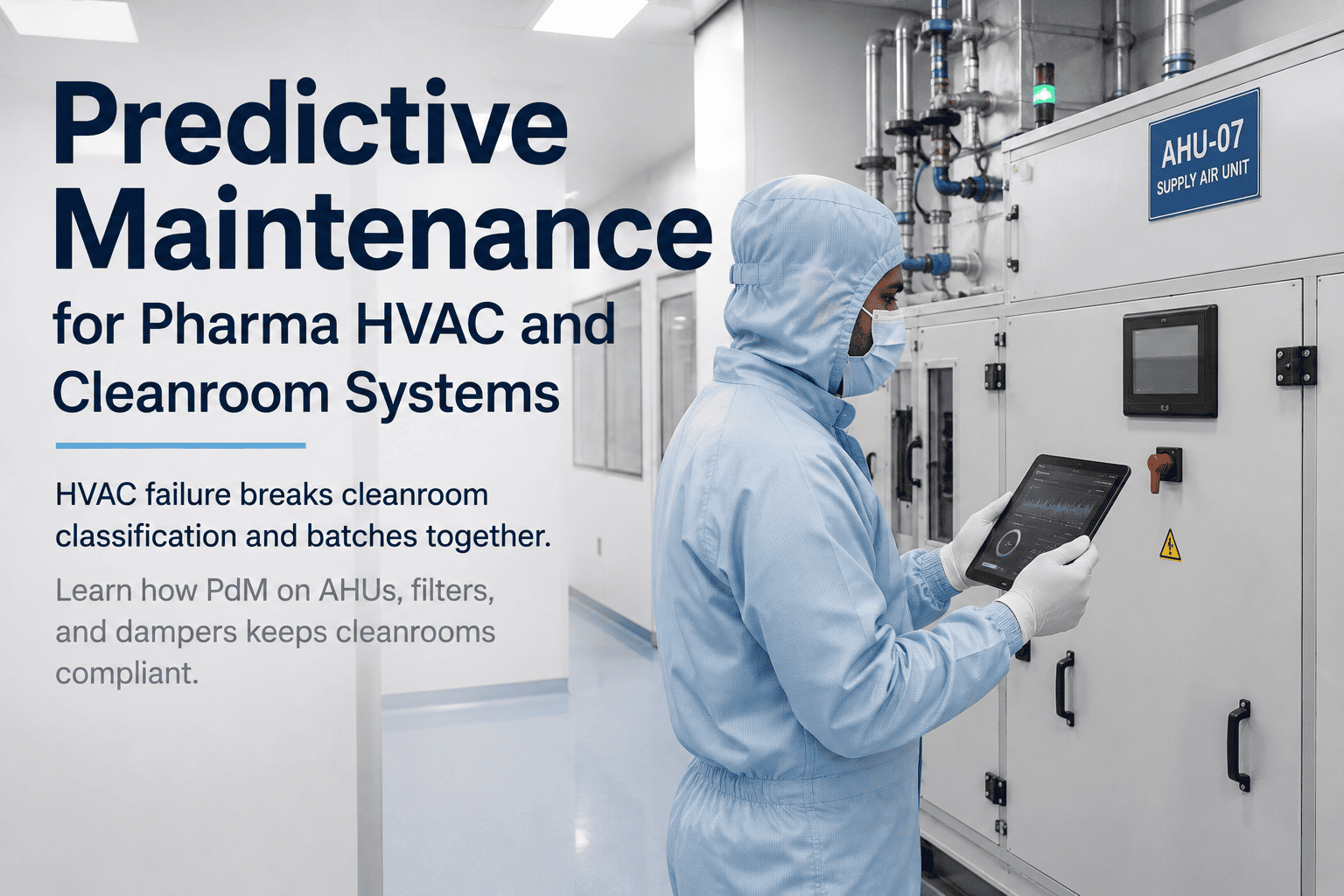
In a pharmaceutical cleanroom, the HVAC system isn't building infrastructure — it's a direct-impact contamination control system regulated under 21 CFR Part 211, EU GMP Annex 1, and ISO 14644. When an AHU fan bearing seizes or a pressure cascade collapses, you don't just lose an air handler; you lose the cleanroom's classification and every batch running in it. A single contaminated sterile batch costs $1–2 million before you count the recall, the regulatory fallout, and the requalification. And the cruel part for a maintenance team is that these failures are slow and silent: a bearing degrades over weeks, a damper drifts over months, a filter loads gradually — none of it trips an alarm until the zone is already out of spec. Predictive maintenance changes that math by watching the AHU's failure signatures continuously, so a maintenance team gets 4 to 12 weeks of warning instead of a 2 a.m. batch loss. To see PdM running on your own AHUs, filters, and dampers, book a demo.
MAINTENANCE RELIABILITY · PHARMA CLEANROOM HVAC
When the AHU Fails, the Cleanroom Classification and the Batch Fail Together.
Pressure cascades collapse gradually as filters load, dampers drift, and AHU performance degrades — often without triggering a single alarm. Predictive maintenance on bearings, belts, filters, and dampers catches the failure signature weeks before it compromises your ISO classification, so your maintenance team schedules the fix instead of explaining the deviation to an inspector.
$1–2M
Cost of a single contaminated sterile batch, before recall
4–12 wks
Early warning most AHU failures give before total loss
10–15 Pa
Pressure differential required between adjacent cleanroom grades
3–5×
Cost of emergency AHU repair vs planned intervention
Why Cleanroom HVAC Failures Are Invisible Until They're Catastrophic
A cleanroom is a controlled environment right up until the moment it isn't — and the transition is almost never announced. Cleanroom pressure differentials between zones degrade gradually as filter loading increases, duct dampers drift, and AHU performance deteriorates. Without continuous monitoring tied to an alarm and response system, a facility can operate with a reversed or collapsed pressure cascade for extended periods, compromising zone classification and contamination control without triggering any visible alert. For a maintenance team running daily spot checks and manual rounds, the drift happens entirely between readings.
What makes this uniquely dangerous in pharma is that the consequences don't stay mechanical. In a commercial building, a degraded AHU means comfort complaints and an energy penalty. In a sterile manufacturing suite, the same degradation is a contamination pathway that puts product sterility, regulatory standing, and ultimately patient safety at risk. The HVAC system is not utility infrastructure supporting the process — it is part of the process, a direct-impact system whose performance determines whether a batch is releasable. That reframing is why reactive schedules and manual rounds, adequate almost anywhere else, fall short of what a GMP cleanroom actually requires.
Pressure Cascade Collapse
A 5 Pa deviation can fail an inspection. As filters load and dampers drift, the differential between a cleaner zone and its neighbor erodes until the cascade reverses — pulling unclassified air into the classified zone. It's a contamination event that leaves no mechanical alarm, only a failed environmental monitoring result after the batch is already exposed. By the time the excursion shows up in the data, the contamination pathway has often been open for hours.
HEPA Filter Bypass
HEPA filters aren't changed on a calendar — they're tested for integrity by aerosol challenge. A single bypass path in a filter housing lets unfiltered air carrying viable and non-viable particles pass directly into the classified zone, which is an immediately reportable GMP deviation. Gradual ΔP drift toward that failure is invisible to a spot check but obvious on a trend.
The Silent Bearing
Fan and motor bearing failure is one of the top causes of unplanned AHU shutdowns, and a seized fan instantly cuts conditioned, filtered air to the zone it serves. The vibration signature climbs for weeks before the seizure — but a monthly manual round samples that trend far too coarsely to catch it before the failure lands mid-batch.
Undocumented Maintenance
The most frequently cited GMP HVAC finding in FDA inspections isn't equipment failure — it's undocumented maintenance. A filter change with no lot number, a HEPA test with no calibration reference, a pressure check with no technician signature: each is a deviation regardless of whether the equipment worked. Paper logs document failures after the fact; they don't prevent them, and they're the exact records that go missing when an inspection arrives unannounced.
The regulatory framework leaves no room for "the equipment was fine." A 5 Pa pressure deviation can fail an inspection, a failed HEPA filter can quarantine a quarter's production, and a consent decree can halt the line entirely. For a maintenance team, the job isn't just keeping the AHU running — it's proving, continuously and on the record, that the cleanroom never left its qualified state.
The AHU Failure Chain, and Where PdM Intercepts It
Every catastrophic cleanroom HVAC event traces back to a small, predictable mechanical failure that was detectable weeks earlier. The value of predictive maintenance is that it watches each of these failure modes continuously and catches the signature while the fix is still a scheduled task. These are the components a maintenance team lives with — and the specific signals that give them lead time. None of these failure modes are exotic; what's changed is the ability to read their early warning continuously instead of sampling it once a round.
FAN & MOTOR BEARINGS
Vibration signature trending
IoT vibration sensors on fan and motor bearings continuously measure the signature and distinguish normal operation from early-stage bearing defects, imbalance, and misalignment. FFT spectrum analysis identifies the specific fault — 1× RPM for imbalance, 2× with high axial for misalignment, non-synchronous bearing defect frequencies for a failing bearing — with alert and alarm thresholds that flag degradation weeks before the bearing seizes and drops the zone.
DRIVE BELTS
Tension, slip & motor current
A slipping or glazing belt drops airflow below design, which quietly weakens the pressure cascade the belt's fan is supposed to sustain. Belt dust, a rising vibration signature, and motor running amps climbing above nameplate all signal degradation early. Tracking belt service history and tension trends per asset means a scheduled belt change during planned downtime — not a snapped belt that collapses airflow to a classified zone mid-shift.
HEPA & PRE-FILTERS
Differential pressure trend
Filter loading is read as a differential-pressure trend rather than a calendar date. AI trained on ΔP trends and incoming air conditions predicts when each filter bank will reach its replacement pressure, enabling advance parts ordering and a scheduled change before rising static pressure starves the cascade. Trending ΔP also surfaces the abnormal drop that can indicate a developing bypass path long before an integrity test is due.
DAMPERS & ACTUATORS
Stroke test & position drift
A damper that drifts, binds, or seizes changes the airflow balance that holds the pressure cascade in place, and a stuck damper is one of the quietest ways a cascade degrades. Automated damper stroke tests verify full travel from closed to open and flag binding or seized blades before position drift shifts the differential out of its qualified range — catching the mechanical cause of a pressure problem before it becomes an environmental one.
See PdM Running on Your Cleanroom AHUs
Bring your AHU list, cleanroom zone map, and current pressure setpoints to the call. iFactory engineers will show how vibration, ΔP, and damper monitoring map onto your specific units — and where your existing manual rounds are leaving blind spots between readings.
Spot Checks vs Continuous PdM: The Same AHU, Two Outcomes
The difference between a manual-rounds program and continuous predictive maintenance isn't diligence — the technicians are equally skilled. It's sampling rate. A degradation that unfolds over weeks is invisible to a monthly check but plainly visible to a sensor reading it continuously. The comparison below follows one failing fan bearing through both approaches.
Most critical AHU failures — belt snaps, bearing seizures, actuator failures — announce themselves 4 to 12 weeks before total loss of function. Continuous monitoring is simply the difference between reading that warning and missing it. For a maintenance team, it converts the worst kind of work — the 2 a.m. emergency that also became a quality event — into a routine line on next week's schedule.
PdM That's Built for GMP, Not Just Uptime
In a pharma cleanroom, keeping the AHU running is only half the job — the other half is proving the cleanroom never left its qualified state, on a record an inspector will accept. This is where PdM for pharma diverges from generic HVAC monitoring: every signal, every intervention, and every filter change has to carry its compliance context with it, because undocumented maintenance is itself a deviation. A perfectly executed HEPA change that isn't documented with its lot number and calibration reference is, to an inspector, indistinguishable from one that never happened.
01
Assets Registered to Zone & Classification
Every HVAC asset is registered against its cleanroom zone and ISO classification — AHUs, HEPA housings, pressure sensors, particle counters. Qualification status and calibration currency live on each asset record, so QA and engineering see compliance status across the facility in real time rather than assembling it before an audit.
02
Every Intervention Documented by SOP
Each PM and repair is completed against its approved SOP with technician sign-off, and filter changes capture lot numbers, HEPA tests capture the calibration reference, and pressure checks capture the signature — closing the exact documentation gaps that generate the most common GMP HVAC findings.
03
Qualification Status Never Goes Overdue Unseen
Resource-intensive tasks like semi-annual HEPA integrity testing are tracked so a deferral never silently becomes overdue qualification status — a direct non-compliance. The system surfaces approaching intervals with enough lead time to schedule around production rather than defer under pressure.
04
One Auditable View Across Every Zone
AHU performance, pressure cascade monitoring, and predictive signals converge into a single compliance-grade record instead of living in separate silos. When an inspector asks to see that a zone held its classification through a batch, the evidence is already assembled — trended, timestamped, and tied to the asset.
What Changes for the Maintenance Team
Predictive maintenance doesn't just protect batches — it changes the daily reality of the people keeping the cleanroom qualified, moving them out of reactive firefighting and giving them the record they've always needed to defend their work.
01
Fewer 2 A.M. Emergencies
When a bearing signature or filter ΔP trend flags weeks ahead, the work moves onto a planned schedule during downtime instead of erupting as an after-hours emergency that also became a quality event. The team's calendar fills with scheduled interventions, not surprise callouts.
02
Manual Rounds Cut, Coverage Raised
Continuous sensor monitoring reduces manual inspection rounds substantially while raising the actual coverage, because a sensor reads a trend every minute where a technician read it once a month. The team spends its time on interventions that matter rather than on rounds that mostly confirm nothing changed — and the readings that do get taken feed a trend line instead of a pass/fail checkbox that forgets everything the moment it's marked.
03
Parts Ready Before the Change
Predicting when a filter bank reaches replacement pressure or a belt reaches end of life means the part is ordered and staged before the scheduled change — so a planned intervention never stalls waiting on a spare, and an overnight failure never happens for lack of one on the shelf.
04
Audit Prep Stops Being a Scramble
Because every intervention is documented by SOP with the required references as it happens, inspection readiness is continuous. The team stops losing days reconstructing maintenance records before an audit and can instead show a complete, trended history on demand.
How iFactory PdM Deploys on a Running Facility
Predictive maintenance layers onto an operating cleanroom without disrupting the qualified state — it reads the AHUs you already run and adds the continuous signals your manual rounds can't provide. Because it builds on existing BAS points and mounts sensors outside the classified airstream, the rollout is a monitoring project rather than a mechanical modification, which is what keeps the qualified state intact throughout.
1
Asset & Zone Mapping
Every AHU, filter housing, pressure sensor, and damper is registered against its cleanroom zone, ISO classification, and current qualification status — building the compliance-aware asset foundation that PdM signals attach to.
2
Sensor & BAS Integration
Vibration sensors on fan and motor bearings, differential-pressure readings from filters and zones, and damper position data are integrated — pulling from existing BAS points where available and adding IoT sensors only where a real coverage gap exists.
3
Baseline & Threshold Setup
Per-asset vibration and ΔP baselines are established and alert and alarm thresholds set to your cleanroom's tolerances, so a flag fires with enough lead time to schedule the fix rather than react to a breach already underway.
4
Predictive Work Orders Go Live
A degrading signature auto-generates a severity-classified work order against the named asset, complete with its SOP and compliance context, so the maintenance team acts on a documented, planned task months before the component would have failed.
Frequently Asked Questions
The questions maintenance and reliability teams in pharma ask most often before adding predictive maintenance to their cleanroom HVAC systems.
Does adding PdM sensors risk disturbing our qualified cleanroom state?
No — PdM is designed to layer onto a running, qualified cleanroom without disrupting it. Much of the required data already exists in your building automation system, and where physical sensors are needed, vibration monitoring mounts on fan and motor bearings outside the classified airstream, not inside the clean zone. The deployment reads existing pressure and airflow signals rather than altering the HVAC balance, so the qualified state is preserved while the continuous monitoring layer is added on top. To review what your specific setup already exposes,
book a demo with your zone map on hand.
How is this different from the environmental monitoring we already run?
Environmental monitoring tells you the result — a particle count, a pressure reading, a temperature at a point in time. It confirms whether the cleanroom is in spec right now, but it doesn't tell you the AHU bearing driving that zone is three weeks from seizing. PdM watches the mechanical failure signatures upstream of the environmental result, so you catch the cause before it becomes a monitoring excursion. The two are complementary: environmental monitoring proves the state, and predictive maintenance protects it by flagging the equipment degradation before it shows up as a failed reading. Run together, they close the loop between the mechanical cause and the environmental consequence that separate systems leave open.
Will the maintenance records actually satisfy an FDA or EU GMP inspector?
That's a core design goal, because the most cited GMP HVAC finding is undocumented maintenance, not equipment failure. Every intervention is completed against its approved SOP with technician sign-off, filter changes capture lot numbers, HEPA tests capture the calibration reference, and pressure checks capture the signature — all timestamped and tied to the asset's zone and qualification status. The result is a continuous, trended, audit-ready record rather than a set of paper logs reconstructed before an inspection, which is exactly the documentation trail that closes the deviations inspectors most frequently write up.
How much lead time does PdM actually give before an AHU failure?
Most critical AHU failures — belt snaps, bearing seizures, actuator failures — develop over 4 to 12 weeks before total loss of function, and continuous monitoring is what turns that window from invisible into actionable. A vibration signature climbs steadily as a bearing degrades, and a filter's differential pressure trends predictably toward its replacement point, so both are flagged well before failure. The exact lead time depends on the component and how fast the specific degradation is progressing, but the entire point is converting a sudden mid-batch failure into a scheduled task with weeks of planning room. Contact
iFactory support to discuss typical lead times for your specific AHU types and operating conditions.
Can this predict pressure cascade problems, or only individual component failures?
Both, because the two are connected — a pressure cascade rarely collapses on its own; it degrades because a filter loaded, a damper drifted, or a fan lost airflow. By monitoring the component-level causes continuously, PdM catches the mechanical drivers before the cascade itself moves out of range. Filter ΔP trending predicts rising static pressure, damper stroke tests catch position drift, and belt and bearing monitoring flag airflow loss — each of which would otherwise erode the differential silently. Watching the causes is how you protect the cascade before a 5 Pa deviation becomes an inspection finding rather than after. In practice this means the pressure-related deviations that most often surprise a maintenance team become the ones they see coming furthest in advance.
PROTECT THE CLASSIFICATION BEFORE THE BATCH IS AT RISK
Catch the AHU Failure Weeks Early — Not During an Inspection.
Give your maintenance team continuous vibration, differential pressure, and damper monitoring backed by GMP-grade documentation. Turn silent, gradual HVAC degradation into scheduled work orders — and keep every cleanroom in its qualified state without the 2 a.m. emergencies that also become quality events.

.png)
.png)