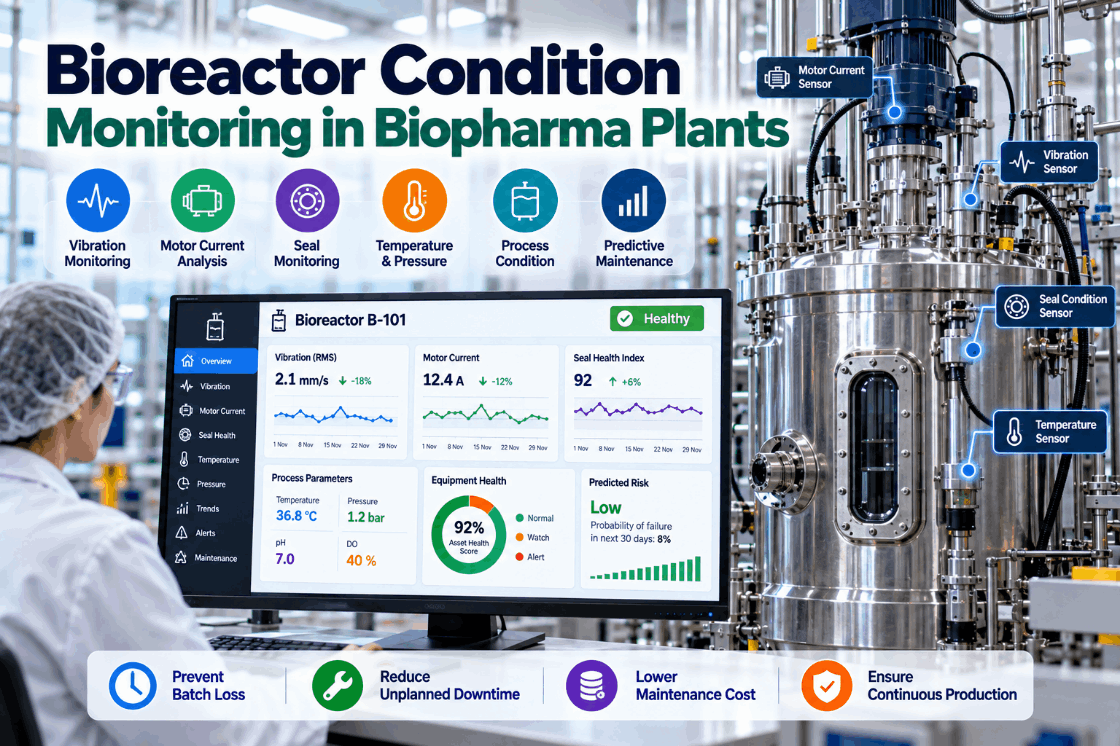
A production bioreactor run is the end of a long chain. Cell banks are thawed, seed trains expanded over days or weeks, media prepared and the vessel sterilized before the main run even starts. If the agitator drive, a mechanical seal or a temperature control loop fails partway through, the loss is not one day of production. It can be the batch, the weeks of work behind it and the slot in a tightly planned campaign. Condition monitoring gives maintenance teams early warning of those failures while there is still time to plan around them. This guide covers the failure modes that matter, the signals that reveal them, how to fit monitoring into a GMP environment and how to time interventions around campaigns. To see bioreactor monitoring on your equipment, book a short walkthrough.
Bioreactor Condition Monitoring in Biopharma Plants: Predict Failures Before a Batch Is Lost
Agitator vibration, motor current, seal fluid and temperature control trended every run, so maintenance is planned between campaigns, not forced during one.
Why Bioreactor Failures Cost So Much
Most bioreactor failures are not dramatic. A gearbox bearing wears, a seal starts to use more flush fluid, a pump in the temperature control skid loses efficiency. Each gives signs for days or weeks. In a plant without condition monitoring, those signs are missed until a parameter alarms mid-run, and then the choices are poor: stop and lose the batch, or continue and risk sterility or process control.
The cost goes beyond the batch itself. Biologics capacity is expensive and scarce. IntuitionLabs’ analysis of new plants puts a typical biotech drug plant at around $2 billion, and building one takes years. Lost runs also ripple into supply: a GAO review found 62% of US drug shortages from 2013 to 2017 were linked to manufacturing quality issues. Reliable equipment is part of reliable supply.
Condition monitoring turns those days or weeks of warning into planned work. We can review your bioreactor failure history on a call.
Bioreactor Failure Modes and the Signals That Reveal Them
Most bioreactor failures that end runs come from a short list of components. Each has a characteristic signal.
| Component | Failure mode | Earliest signal | Typical warning |
|---|---|---|---|
| Agitator gearbox | Gear and bearing wear | Vibration at gear mesh and bearing frequencies | Weeks |
| Agitator shaft bearings | Wear, lubrication loss | Vibration and bearing temperature rise | Weeks |
| Mechanical seal | Face wear, leakage | Change in seal fluid consumption, pressure or temperature | Days to weeks |
| Magnetic coupling | Internal bearing wear | Torque and motor current changes at set speed | Weeks |
| Drive motor | Winding or rotor faults | Current imbalance and signature changes | Weeks to months |
| Temperature control skid | Pump wear, valve sticking | Slower loop response, higher valve output | Days to weeks |
| Gas and feed pumps | Wear, blockage | Flow versus speed or pressure changes | Days |
The earliest signals are mechanical, long before process parameters move. That is why condition monitoring complements, rather than duplicates, the bioreactor control system. Our engineers map these modes to your vessels during a survey.
Why Drive and Seal Design Changes the Monitoring Plan
A review of stirred bioreactor drives in Applied Microbiology and Biotechnology sets out how design choices affect risk and maintenance. Monitoring should follow the same logic.
- Shaft passes through the vessel wall
- Double seals with sterile flush fluid are common in pharma
- Seal failure risks ingress and leakage
- Bottom drives need more frequent seal maintenance
- Watch seal fluid use, pressure and temperature
- Plus gearbox and bearing vibration
- No shaft penetration, hermetic separation
- Torque limited by magnet strength
- Internal bearings sit in the product side
- Bearing wear can generate particles
- Watch motor current and torque at set speed
- Plus external drive vibration
The same review notes that bottom-drive systems expose seals to greater chemical and biological load, with increased maintenance and shorter replacement intervals. Knowing which design each vessel uses sets which signals matter most.
For single-use bioreactors the vessel is disposable, but the motor, drive, load cells, pumps and temperature control remain and still fail. The monitoring plan adapts, as shown in a demo.
The Signals Worth Monitoring
A practical bioreactor monitoring set combines a few mechanical sensors with data the control system already records.
Context is the part most often missed. Vibration and current change naturally as volume, speed and broth viscosity change during a run. Comparing readings only at matching conditions, or normalizing for them, separates real wear from normal process change.
Most of the context data already sits in the batch control system and historian, so the added sensors are few. We connect to those systems during integration.
Fitting Condition Monitoring Into a GMP Environment
Monitoring must not add risk to the process it protects. These principles keep it compatible with GMP expectations.
In most plants, condition monitoring is treated as a maintenance tool that informs GMP decisions rather than a GMP system itself, but local QA should agree the approach. Our team can help frame it.
Timing Maintenance Around Campaigns
Early warning is only valuable if it changes when work happens. Bioreactor maintenance should be planned around the campaign schedule.
A trend crosses its learned band for long enough to count, with the component named.
The rate of change gives a window: days, weeks or longer.
The window is compared with the current run, the next turnaround and campaign end.
Finish the run and repair at turnaround, swap to a spare vessel, or intervene now if risk is high.
Parts, people and permits are ready before the vessel comes offline.
After repair, signals return to baseline before the next inoculation.
Record every decision and its outcome, so later findings on the same component are judged with that history in view.
Most findings fall into the first option: finish the run, repair at the next turnaround. That is only possible because the warning came early. Without monitoring, the same fault might have forced a mid-run decision.
Turnaround work lists built from condition data are often shorter and better targeted than calendar lists. See one built from real data in a session.
Beyond the Vessel: Supporting Equipment
The bioreactor depends on a ring of supporting equipment. Failures there end runs just as surely.
Steam traps, pumps and heat exchangers that support sterilization and media preparation.
Pumps, valves and heat exchangers holding jacket temperature.
Mass flow controllers, filters and compressors supplying air, oxygen and CO2.
Feed and base addition pumps and load cells tracking volume.
Harvest equipment that must run when the batch is ready.
Motors, mixers, load cells and pumps around disposable vessels.
Monitoring these alongside the vessels gives a complete view of run risk. Most sites start with agitators and temperature skids, then extend. Ask our support team for a typical scope.
Building the Case for Bioreactor Monitoring
The business case rests on avoided run losses, and those are worth estimating carefully with your own figures rather than borrowed averages.
Most sites find that preventing one or two run-ending failures a year covers the cost of monitoring, but the number depends entirely on your failure history and run value. Start with the last three years of equipment-related run losses and near misses.
Near misses matter as much as losses: every time a run was saved by luck, the same fault could have ended it. We help count both in a history review.
How iFactory Delivers Bioreactor Condition Monitoring
Vibration and current sensors outside the sterile boundary.
Seal fluid, temperature loops and flows read from existing systems.
Readings compared by phase, speed and volume.
Alerts name the likely component and failure mode.
Warning windows compared with the run and turnaround schedule.
Findings and repairs linked to equipment history.
It works with your existing control system, historian and CMMS. Share a recent failure and we will show how it would have looked in a review.
See Early Warnings on Your Own Bioreactors
Start with two or three vessels. We fit non-intrusive sensors, connect control system data and show component health and warning windows through a full campaign.
Gearbox vibration rising slowly for 12 days at constant agitation speed. Seal fluid use is normal.
A Warning Handled Between Runs
This exchange shows how a maintenance planner might use iFactory in a biologics plant.
iFactory ships as a pre-configured NVIDIA AI server, racked and ready with the bioreactor condition monitoring models loaded. Rack it, plug in power and Ethernet, and the AI is live on your network. Our scope covers sensors and data connections across bioreactor suites and utilities, PLC/SCADA, MES, LIMS and ERP integration, cabling and network setup, operator and quality team training, and 24×7 remote monitoring.
Server installed, sensors and system links live, historical batch, lab and maintenance records loaded.
Models trained on your own batches and equipment, then run in parallel on one area with your quality and engineering teams reviewing every output.
Rollout to the agreed areas under your change control and validation procedures, team training and 24×7 remote monitoring in place.
Sensors, server, software and integration come as one package. For pricing on your suites, contact our sales team.
Frequently Asked Questions
It tracks the health of bioreactor equipment, such as agitator drives, seals, motors and temperature control skids, using vibration, motor current, seal fluid and process data to predict failures before they affect a run.
Agitator gearboxes and bearings, mechanical seals, magnetic coupling bearings, drive motors and the pumps and valves in temperature control skids are common sources of run-ending failures.
No. Vibration and current sensors mount outside the sterile boundary, and seal fluid, temperature and flow data usually come from the existing control system.
Mechanical seal drives need seal fluid, pressure and temperature monitoring plus vibration. Magnetic couplings have no shaft penetration, so motor current and torque changes are key signs of internal bearing wear.
Yes. The vessel is disposable, but motors, drives, load cells, pumps and temperature control equipment remain and can be monitored.
A typical rollout takes 6–12 weeks: sensors and data links first, then baselines learned over runs, then go-live and training. Plan it with our engineers.
Protect Every Run From Preventable Equipment Failures
iFactory watches your bioreactors and the equipment around them, warns early and helps you plan repairs between runs, so batches are not lost to failures that gave notice.
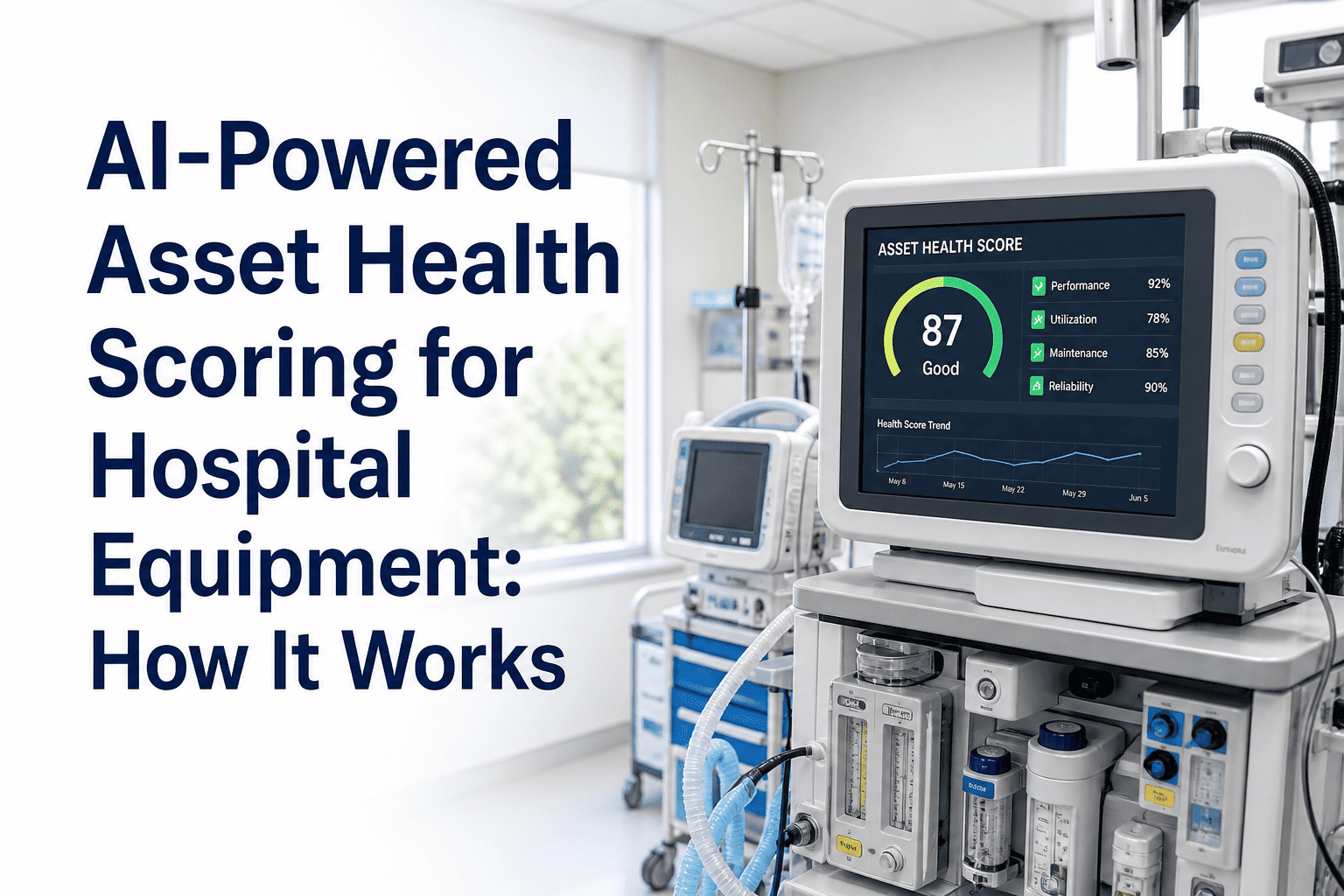
Scores combine vibration, motor current, seal fluid and process data for each component.



.png)
.png)