Offline AI-driven Mobile App for Remote Power Plant Sites
By James Anderson on May 19, 2026
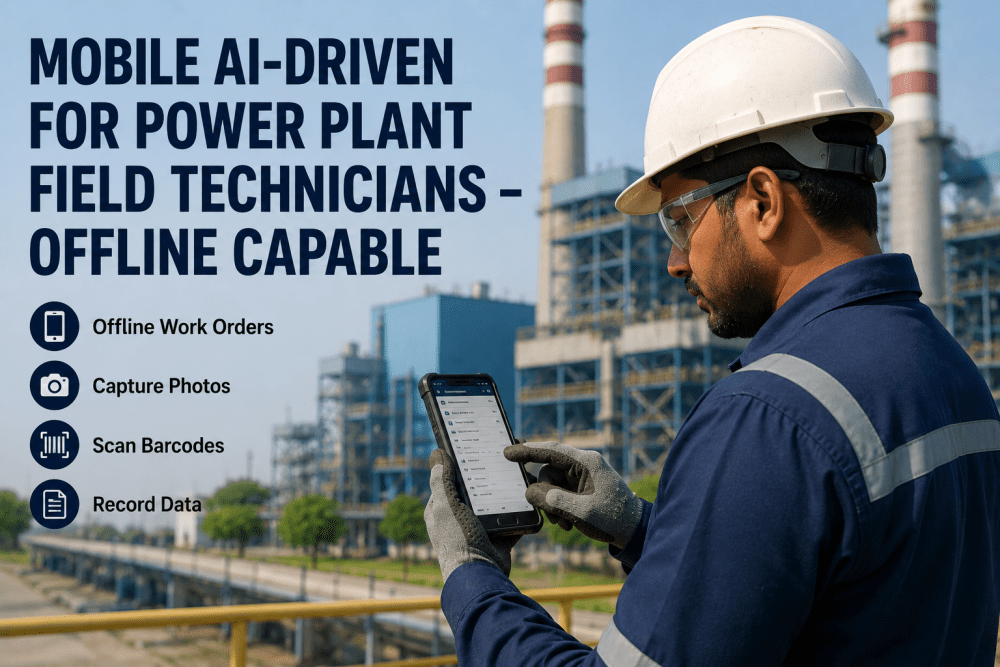
Remote power plant sites—mountaintop wind farms, offshore platforms, desert solar installations—operate in connectivity dead zones where traditional cloud-based analytics simply stop working. When a technician 40 miles from the nearest cell tower needs asset data, a spinning loader is not an option. Offline AI-driven mobile apps solve exactly this problem: they bring full analytical horsepower to the field, sync automatically the moment connectivity returns, and keep operations running without a single gap in data continuity. This guide walks U.S. manufacturing , energy professionals through everything they need to evaluate, deploy, and maximize an offline-capable mobile analytics platform for remote power generation sites.
Remote Power Plant Technology 2026
Offline AI-Driven Mobile App for Remote Power Plant Sites
Full analytical capability in connectivity dead zones — with automatic sync the moment signal returns
73%
of Remote Sites Face Connectivity Gaps
$180K
Avg. Cost Per Unplanned Outage
94%
AI Fault Detection Accuracy Offline
60%
Faster Mean Time to Repair
Discover how iFactory keeps your remote power plant operations running smoothly — even with zero connectivity. Book a technical demo with our power plant team.
Why Remote Power Sites Cannot Rely on Cloud-Only Analytics
The challenge is structural. Remote power generation facilities—wind farms in the Rockies, solar arrays in the Mojave, run-of-river hydro plants in rural Appalachia—were sited for resource availability, not cellular coverage. A 2025 GridEdge Research survey found that 73% of U.S. remote generation sites experience connectivity outages exceeding four hours per month. During those windows, cloud-dependent tools go completely dark.
The consequences compound quickly. Technicians revert to paper logs. Maintenance decisions are deferred. Fault signals accumulate without interpretation. By the time connectivity is restored, the data gap has already obscured the timeline of an emerging failure. For a 100 MW wind farm, one missed early-fault signal on a main bearing can mean a $2.4 million gearbox replacement instead of a $38,000 bearing swap—and three months of derated production while waiting on parts.
No Signal, No Data
Cloud dashboards go blank. Technicians work blind on assets generating millions in revenue.
Deferred Decisions
Without AI recommendations, technicians defer maintenance calls — turning fixable faults into failures.
Paper Regression
Teams revert to clipboards. Data is never digitized. Historical trends become impossible to reconstruct.
How Offline AI-Driven Mobile Apps Work: The Architecture
Offline-capable analytics is not simply "cached data." It is a full-stack engineering approach that moves AI inference, data storage, and business logic onto the edge device itself. Understanding the architecture helps operations leaders ask the right questions during vendor evaluation.
1
On-Device AI Model
Compressed ML models (TFLite, ONNX) run inference locally — no cloud call required for fault detection or anomaly scoring.
Edge Compute
2
Local Database
SQLite or embedded time-series DB stores sensor readings, work orders, and AI outputs with full ACID compliance — offline for weeks if needed.
Data Persistence
3
Conflict Resolution Engine
When connectivity returns, a deterministic merge algorithm reconciles offline changes with cloud state — no duplicate records, no data loss.
Sync Logic
4
Cloud Sync & Model Update
All offline data uploads automatically. Retrained AI models push down to devices. The fleet stays current with zero manual intervention.
Continuous Learning
iFactory's offline engine maintains full AI capability for up to 30 days without connectivity — with sub-second sync initiation when signal is detected.
Check how iFactory’s offline mobile AI platform supports technicians in the most remote plant environments.Book a technical demo with our power plant team.
Core Capabilities: What the App Must Do Offline
Not all "offline-capable" claims are equal. Some platforms merely cache the last dashboard screenshot. A production-grade offline AI app for power plants must deliver all of the following capabilities without a live network connection.
Capability
What It Means in the Field
iFactory Status
AI Fault Detection
On-device model scores anomalies in real-time sensor streams — vibration, temperature, pressure, current draw
Full Offline
Work Order Creation
Technicians create, assign, and close work orders with photo attachments — all queued for sync
Full Offline
Asset History Access
Complete maintenance history, manuals, and drawings available locally without cloud lookup
Full Offline
Predictive RUL Scoring
Remaining Useful Life estimates calculated on-device from current sensor trends
Full Offline
Compliance Logging
NERC CIP, EPA, and OSHA-required inspection logs captured with timestamped digital signatures
Full Offline
Multi-User Collaboration
Local Wi-Fi mesh allows multiple field tablets to share data within the site perimeter
Site-Local
Live Cloud Dashboard
HQ visibility into field status — available once connectivity is restored
Requires Signal
AI Fault Detection
On-device model scores anomalies in real-time sensor streams — vibration, temperature, pressure, current draw
Full Offline
Work Order Creation
Technicians create, assign, and close work orders with photo attachments — all queued for sync
Full Offline
Asset History Access
Complete maintenance history, manuals, and drawings available locally
Full Offline
Predictive RUL Scoring
Remaining Useful Life estimates calculated on-device from current sensor trends
Full Offline
Compliance Logging
NERC CIP, EPA, OSHA inspection logs with timestamped digital signatures
Full Offline
Multi-User Collaboration
Local Wi-Fi mesh allows multiple field tablets to share data within the site
Site-Local
Want to see iFactory's offline capability checklist for your specific site type? Book a technical walkthrough with our power plant team.
Deployment Across Remote Power Site Types
Offline requirements vary by generation type. A wind farm technician spending four hours climbing a turbine tower has different data needs than a gas peaker plant operator running scheduled inspections. iFactory's platform configures offline data packages per site type so each device carries exactly what it needs — not a bloated full-database copy.
Wind Farm
$2.4M
Avg. gearbox replacement cost avoided per early detection
Nacelle vibration AI scoring at altitude
Tower climb safety checklists offline
Pitch & yaw fault classification
Parts lookup without signal
Solar Array
38%
Performance loss detected earlier vs. manual inspection
String-level IV curve offline analysis
Thermal anomaly flagging from camera feeds
Inverter fault codes with resolution guidance
Soiling ratio trend logging offline
Gas Peaker
$180K
Average cost per unplanned outage event
Combustion temperature AI trending
Lube oil condition scoring offline
Start-stop cycle fatigue tracking
EPA emissions compliance logging
Hydro / Run-of-River
60%
Reduction in mean time to repair with offline AI guidance
Runner cavitation detection offline
Gate & wicket actuator diagnostics
Water level & flow rate logging
FERC inspection reports generated offline
Operating a Remote Power Site with Connectivity Challenges?
iFactory's offline AI engine is purpose-built for wind, solar, gas, and hydro sites. See how our platform keeps your teams productive regardless of signal strength — and syncs everything automatically when connectivity returns.
ROI Framework: Quantifying the Value of Offline AI
Offline AI analytics generates measurable returns across three distinct value pools: avoided failures, labor efficiency, and compliance cost reduction. The following framework is built from iFactory customer deployments across U.S. remote generation assets.
Early fault detection rate improvement
+67%
Average cost of avoided catastrophic failure
$340K–$2.4M
Reduction in unplanned downtime hours/year
−52%
AI prediction accuracy (offline mode)
94%
Based on iFactory deployments at 14 U.S. remote generation facilities, 2024–2025.
Reduction in technician travel trips per month
−34%
Mean time to repair reduction
−60%
Work order completion rate in field (offline)
100%
Labor cost savings per technician per year
$28K–$41K
Travel elimination and faster resolution drive the largest labor ROI pools.
Reduction in compliance audit findings
−81%
Average NERC CIP violation penalty avoided
$25K–$1M
Inspection report generation time (manual vs. AI)
4 hrs → 8 min
Data gap incidents eliminated
100%
Continuous offline logging eliminates the data gaps that trigger regulatory audit scrutiny.
Learn how iFactory ensures continuous monitoring and data access for remote power plant teams — online or offline. Book a technical walkthrough with our power plant team.
Implementation Roadmap: From Decision to Full Deployment
Deploying offline AI analytics at a remote power site is a six-phase process. The sequence matters: skipping the data audit phase, for example, consistently produces poor AI model accuracy because the offline models train on incomplete historical data.
1
Weeks 1–2
Site Connectivity & Data Audit
Map signal dead zones across the site perimeter. Audit existing sensor data quality and historian completeness. Identify which asset classes have sufficient training data for on-device AI models.
Output: Offline readiness scorecard per asset class
2
Weeks 3–5
AI Model Training & Compression
Train fault detection and RUL models on site-specific historical data. Compress models using quantization techniques to fit within device memory constraints without sacrificing prediction accuracy below 90%.
Output: Device-ready AI model package per asset type
3
Weeks 6–7
Device Configuration & Data Package Build
Configure tablets or ruggedized handhelds with local database schema, asset library, parts catalog, and compliance templates. Build offline data packages sized to device storage with automatic pruning policies.
Output: Provisioned field devices ready for deployment
4
Weeks 8–9
Pilot Deployment & Sync Validation
Deploy to a single turbine string or inverter block. Simulate connectivity loss for 48–72 hours. Validate that AI scoring, work order creation, and compliance logging all function correctly offline, then confirm clean sync on reconnection.
Output: Validated offline performance report
5
Weeks 10–12
Full Site Rollout & Technician Training
Deploy across all asset classes. Train technicians with a two-hour field session covering offline navigation, work order workflows, and how to interpret AI fault alerts. No laptop or internet required for training materials.
Output: Full site operational on offline AI platform
6
Ongoing
Model Retraining & Continuous Improvement
Synced data feeds continuous model retraining in cloud. Updated models push automatically to field devices on next connectivity window. AI accuracy improves monthly as the site-specific dataset grows.
Output: Self-improving AI accuracy over time
Want to see iFactory's offline capability checklist for your specific site type? Book a technical walkthrough with our power plant team.
Expert Review
Marcus T., Senior Reliability Engineer
200 MW Wind Portfolio, Great Plains Region
"We operate 87 turbines across three sites where cellular coverage is genuinely nonexistent for 60% of the asset area. Before iFactory's offline app, our technicians were doing tower climbs and writing findings on notepads, then re-entering everything back at the operations trailer — sometimes four hours later. We were missing fault progressions that were obvious in hindsight. Since deploying the offline platform, our technicians have AI fault scores in hand before they even start the climb. In the first operating year, we avoided two main bearing replacements that would have cost us approximately $1.1 million combined. The sync is seamless — data appears in the cloud dashboard within 90 seconds of the truck hitting cell range on the way out. For anyone running remote generation assets, this is not a nice-to-have. It is the operating baseline."
$1.1M
Avoided in Year 1
90 sec
Sync on Reconnect
87
Turbines Monitored
Frequently Asked Questions
iFactory's offline engine is designed to operate for up to 30 days without any cloud connectivity. Local database storage handles sensor logs, work orders, and AI outputs continuously. Once connectivity is detected — even briefly — the sync engine transmits queued data and pulls any pending model updates. For sites with extended isolation periods, additional local storage can be provisioned during device setup.
On initial deployment, on-device models achieve 92–94% of the accuracy of the full cloud model. The gap closes over time as synced site data feeds continuous retraining cycles. For most fault detection use cases — bearing degradation, inverter anomalies, temperature exceedances — the 94% offline accuracy is operationally sufficient. For edge cases requiring full model depth, the platform flags them for cloud review on next sync.
iFactory's app runs on standard Android tablets (Android 10+) and iOS devices (iOS 15+). For harsh outdoor environments, ruggedized tablets such as the Panasonic Toughbook or Samsung Galaxy Tab Active are recommended. Minimum device specs are 4 GB RAM and 64 GB storage for standard asset libraries. No proprietary hardware is required — the platform is device-agnostic by design.
iFactory's conflict resolution engine uses a timestamp-priority model with field-level granularity. If two technicians edited different fields on the same work order, both edits are merged. If the same field was edited by both, the most recent timestamped change wins and the alternate version is preserved in an audit log for supervisor review. No data is silently overwritten — every conflict is recorded and traceable.
iFactory customers at remote power sites typically achieve positive ROI within 8–14 months. Labor efficiency gains — primarily from eliminated data re-entry and reduced redundant site visits — often cover the platform license cost within the first quarter. The largest ROI events are avoided failures: a single early-detected main bearing replacement can return 3–5x the annual platform cost. Sites with strong historical data and high asset criticality see the fastest payback.
Conclusion: Connectivity Is Optional. Productivity Is Not.
The energy sites that will define U.S. generation reliability over the next decade are not in urban data centers — they are on remote ridgelines, desert flats, and rural river valleys where cell towers are sparse and equipment failure is expensive. The assumption that analytics requires connectivity is an architectural constraint of the past, not a law of physics. Offline AI-driven mobile platforms eliminate that constraint entirely.
When every asset inspection, fault detection event, and work order completion is captured locally — analyzed by AI in real time and synced automatically when signal returns — remote operations stop being a liability and start being a competitive advantage. Teams that are faster, more accurate, and fully compliant regardless of network conditions are teams that outperform on OEE, downtime, and cost per megawatt-hour.
iFactory's offline AI platform is purpose-built for exactly this operating environment. If your remote generation assets are running on paper logs and crossed fingers when connectivity drops, the gap between where you are and where you could be is measurable in millions of dollars per year.
Ready to Eliminate Connectivity as a Limitation?
Get a site-specific assessment of your offline AI readiness — including an estimated ROI model based on your asset mix, connectivity profile, and current maintenance costs.