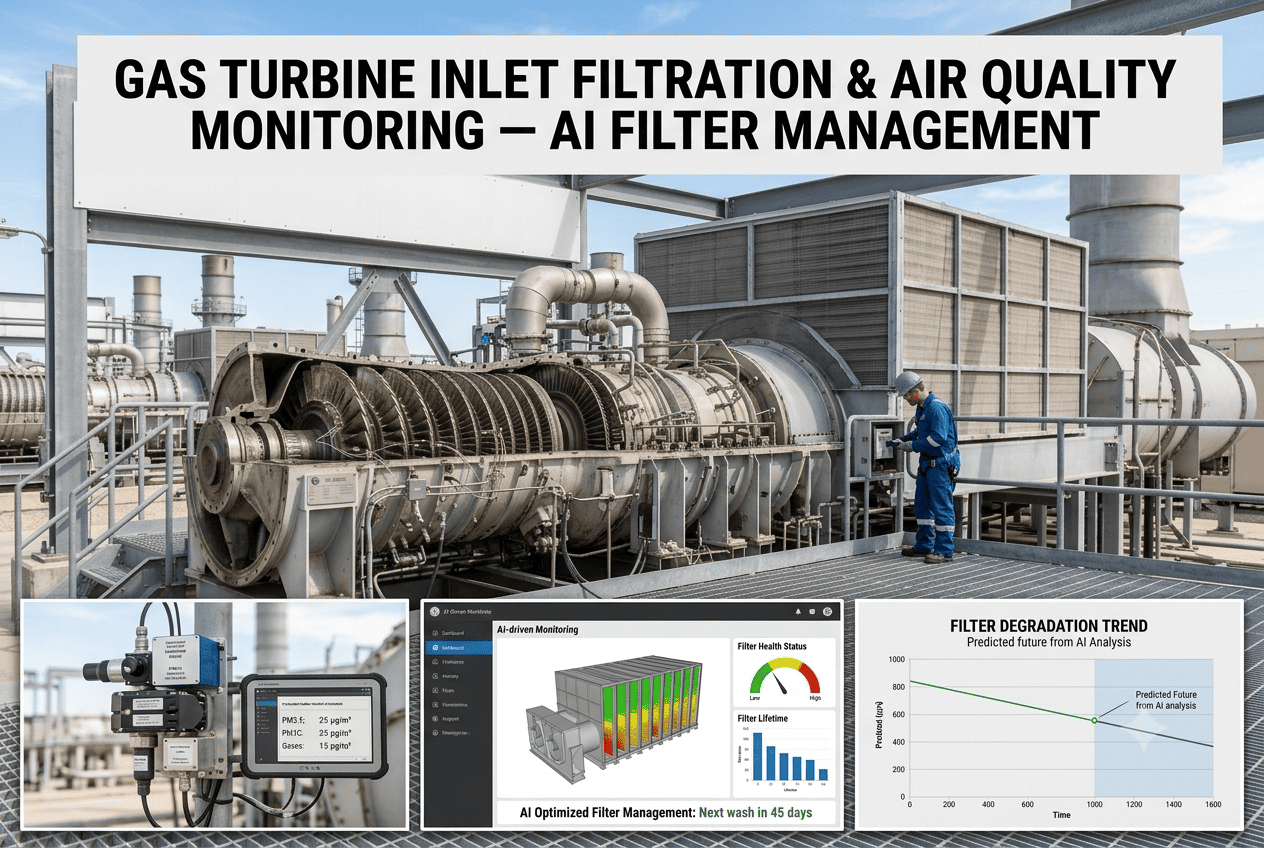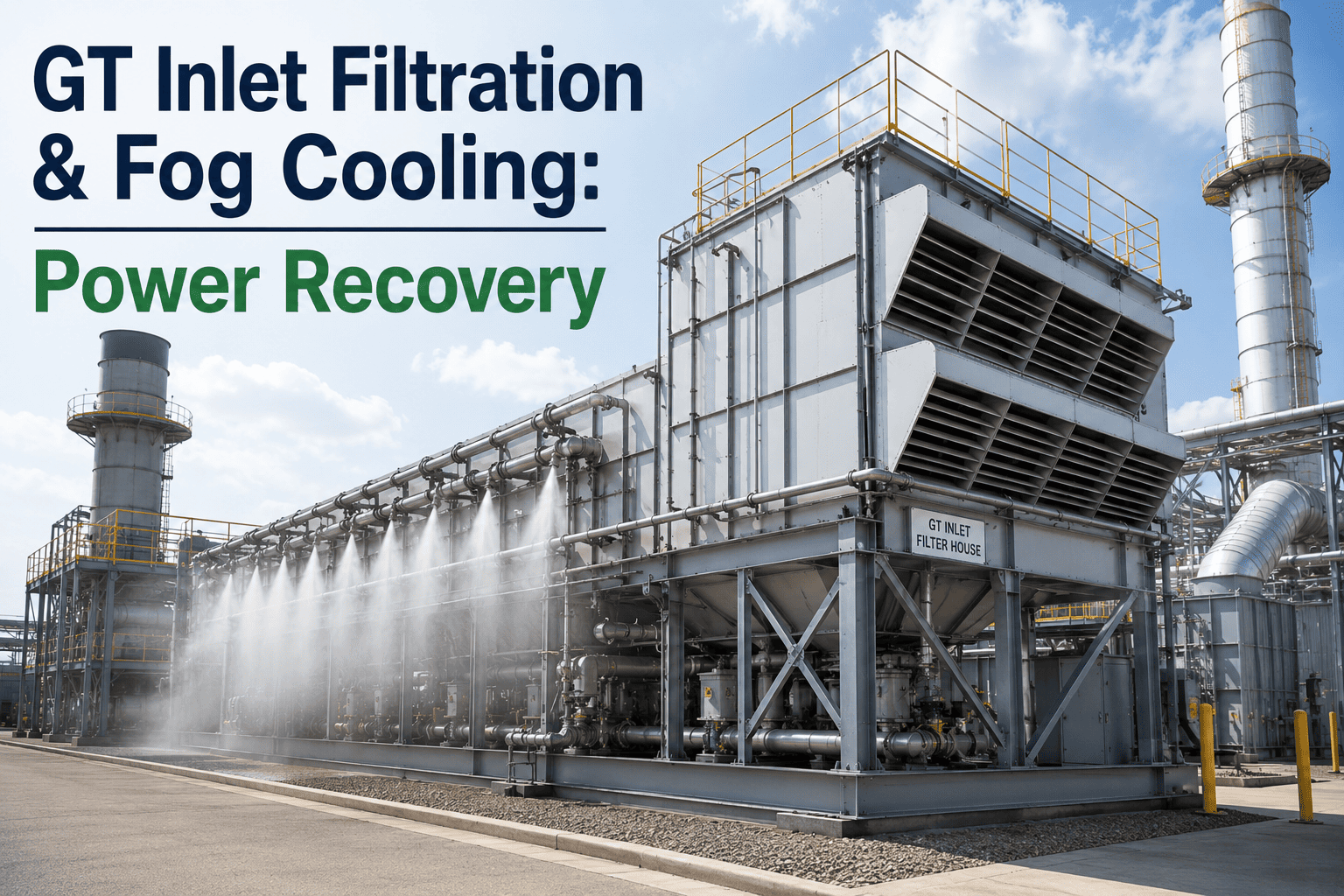
Every degree Celsius the ambient air rises above ISO conditions quietly strips output away from a gas turbine, and on a hot summer afternoon that loss can easily reach ten percent or more of rated capacity, right when the grid needs that power most. Most of that lost output is recoverable, either by keeping the inlet air cleaner and cooler with better filtration or by pulling ambient temperature down directly with fog or evaporative cooling before the air ever reaches the compressor. See how iFactory tracks filter differential pressure and cooling system performance together with a Book a Demo.
The Power You Lose To Hot, Dirty Inlet Air Is Usually Recoverable
Gas turbine output is directly tied to inlet air mass flow, which means both filter condition and ambient temperature have a measurable effect on megawatts delivered. iFactory correlates filter differential pressure, ambient conditions, and fogging system performance against actual output so lost capacity gets traced back to its real cause.
Why Filter Differential Pressure Is A Power Number, Not Just A Maintenance Number
As inlet filters load up with dust and debris, differential pressure across the filter bank rises, and that pressure drop directly reduces the mass of air reaching the compressor inlet. Plants that track differential pressure purely as a filter-change trigger miss the fact that it's also quietly costing output well before the change point is reached.
Pre-Filter Stage
Captures large particulate and insects, protecting the finer downstream stage from premature loading and extending overall filter life.
Final Filter Stage
High-efficiency media that captures fine particulate responsible for both compressor fouling and accelerated blade coating erosion.
Weather Protection
Louvers and moisture separators prevent rain and snow ingestion from loading filters prematurely or icing the inlet system in cold climates.
Anti-Icing System
Prevents ice formation on inlet screens during cold, humid conditions that would otherwise restrict airflow and risk compressor damage from ice ingestion.
Comparing Inlet Cooling Methods For Hot Weather Power Recovery
Fog cooling, evaporative media, and mechanical chilling each recover lost output differently, and the right choice depends on local humidity, capital budget, and how much of the hot-weather output gap actually needs closing.
| Method | Typical Recovery | Best Suited Climate |
|---|---|---|
| Evaporative Media Cooling | 3-5% output gain | Hot, dry, low-humidity regions |
| Fog Inlet Cooling | 4-7% output gain | Hot climates with moderate humidity margin |
| Mechanical Chilling | 8-15% output gain | High-humidity or peak-value regions |
Wet compression, where fog droplets carry past the compressor inlet, adds further gain in some installations but requires careful control to avoid compressor blade erosion.
A Seasonal Checklist For Inlet System Performance
Where Inlet Air Power Recovery Programs Fall Short
Changing Filters On A Fixed Calendar
Replacing filters on a set schedule regardless of actual differential pressure trend either wastes filter life or leaves a loaded filter in place too long, both of which cost output.
Running Fog Cooling Without Wet-Bulb Tracking
Operating a fogging system without comparing achieved temperature drop against theoretical wet-bulb limit makes it hard to tell whether the system is underperforming or the conditions simply don't allow more cooling.
Ignoring Water Quality For Fogging Systems
Poor water quality feeding fog nozzles causes mineral deposit buildup on compressor blades, quietly trading a power gain for accelerated blade fouling.
Overlooking Cold Weather Inlet Risk
Focusing entirely on hot-weather power recovery while neglecting anti-icing readiness leaves the unit exposed to inlet icing events during cold, humid conditions.
Stop Losing Megawatts To Air You Could Be Managing
iFactory ties filter condition and inlet cooling performance directly to output so lost capacity gets traced to its actual cause.
What Plants Typically Recover With Connected Inlet Monitoring
Putting A Dollar Figure On Inlet Air Losses And Recovery
It's easy to treat a few percentage points of lost output as a rounding error, but on a large frame unit running at peak summer demand, even a five percent output gap translates into a meaningful number of megawatts, and those megawatts often carry the highest market value of the entire year precisely because everyone else's output is depressed by the same heat at the same time. Filter and cooling system investments that seem hard to justify on a simple payback basis against average annual output look very different once the analysis weights the recovered megawatts by the price they would actually command during peak demand hours.
The same logic applies in reverse to filter replacement timing. A filter left in service past its optimal differential pressure point doesn't just risk a maintenance event, it costs output every single hour it remains in place, and that ongoing cost frequently exceeds the price of the replacement filter media itself well before the filter reaches its rated end-of-life pressure drop. Framing filter and cooling decisions in terms of megawatt-hours recovered rather than purely as a maintenance line item tends to shift both the urgency and the budget conversation around these projects.
Peak-Weighted Value
Output recovered during high-demand hot afternoons often carries market value well above the annual average price per megawatt-hour.
Filter Replacement Timing
The output cost of a loaded filter frequently exceeds the price of replacement media before the filter reaches its rated pressure drop limit.
Cooling System Payback
Fog and evaporative cooling investments typically pay back faster when evaluated against peak-hour pricing rather than flat annual averages.
Frequently Asked Questions
Q: How much output can fog cooling realistically recover on a hot day?
Recovery depends heavily on ambient humidity, since fog cooling works by evaporative cooling and the achievable temperature drop is limited by the gap between dry-bulb and wet-bulb temperature. In hot, dry conditions, gains in the range of four to seven percent of rated output are common, while in more humid climates the achievable gain narrows considerably because there is less room between actual temperature and the wet-bulb limit. Reach out through Support Contact to review what a realistic gain looks like for your site's typical summer humidity profile.
Q: Does a rising filter differential pressure always mean output is being lost?
Yes, though the magnitude varies by turbine model and how far differential pressure has risen above its clean baseline. As filters load, the pressure drop across the inlet system increases, which reduces compressor inlet mass flow and directly reduces achievable output at a given ambient condition. This loss is often small enough in the early stages of loading that it goes unnoticed without a baseline comparison, which is exactly why tracking the trend against a clean-filter reference matters more than watching for a single alarm threshold.
Q: Can fog cooling and inlet filtration upgrades be implemented at the same time?
In most cases yes, and doing so together is often more cost-effective than implementing them separately, since both projects typically involve work in and around the same inlet plenum and ductwork. Coordinating the two also makes it easier to establish a clean combined performance baseline afterward, rather than trying to separate out the effect of each upgrade from a series of sequential before-and-after comparisons. A Book a Demo session can walk through how combined tracking works once both systems are in place.
Q: What is wet compression and how does it differ from standard fog cooling?
Standard fog cooling evaporates droplets in the inlet duct before air reaches the compressor, cooling the air to close to wet-bulb temperature. Wet compression intentionally allows a controlled amount of fog to carry through into the compressor itself, where continued evaporation provides an intercooling effect during compression that can add further output beyond what inlet cooling alone achieves. This approach requires more careful water quality control and nozzle management, since excess liquid carryover raises the risk of compressor blade erosion if not properly managed.
Q: How does altitude affect the output loss from hot ambient temperature?
Altitude and ambient temperature both reduce air density, and their effects compound rather than offset each other, meaning a plant at higher elevation experiences a steeper output loss curve for the same rise in ambient temperature compared to a sea-level site. This is why output loss figures published for a specific turbine model at ISO conditions need to be adjusted for a given site's actual elevation before being used for operational planning or cooling system sizing decisions.
Turn Inlet Air Into A Managed Performance Lever
iFactory connects filter condition, cooling system performance, and ambient data so you know exactly how much output the inlet system is costing or recovering.