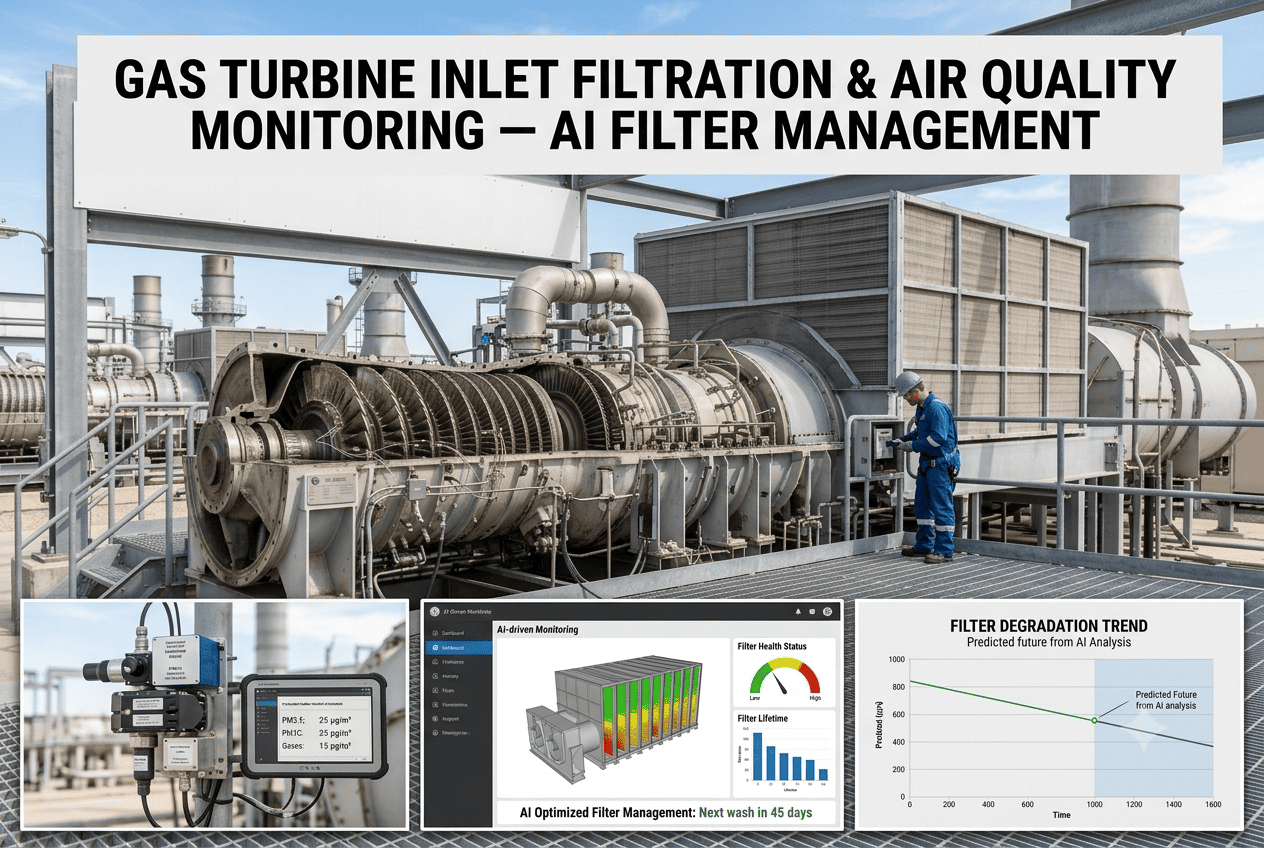
A gas turbine pulls in a genuinely enormous volume of ambient air, and more than 95 percent of everything that ends up flowing through the compressor arrived through the inlet filter house. When that filtration system quietly degrades, nobody hears an alarm right away. Efficiency drifts down, fuel consumption creeps up, and by the time a plant manager notices the trend on a monthly report, the compressor blades have already been absorbing weeks of dust, salt, and moisture damage. iFactory trends differential pressure across every filtration stage in real time and flags both slow fouling and sudden filter failures the moment they start, and you can book a demo to see your own filter house data plotted against the alarm and load-reduction thresholds your control system already uses.
Your Compressor Only Stays Clean as Long as the Filter House Nobody Watches Closely Stays Clean
iFactory continuously trends differential pressure across every filtration stage, catching both the gradual pressure rise that signals a needed filter change and the sudden pressure drop that signals a torn filter letting contaminants straight into the compressor.
Differential Pressure Is the Single Number That Tells You Everything About Filter Health
Every inlet filter house has a pressure transmitter comparing outside air to the pressure inside the combustion air inlet plenum. On many units, that single differential pressure reading drives both an alarm and an automatic load reduction — which means a plant manager should never be finding out about a filtration problem from a load curtailment.
These thresholds vary by turbine model and filter house design, which is exactly why a plant manager needs the trend, not just the current reading, to know whether a rise is normal seasonal loading or an early warning of a bigger problem.
A Rising DP and a Falling DP Are Both Alarms — They Just Mean Opposite Problems
Gradual DP Rise
Particulate accumulates on the filter media over weeks or months, steadily restricting airflow. Left unaddressed, this path leads to reduced mass flow, lower pressure ratio, and an eventual load reduction trip. The fix is a scheduled filter replacement before the threshold is reached.
Sudden DP Drop
A torn filter, a bypass event, or a seal failure lets unfiltered air straight into the compressor. This is the more dangerous failure because efficiency indicators may look temporarily fine while the compressor blades take direct erosion and corrosion damage.
A Torn Filter Can Cost More in One Season Than Years of Filter Replacements
Blade erosion and foreign object damage from a bypassed filter can require a compressor blend repair running into hundreds of thousands of dollars and a forced outage on top of it.
Contaminants Are Removed in Stages — and Each Stage Needs Its Own Differential Pressure Check
Modern inlet filtration systems rarely rely on a single filter media. Instead, air passes through progressively finer stages, and a plant manager who only tracks one overall DP reading can miss which specific stage is actually degrading.
Coarse Pre-Filtration
Removes larger particles, insects, and debris before they reach the finer downstream media.
Fine Particulate Filtration
Targets smaller dust, sand, and coal particulate that the coarse stage lets through.
Final Filtration
Ensures uniform, contaminant-controlled air quality immediately before the compressor inlet.
The Same Handful of Contaminants Cause Nearly Every Filtration-Related Failure
| Contaminant | Primary Damage Mechanism |
|---|---|
| Dirt / soil / dust | Compressor fouling, reduced airflow and efficiency |
| Sand | Blade erosion, aerodynamic profile degradation |
| Salt | Corrosion of blades and ductwork, scale ingestion |
| Oil / hydrocarbon aerosols | Sticky fouling layer that traps other particulate |
| Moisture / humidity | Reduced filter effectiveness, water-soluble particle ingestion |
What Plant Managers Report After Moving to Continuous Filtration Monitoring
Questions Plant Managers Ask About Inlet Filtration Monitoring
Stop Finding Out About Filter Problems From a Load Reduction Alarm
iFactory trends every filtration stage continuously so gradual fouling and sudden filter failures are both caught long before they reach your control system's hard limits.