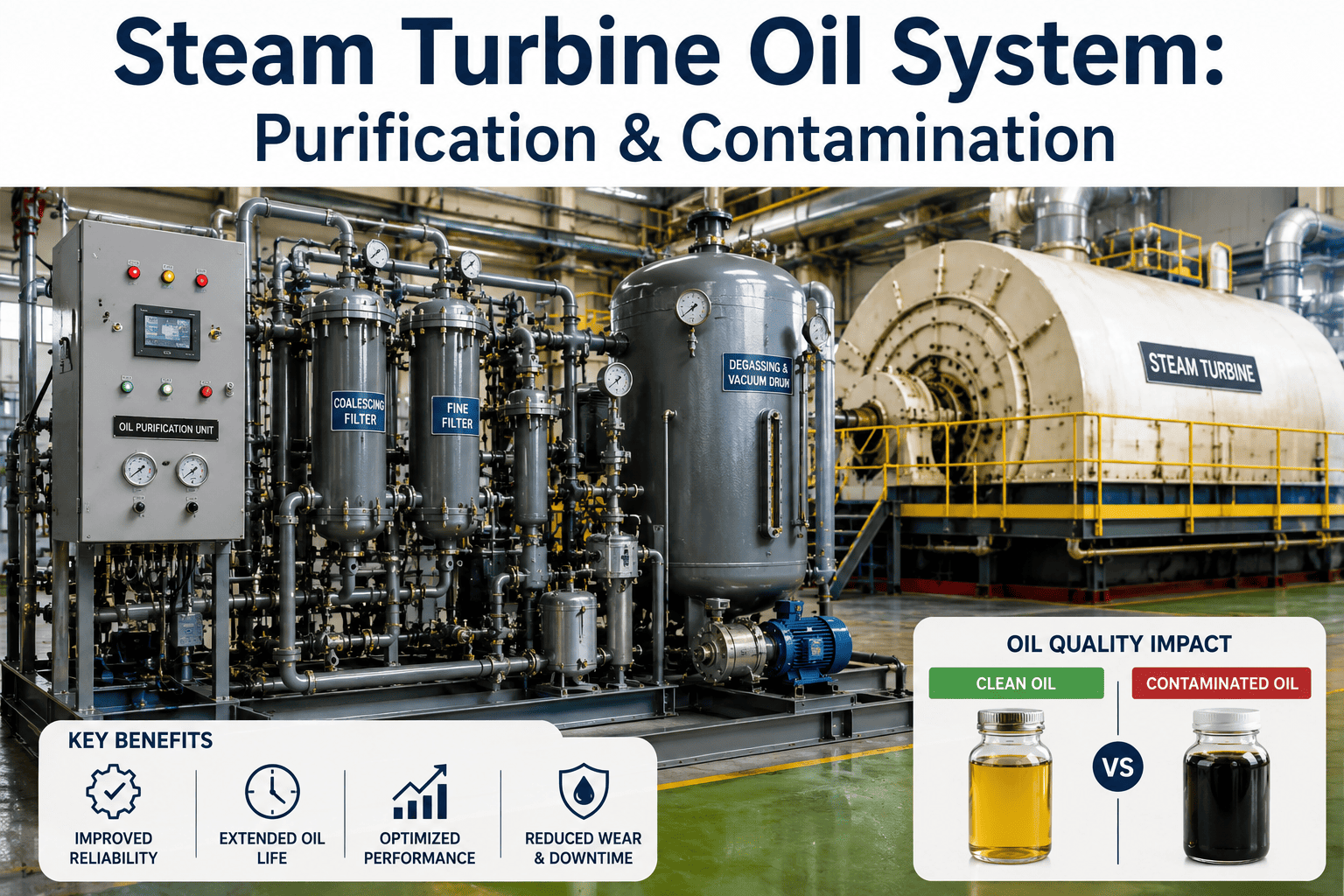
A turbine sits on turning gear overnight, cooling slowly, and the oil that looked perfectly clear at operating temperature turns visibly cloudy as it cools down. By morning, a servo valve that shifted smoothly the day before sticks, the start sequence trips, and the plant loses hours chasing what looks like a mechanical fault. It isn't one. It is varnish, a byproduct of oil breakdown too small for standard filtration to catch and too subtle for routine oil tests to flag before it costs a start. You can see how a structured purification program prevents that exact failure by choosing to book a demo with our team.
Your Turbine Oil Can Pass Every Standard Test and Still Be Building Toward a Trip
Viscosity in range, acid number in range, everything on the routine oil report looks fine, right up until a servo valve seizes or a bearing wears faster than the maintenance plan expected. Turbine oil degrades in ways that standard testing was never built to catch early, and iFactory helps plants close that gap with structured purification and condition monitoring.
The Warning Signs Are Almost Never on the Standard Oil Report
Turbine lube systems don't fail because plants skip oil analysis. They fail because the analysis that gets run, viscosity, acid number, and basic particle counts, is genuinely useful but structurally blind to the specific failure mode that causes most trip and fail-to-start events: varnish. The soluble oxidation byproducts that eventually become varnish start invisible, accumulate for months or years, and only become a mechanical problem once the oil's capacity to hold them in solution is exceeded.
Peaking units and turbines that cycle frequently between start and stop are especially exposed to this pattern, since each thermal cycle gives the oil another opportunity to cool, lose solubility, and drop out contaminants it had been holding in suspension while running hot. A unit that used to run baseload and now cycles daily can see its varnish risk rise sharply even though nothing about the oil fill or the maintenance schedule has changed on paper.
By the time deposits are visible on a bearing or a valve spool, the underlying degradation has usually been progressing for a long time. Turbine oil failure is not typically a slow, linear slide, it tends to look stable on paper and then fail rapidly once a threshold is crossed, which is exactly why proactive monitoring and purification matter more for turbine oil than for almost any other industrial fluid.
This behavior catches maintenance teams off guard because it runs against the intuition built from most other equipment failure modes, where a gradual decline gives ample warning before a hard failure. Turbine oil behaves differently: the additive package holds the line for a surprisingly long time, masking the underlying chemical change, and then gives way quickly once the oil's capacity to keep degradation byproducts in solution runs out. A monitoring program built around occasional spot checks will very often miss that inflection point entirely.
Water, Particulate, and Varnish Do Not Behave the Same Way, and None of Them Are Solved by the Same Fix
Plants often treat "oil contamination" as one problem with one solution, usually a filter change. In practice, a turbine lube system faces three distinct contamination mechanisms, each with its own detection method, its own removal technology, and its own failure signature if it goes unmanaged.
Treating all three as one undifferentiated problem is the single most common reason a purification budget gets spent without the corresponding drop in trip events a plant expects. A mechanical filter upgrade, for example, does very little for a water ingression problem, and a vacuum dehydration unit does very little for hard particulate wear, so matching the technology to the specific contaminant actually present in the oil is the deciding factor in whether a purification investment pays off.
What ISO 4406 Actually Tells You, and What Target to Aim For
The ISO 4406 cleanliness code reports particle counts at three size thresholds, commonly written as three numbers separated by slashes, corresponding to particles at 4, 6, and 14 microns and larger per milliliter of fluid. A lower number at each position means a cleaner fluid, and the target code should be set based on how sensitive the equipment downstream actually is to particle damage.
Reading the code correctly matters more than most maintenance teams realize, because a single overall "clean" or "dirty" label hides which size range is actually driving the problem. A system reporting a high count at the 4-micron threshold but a reasonable count at 14 microns is telling a very different story than the reverse, and that distinction changes which filtration media and micron rating actually solves the issue rather than simply relocating it.
| System or Component | Typical Target ISO Code | Why This Target |
|---|---|---|
| Turbine Bearings and Compressor Lubrication | 17/15/12 | Standard baseline for rotating equipment lubrication where moderate particle exposure is tolerable |
| Rolling Element Bearings | 16/14/11 | Tighter tolerance reflecting greater sensitivity to fine particle abrasion at the rolling contact surface |
| Servo Valves and EHC Control Fluid | 14/13/10 or Tighter | Servo valve clearances are extremely tight, making them the most contamination-sensitive component in the system |
| New or Recently Flushed Systems | 10/8/7 or Better | Achievable target immediately following a high-velocity flush or fine filtration pass before commissioning |
Know Exactly Where Your Turbine Oil Stands Before It Costs You a Start
iFactory brings oil condition data, ISO cleanliness trends, and purification scheduling into one operational view, so contamination gets caught while it is still a filter change, not a trip.
Why Mechanical Filtration Alone Cannot Remove Varnish
Filtration and purification get used interchangeably in casual plant conversation, but they describe genuinely different technologies solving genuinely different problems. Filtration mechanically strains solid particles out of the oil using porous media. Purification is the broader discipline, addressing dissolved water, entrained gas, and chemical degradation products, including varnish precursors that are still in solution and have not yet formed a particle a filter could catch.
This distinction is why a plant can run a diligent filter-change schedule for years and still get blindsided by a varnish-related trip. The filtration program was doing exactly what it was designed to do, keeping particulate counts within target, while the dissolved oxidation byproducts driving varnish formation moved past it entirely unaddressed, since they were never in a form a filter is capable of capturing in the first place.
| Technology | What It Removes | Best Suited For |
|---|---|---|
| Mechanical Depth or Surface Filtration | Hard solid particles across standard ISO 4406 size ranges | Routine particulate control and sustaining a target ISO cleanliness code |
| Vacuum Dehydration | Free, emulsified, and dissolved water, along with entrained air and gas | Sustained dryness control, especially after a water ingression event |
| Electrostatic or Ion-Exchange Conditioning | Soluble oxidation byproducts and varnish precursors while still dissolved | Proactive varnish prevention before deposits ever form on critical surfaces |
| High-Velocity Oil Flushing | Fabrication debris and installation residue from new or overhauled piping | Pre-commissioning cleanup ahead of first start-up on new or rebuilt systems |
Exclusion, Removal, and Monitoring: The Discipline That Actually Prevents Varnish
Reactive purification, waiting for deposits to become visible and then treating the problem, misses the window where intervention is cheapest. A proactive program built on three coordinated disciplines keeps oil solubility high enough that breakdown products never accumulate to the point of forming deposits in the first place.
Reactive removal technologies, by definition, can only capture spillover that has already fallen out of solution, which means they are addressing a symptom that appeared well after the underlying risk to the turbine was already present. Shifting the program earlier in the timeline, so it prevents saturation rather than cleaning up after it, is the difference between a purification budget that quietly protects uptime and one that mostly reacts to problems that have already started costing money.
The Measurable Difference Between Reactive and Proactive Oil Management
These outcomes reflect what plants consistently report once oil condition monitoring, offline purification, and a documented exclusion strategy replace an ad hoc approach built around periodic filter changes and waiting for a problem to surface on its own.
None of these gains depend on switching to an exotic new lubricant or replacing turbine hardware. They come from managing the same oil already in the reservoir with more discipline, catching the trend before it becomes a deposit, and matching the right purification technology to the specific contaminant actually present rather than defaulting to whichever filter cart happens to already be on site.
Questions Reliability Engineers Ask About Turbine Oil Purification
Stop Waiting for a Cold Start to Reveal a Problem That Has Been Building for Months
iFactory helps reliability teams track oil condition trends, purification schedules, and ISO cleanliness targets in one place, so turbine trips traced back to lubrication become the exception instead of the pattern.