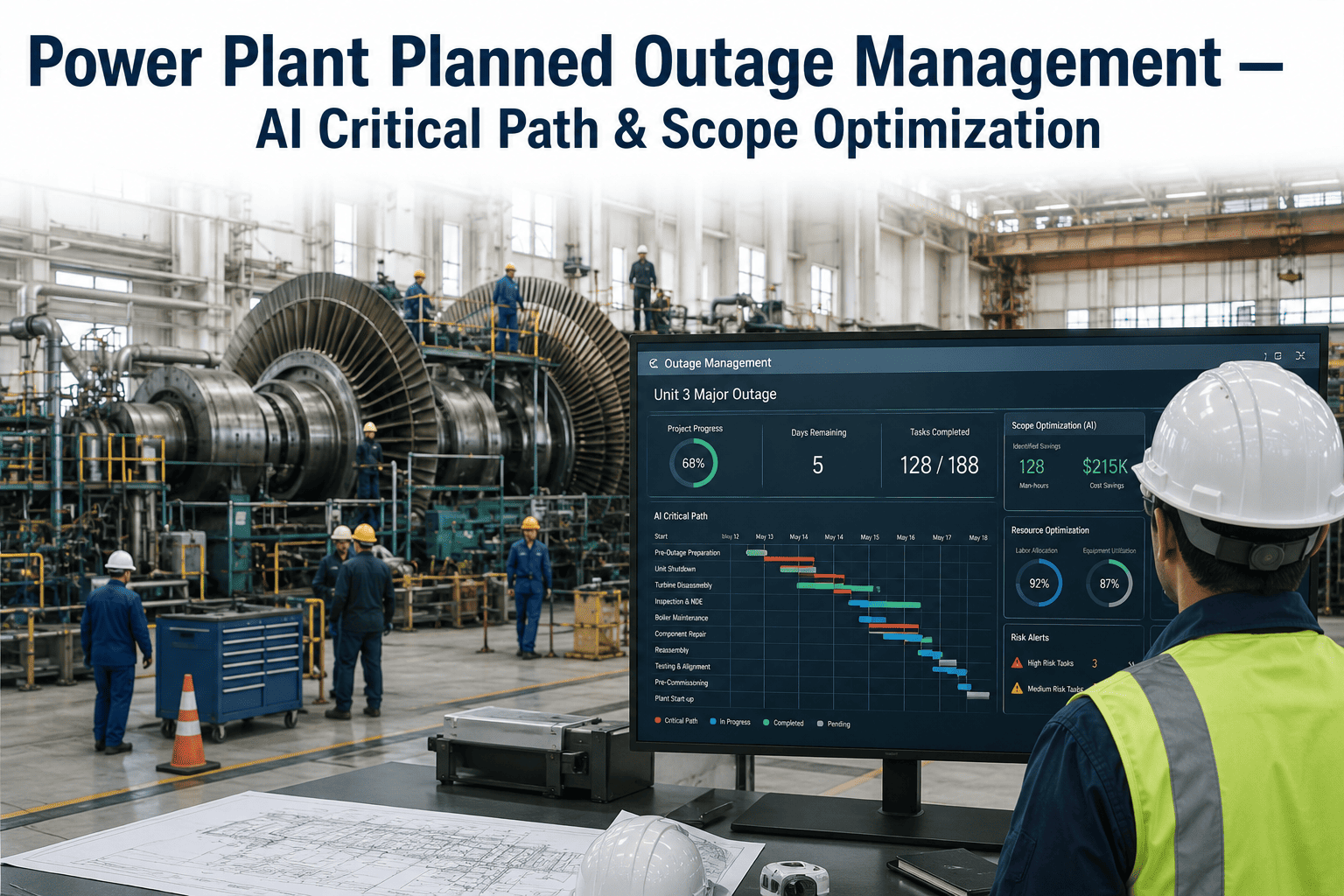
A hot gas path outage is planned months before the unit comes off line. The scope depends on borescope findings and parts life. Refurbished nozzles and buckets must be on site, OEM crews booked, and the crane rigged on day one. When these items live in separate emails and spreadsheets, one late part or missing crew can stretch the whole outage. Hot gas path inspection planning brings scope, parts, crews and lifting onto one board, tracked to the critical path. Plan your next outage in a planning session.
Hot Gas Path Inspection Planning: Scope, Parts and Crews
Scope built from borescope findings and parts life. Parts, crew and crane cards tracked to the critical path. Daily voice status from the turbine deck, so planners see what is late before it moves the end date.
- Scope, parts, crews and cranes on one board
- Critical path cards flagged first
- Status by voice from the deck
Why Hot Gas Path Outages Run Long
The inspection is well known. The coordination around it is not.
Most turbine teams know what a hot gas path inspection involves. The delays come from the work around it. A refurbished nozzle set leaves the repair shop late. A crew is booked for the wrong week. The crane arrives without the right lifting gear. A borescope finding from last year was never added to the scope, so a repair is found on the deck instead of in the plan. By the time anyone sees the clash, the outage clock is already running. Our outage specialists can review how your last outage was planned.
Outage in spreadsheets and emails
- Scope fixed before the latest borescope
- Parts status asked for by phone
- Crew and crane bookings in separate files
- Late items found on the day they are needed
Outage kanban
- Scope linked to findings and parts life
- Every part, crew and crane is a card
- Critical path cards marked and watched
- Delays shown with their effect on the end date
Combustion, Hot Gas Path and Major Inspections
Each inspection level builds on the one below it.
Heavy-duty gas turbine maintenance is usually planned as three disassembly inspections. GE's guide GER-3620 describes them as progressing from the combustion inspection to the hot gas path inspection to the major inspection. A combustion inspection is a fairly short check of fuel nozzles, liners, transition pieces and related parts. A hot gas path inspection covers everything in the combustion inspection plus the turbine section, such as the turbine nozzles, shrouds and buckets. A major inspection is a flange-to-flange inspection of the whole unit, including the compressor. Between outages, borescope inspections check internal parts without removing the casing. Confirm the right level for your unit in a scope review.
Borescope
Checks internal parts through access ports, without casing removal.
Combustion
Fuel nozzles, liners, transition pieces and crossfire tubes.
Hot gas path
Combustion scope plus turbine nozzles, shrouds and buckets.
Major
Flange to flange, including the compressor.
Summary for orientation only. Your OEM manual, contract and unit hours and starts set the actual scope and timing.
Building the HGP Scope from Findings and Parts Life
A good scope is written from evidence, not copied from the last outage.
The base scope for a hot gas path inspection comes from the OEM. What makes it right for your unit is the evidence you already hold. Borescope findings show where coatings, cooling holes or seals look worse than expected. Parts life records show how many hours, starts and repair cycles each set has used. The AI agent reads these sources and suggests scope items with the reason for each one. Your planner and the OEM engineer decide what goes in. Talk through your evidence with our turbine team.
Outage Board Columns for an HGP Inspection
Columns follow the outage, from planning to return to service.
The board has two jobs. Before the outage, it shows whether every part, crew and lift is ready. During the outage, it shows which work is open, waiting or done. Each column has an exit rule, so a card cannot move until its evidence is in place. A parts card leaves Staged only when the part is on site and inspected on receipt. A repair card leaves Inspect only when the repair decision is signed. Agree your exit rules in a working session.
Put Your Next HGP Outage on One Board
The agent suggests scope from your borescope findings and parts life, cards every part, crew and lift, and flags anything late on the critical path while there is still time to act.
Parts, Crews and Cranes as Cards
If a resource can delay the outage, it belongs on the board.
Scope items are only half of the plan. The other half is the set of things that must arrive on time for the work to happen. Each one becomes a card with an owner, a need-by date and a link to the scope items that depend on it. Refurbished hot section parts often come from a repair shop, so their cards also carry the shop status and the inspection on receipt. Our planning team can help you list the card types for your units.
Refurbished sets
Nozzles, buckets and shrouds back from repair, with shop status.
New parts
Items replaced rather than repaired, with lead time.
Consumables
Gaskets, seals, bolting and other small items.
OEM field service crew
Shifts, skills and arrival dates.
Crane and rigging
Crane, lifting gear and the approved lift plan.
Special tooling
OEM tools, fixtures and inspection kits.
Tracking Cards to the Critical Path
Not every late card is a problem. The board shows which ones are.
Outage duration is set by the critical path, the chain of work with no spare time. A card on that chain moves the end date day for day once its float is used up. A card off the chain can often slip without any effect. The board links each card to the outage schedule and shows its float, so the planner sees at once whether a delay matters. The worked example below is illustrative. Build your critical path view in a short session.
Illustrative figures. Your outage schedule sets the real paths and float.
Daily Voice Status from the Turbine Deck
Crew leads report where they work. The board keeps up.
During the outage, the people who know the real status are on the turbine deck, not at a desk. Crew leads give a short voice status at the end of each shift: what was finished, what was found and what is blocked. The agent turns this into card moves and notes, and asks a follow-up question when something is unclear. Ask our team how voice status works on a noisy deck.
Report
Voice status at shift end.
Move
Cards moved, notes added.
Check
Float on each path recalculated.
Flag
Critical path risks raised.
Decide
Planner and OEM agree the response.
Hot Gas Path Inspection Planning Checklist
Eight checks before the unit comes off line.
Use this checklist for the next outage on one unit. Tick items already in place. Get help with any gaps from our outage team.
HGP Outage Planning Mistakes to Avoid
Most outage overruns start in the planning, not on the deck.
These are common patterns that make hot gas path outages longer than planned. A short outage review can find them before your next one.
What works
- Scope written from the latest findings
- Need-by dates on every part and crew
- Critical path cards watched daily
- Lift plan approved before the outage
What fails
- Copying the last outage scope
- Assuming refurbished parts arrive on time
- Treating every late item as urgent
- Status gathered only at the morning meeting
How iFactory Runs Hot Gas Path Inspection Planning
Outage Kanban and an AI agent, on your own network.
iFactory's Outage Kanban builds the HGP scope from borescope findings and parts life, tracks parts and crew cards to the critical path and takes daily voice status from the turbine deck. It runs on an on-prem AI server inside your plant.
Evidence-based scope
Borescope findings and parts life.
One outage board
Scope, parts, crews and lifts.
Parts cards
Refurbished and new, with need-by dates.
Critical path
Float shown on every linked card.
Voice status
Daily reports from the deck.
Risk flags
Late critical cards raised early.
Scope, repair and return-to-service decisions remain with your planners and the OEM. Figures on this page are worked examples.
Turnkey AI: Delivered, Connected and Live in 6–12 Weeks
You do not build this. It arrives ready.
iFactory ships as a pre-configured NVIDIA AI server with the software pre-loaded, racked and ready. Rack it, plug in power and Ethernet, and the AI is live on your network. Our team handles cabling, network setup, PLC, SCADA, DCS and CMMS integration, outage schedule and parts system links, operator training and 24×7 remote monitoring. Data stays on your network. For a scope matched to your plant, request a turnkey quote.
Ship, network and data
Server installed. Borescope reports, parts life records and the outage schedule connected. Card types loaded.
Model training and pilot
Scope suggestions, exit rules and voice status set up and tested on one planned outage.
Go-live and training
Outage board live. Planners and crew leads trained. 24×7 monitoring begins.
Frequently Asked Questions
What is a hot gas path inspection?
A disassembly inspection that covers the combustion inspection scope plus the turbine section, such as nozzles, shrouds and buckets.
How is it different from a major inspection?
A major inspection goes further. It is a flange-to-flange inspection of the whole unit, including the compressor.
When is an HGP inspection due?
Your OEM sets the interval from operating hours and starts. Check your manual and service agreement for your unit.
Does the AI decide the scope?
No. It suggests scope items from findings and parts life, with reasons. Your planner and the OEM engineer decide.
How are refurbished parts tracked?
Each set is a card with shop status, need-by date, inspection on receipt and links to the work that depends on it.
What does critical path tracking show?
Which cards sit on the chain that sets outage length, how much float each has and what a delay would do to the end date.
How does voice status work?
Crew leads speak a short status at shift end. The agent moves cards, logs findings and asks follow-up questions.
Does this replace our scheduling tool?
No. The schedule stays in your tool. The board links to it and shows parts, crews and status in one place.
How do we start?
Start with one unit and its next planned outage. A 6-week pilot connects records and sets up cards, exit rules and voice status. To plan it, contact our team.
Plan Your Next HGP Outage with Fewer Surprises
In thirty minutes we map your next outage onto one board and show which parts, crews and lifts could touch the critical path. You keep the map either way.
- 1Your latest borescope report
- 2Parts life records for hot section sets
- 3The draft outage schedule
- 4Last outage report and lessons
- 5One item that ran late last time