A lean premixed gas turbine combustor runs close to its limits by design. Low NOx needs a lean flame, and a lean flame is more easily pushed into pressure pulsations that shake liners, nozzles and transition pieces. The OEM protection system trips the unit when pulsations get too high. What it does not do well is show the slow drift beforehand, can by can and band by band. Combustion dynamics monitoring with AI watches that drift, so tuning or inspection happens before a trip. Review your data in a dynamics review.
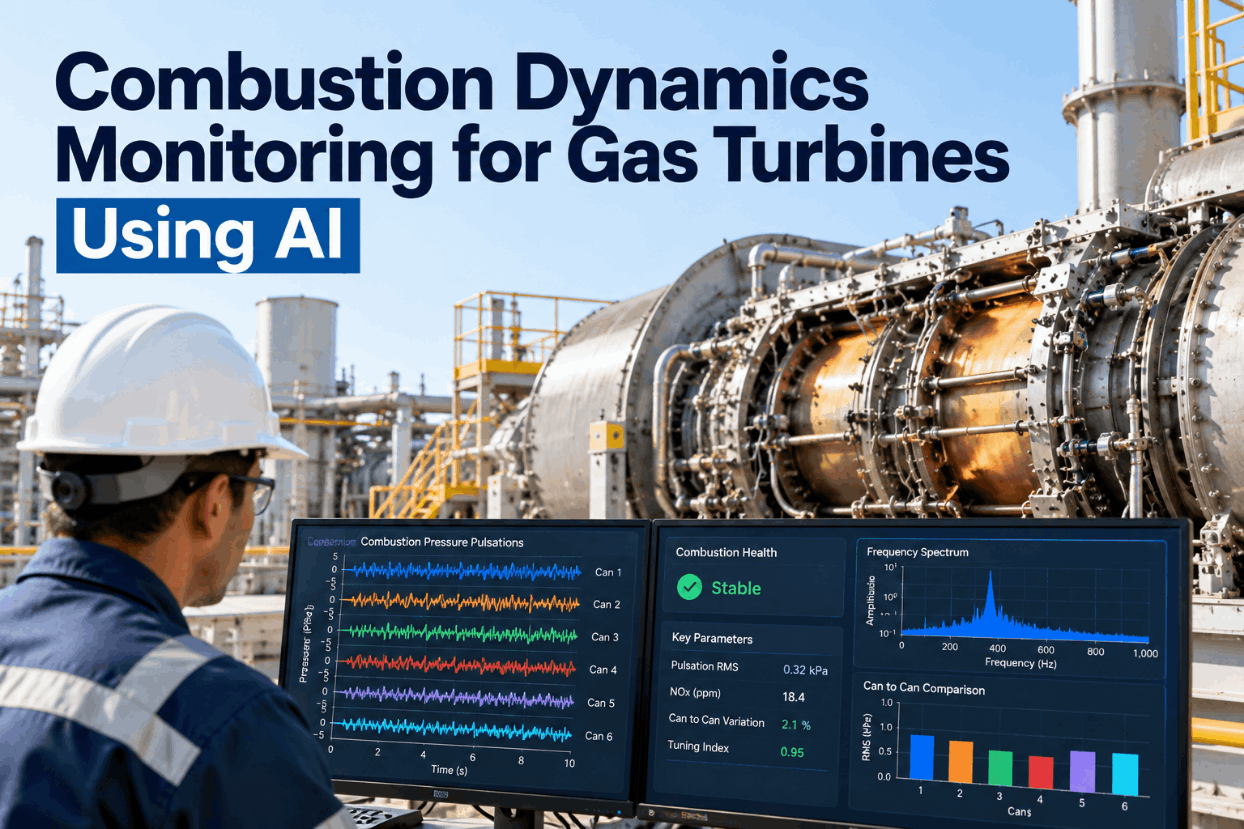
Combustion Dynamics Monitoring for Gas Turbines Using AI
Pressure pulsations modelled per can and per frequency band, with emissions alongside, so engineers see tuning drift and early signs of hardware damage while there is still time to plan the response.
- Every can compared with its own baseline
- Tuning drift told apart from damage signs
- Voice alerts and work orders, not just alarms
What Combustion Dynamics Are
Heat release and pressure waves feeding each other inside the can.
Combustion instability happens when changes in the flame's heat release line up with pressure waves in the combustor. A 1995 NASA paper on premixed combustors describes this coupling, and notes that lean premixed designs, used for low NOx, are prone to it. When the system has too little damping, the flame adds energy to the pressure wave and the pulsation grows. The paper lists the results: damaging vibration of combustor hardware, worse emissions, lower efficiency and, in a lean flame, blowout. A GE patent on dynamics monitoring adds that repeated pulsation can fatigue the combustor and has been linked to failures of fuel nozzles, cans and transition pieces. Our combustion specialists can review what your units show today.
Watching the trip limit only
- Alarm when a level is crossed
- One overall number per can
- No link to emissions or season
- Cause found after the trip
Watching the trend
- Change flagged well below the limit
- Each band tracked on its own
- Emissions and ambient read alongside
- Likely cause shown before action
Frequency Bands and What They Point To
Different tones tell you different things about the flame.
Dynamics are measured by a pressure sensor on each can and split into frequency bands. Each band tends to point at a different cause. The ranges below come from two GE patents, each describing a specific combustor. They are examples, not limits. One patent describes a lean blowout band of about 10 to 25 Hz, a cold tone of about 70 to 120 Hz and a hot tone of about 120 to 160 Hz, and notes that as the fuel-air mix gets leaner, cold tone rises and hot tone falls. The other describes low frequency rumble up to 50 Hz, mid frequency at 100 to 250 Hz and high frequency screech above 250 Hz, which it says can, at high amplitude, cause component failure in as little as a few minutes. Your OEM sets the bands for your combustor. Map yours in a working session.
Ranges are from GE patents US7210297 and US8125646 and are combustor specific. Use your OEM's bands and limits.
Can-to-Can Variation
Cans on the same unit do not burn exactly alike.
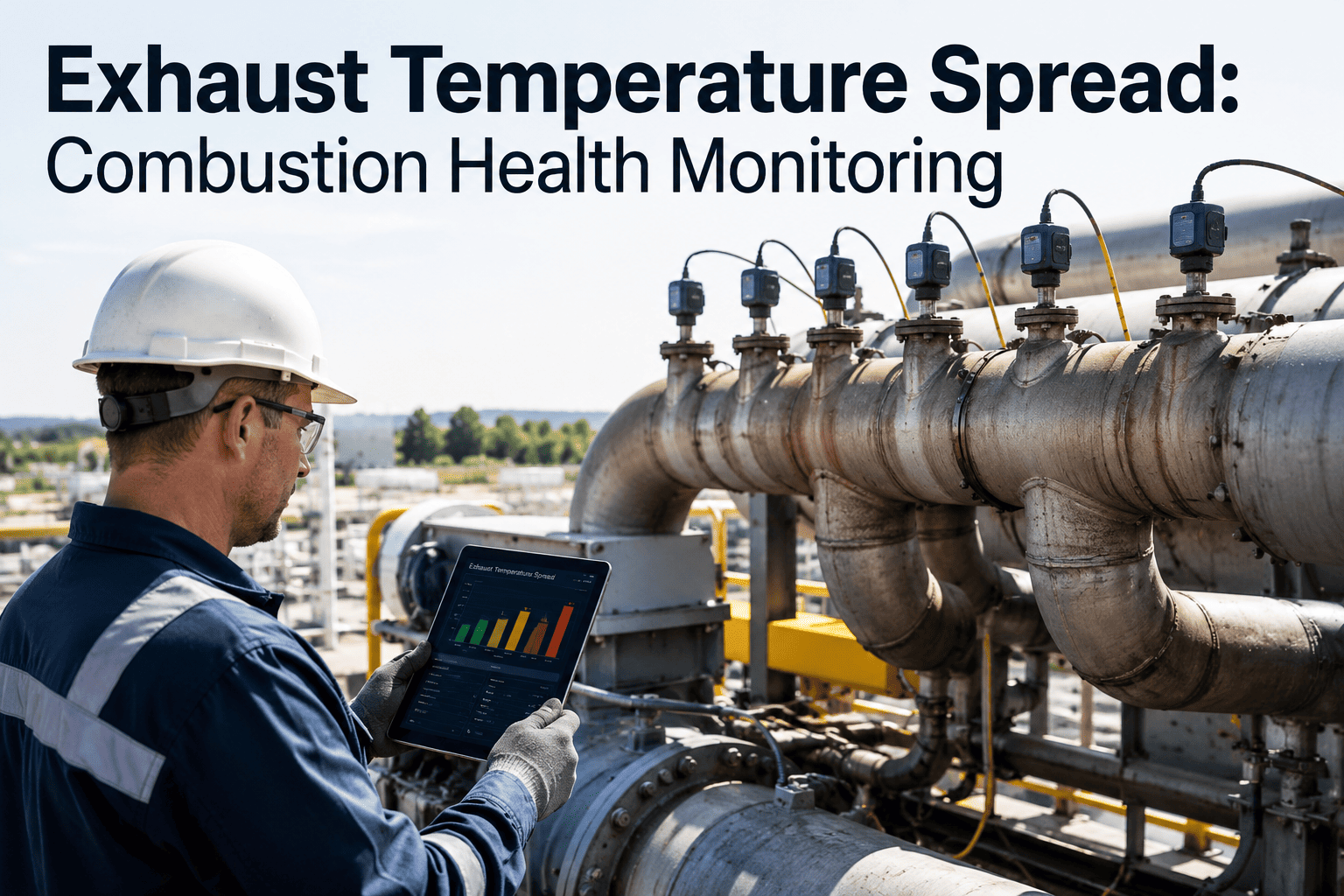
In a multi-can combustor, each can gets its own share of fuel and air. A GE patent on finding hot and cold chambers notes that the fuel-air ratio can differ slightly from can to can, and that small changes in flame temperature can cause large changes in emissions. These differences do not average out. One lean can may be near blowout while another runs hot, and the unit average still looks fine. This is why each can needs its own trend, not just a unit total. Exhaust thermocouples give a second view. Because the gas swirls on its way through the turbine, a cold spot in the exhaust does not sit directly behind the can that made it, and the patent notes that mapping one to the other needs care. Compare your cans with our engineers.
Per can pressure
Each can's bands against its neighbours.
Temperature spread
Hot and cold spots, mapped back with swirl.
NOx and CO
Stack values, which show the sum of all cans.
Tuning Drift or Hardware Damage?
The same alarm can have two very different causes.
DLN combustors are usually tuned at commissioning and after major maintenance, and many units are retuned as the seasons change. GE Vernova, for example, describes its F-class AutoTune as a way to end seasonal retunes. Between tunes, ambient conditions, fuel and wear move the combustor away from its tuned point. That is tuning drift. Hardware damage is different: a cracked liner, a worn seal or a damaged nozzle changes one can. The patterns below are typical rather than certain, and an engineer confirms the cause. Get help reading your trends in a short session.
Gradual and shared
Many cans move together, often with ambient or fuel changes, and NOx drifts with them. A retune usually brings them back.
Sudden and local
One can steps away from its neighbours and stays there after tuning. It may also show in that can's exhaust sector.
See Every Can and Every Band in One View
Dynamics modelled per can and per band, emissions alongside, drift and damage signs flagged early, the control room told by voice and a work order opened for review.
NOx Drift and Flashback Risk
Emissions and dynamics are two views of the same flame.
NOx depends strongly on flame temperature, so a slow NOx rise at the stack often means part of the combustor is running hotter than when it was tuned. Reading NOx and CO next to the per-can dynamics helps show which cans are moving. Flashback is a different risk. It happens when the local flame speed is faster than the speed of the fuel-air mix, so the flame moves back into the premixer, where it can damage hardware. The OEM protection system guards against it. The AI's role is narrower: looking for changes in dynamics, emissions and temperatures around events, and showing them to engineers. Ask our team how this fits your protection scheme.
Slow rise
Hotter running in one or more cans.
Rising CO
Cooler or incomplete burning.
Season change
Shifts the tuned point.
Gas quality
Changes flame behaviour.
How AI Models Dynamics per Band and per Can
The baseline moves with load and weather. The model moves with it.
A fixed alarm level cannot tell a normal summer value from an early warning. The model learns what each band in each can looks like at each load, ambient temperature and fuel condition, from your own history. It then flags a can when it moves away from that expected value, or away from its neighbours, before any protection limit is near. It suggests a likely cause and a response. It does not change tuning or settings. Engineers decide. See an example in a live demo.
Voice Alerts and Work Orders
The right person hears about it, and the follow-up is recorded.
A dynamics alert is only useful if someone acts on it. Control room operators hear a short voice alert naming the unit, the can, the band and what the AI suggests. The combustion engineer gets the detail. A tuning or inspection work order opens in your CMMS for review, so the alert does not vanish at shift change. When the work is done, the finding is recorded against the alert. Over time this builds a history of which patterns were tuning, which were hardware and which were a faulty sensor. Ask our team how alerts are routed.
Detect
Can and band move from baseline.
Compare
Against neighbours and emissions.
Alert
Voice alert to the control room.
Open
Tuning or inspection work order.
Close
Finding recorded, model learns.
Combustion Dynamics Monitoring Checklist
Eight checks before dynamics monitoring goes live.
Use this checklist for one unit first. Tick items already in place. Get help with any gaps from our setup team.
Combustion Dynamics Mistakes to Avoid
A quiet average can hide one loud can.
These are the patterns that most often weaken combustion dynamics programs. A short dynamics review can find them.
What works
- Each can and band trended on its own
- Baselines that follow load and season
- Emissions read next to dynamics
- Every alert closed with a finding
What fails
- Watching only the unit average
- Retuning to hide a hardware problem
- Ignoring a faulty dynamics sensor
- Waiting for the trip to investigate
How iFactory Monitors Combustion Dynamics
Predictive AI and Voice Alerts, on your own network.
iFactory's Predictive AI models dynamics per frequency band and can, and flags tuning drift. Voice Alerts tell the control room, and a tuning or inspection work order opens. It runs on an on-prem AI server inside your plant.
Per band
Each frequency band modelled apart.
Per can
Every can against its neighbours.
Emissions
NOx and CO read alongside.
Drift flags
Change seen below trip limits.
Voice alerts
Unit, can and band, spoken.
Work orders
Tuning or inspection, opened for review.
Tuning, protection settings and inspection decisions remain with your engineers and OEM. Figures on this page are worked examples.
Turnkey AI: Delivered, Connected and Live in 6–12 Weeks
You do not build this. It arrives ready.
iFactory ships as a pre-configured NVIDIA AI server with the software pre-loaded, racked and ready. Rack it, plug in power and Ethernet, and the AI is live on your network. Our team handles cabling, network setup, PLC, SCADA, DCS and CMMS integration, dynamics and emissions signal mapping, operator training and 24×7 remote monitoring. Data stays on your network. For a scope matched to your plant, request a turnkey quote.
Ship, network and data
Server installed. Dynamics, exhaust temperature, emissions and load signals connected.
Model training and pilot
Per-can, per-band baselines learned from history. Alerts checked against past events.
Go-live and training
Dynamics monitoring live. Control room and engineers trained. 24×7 monitoring begins.
Frequently Asked Questions
What is combustion dynamics monitoring?
Measuring pressure pulsations in each combustor can, split into frequency bands, to spot instability, tuning drift and hardware problems.
Why are DLN combustors prone to pulsation?
Low NOx needs lean premixed flames, and lean premixed flames couple more easily with pressure waves in the combustor.
What are cold tone and hot tone?
Names for frequency bands in some combustors. In one GE patent, cold tone rises as the mix gets leaner and hot tone falls.
Why watch each can separately?
Cans differ slightly in fuel and air. One can may drift or be damaged while the unit average looks normal.
Does the AI retune the turbine?
No. It flags drift and suggests a response. Tuning stays with your engineers, OEM or tuning system.
Does it replace the protection system?
No. OEM protection still trips the unit. The AI works below those limits to give earlier warning.
What data does it need?
Per-can dynamics, exhaust temperatures, NOx and CO, load, ambient conditions and fuel data where available.
Can it tell drift from damage?
It shows the pattern, such as one can or many, and suggests the likely cause. An engineer confirms it.
How do we start?
Start with one unit and its dynamics history. A 6-week pilot connects signals and learns baselines. To plan it, contact our team.
Catch Combustion Drift Before the Trip
In thirty minutes we review one unit's dynamics and emissions history and show which cans have moved and which bands are worth watching. You keep the findings either way.
- 1Dynamics trends per can
- 2NOx and CO history
- 3Your last tuning report
- 4Recent combustion inspection findings
- 5One trip you never fully explained