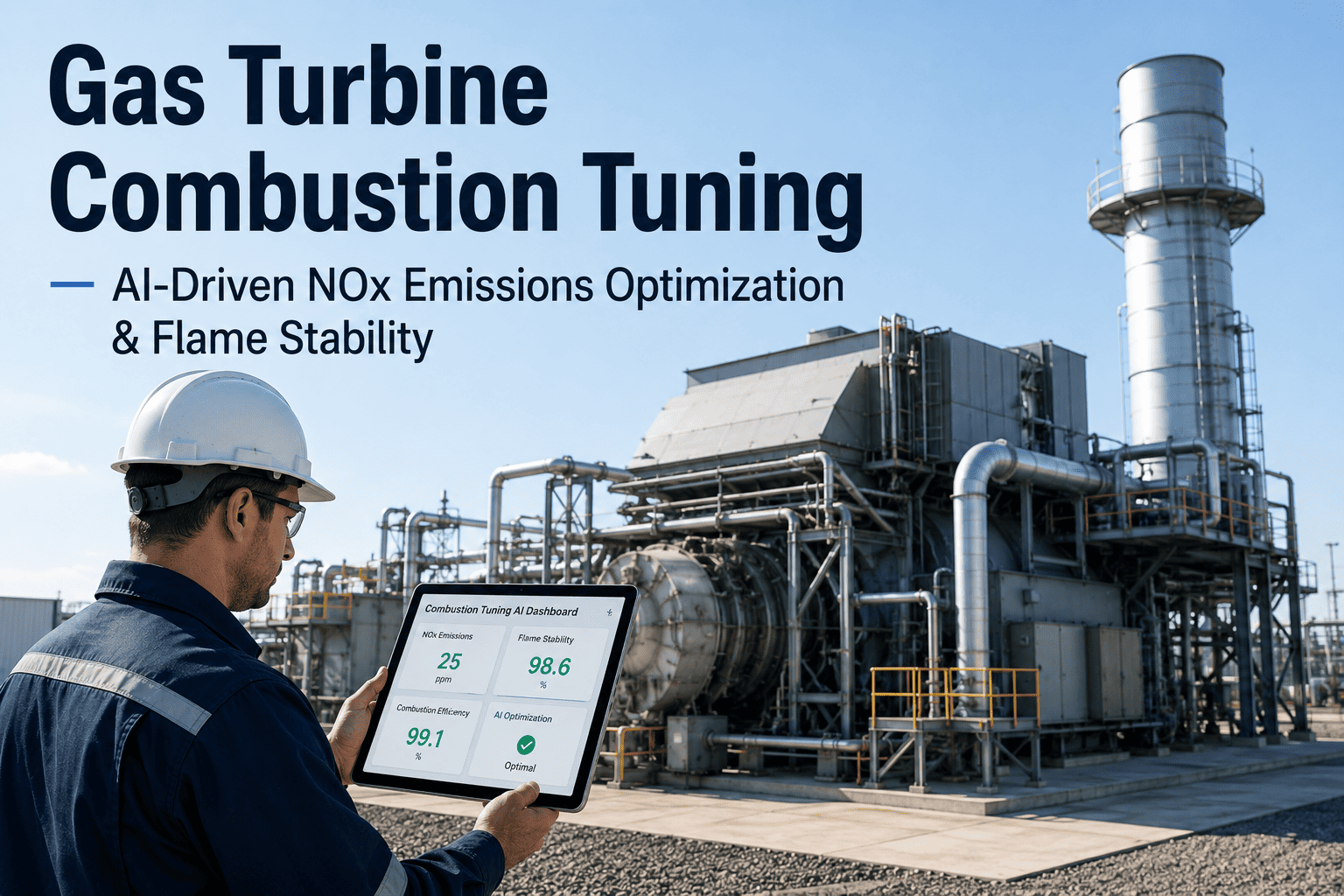
Dry Low NOx combustion buys its emissions performance by running deliberately lean, and lean premix flames sit close to the edge of instability by design — which is exactly why DLN-equipped turbines need retuning as often as twice a year just to keep pace with ambient temperature swings. Get the fuel split wrong in one direction and NOx creeps past the compliance limit; get it wrong in the other and combustion dynamics pulsations climb toward the level that cracks a transition piece or triggers a flashback. Process engineers are usually the ones caught between an environmental permit that will not move and a combustion system that will not sit still, manually re-tuning fuel splits after every seasonal shift because the alternative is either an emissions excursion or a damaged combustor can. Teams looking to close that gap with continuous dynamics monitoring often start by choosing to book a demo and see their own combustor-by-combustor dynamics data mapped against NOx output.
Hold NOx Compliance Without Pushing Combustion Dynamics Toward the Damage Threshold
iFactory continuously analyzes combustion dynamics frequency, flame temperature distribution, and emissions output together — so fuel split adjustments are based on real combustor-by-combustor data, not a seasonal retune from memory.
Four Parameters Every DLN Tuning Decision Has to Balance at Once
DLN tuning is not a single-variable problem. Every fuel split adjustment made to pull NOx down pushes combustion closer to a lean blowout limit, and every adjustment made to stabilize dynamics tends to raise flame temperature and NOx output with it. The four panels below are the parameters a tuning decision has to weigh simultaneously, and they are exactly the parameters iFactory tracks together in real time.
Lean premix combustion operates in a metastable state that produces pressure pulsations at known frequency bands, and rising amplitude in those bands is the earliest sign that a combustor can is drifting toward instability. Left unaddressed, sustained high-amplitude dynamics fatigue combustor liners and crossfire tubes well before any other symptom appears. iFactory tracks amplitude per combustor can continuously, flagging a rising trend days before it would reach a hard alarm threshold.
NOx and CO move in opposite directions as fuel splits shift, and the compliance window between the two limits narrows further as ambient temperature and fuel composition change through the year. iFactory trends emissions output against the specific fuel split in effect at the time, building a picture of where your unit's real operating window sits today, rather than relying on the tuning matrix from the last commissioning.
Individual combustor cans and fuel nozzles do not degrade at the same rate, and a spread that was normal at commissioning can widen significantly over a few thousand operating hours without crossing an alarm limit at any single point along the way. iFactory trends every exhaust thermocouple channel against its own can-specific baseline, catching the specific combustor that is drifting instead of only the fleet average.
Fuel nozzle coking gradually shifts the effective fuel split away from the intended tuning point even when the control system's commanded split hasn't changed, which is one of the most common causes of a tune that "worked fine last month" quietly drifting out of window. iFactory correlates fuel flow split data against dynamics and exhaust spread trends to flag nozzle-related drift before it forces an unscheduled retune.
How Continuous Monitoring Turns a Seasonal Retune Into a Standing Process
Instead of a scheduled retune event every few months, continuous dynamics and emissions tracking turns combustion tuning into a standing background process — small, frequent adjustments rather than a large correction after drift has already accumulated.
Find Out Which Combustor Can Is Drifting First
A short review of your dynamics and exhaust spread history usually identifies which specific can is closest to needing attention, not just a fleet-average trend.
Matching the Right Response to Each Tuning Concern
Different tuning problems call for different corrective directions, and applying the wrong one — increasing fuel split to fix dynamics when NOx is already near its limit, for example — trades one compliance problem for another.
| Dominant Concern | Observed Signal | Typical Adjustment Direction | Secondary Effect to Watch |
|---|---|---|---|
| High combustion dynamics | Rising amplitude, 100–500 Hz band | Incremental fuel split increase | NOx rise |
| High NOx | Emissions above compliance limit | Fuel split reduction toward lean side | Dynamics amplitude rise, blowout risk |
| Low NOx / blowout risk | Emissions unusually low, flame instability | Fuel split increase toward stability | NOx approaching limit again |
| Can-to-can exhaust spread | Growing thermocouple deviation | Individual can trim, nozzle inspection | Blade path thermal stress if unaddressed |
We used to schedule a full retune twice a year and just accept that the weeks in between were a guess. Having dynamics and exhaust spread trending live in front of us means the retune isn't a big event anymore — it's a series of small nudges, and we catch a can starting to drift days before it would have shown up as an emissions excursion at the next audit.
Gas Turbine Combustion Tuning — Frequently Asked Questions
Keep Combustion Inside the Window Without Guessing at the Retune
iFactory watches dynamics, emissions, and exhaust spread together so fuel split decisions are backed by combustor-level trend data — not a calendar-driven retune based on last season's assumptions.