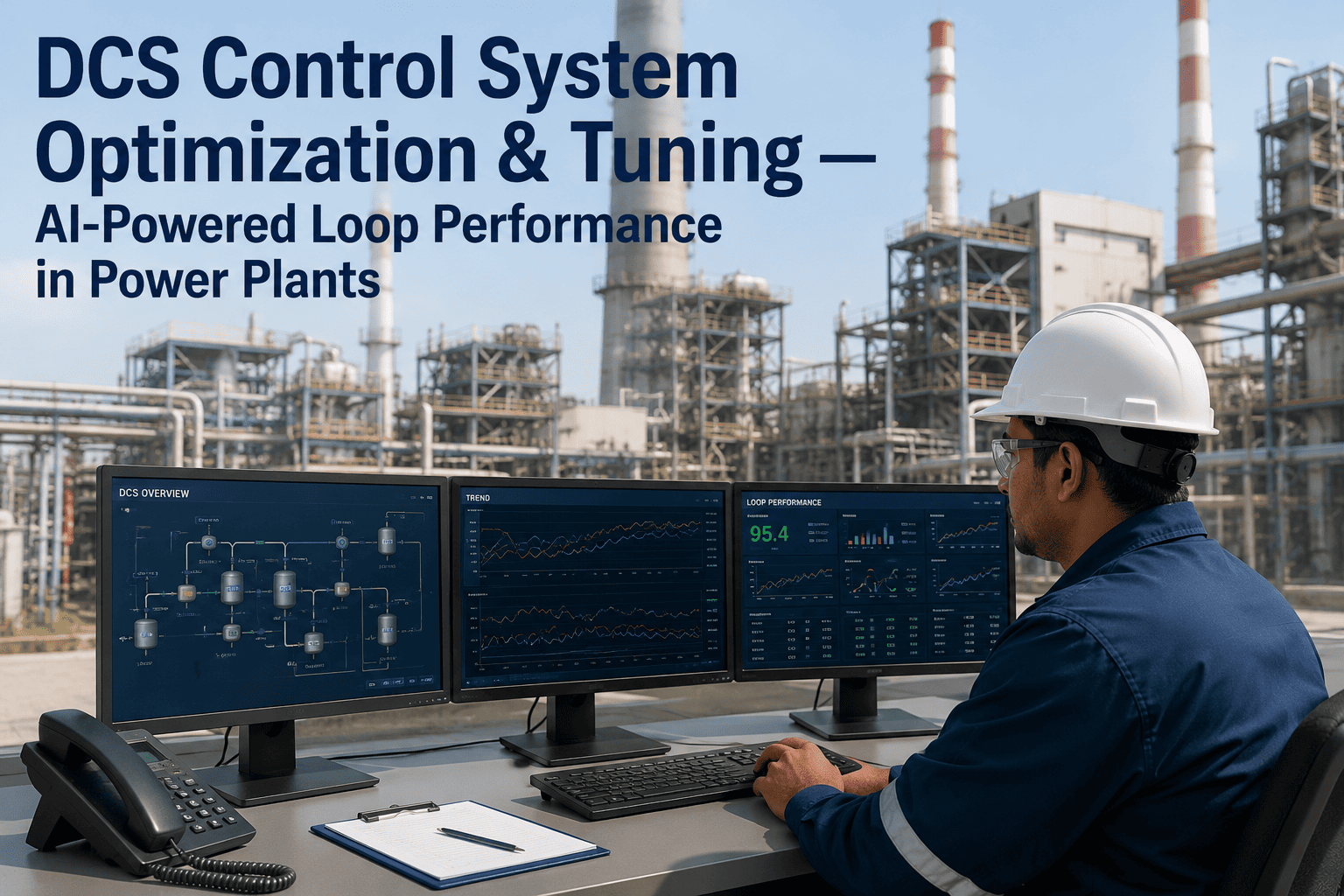
A control loop that hunts back and forth around its setpoint doesn't announce itself as a tuning problem. It shows up as inconsistent product quality, a valve that seems to wear out faster than its neighbors, or an operator quietly switching a loop to manual because "it's easier to just run it by hand." Underneath almost all of these symptoms sits the same root issue: PID parameters that no longer match how the process actually behaves.
Why Poorly Tuned Loops Are So Easy to Overlook
Most plants have far more control loops than they have people dedicated to watching them, and a loop that's oscillating gently or responding sluggishly rarely trips an alarm or causes an obvious trip. It just quietly costs efficiency, wears equipment faster than it should, and makes the process harder to run smoothly than it needs to be — day after day, without ever presenting as a single, attributable event that would prompt an investigation.
Industry studies on control loop performance have repeatedly found that a meaningful share of loops in a typical industrial plant are operating in a degraded state at any given time, whether from original tuning that never matched actual process dynamics, mechanical wear in the final control element, or process conditions that have drifted from what the original tuning assumed. The default assumption in most plants is that loops, once tuned, stay tuned — but process equipment, control valves, and even sensor characteristics change over years of service, and the tuning parameters set during commissioning rarely get revisited unless something goes visibly wrong.
Matching Loop Behavior to Likely Tuning Problems
Before adjusting any parameter, a disciplined tuning process starts with careful observation of how the loop actually behaves. Different failure patterns point toward different corrective directions, and adjusting the wrong parameter based on a misread symptom often makes the loop worse rather than better.
What Each PID Term Is Actually Doing to the Loop
Most process control loops in a power plant setting use some combination of these three terms, but not every loop needs all three active. Flow loops, which respond quickly and often carry significant measurement noise, are frequently run with derivative action disabled entirely, while slower thermal loops with less noise but longer process lags often benefit from a more deliberate derivative contribution.
Loop Performance Metrics Worth Tracking Continuously
| Metric | What It Measures | Why It Matters |
|---|---|---|
| Percent time in automatic | How often the loop runs under controller command versus manual | A loop frequently switched to manual is a strong signal of an underlying tuning or mechanical issue |
| Setpoint tracking error | Average deviation between process variable and setpoint over time | Sustained deviation often points to integral action that's too weak or a valve that can't reach the commanded position |
| Output reversal rate | How frequently the controller output changes direction | High reversal rates accelerate valve and actuator wear even when the process variable looks acceptable |
| Valve travel | Cumulative distance the control valve stem or actuator moves over time | Excessive travel relative to production throughput often indicates unnecessary loop activity from overly aggressive tuning |
Output reversal rate deserves particular attention because it's the metric most directly tied to mechanical wear costs that rarely get connected back to tuning quality. A loop can look acceptable on a process variable trend while quietly driving a control valve through far more cycles than necessary, shortening its service life and increasing the frequency of valve maintenance and replacement. Book a demo to see how valve travel and reversal metrics connect to your maintenance history.
A Structured Approach to Re-Tuning a Degraded Loop
Re-tuning a loop that's drifted out of good performance benefits from a structured sequence rather than trial-and-error adjustment on a live process, particularly for loops on critical or safety-related equipment where an aggressive test disturbance carries real consequences.
Why Loop Tuning Deserves a Plant-Wide Program, Not Just Reactive Fixes
Individual loop tuning fixes are valuable, but plants that only address loops after a problem becomes visible are missing the majority of the opportunity. A structured, plant-wide loop performance program tracks every critical loop continuously, prioritizing re-tuning efforts based on actual measured degradation rather than which loop happens to generate a complaint from operations that week.
This kind of program also creates a valuable feedback loop of its own: loops that repeatedly drift out of tune despite good tuning work are often signaling a mechanical issue — valve stiction, sensor drift, actuator wear — rather than a tuning issue at all, and catching that pattern early redirects maintenance effort toward the actual root cause instead of re-tuning the same loop repeatedly with diminishing results.
The plants that get the most value from process control investment tend to treat loop tuning as an ongoing discipline with assigned ownership and regular review, not a one-time commissioning activity that's revisited only when something breaks. That shift in mindset, more than any specific tuning technique, is usually what separates a plant with consistently stable processes from one that's perpetually fighting the same handful of unstable loops.
When Loops Aren't Actually Independent of Each Other
Tuning is often approached one loop at a time, but many process control loops in a plant are not truly independent — a change to one loop's output can shift the process conditions another loop is trying to control, and tuning each loop in isolation without accounting for that interaction can produce a plant that looks fine loop-by-loop but behaves poorly when everything runs together.
Identifying loop interaction usually requires watching how one loop responds when a neighboring loop is deliberately disturbed, rather than assuming independence based on the control diagram alone. Loops that show meaningful cross-response often need coordinated tuning, sometimes with one loop tuned more conservatively than it would be if it stood alone, specifically to avoid amplifying the other loop's corrections.
Documenting Tuning Changes So the Next Engineer Isn't Starting Blind
Tuning parameters that get adjusted informally during a shift, without a documented record of what was changed and why, tend to drift over time as different engineers make well-intentioned adjustments without full visibility into the loop's tuning history. The result is a loop that's been "tuned" repeatedly without ever converging on a stable, well-understood configuration.
A simple discipline addresses most of this: every parameter change should be logged with the date, the specific values changed, the observed symptom that prompted the change, and the outcome observed afterward. Over time, this log becomes a valuable diagnostic tool in its own right, since a loop that shows a long history of repeated adjustments without lasting improvement is very likely signaling a mechanical issue rather than a tuning issue that hasn't been found yet.