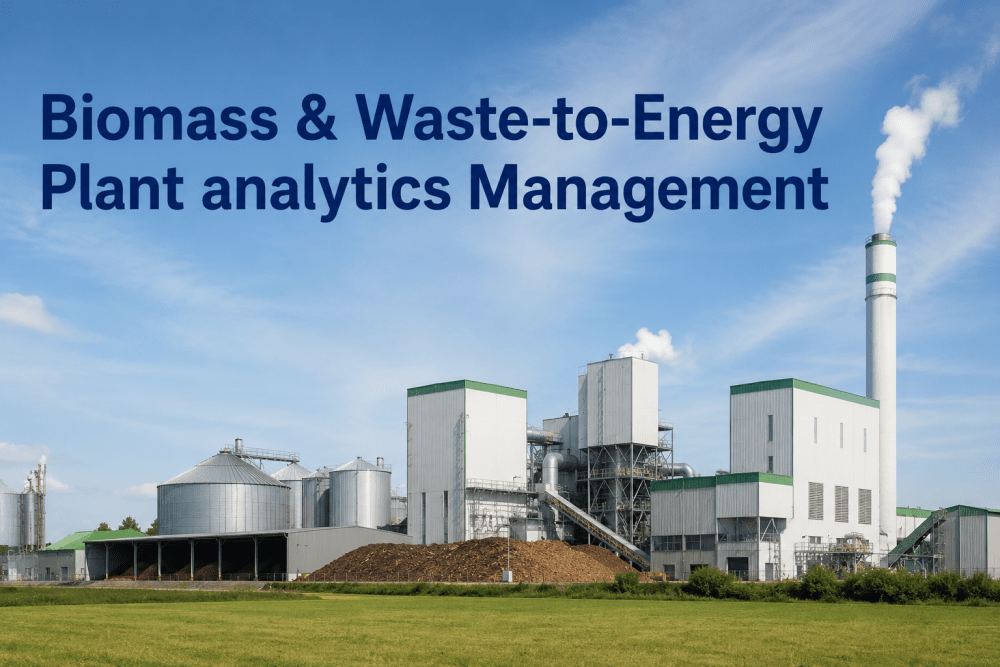
Municipal solid waste arrives at a WtE plant with a heating value that can swing meaningfully from one truckload to the next, and the fuel mass flow itself typically cannot be measured directly — most facilities still estimate it from an averaged crane weigher reading. That heterogeneity is the root cause behind almost every combustion control and emissions challenge a Process Engineer deals with day to day: unstable steam output, CO and NOx spikes that appear with little warning, and grate wear patterns that never quite match the maintenance schedule built for a more consistent fuel. AI-driven combustion control does not eliminate that variability, but it lets the plant react to it in seconds rather than minutes, which is often the difference between a stable stack reading and a reportable exceedance. See how iFactory's combustion and emissions platform fits into that picture below.
Why Fixed Control Loops Struggle With Municipal Waste
A conventional PID control loop assumes a reasonably predictable process. Municipal solid waste does not cooperate. A surge of wet waste or a sudden drop in heating value can pull furnace temperature, oxygen levels, and steam output out of range faster than a static control loop can compensate, and by the time the operator manually adjusts grate speed, air flow, and fuel feed rate, the disturbance has often already produced a CO or NOx spike. AI-driven combustion controllers address this differently: they learn the plant's actual dynamics over time and anticipate disturbances — a surge of wet waste, a drop in calorific value — rather than only responding once the process has already moved off setpoint.
The payoff shows up directly in emissions stability. Adaptive combustion control tightens the process around optimal setpoints even as waste characteristics shift, which means fewer CO and NOx excursions, more consistent steam output, and less unburned carbon left in the ash. For a Process Engineer accountable for both throughput and permit compliance, that stability is the difference between a "no surprises" emissions profile and a control room spending its shift chasing setpoints.
Grate speed, primary and secondary air distribution, and fuel feed rate are adjusted continuously against real-time furnace temperature and oxygen readings, not fixed setpoints.
Combustion staging, flue gas recirculation, and SNCR reagent dosing are coordinated to keep NOx well below permit limits while reducing excess ammonia and reagent consumption.
Thermal and vibration data on moving grate bars and ram feeders catch abrasive wear well ahead of the 12-24 month inspection cycle most plants still rely on.
HF, HCl, SO2, NOx, CO, and particulate trends are correlated against fuel and combustion data so shifts in flue gas chemistry are explained, not just recorded.
Static PID Control vs. Adaptive AI Combustion Control
| Control Dimension | Fixed PID Loop | AI-Assisted Adaptive Control |
|---|---|---|
| Response to fuel heating value shifts | Reacts after temperature drifts off setpoint | Anticipates based on learned combustion dynamics |
| NOx/CO stability | Excursions common during feedstock swings | Held closer to setpoint through predictive adjustment |
| Reagent consumption | Often over-dosed to stay safely under limits | Dosed to actual NOx trajectory, reducing waste |
| Grate wear detection | Found at scheduled 12-24 month inspection | Flagged through continuous thermal and vibration data |
| Operator workload | Manual adjustment during every disturbance | Operator co-pilot handles low-risk parameter changes |
The Fuel Mass Flow Problem Nobody Talks About
One detail that rarely comes up outside process engineering circles: neither fuel mass flow nor real-time heating value can typically be measured directly on a grate-fired MSW line. Plants estimate mass flow from an averaged crane weigher reading taken over several hours, which means the combustion control system is often working from a lagging, smoothed estimate of what is actually landing on the grate at any given moment. That gap between estimated and actual fuel input is a major reason why firing control historically leaned on operator experience — adjusting ram feeder frequency, stroke length, and air distribution by feel — rather than a purely model-based approach.
Closing that gap is exactly where a learned combustion model earns its value over a static one. By correlating furnace temperature response, oxygen trends, and steam generation against the crane weigher data and historical charge patterns, an adaptive model can infer likely heating value and composition shifts faster than the weigher data alone would suggest, and adjust grate speed and air distribution ahead of the disturbance instead of after it shows up in the steam drum.
Where Operators Fit Once the Loop Gets Smarter
A common concern when adaptive control comes up in the control room is whether it is meant to replace the operators who currently make these adjustments by feel. In practice, a well-scoped rollout starts narrower than that. Advisory models surface recommended setpoint adjustments for low-risk parameters — grate speed, air balance — while the operator retains approval authority, effectively acting as a co-pilot rather than an autonomous controller. Only after the model has demonstrated consistent, explainable recommendations across a meaningful range of waste conditions does it make sense to close the loop on any parameter automatically, and even then it is typically scoped to the lowest-risk adjustments first.
That staged approach matters for buy-in as much as for safety. Operators who have run a grate-fired line for years have genuine pattern recognition that a model trained on a few months of data will not initially match, and the fastest way to lose their trust is to present a black-box recommendation with no reasoning attached. Combustion advisory tools that show which signals drove a given recommendation — a falling steam pressure trend combined with a rising CO reading, for instance — tend to get adopted faster than ones that simply issue a setpoint change with no explanation.
Dioxin and Trace Pollutant Control Deserve Their Own Attention
NOx and CO get most of the operational attention because they respond quickly to combustion conditions and show up on a continuous monitor in near real time, but dioxin formation follows a different pattern that is easy to overlook. Dioxins and furans form predominantly in the post-combustion cooling zone, between roughly 200 and 450 degrees Celsius, when incompletely combusted carbon recombines with chlorine in the presence of certain metal catalysts on fly ash surfaces. That means dioxin risk is driven as much by how quickly flue gas passes through that temperature window as by combustion completeness in the furnace itself — a detail that purely furnace-focused combustion optimization can miss entirely.
Because continuous online dioxin measurement is still uncommon at most facilities, plants typically rely on predictive correlation instead: modeling dioxin risk from combustion stability indicators, CO trends, activated carbon injection rates, and cooling zone residence time, then validating periodically against stack testing. Feeding those same combustion stability signals into an adaptive control model gives a plant an earlier, indirect read on dioxin risk than waiting for the next scheduled stack test would provide.
Building a Plant-Specific Model Instead of a Generic One
The starting point is a full inventory of process historian tags — temperatures, pressures, flows, crane weigher data, and CEMS readings — so the model learns from data your plant already generates.
Historical charge patterns and known heating value swings for your specific waste catchment area are used to calibrate the model, rather than assuming a generic national average waste composition.
Recommendations run in advisory mode first, compared against what operators actually did, before any parameter is closed into automatic control.
Seasonal waste composition shifts and changes in the collection catchment area mean the model needs periodic recalibration, not a one-time training pass.
It is tempting to treat flue gas cleaning — bag filters, scrubbers, SCR or SNCR systems — as the layer responsible for emissions compliance, with combustion control handled separately for efficiency reasons. In practice the two are inseparable. A combustion process that is running unstable, with fluctuating CO and incomplete burnout, pushes a heavier and more variable load onto downstream treatment systems, accelerating catalyst poisoning and filter blinding. Stabilizing combustion first is usually the cheapest lever a Process Engineer has for reducing the burden on flue gas treatment. Bag filters, scrubbers, and SCR systems all face progressive blinding, casing corrosion, and catalyst poisoning as their normal wear pattern, and differential pressure monitoring across those stages can flag degradation before it ever threatens an emission limit — but that monitoring works best when it is reading a flue gas stream that combustion control has already kept relatively stable.