A single unplanned outage at a nuclear generating station can cost between $700,000 and $2 million per day in replacement power, and refueling outages already consume 30 or more days every 18 to 24 months. For an Operations Director, every one of those days is a line item that regulators, ratepayers, and the board all scrutinize. The plants that consistently post capacity factors above 90 percent are not lucky — they run maintenance programs built on continuous, data-driven equipment intelligence rather than fixed calendars and after-the-fact failure analysis. This page walks through what that looks like in practice, and where iFactory's nuclear operations platform fits into a plant that is trying to close that gap without adding regulatory risk.
Why the Maintenance Rule Makes This a Compliance Question, Not Just an Efficiency One
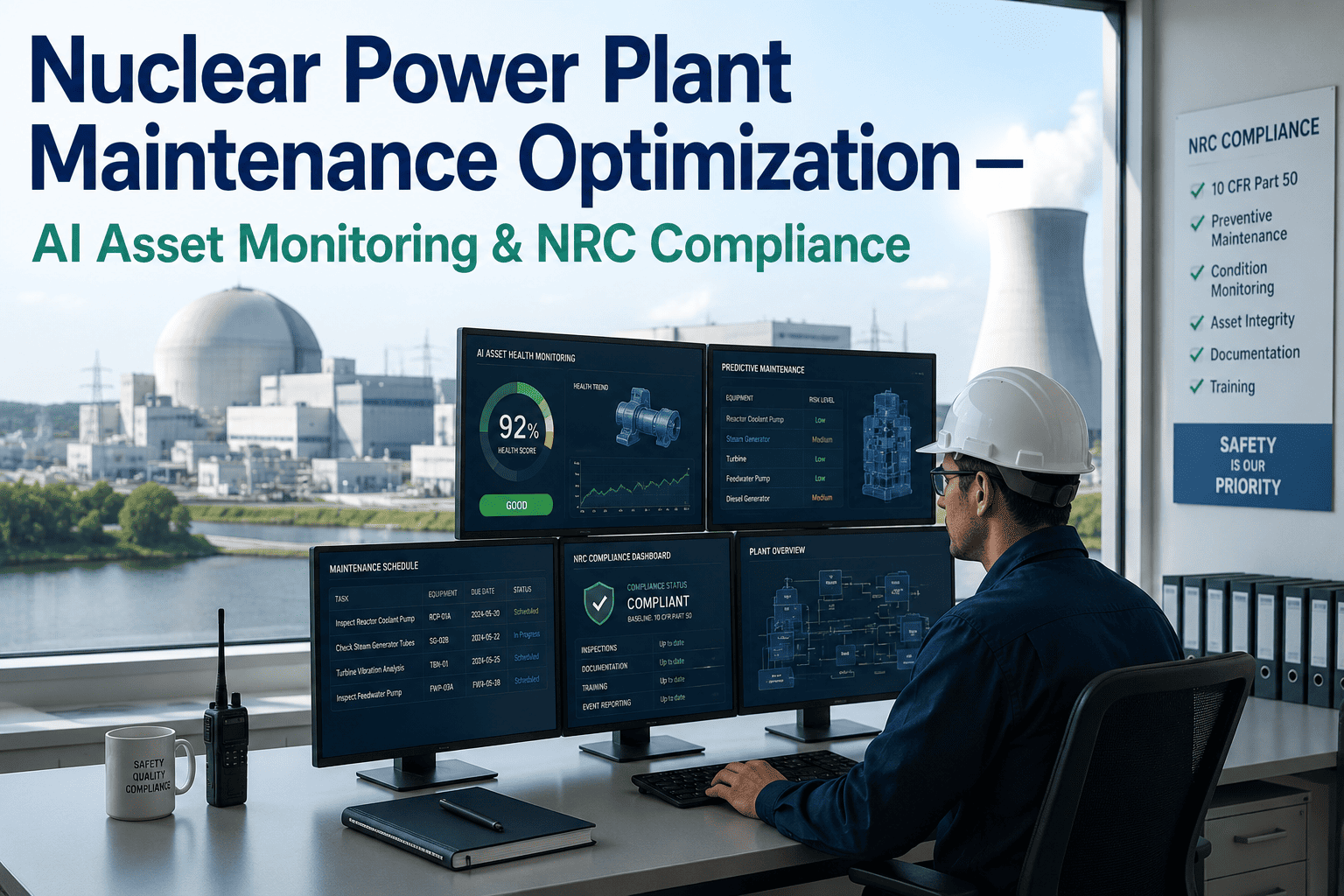
10 CFR 50.65, the NRC Maintenance Rule, requires every licensee to monitor the effectiveness of maintenance on safety-related and risk-significant structures, systems, and components, and to demonstrate that performance is being controlled through appropriate preventive maintenance. Historically, plants have satisfied that requirement through periodic surveillance testing and post-failure root cause analysis — both of which are backward-looking by design. Continuous, sensor-driven condition monitoring changes the evidence base entirely. Instead of demonstrating effectiveness through a snapshot test every quarter, the plant produces a running trend line for every monitored asset, with the degradation trajectory, the engineering disposition, and the resulting work order all timestamped and linked.
For an Operations Director, this matters in two directions at once. It gives your (a)(1) and (a)(2) assessments a stronger evidentiary base heading into an NRC inspection, and it gives your maintenance planners a genuine early-warning system instead of a compliance checkbox. Technical Specification surveillance intervals themselves cannot be substituted or extended based on operating experience without a formal license amendment — AI-driven monitoring does not replace that testing. What it does is make the outcome of each surveillance far more predictable, because your reliability engineers already have a high-confidence read on equipment health going in.
Four Places Continuous AI Monitoring Changes the Maintenance Picture
Vibration, thermal, and process signals from safety-related pumps, motors, and heat exchangers are trended continuously rather than sampled quarterly, surfacing degradation weeks before it would show up on a fixed surveillance schedule.
Health scores are mapped against TS action levels, flagging components approaching an LCO condition before the surveillance interval arrives, so redundant-train availability is never a surprise during a shift turnover.
When a deviation is detected, a draft Corrective Action Program entry with severity classification is generated automatically, cutting the administrative load on engineers who would otherwise write it from scratch.
Condition data collected months before a refueling outage lets planners finalize scope earlier, when schedule and budget can still absorb changes, instead of discovering emergent work once the unit is already down.
Reactive Surveillance vs. Continuous Condition Intelligence
| Maintenance Dimension | Calendar-Based Approach | AI-Driven Continuous Monitoring |
|---|---|---|
| Failure discovery | Found during scheduled test or after failure | Trended weeks ahead through continuous signals |
| Maintenance Rule evidence | Point-in-time test results | Continuous, timestamped degradation trend |
| Outage scoping | Emergent work found once unit is down | Condition data drives scope months in advance |
| CAP documentation | Manually drafted by engineers | Draft generated automatically with severity tag |
| Workforce dependency | Relies on senior technician judgment | Institutional knowledge captured in the model |
A Deployment Model Built Around Nuclear's Non-Negotiables
Rolling out predictive analytics inside a licensed facility is a different exercise than doing it at a conventional plant, because every connection, every alert, and every change to plant records has to sit inside the current licensing basis. A workable rollout typically moves through three stages: establishing a read-only connection to existing historian and CMMS data with no modification to I&C configurations, building statistically robust health baselines across at least one full operating cycle per asset class, and finally activating automated alerting and CAP drafting once engineering has validated the model against real operating history. Facilities with an established PI or AVEVA historian usually skip the instrumentation phase entirely, since the sensor data already exists.
The stage most programs underestimate is validation, not connection. Engineering has to see the model score a full cycle of known events correctly — including planned transients, seasonal load shifts, and at least one maintenance outage — before anyone will trust an alert enough to act on it. Rushing past that step to show early wins is usually what causes a promising pilot to lose credibility six months in, once the first false alarm arrives without an explanation attached to it.
Building the Business Case Without Overselling the Model
Operations Directors who have sat through a failed digital transformation pitch tend to be skeptical of round numbers, and rightly so. The more useful framing for a capital or O&M budget request is to separate the guaranteed value from the probabilistic value. The guaranteed value is administrative: fewer hours spent manually compiling Maintenance Rule evidence, fewer hours drafting CAP entries by hand, and a documented audit trail that shortens the prep time before an NRC inspection. Those savings show up in the first operating cycle and are easy to defend to a finance committee because they do not depend on catching a failure before it happens.
The probabilistic value is where the bigger numbers live, and it deserves to be treated as a range rather than a promise. Avoiding even one unplanned outage day at $700,000 to $2 million in replacement power, or shaving a few days off a refueling outage by finalizing scope earlier, can pay for a multi-year deployment on its own. But the honest way to present this internally is as expected value across a fleet or a multi-year horizon, not as a guaranteed return in year one. Reliability engineers who have lived through false-positive fatigue from earlier condition-monitoring tools will also want to know how alert thresholds are tuned against your plant's own operating history rather than a generic industry model, since that is usually what separates a system people trust from one they eventually silence.
Which Equipment Classes Actually Move the Reliability Numbers
Not every asset in a plant justifies the same monitoring investment, and an Operations Director building a program from scratch needs a way to prioritize. The equipment classes that consistently produce the fastest payback are the ones that combine high failure consequence with a well-understood degradation signature: reactor coolant pumps and their seals, emergency diesel generators, motor-operated valves in safety-related trains, main feedwater and condensate pumps, and large motors driving essential service water. Each of these has decades of industry failure data behind it — bearing wear, seal degradation, winding insulation breakdown — which means the models built to detect early degradation are working from a mature base rather than starting cold.
Balance-of-plant equipment deserves a second look too, even though it sits outside the Maintenance Rule's safety-related scope. Condensers, cooling water systems, and turbine-generator auxiliaries rarely threaten a scram, but they are frequently what actually derates output or forces a planned power reduction. A monitoring program that only covers safety-related assets will satisfy a compliance audit while still leaving an Operations Director exposed to the capacity factor losses that come from balance-of-plant degradation nobody was watching closely enough.
Questions Worth Asking Before You Sign a Vendor Contract
On-premises or private-cloud deployment with role-based access is generally a non-negotiable for nuclear operators, given NRC expectations around data sovereignty and cybersecurity boundaries.
Ask for a specific description of how alert thresholds are calibrated against your plant's own operating history rather than a generic industry baseline, since threshold mismatch is the single biggest driver of alert fatigue.
Non-safety-related software classification, the associated QA package, and the 10 CFR 50.59 screening documentation should be a defined deliverable, not something your licensing team has to reconstruct after deployment.
A monitoring platform that goes blind every time the PI Historian is down for maintenance is a liability during exactly the periods when visibility matters most — ask how gaps in the data feed are handled.
A prediction that cannot be traced is not useful evidence in an NRC inspection. Every health score, alert, and resulting CAP entry needs to be logged, timestamped, and tied back to the specific sensor readings that triggered it, so your team can hand an inspector a complete evidence chain on request rather than reconstructing it after the fact. That auditability is what turns a data science tool into something a licensing engineer will actually trust in front of a regulator.