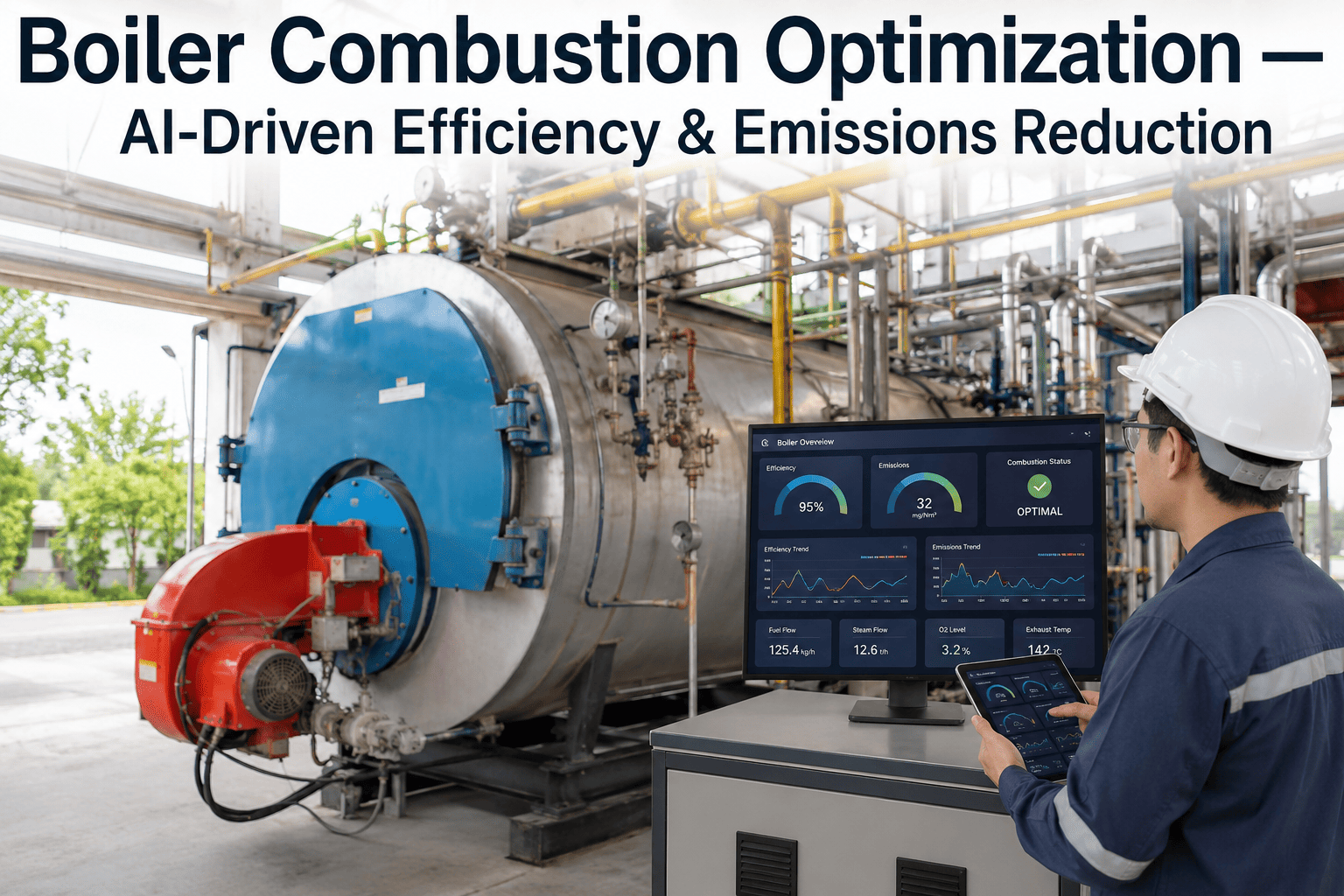
Every boiler burns some amount of air beyond the theoretical minimum needed to combust its fuel completely, and getting that excess air number right is one of the highest-leverage efficiency levers a process engineer has. Too little excess air leaves unburned fuel, soot, and carbon monoxide in the flue gas. Too much air carries heat straight up the stack instead of into the steam, and every extra percentage point of excess oxygen forces the combustion air fan to work harder while doing nothing for output. Coal-fired units typically run 10 to 20 percent excess air while gas-fired boilers can hold as low as 5 percent, yet without continuous O2 trim control most boilers drift well above their optimal setpoint as burners age, fuel composition shifts, and load changes throughout the day. AI-driven combustion optimization closes that gap automatically instead of relying on periodic manual tuning, and a short review of your current flue gas data shows how much room your unit has to improve.
Find the Efficiency Your Boiler Is Losing Up the Stack
iFactory's Combustion AI module reads flue gas oxygen, stack temperature, and burner load continuously, adjusting the air-fuel ratio in real time instead of waiting for the next manual tuning cycle.
Too Little Air, Too Much Air, Both Cost You
Combustion efficiency sits at the balance point between two failure modes, and both get worse the longer a burner runs without recalibration.
What O2 Trim Control Has Delivered on Real Boilers
These are documented before-and-after results from industrial boilers after installing continuous oxygen trim control and recalibrating the air-fuel ratio.
Excess Air Levels by Fuel Type
The optimal excess air target depends heavily on fuel type and burner design. AI-driven trim control tracks the specific target for your fuel rather than applying a generic industry rule of thumb.
| Fuel Type | Typical Excess Air | Stack O2 Reading | Primary Risk if Untrimmed |
|---|---|---|---|
| Natural Gas | 5-10% | 1-2% | Stack heat loss climbs fastest per point of drift |
| Fuel Oil | 10-15% | 2-3% | Soot formation at low excess air, heat loss at high |
| Pulverized Coal | 15-20% | 3-4% | Incomplete carbon burnout and slagging risk |
| Multi-Fuel or Variable | Varies by blend | Requires online analyzer | Fixed setpoints cannot track fuel composition shifts |
How Continuous O2 Trim Actually Works
The control loop behind combustion optimization runs constantly rather than only during periodic manual tuning visits.
Check Where Your Boiler Sits Against Its Target O2
Bring your last combustion tuning report and our team will show how far your current excess air setpoint sits from optimal for your fuel and load profile.
Efficiency Gains Come With Emissions Gains Too
Combustion tuning is rarely just a fuel-cost conversation. The same air-fuel ratio correction that lowers flue gas heat loss also reduces the pollutants tied directly to poor combustion control.
Frequently Asked Questions
Do we need new O2 analyzers and dampers, or can this work with what we already have?
Most industrial boilers already carry flue gas O2 analyzers and modulating dampers as part of their existing burner management system, and the AI layer connects to that instrumentation rather than replacing it. Where a boiler still relies on a fixed-position damper or lacks CO monitoring alongside O2, those gaps get flagged during the initial data review. The support team can assess your current combustion control setup and confirm what connects directly.
How is this different from a periodic manual combustion tuning visit?
A manual tuning visit sets the air-fuel ratio correctly for the conditions present that day, then holds that setting until the next visit, often months later. Fuel composition, ambient conditions, and burner wear all drift in between, which is why boilers commonly run well above their optimal excess air by the time the next tuning cycle comes around. Continuous AI-driven trim control adjusts against a load-matched target constantly, so the setpoint stays close to optimal every hour rather than only right after a tuning visit.
Will reducing excess air increase our carbon monoxide risk?
This is exactly the balance continuous CO monitoring alongside O2 trim is built to manage. Reducing excess air without watching CO can push combustion toward the incomplete-combustion side of the curve, producing unburned fuel and carbon monoxide. The control loop reads both signals together, trimming air down only as far as CO stays within its target band, which keeps the boiler on the efficient side of the curve without crossing into unsafe or incomplete combustion.
How much fuel savings can we realistically expect for our boiler?
Documented results range from 2 to 5 percent fuel savings from excess air optimization alone, with some boilers reaching 6 to 7 percent when combined with burner recalibration and damper repair. The actual number depends on how far your current excess air setpoint sits from optimal today; a boiler already running close to its target through disciplined manual tuning will see a smaller gain than one drifting significantly above target. A short review of your current flue gas O2 and stack temperature trend on a call gives a realistic estimate for your specific unit.
Does this handle boilers that run on variable or multi-fuel blends?
Variable and multi-fuel boilers benefit the most from continuous trim control because a fixed setpoint simply cannot track composition shifts the way an online analyzer paired with an adaptive model can. As fuel BTU content, ash, or sulfur levels shift between deliveries, the target O2 curve adjusts with them instead of requiring a manual recalibration each time the fuel supply changes. This is typically the scenario where the gap between fixed-timer tuning and continuous optimization is largest.
Turn Your Next Combustion Tuning Into a Continuous Process
iFactory's Combustion AI module keeps your boiler's air-fuel ratio at its optimal setpoint every hour, not just the week after a manual tuning visit.