Heat rate is the one number that quietly decides how much fuel a plant burns to make the same megawatt-hour every single day. A 500 MW unit running just 100 Btu/kWh above design can mean well over a million dollars in avoidable fuel spend across a single year, yet most process engineers only see the aggregate number in a monthly report, long after the deviation started compounding. The real opportunity sits in five distinct, addressable sources of loss — combustion, turbine, condenser, feedwater, and auxiliary power — that rarely get separated cleanly enough to act on. Identifying which one is drifting today, not last quarter, is what AI-driven heat rate monitoring for thermal power plants is built to do.
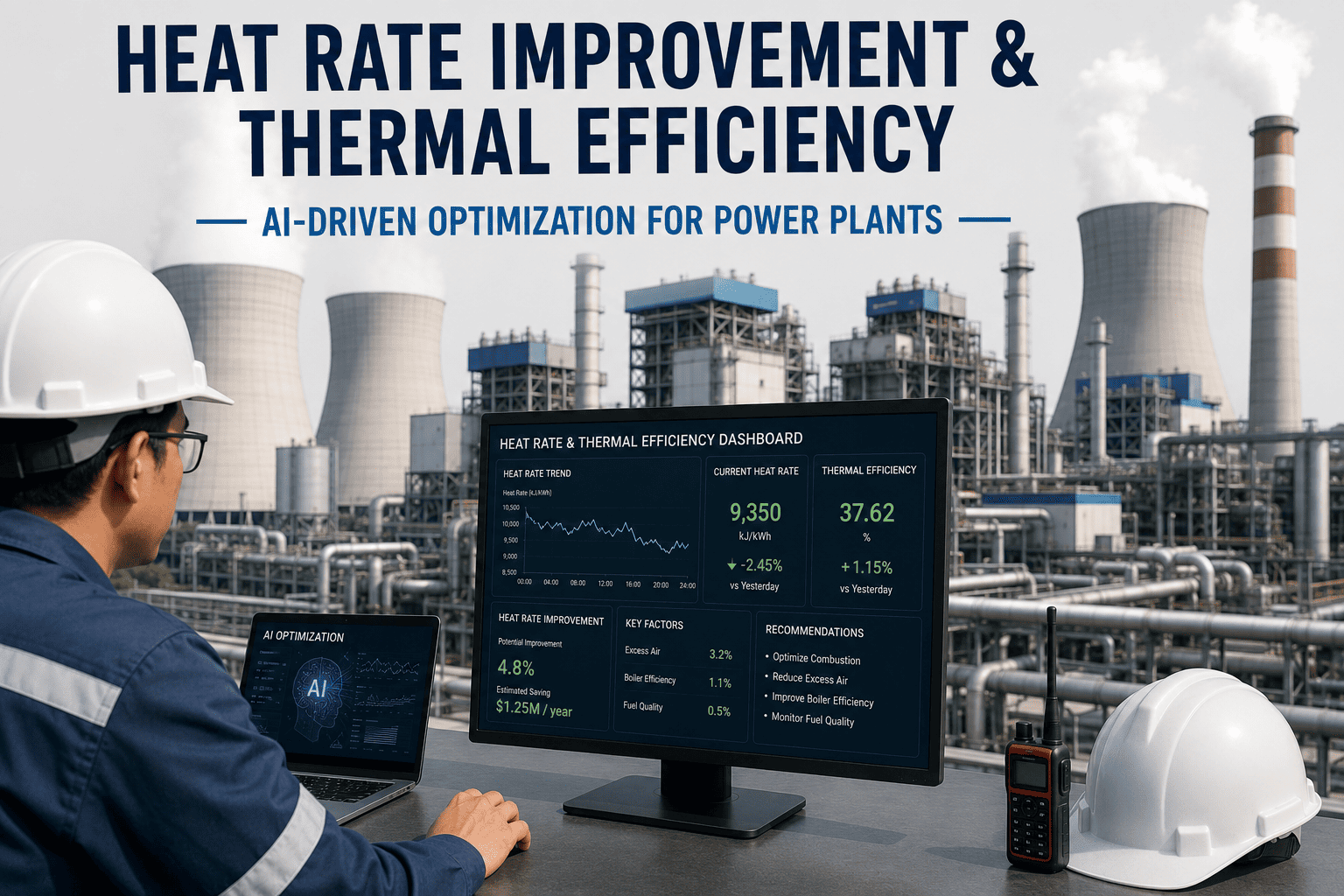
Heat Rate Improvement & Thermal Efficiency
AI-driven optimization that tracks every BTU/kWh deviation from design across combustion, turbine, condenser, feedwater, and auxiliary systems — and tells you which one to fix first.
Where Heat Rate Deviation Actually Comes From
Most plants track heat rate as one aggregate figure. Separating it into five sources turns a vague efficiency complaint into a specific, assignable fix.
Combustion
Excess air, incomplete combustion, unburned carbon, and suboptimal fuel-air ratio. The single largest efficiency lever in most thermal plants.
Turbine Performance
HP and IP turbine blade fouling and steam temperature spread away from target values, both of which erode cycle efficiency gradually and silently.
Condenser Backpressure
Tube fouling and air ingress raise condenser pressure, and the condenser effectively sets the efficiency ceiling for the rest of the plant.
Feedwater Heater Performance
Degraded heat transfer across feedwater heaters forces the boiler to supply heat more expensively than the cycle was designed for.
Auxiliary Power Consumption
Boiler feed pumps, ID/FD fans, and cooling water pumps drawing more power than optimal due to control setpoint drift and wear.
Why One System Sets the Ceiling for Every Other
The condenser has an outsized effect on cycle efficiency because every other system's performance is measured against the backpressure it establishes.
Typical heat rate improvement from a 0.35 inch Hg gain in condenser vacuum on a mid-size unit.
Approximate combined fuel and O&M savings for a 500 MW plant from that same vacuum improvement.
Heat rate recovered in a documented case after repairing a single condenser hotwell leak.
Cycle heat rate change from just a 1°C shift in cooling water temperature reaching the condenser.
The Financial Translation Engineers Rarely See
A heat rate deviation only becomes urgent once it is expressed in the currency operations leadership actually responds to.
0.3% Heat Rate Loss
At $45/MWh fuel cost, a modest 0.3% deviation on a large thermal unit can translate into roughly $4,200 of avoidable cost per day — a number that rarely appears on an engineer's dashboard.
Compounded Annually
Left uncorrected across a full year, that same daily figure adds up to well over $1.5 million in fuel spend the unit never needed to burn for the generation it delivered.
Prioritization Signal
Ranking deviations by dollar impact rather than raw Btu figures ensures the maintenance queue reflects real financial urgency, not just engineering curiosity.
Catch the Drift Before the Quarterly Review
Manual heat rate testing happens periodically; AI-driven monitoring tracks every BTU/kWh deviation continuously, attributes it to combustion, turbine, condenser, feedwater, or auxiliary systems, and quantifies the fuel cost per day so your team can prioritize with confidence.
Why Quarterly Heat Rate Tests Miss the Money
Traditional heat rate testing is a snapshot. AI-driven monitoring is a continuous feed that catches deviation the day it begins.
| Capability | Periodic Testing | AI-Driven Monitoring |
|---|---|---|
| Detection frequency | Quarterly or annual test | Continuous, real time |
| Root cause attribution | Manual engineering review | Automatic system-level attribution |
| Financial context | Rarely quantified in dollars | Cost-per-day calculated automatically |
| Tuning recommendations | Reactive, after report review | Issued continuously as conditions shift |
A Practical Path to Heat Rate Recovery
Heat rate improvement programs succeed when they are sequenced, not attempted as one sweeping overhaul.
Establish Your Design Baseline
Confirm the design heat rate curve across load points and ambient conditions so every later deviation compares against the right reference.
Instrument the Five Sources
Connect combustion, turbine, condenser, feedwater, and auxiliary power data so each source can be isolated instead of blended into one number.
Assign a Dollar Value to Every Deviation
Translate Btu/kWh drift into daily fuel cost so engineering findings compete fairly with other capital and maintenance priorities.
Fix the Condenser First
Because backpressure sets the ceiling for the rest of the cycle, condenser cleaning and leak repair typically deliver the fastest payback.
Tune Combustion Continuously
Since fuel-air ratio drifts with fuel quality and ambient conditions, treat combustion tuning as an ongoing task rather than a one-time exercise.
Heat Rate Improvement — Questions Answered
What process engineers ask most often when scoping a heat rate optimization program.
Q: How much heat rate improvement is realistically achievable?
Combustion tuning alone typically recovers 0.5% to 2% of heat rate in most thermal plants, and condenser vacuum improvements of around 0.35 inches of mercury can add another 30 to 70 Btu/kWh depending on unit size. Feed pump rebuilds and steam turbine upgrades can add roughly another quarter to half a percent each. Combined across all five sources, a plant that has never systematically pursued heat rate improvement can often recover 2% to 4% of its baseline heat rate, which compounds into a substantial annual fuel savings figure.
Q: Which of the five sources usually offers the fastest payback?
Condenser-related fixes tend to have the shortest payback because the condenser sets the efficiency ceiling for the entire steam cycle, so even a modest vacuum improvement propagates through turbine and feedwater performance as well. Combustion tuning is a close second since it requires no capital equipment, only control setpoint adjustment. Turbine blade fouling and feedwater heater degradation typically require a planned outage to address, so they are usually scheduled rather than treated as immediate fixes. Book a demo to see which source is driving your current deviation.
Q: Why does a small cooling water temperature change matter so much?
Because condenser performance is highly sensitive to cooling water conditions, a change of just one degree Celsius in cooling water temperature can shift condenser pressure enough to move cycle heat rate by roughly a third of a percent. Ambient temperature swings across seasons therefore need to be separated from genuine equipment degradation, or engineers risk chasing a phantom fouling problem that is actually just weather. AI-driven monitoring normalizes for ambient conditions automatically so the underlying equipment trend stays visible.
Q: Do auxiliary loads really move the needle on heat rate?
Yes, because auxiliary power consumption is subtracted from gross generation before net heat rate is calculated, so a boiler feed pump or fan running even a few percent above its optimal power draw directly worsens the net number. Control setpoint drift and bearing wear are the most common causes, and both are typically inexpensive to correct once identified. Auxiliary losses are often the most overlooked of the five sources simply because they show up as a power draw increase rather than a thermal deviation.
Q: How does AI improve on traditional performance monitoring software?
Traditional performance monitoring typically reports a single aggregate heat rate number and leaves engineers to manually investigate which system is responsible. AI-driven monitoring analyzes thousands of operating parameters simultaneously, attributes deviations to a specific system such as condenser backpressure or combustion air-fuel ratio, and quantifies the daily fuel cost of that deviation so the finding arrives with financial context already attached. Our support team can walk through the attribution logic in detail.
Every BTU/kWh Deviation, Attributed and Priced
Heat rate drift that costs a million dollars a year rarely announces itself. Let iFactory track combustion, turbine, condenser, feedwater, and auxiliary performance continuously, quantify the fuel cost of every deviation, and issue tuning recommendations before the next quarterly review even happens.