Every power plant incident — whether a turbine overspeed trip, a hydrogen seal oil leak, a switchgear arc flash, or a boiler tube rupture — follows a predictable trajectory: a chain of latent conditions, active failures, missed recovery opportunities that converge at a specific moment in time.Facilities that book a demo with iFactory are discovering that a structured, data-driven incident management program does not just satisfy regulatory requirements — it fundamentally compresses the learning cycle between event occurrence and systemic prevention.
Turn Every Incident into a Structural Improvement — Not Just a Closed Report
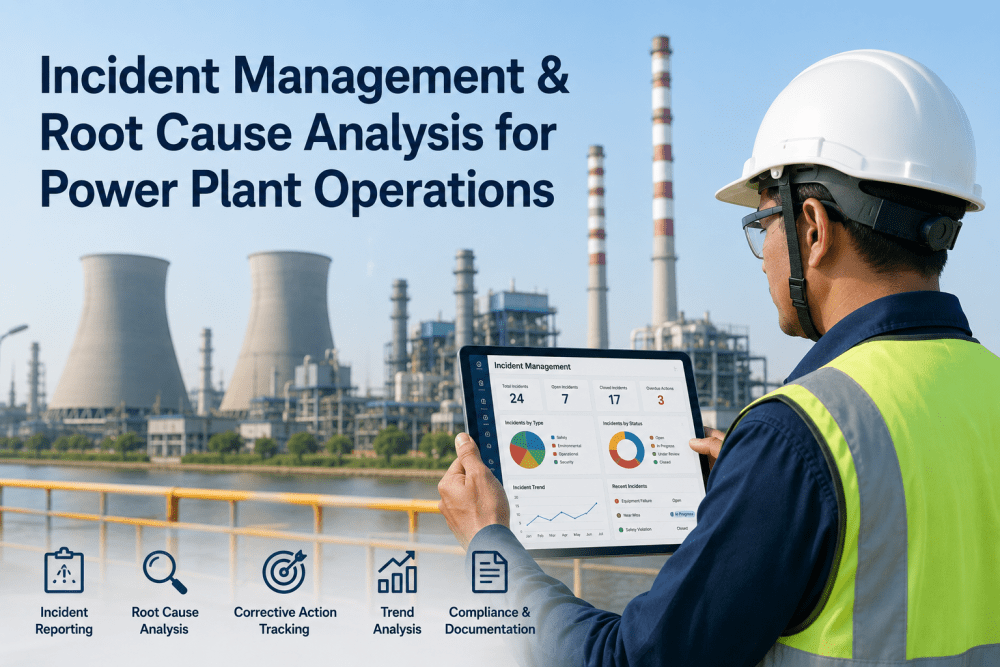
iFactory digitizes the full incident management lifecycle — near-miss reporting, event classification, RCA execution, corrective action tracking, and trend analytics — into a single platform purpose-built for power generation safety and reliability teams.
Why Most Power Plant Incident Programs Learn Nothing from the Last Event
The fundamental failure of incident management in power generation is not a failure of investigation methodology — it is a failure of data persistence and organizational memory. A plant experiences a trip, a fire, or an injury. A cross-functional team conducts an investigation over two to four weeks. The team identifies root causes, assigns corrective actions, and writes a report. The report is reviewed, approved, and filed. Within six months, the specific findings of that investigation — the causal factor codes, the recurrence risks, the systemic conditions that enabled the event — are effectively inaccessible to anyone who was not on the investigation team. When a similar near-miss occurs 18 months later on a different shift, the connection to the original event is never made. The plant repeats the cycle: investigate, document, file, forget.
This pattern-matching capability is the difference between a plant that treats each incident as a discrete event and a plant that treats incident data as a continuously improving risk management asset. Plant managers evaluating this approach typically begin by scheduling a session to book a demo and assessing how their current investigation closeout rate compares against industry benchmarks.
Moving Beyond 5-Whys: Building a Defensible RCA Framework for Power Plants
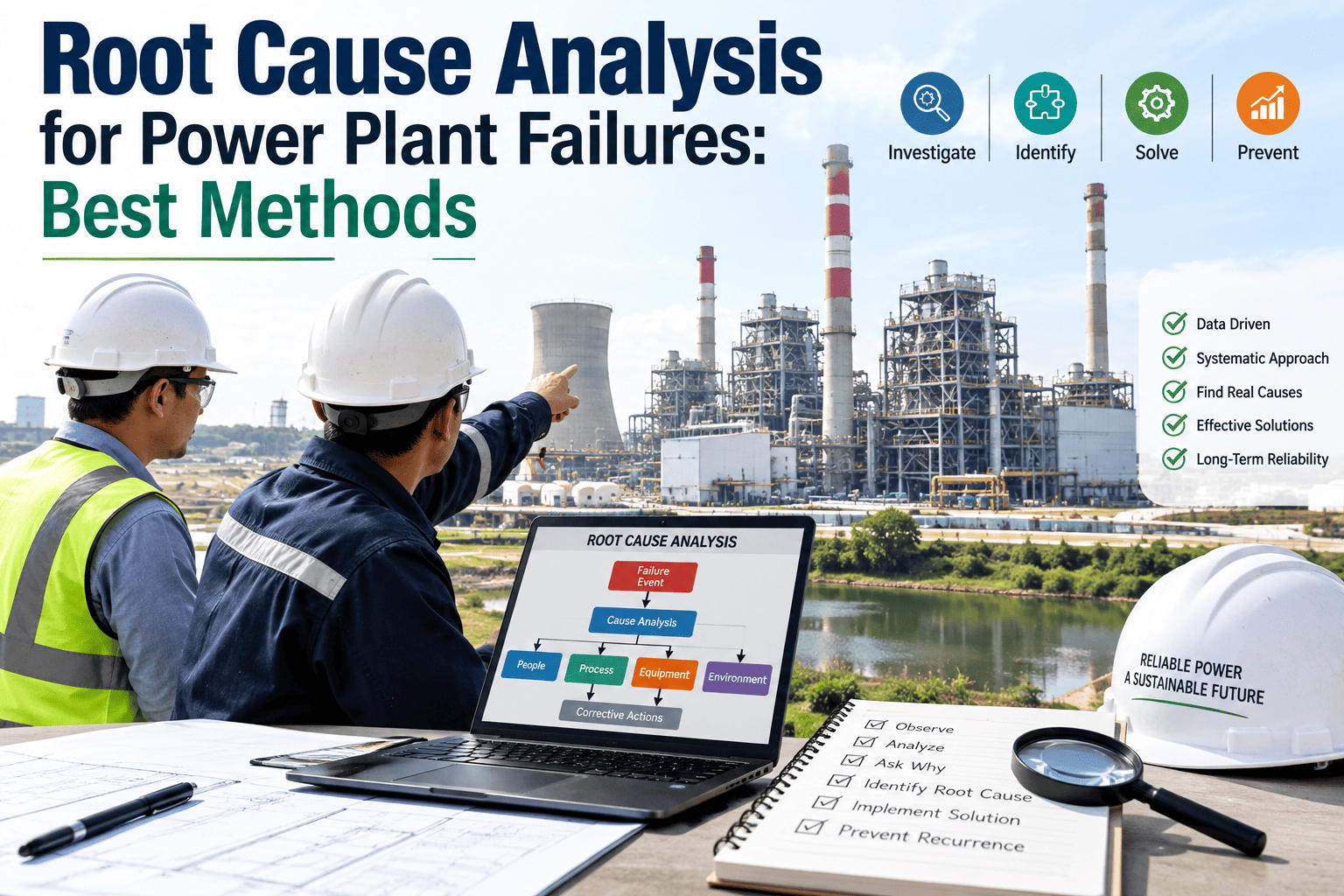
The quality of an incident investigation is determined by the rigor of its causal analysis methodology. A superficial RCA — one that stops at "operator error" or "equipment failure" as the root cause — cannot generate corrective actions that prevent recurrence, because it has not identified the organizational and systemic conditions that made the error or failure possible.
The 5-Whys method is the most widely used RCA technique in power generation due to its simplicity and speed, but its effectiveness depends entirely on the investigator's discipline to continue asking "why" until the systemic root cause — not just the immediate physical cause — is identified. iFactory's guided 5-Whys template requires the investigator to document each "why" as a structured data field rather than a free-form narrative, ensuring that each causal link in the chain is explicit and auditable. The platform enforces a minimum of three causal levels before accepting the analysis as complete, preventing the premature closure that characterizes most 5-Whys investigations in practice.
- Structured depth enforcement — minimum 3 causal levels required
- Auto-population of causal factors from previous similar events for pattern matching
- Linkage to asset hierarchy and operating procedure at each causal level
- Automatic corrective action type suggestion based on causal factor category
- Audit-ready documentation for regulatory and internal review
The Fishbone diagram is the preferred RCA method when an incident involves multiple contributing factors across different categories — equipment condition, operating procedures, human factors, training, environment, and management systems. iFactory's digital Fishbone module provides a visual drag-and-drop interface for mapping causal factors across the six standard categories, with the ability to add custom categories for power plant-specific domains such as grid conditions, fuel quality, or chemical treatment.
- Six standard causal categories plus unlimited custom category creation
- Visual drag-and-drop Fishbone mapping with causal factor weighting
- Automatic aggregation of categorized causes into corrective action recommendations
- Multi-investigator collaboration with real-time Fishbone editing
- Export to presentation-ready format for management review
Change Analysis is one of the most powerful but underutilized RCA techniques in power plant investigations. It is based on the principle that every incident is preceded by a change — a new operator on shift, a different fuel blend, a modified control logic setting, a recently completed maintenance outage — and that identifying this change is the most direct path to understanding causation. iFactory's Change Analysis module prompts investigators to compare the event conditions against the baseline condition systematically, capturing changes across equipment configuration, personnel, procedures, environment, and management systems.
- Guided baseline-vs-event condition comparison across five change categories
- Automatic linkage to plant operating logs, shift assignments, and maintenance records
- Configuration change history integration with CMMS and engineering records
- Temporal change trend analysis — identifying recurring change patterns across multiple events
- Corrective action targeting specifically at the change that enabled the event
For high-consequence incidents — those involving fatalities, major asset damage, or environmental releases — the investigation methodology must withstand regulatory scrutiny and potential litigation. iFactory's TapRooT-compatible RCA module provides the structured framework required for Level 1 and Level 2 investigations, guiding the team through SnapCharT timeline development, causal factor identification, and root cause determination using the ICAM (Incident Cause Analysis Method) framework adapted for power generation.
- SnapCharT timeline builder with evidence tagging and source attribution
- Causal factor identification using the TapRooT human factors and equipment classification system
- Root cause determination with corrective action hierarchy (eliminate, control, mitigate)
- Cross-reference with industry event databases (INPO, NERC, OSHA) for shared learning
- Regulatory-grade documentation with chain-of-evidence custody for legal review
The iFactory incident classification engine assigns a unique severity score to every reported event based on actual and potential consequences, enabling the investigation team to prioritize resources where they will have the greatest prevention impact. Book a demo to see how automated trend analysis transforms your incident data from an administrative burden into a strategic prevention tool.
| Event Type Category | Severity Level (1-5) | Investigation Method Required | Corrective Action Deadline | Regulatory Reporting |
|---|---|---|---|---|
| Near-Miss / Unsafe Condition | Level 1 | 5-Whys or Quick Evaluation | 30 days | Internal only |
| First Aid / Minor Equipment Damage | Level 2 | 5-Whys or Fishbone | 45 days | Internal + OSHA 300 if applicable |
| Recordable Injury / Significant Damage | Level 3 | Fishbone or Change Analysis | 60 days | OSHA 300 / State reporting |
| Lost Time Injury / Major Outage | Level 4 | TapRooT or ICAM | 90 days | OSHA + NERC / FERC if applicable |
| Fatality / Catastrophic Failure | Level 5 | Full TapRooT + Independent Review | 120 days | OSHA + NTSB / State agency |
The Corrective Action Gap: Why 63% of Investigation Recommendations Never Close
The most common failure in incident management is not the quality of the investigation — it is the follow-through on corrective actions. Investigations generate recommendations. Those recommendations are assigned to department managers. And then, amid the competing priorities of production targets, maintenance backlogs, and staffing shortages, they drift. Deadlines pass. Verification requirements are waived. The investigation report is filed as "closed" even though the corrective actions that would prevent recurrence have not been implemented. The next time a similar event occurs — and it will — the investigation team will find the same root causes, write the same recommendations, and the cycle will repeat.
This enforcement chain is the mechanism that ensures incident investigations produce lasting prevention rather than filed reports. Safety and reliability leaders evaluating this capability typically find it valuable to book a demo and see how automated corrective action tracking integrates with their existing work management systems.
Incident Management Is Organizational Learning — Treat It Like One
Power plants generate incident data continuously. Every trip, every near-miss, every equipment failure, every human error is a data point that contains the information needed to prevent the next event. The difference between a plant that learns from its incidents and one that repeats them is the infrastructure it has in place to capture, classify, analyze, and act on that data. Paper-based investigation reports, spreadsheet corrective action trackers, and annual safety statistics are not infrastructure — they are administrative artifacts that create the illusion of learning without delivering its substance.
For power generation facilities operating under the reliability and safety expectations of modern grid operations, this is not an optimization. It is a structural requirement for continuous improvement.
Incident Management & Root Cause Analysis — Frequently Asked Questions
Transform Incident Data from Compliance Burden into Prevention Intelligence
iFactory's incident management and RCA platform digitizes the full investigation lifecycle — near-miss reporting, root cause analysis, corrective action tracking, and systemic trend analytics — into a single platform that turns every event into a structural improvement.