The power generation sector is undergoing a fundamental operating shift. Turbines, transformers, and control systems that once produced data only for local historians are now feeding AI models, digital twins, and autonomous decision engines in real time. Industry 4.0—the convergence of artificial intelligence, Industrial Internet of Things (IIoT), anddigital twin technology, and edge computing—is no longer a roadmap item for forward-thinking utilities. It is the current competitive baseline for U.S. plants that intend to lead on reliability and cost per megawatt-hour, and regulatory compliance. This guide breaks down exactly how these technologies converge inside a modern AI-driven analytics platformwhat operational outcomes they unlock, and how plant leaders can build a realistic adoption path.
Industry 4.0 Power Plant Guide 2026
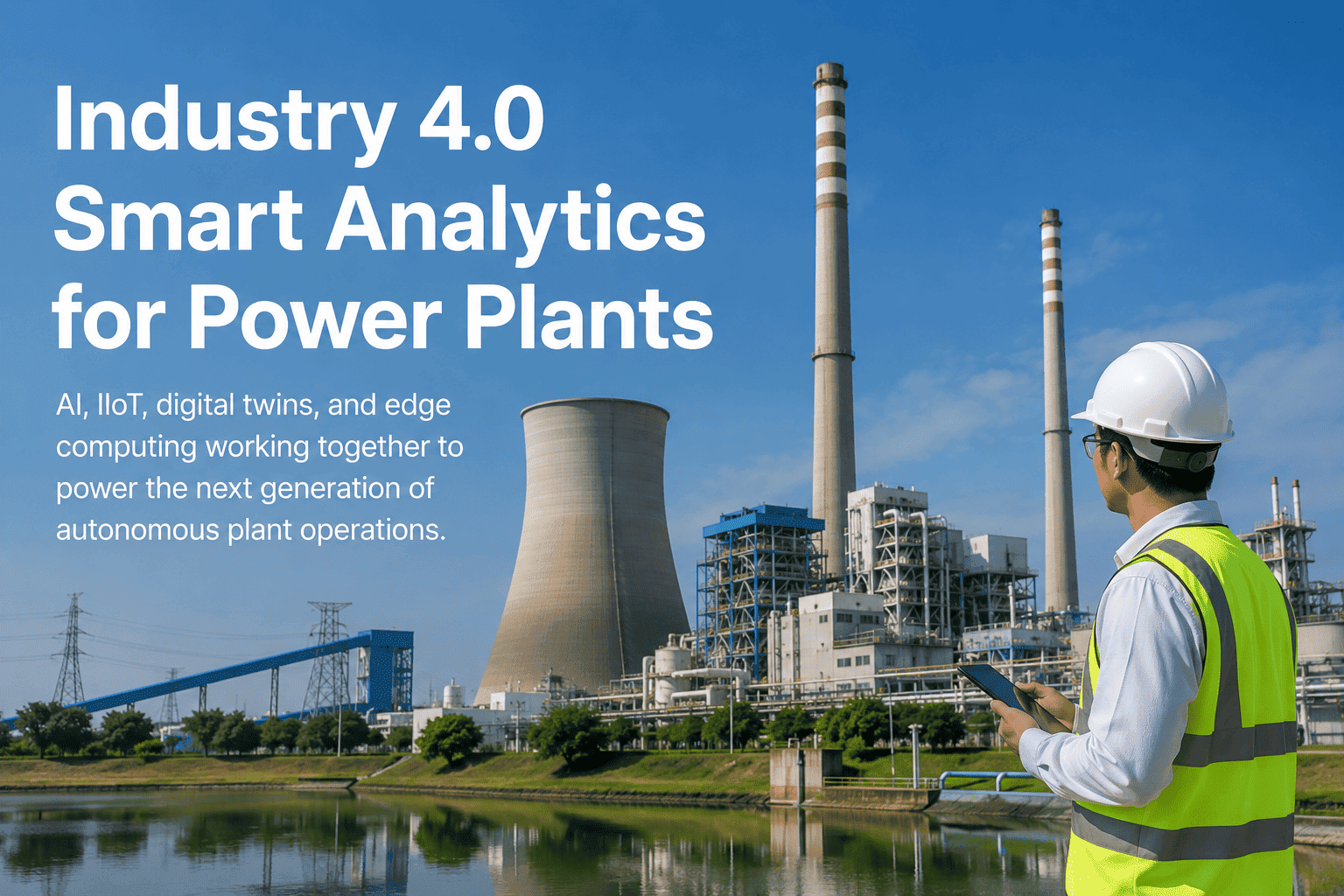
Industry 4.0 Smart Analytics for Power Plants
How AI, IIoT, digital twins, and edge computing are converging to create fully autonomous plant operations
$4.2B
U.S. Power Plant AI Market by 2028
41%
Reduction in Unplanned Downtime
3.2x
Faster Fault Identification vs. Manual
$210K
Avg. Savings Per Avoided Outage Event
iFactory helps U.S. power plants move from Stage 2 to Stage 4 within a 12-month deployment window. Book a maturity assessment to see exactly where your plant stands and what the next stage of Industry 4.0 adoption delivers for your asset mix.
The Four Pillars of Industry 4.0 in Power Generation
Understanding how Industry 4.0 applies to power plants requires separating the four core technology pillars and understanding the role each plays before examining how they function as an integrated system. Each pillar delivers value independently; together, they create something qualitatively different—a self-monitoring, self-optimizing plant operation.
01
Artificial Intelligence
Machine learning models detect anomalies in vibration, temperature, pressure, and current signals with accuracy exceeding human review. AI moves maintenance from reactive to predictive — catching bearing degradation weeks before failure.
02
Industrial IoT (IIoT)
Sensor networks across turbines, generators, switchgear, and balance-of-plant equipment stream real-time telemetry into the analytics layer. IIoT transforms every asset into a continuously reporting data source.
03
Digital Twins
Physics-based virtual replicas of physical assets run simulations in parallel with live operations. Digital twins let engineers test load scenarios, maintenance strategies, and degradation curves without touching the actual plant.
04
Edge Computing
Processing power moves to the asset level. Edge nodes execute AI inference locally — eliminating cloud latency for time-critical decisions and maintaining full analytical capability when network connectivity is unavailable.
See how iFactory's Industry 4.0 platform integrates all four pillars into a single operational layer for U.S. power generation assets. Book a technical demo with our power plant analytics team.
How the Technology Stack Converges: A Layered Architecture
The true operational leverage of Industry 4.0 comes not from deploying these four technologies in parallel silos, but from integrating them into a unified data and decision pipeline. The architecture below reflects how a production-grade smart analytics platform actually functions in a U.S. power generation environment.
L1
Asset & Sensor Layer
IIoT Foundation
Vibration sensors, thermocouples, pressure transducers, current transformers, and flow meters across all critical assets. Data acquisition systems (DAS) collect readings at 1–100 Hz depending on asset criticality. OPC-UA and MQTT protocols normalize data from heterogeneous sensor vendors into a unified stream.
OPC-UAMQTTModbusDAS Integration
L2
Edge Processing Layer
Local AI Inference
Edge nodes co-located with critical asset clusters execute compressed AI models (TFLite, ONNX) for real-time anomaly scoring. Local decisions — alert generation, protective action triggers — occur in under 50 milliseconds without cloud dependency. Raw data is filtered and aggregated before uplink, reducing bandwidth requirements by 60–80%.
TFLiteONNX<50ms LatencyLocal Storage
L3
Digital Twin Layer
Physics + AI Simulation
Live sensor feeds update virtual asset models continuously. Digital twins run degradation simulations using both physics-based equations and AI-trained behavioral models. Engineers query the twin to simulate what-if maintenance scenarios — "if we defer this inspection 30 days, what is the probability of failure increase?" — without operational risk.
Physics ModelingScenario SimulationRUL ProjectionLive Sync
L4
Cloud AI & Analytics Layer
Fleet Intelligence
Cloud-side models train on aggregated fleet data — surfacing cross-asset patterns invisible at the site level. Full-fidelity AI models retrain continuously as operational data accumulates. Updated models push automatically to edge nodes. Fleet-level dashboards, compliance reporting, and ERP/CMMS integration operate at this layer.
Fleet LearningContinuous RetrainingCMMS IntegrationCompliance Reporting
Operational Outcomes: What Smart Analytics Actually Delivers
Industry 4.0 technology generates measurable operational outcomes across five distinct performance dimensions. The table below maps each technology pillar to the specific KPIs it moves — and by how much, based on deployment data from U.S. power generation facilities.
Unplanned Downtime
AI
−41% downtime hours/year
$180K–$2.4M per event avoided
Mean Time to Repair (MTTR)
IIoT AI
−55% MTTR
$28K–$41K per technician/year
Maintenance Cost per MWh
Digital Twin
−28% O&M spend
$3.20–$6.80/MWh reduction
Compliance Audit Findings
IIoT
−81% audit findings
$25K–$1M per NERC violation avoided
Remote Site Visibility
Edge
100% data continuity offline
Eliminates $0 data gap penalties
Asset Remaining Useful Life
Digital Twin AI
+23% asset life extension
Deferred capex of $400K–$3M per unit
Unplanned Downtime
AI
−41% downtime hours/year
$180K–$2.4M per event avoided
Mean Time to Repair
IIoT AI
−55% MTTR
$28K–$41K per technician/year
Maintenance Cost per MWh
Digital Twin
−28% O&M spend
$3.20–$6.80/MWh reduction
Compliance Audit Findings
IIoT
−81% audit findings
$25K–$1M per NERC violation avoided
Remote Site Visibility
Edge
100% data continuity offline
Eliminates data gap compliance penalties
Asset Remaining Useful Life
Digital Twin AI
+23% asset life extension
Deferred capex of $400K–$3M per unit
iFactory helps U.S. power plants move from Stage 2 to Stage 4 within a 12-month deployment window. Book a maturity assessment to see exactly where your plant stands and what the next stage of Industry 4.0 adoption delivers for your asset mix.
Adoption Maturity Model: Where Does Your Plant Stand?
Industry 4.0 adoption in power generation is not a binary switch — it follows a five-stage maturity progression. Most U.S. plants currently operate between Stage 2 and Stage 3. Understanding your current stage clarifies both the investment required to advance and the incremental value unlocked at each transition.
Paper & Manual Operations
Maintenance driven by operator rounds and failure response. No digital data capture. Asset history exists in paper logs or disconnected spreadsheets. Analytics consists of monthly reports compiled manually from historian exports.
Where most legacy plants start
Downtime Profile
Fully reactive
Digitized Monitoring
Sensors connected to a historian or SCADA system. Alarm-based monitoring alerts operators to threshold breaches. Digital work orders replace paper. Data is captured but not intelligently analyzed — patterns require human interpretation.
Typical baseline for U.S. plants built after 2010
Downtime Profile
Alarm-driven
AI-Powered Fault Detection
Machine learning models run on historian data to score anomalies and generate fault predictions before alarms trigger. Maintenance is scheduled based on asset condition rather than calendar intervals. This is the primary value inflection point — where unplanned failures begin declining sharply.
Highest ROI transition point for most plants
Downtime Profile
Condition-based
Digital Twin Integration
Physics-based digital twins simulate asset behavior under current and projected operating conditions. The system recommends specific maintenance actions — not just alerts — with quantified risk trade-offs. Scenario modeling replaces intuition-driven planning at the asset level.
Leading utilities and independent power producers
Downtime Profile
Scenario-optimized
Self-Optimizing Operations
AI and digital twins close the loop — executing approved maintenance workflows, adjusting operating parameters within defined bounds, and continuously retraining models from fleet-wide operational data. Human operators shift from task execution to exception management and strategic oversight.
Emerging frontier; near-term achievable with the right platform
Downtime Profile
Self-optimizing
iFactory helps U.S. power plants move from Stage 2 to Stage 4 within a 12-month deployment window. Book a maturity assessment to see exactly where your plant stands and what the next stage of Industry 4.0 adoption delivers for your asset mix.
Implementation Roadmap: Moving From Connected to Intelligent
The most common implementation failure in Industry 4.0 adoption is attempting to deploy all four pillars simultaneously. The sequence below reflects the validated approach from iFactory deployments across U.S. generation facilities — each phase builds the data and infrastructure foundation that the next phase depends on.
Months 1–2
IIoT Sensor Audit & Data Quality Assessment
Inventory all existing sensors, historians, and SCADA systems. Identify data quality gaps — missing sensors, failed transmitters, inconsistent tagging conventions. Establish the minimum viable sensor coverage required for AI model training on critical asset classes. Poor data quality at this stage is the leading cause of underperforming AI models downstream.
Output: Asset data readiness scorecard; sensor gap remediation plan
Months 2–4
Edge Node Deployment & Data Pipeline Integration
Deploy edge compute nodes at critical asset clusters. Integrate historian, DAS, and SCADA data streams into a unified data pipeline using OPC-UA or MQTT. Establish baseline data normalization and tagging standards across all asset classes. This layer becomes the permanent foundation for both AI inference and digital twin synchronization.
Output: Unified real-time data stream from all critical assets
Months 4–7
AI Model Training & Predictive Fault Deployment
Train site-specific fault detection and RUL models on historical sensor data. Compress models for edge deployment. Validate accuracy against historical failure events — target 90%+ fault detection rate before production deployment. Deploy models to edge nodes and begin live anomaly scoring across instrumented assets.
Output: Live AI fault scoring on all critical assets; first predictive alerts
Months 7–10
Digital Twin Build & Scenario Modeling Activation
Build physics-based digital twins for highest-criticality assets — typically main turbines, generators, and transformers. Synchronize twins with live IIoT feeds. Commission scenario modeling workflows for maintenance planning teams. Initial twin deployments typically focus on three to five assets before expanding to full fleet coverage.
Output: Live digital twins on critical assets; scenario-based maintenance planning active
Months 10–12
Fleet Analytics & CMMS Integration
Connect cloud analytics layer to existing CMMS and ERP systems. Activate fleet-level dashboards, automated compliance reporting, and cross-asset pattern detection. Establish continuous model retraining pipeline so AI accuracy improves automatically as operational data accumulates.
Output: Fully integrated Industry 4.0 stack; continuous learning active
Month 12+
Autonomous Operations Transition
Gradually expand AI-recommended actions into approved autonomous execution workflows — starting with low-risk adjustments and progressing based on operator confidence. Operators transition from task execution to exception management. AI accuracy compounds as fleet dataset grows, creating a durable competitive moat in operational efficiency.
Output: Self-optimizing plant operations; operators focused on strategic decisions
Ready to Advance Your Plant's Industry 4.0 Maturity?
iFactory's platform integrates AI, IIoT, digital twins, and edge computing into a single deployment — purpose-built for U.S. power generation assets across wind, solar, gas, and hydro. Get a site-specific roadmap based on your current technology stack and asset mix.
Expert Review
"We spent two years evaluating Industry 4.0 vendors before deploying iFactory across our three combined-cycle facilities. The distinction that mattered most to us was not the AI accuracy numbers in the sales deck — it was the architecture. Most platforms we evaluated were cloud-first, which created two problems: latency on time-critical alerts, and complete analytical blackout during network outages at our rural sites. iFactory's edge-plus-cloud approach solved both. The digital twin capability was the capability that moved our maintenance planning team from reactive to genuinely strategic. Our lead reliability engineer now runs 30-day maintenance scenarios on the twin before touching the physical asset. In the 14 months since full deployment, we have avoided three major forced outage events with a combined avoided cost of approximately $2.1 million. The system paid back its three-year contract value in 11 months. What we underestimated going in was how much the continuous learning component compounds over time — our AI accuracy at month 14 is measurably better than it was at month 3, without any manual retraining effort on our side."
$2.1M
Avoided in 14 Months
Frequently Asked Questions
iFactory helps U.S. power plants move from Stage 2 to Stage 4 within a 12-month deployment window. Book a maturity assessment to see exactly where your plant stands and what the next stage of Industry 4.0 adoption delivers for your asset mix.
Conclusion: The Analytics Gap Is Now a Competitive Disadvantage
The convergence of AI, IIoT, digital twins, and edge computing in power generation is not a technology forecast — it is the current operational reality for the plants that are winning on reliability, cost, and compliance performance. The question for U.S. generation operators in 2026 is not whether to adopt Industry 4.0 analytics, but how quickly the gap between current and leading-edge operations translates into measurable cost and reliability disadvantage.
Plants that move from alarm-based monitoring to AI-driven predictive maintenance typically see the first avoided-failure event within the first operating quarter — and that single event frequently returns more value than the annual platform cost. The compounding effect of continuous model retraining means the system becomes more accurate and more valuable with every month of operational data. The architecture — edge AI for real-time inference, digital twins for planning-level simulation, and fleet cloud analytics for cross-asset learning — is the platform that makes autonomous operations achievable, not aspirational.
Ready to Move Your Plant Into Industry 4.0?
Get a site-specific Industry 4.0 readiness assessment — including an estimated ROI model based on your asset mix, current analytics maturity, and historical O&M costs. No obligation, no generic demo.