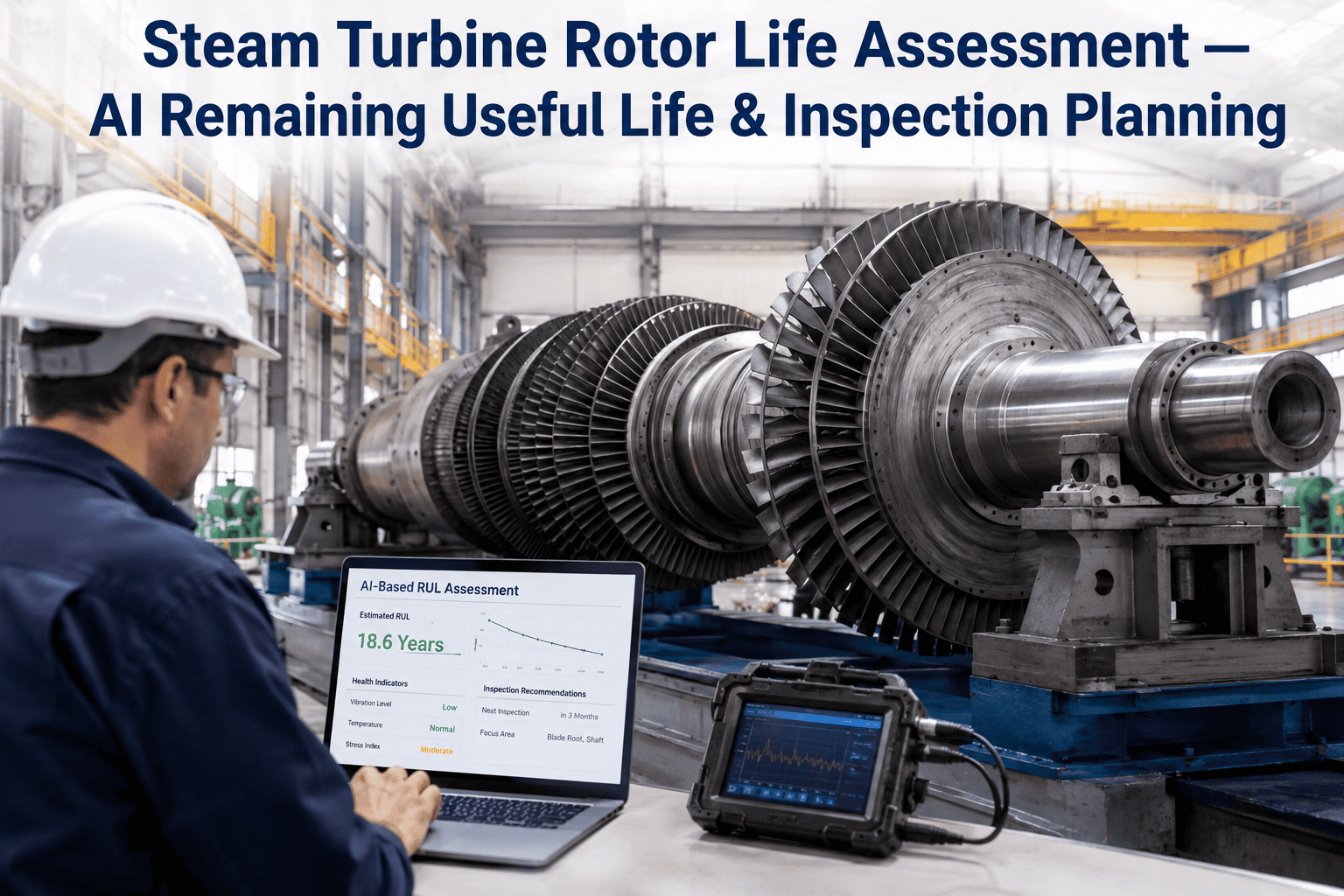
Power plant engineers and asset managers are sitting on a decades-long accumulation of sensor data, maintenance records, and operational telemetry — yet most facilities are still making replacement decisions based on calendar schedules, OEM manuals, and gut instinct. The result is predictable: components replaced to early waste budget, components that run to long fail mid-cycle, triggering unplanned outages that cost $50,000–$500,000 per event. Machine learning-based Remaining Useful Life (RUL) prediction changes this equation entirely. By training models your plant own historical degradation data, ML systems can forecast exactly how much service life remains in critical component — letting your team plan replacements before failure, not after, and at precisely the right time.
Machine Learning for Equipment Remaining Useful Life Prediction
Turbines · Bearings · Transformers · Boilers · Rotating Equipment · Predictive Replacement Planning
Why Calendar-Based Replacement Schedules Are Failing Power Plants
Fixed-interval maintenance schedules were designed for a world where sensor data was sparse and computational power was limited. In that world, replacing a bearing every 18 months regardless of its actual condition was a reasonable hedge against uncertainty. In 2026, that hedge is expensive and increasingly unnecessary.
The core problem with calendar-based replacement is that it treats all components as identical — same stress, same load cycles, same operating environment. In practice, a bearing on a baseload turbine running 24/7 at full capacity degrades at a fundamentally different rate than an identical bearing on a peaking unit that cycles twice a day. A fixed replacement interval that protects the high-stress asset will massively over-maintain the low-stress one, and vice versa.
ML-based RUL prediction solves this by building asset-specific degradation models trained on each component's actual operating history. The model learns how this bearing, on this shaft, in this plant, degrades under the specific load profiles and environmental conditions it actually experiences — and forecasts a remaining service life window with quantified uncertainty bounds.
Calendar-Based vs. ML-Driven RUL Prediction: What Changes Operationally
How ML Models Actually Predict Remaining Useful Life
RUL prediction is not a single algorithm — it is a stack of complementary modeling techniques applied to multivariate time-series sensor data. Understanding how the stack works helps reliability engineers evaluate vendor claims and ask the right questions during platform selection.
Physics-Informed Degradation Curves
ML models embed physical degradation laws — Arrhenius thermal aging, Palmgren-Miner fatigue accumulation, Hertzian contact stress — as structural constraints on learned curves. This prevents models from producing physically impossible RUL estimates during extrapolation beyond the training data range.
Operating Regime Segmentation
Degradation rates are not constant — they accelerate under high load, elevated temperature, and aggressive cycling. ML regime classifiers segment training data by operating condition before fitting degradation curves, producing separate rate models for baseload, cycling, and peaking modes on the same asset.
Uncertainty Quantification
Probabilistic RUL outputs — expressed as P10/P50/P90 confidence intervals — give maintenance planners actionable risk information rather than single-point estimates. A P90 RUL of 18 days means the model is 90% confident the component will survive at least 18 more days under current operating conditions.
Transfer Learning for Data-Sparse Assets
For components with few historical failures, models pre-trained on analogous assets from iFactory's anonymized cross-plant dataset are fine-tuned on your plant-specific sensor data — achieving 85–91% RUL accuracy even on assets with fewer than three confirmed failure events in the training window.
Multivariate Baseline Envelopes
Normal operating envelopes are defined across all correlated sensor streams simultaneously — vibration, temperature, pressure, current draw, and efficiency metrics. Deviations from the learned envelope trigger anomaly scores rather than fixed threshold alarms, reducing false positive rates to under 3.5%.
Compound Signature Detection
Single-sensor threshold systems miss compound failure signatures where no individual parameter exceeds its alarm limit, but the correlation pattern across four or five parameters has shifted significantly. ML anomaly models detect these multi-dimensional shifts weeks before any single-sensor alarm would fire.
Adaptive Baseline Recalibration
Operating conditions shift over seasons, fuel changes, and load profile changes. Adaptive anomaly models recalibrate baselines automatically when operating regime changes are detected — preventing alert storms during legitimate operational transitions while maintaining sensitivity to genuine degradation signals.
Fleet-Level Peer Benchmarking
Anomaly scores are calibrated against fleet-wide performance distributions — flagging an asset not just when it deviates from its own historical baseline, but when it underperforms statistically similar assets operating under identical conditions. This catches gradual performance degradation that self-referential models miss.
Rolling Failure Probability Windows
Time-series forecasting models generate failure probability scores over 1, 2, 4, and 6-week rolling windows — updated continuously from live sensor streams. Maintenance planners see not just "this component is degrading" but "there is a 73% probability of failure within 14 days under current operating load."
Scenario-Based RUL Projection
Forecasting models support what-if scenario analysis — projecting how RUL changes if load is reduced by 20%, if ambient temperature rises during a summer heat event, or if a planned maintenance action is deferred by two weeks. This gives planners quantified tradeoffs between generation revenue and maintenance risk.
Outage Window Synchronization
RUL forecasts are automatically cross-referenced against the plant's planned outage calendar. When a component's P50 RUL intersects with the next scheduled maintenance window, the system generates a proactive work order. When RUL falls below the next planned outage date, an expedited intervention alert fires.
Cascade Failure Prevention
Forecasting models identify when degradation in one component is likely to accelerate failure in downstream assets — for example, when bearing wear creates rotor imbalance that accelerates seal degradation. Multi-asset cascade models allow planners to sequence interventions that break failure chains before they propagate.
Root Cause Isolation
Classification models trained on historical failure signatures isolate the most likely root cause from the anomaly pattern — distinguishing between lubrication degradation, contamination ingress, and mechanical overload in bearings based on the specific vibration spectral signature, not just the overall vibration level.
Intervention Recommendation Engine
Classified failure modes map directly to intervention playbooks — lubricate now, inspect and report, replace at next opportunity, or emergency shutdown protocol. Work orders auto-populated with the classified failure mode, recommended corrective action, required parts, and technician skill level reduce field response time by up to 40%.
False Positive Feedback Loops
When technicians close work orders as false positives, that feedback automatically updates the classification model's decision boundary for that asset class — reducing repeat false alarms while maintaining detection sensitivity. Models improve measurably with every confirmed true positive and every dismissed false alert.
Multi-Asset Failure Mode Library
Pre-trained classification models cover the most common power plant failure modes — rolling element bearing defects (BPFO, BPFI, BSF, FTF), transformer insulation thermal aging, boiler tube corrosion fatigue, and pump seal degradation — reducing cold-start model training time from weeks to days for common asset classes.
The RUL Deployment Workflow: From Data Audit to Live Prediction
Deploying ML-based RUL prediction is a structured operational program — not a software installation. Plants that see the strongest accuracy and fastest ROI follow a disciplined implementation sequence that treats data quality, model training, and operator adoption with equal rigor.
Historical Data Audit and Quality Assessment
Map all existing sensor points, historian tags, and maintenance records against the target asset list. Identify data gaps, calibration drift, and timestamp misalignment. Most plants discover 15–25% of critical tags have quality flags before this step — remediation here directly determines final model accuracy.
Historian Integration and Data Pipeline Establishment
Connect to PI Historian, OSIsoft AF, DCS archives, and CMMS work order databases via OPC-UA, Modbus TCP, and REST APIs. Implement data normalization, timestamp alignment, and edge computing nodes where cloud round-trip latency is unacceptable for real-time fault detection requirements.
Asset-Specific Model Training and Validation
Train physics-informed ML degradation models on 12–36 months of historical SCADA data per asset class. Validate RUL accuracy against known failure events using hold-out test sets. Calibrate P10/P50/P90 confidence intervals. Establish normal operating envelopes per regime. Target: prediction accuracy above 90% before live deployment.
CMMS Integration and Work Order Automation
Connect RUL model outputs to SAP PM, IBM Maximo, Infor EAM, or Oracle EBS. Configure automated work order generation logic tied to RUL thresholds, failure probability scores, and outage calendar synchronization. Pre-populate work orders with failure mode classification, required parts, and recommended intervention procedures.
Operator Training and Dashboard Deployment
Deploy role-based RUL dashboards for reliability engineers, maintenance planners, and plant managers. Train teams on RUL curve interpretation, confidence interval significance, scenario modeling tools, and false positive feedback protocols. Establish weekly RUL review cadences anchored to the rolling 6-week maintenance horizon.
Continuous Model Retraining and KPI Tracking
Every confirmed failure event, false positive dismissal, and maintenance outcome feeds back into the ML training pipeline — improving model accuracy by an average of 12% per 6-month retraining cycle. Track MTBF, unplanned outage events, maintenance cost per MWh, and parts procurement lead time against pre-deployment baselines monthly.
RUL Prediction by Asset Class: What ML Models Target in Power Plants
Remaining Useful Life models are not generically applicable — each asset class has distinct physics, dominant failure modes, and sensor modalities that drive model architecture choices. The following breakdown covers the four most economically significant asset classes in thermal and renewable power generation facilities.
Measured KPI Impact: What U.S. Power Plants Are Reporting Post-Deployment
The following performance metrics reflect aggregated outcomes from iFactory RUL prediction deployments across rotating equipment, electrical assets, and process systems at operating power facilities in the USA, Canada, UK, and Australia as of 2025–2026.
Expert Review: What Reliability Engineering Research Shows About ML-Based RUL
The most consistent finding across independent RUL prediction research is that physics-informed machine learning models significantly outperform purely data-driven approaches on power plant assets — particularly for components with limited failure history. Embedding known degradation physics as structural model constraints prevents the extrapolation failures that have historically caused data-driven models to produce unreliable RUL estimates outside their training range.
A second persistent finding: the operators achieving the highest RUL prediction accuracy are not those with the most sophisticated algorithms — they are those with the cleanest, most complete sensor data and the most disciplined feedback loops between field technician outcomes and model retraining. Platforms that invest as heavily in data quality tooling and operator feedback mechanisms as they do in ML architecture consistently deliver superior real-world accuracy compared to those that prioritize algorithmic complexity over data discipline.
On economic impact, the most reliable ROI measurement methodology treats RUL-driven avoided failures as the primary value metric, with parts procurement optimization and maintenance labor reduction as secondary gains. At plants with strong baseline sensor coverage, avoided failure costs alone typically recover full platform investment cost within 9–14 months — well ahead of the 18-month figure commonly cited in vendor marketing materials.
Frequently Asked Questions
Conclusion: The Shift from Interval-Based to Intelligence-Based Replacement
The economic case for ML-based Remaining Useful Life prediction is no longer theoretical — it is measured and documented across operating power facilities in the USA, Canada, UK, and Australia. The 94% failure prediction accuracy, the 87% reduction in reactive maintenance spend, and the $480,000 average annual unplanned outage cost avoidance per plant are outcomes already achieved at live deployments. They are available to any reliability team willing to trade calendar-based guesswork for data-driven foresight.
The transition from interval-based to intelligence-based replacement planning does not require new sensors, new control systems, or new organizational structures. It requires connecting the historian data your plant already generates to ML models trained specifically on your assets' degradation physics — and giving your reliability engineers a rolling 6-week window of foresight instead of a reactive inbox of threshold alarms. That is the operational shift ML-based RUL prediction makes possible, and it compounds in value with every passing month as models learn more about your specific asset fleet.
Start Predicting Component Life Across Your Entire Asset Fleet
iFactory's ML-powered RUL platform trains on your plant's own historical sensor data, delivers 1–6 week failure prediction lead times, and generates automated CMMS work orders — fully deployed in 5 weeks, with measurable ROI from Week 3.