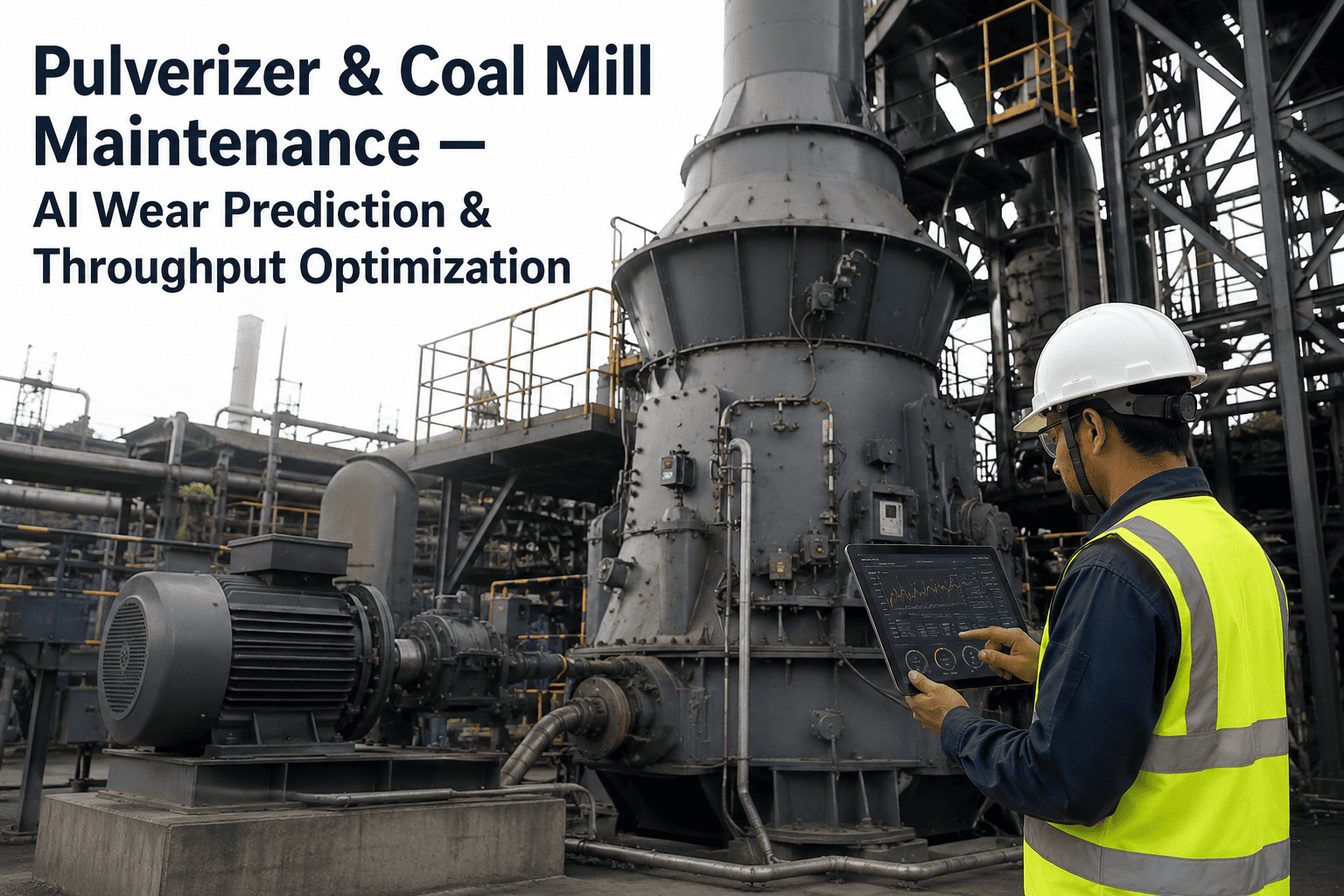
A maintenance manager scheduling the next pulverizer overhaul is working from a number that was accurate the day it was calculated and has been slowly wrong ever since. Roller and ball wear does not follow a fixed calendar, it follows coal hardness, moisture, throughput, and how hard the mill has actually been run since the last inspection, and a fleet running six different coal blends this quarter is wearing its grinding elements at six different rates. Pull a mill for overhaul too early and you waste a maintenance window and lose generation for no reason. Wait too long and a mill that can no longer hold particle size fineness starts dragging boiler combustion efficiency down before anyone connects the dots. iFactory tracks mill motor current, differential pressure, and throughput together to estimate actual grinding element wear in real time, and you can book a demo to see it run against your own mill fleet's operating history.
Grinding Element Wear Follows What the Mill Actually Processed, Not a Fixed Calendar Interval
iFactory's AI wear prediction tracks roller and ball condition, classifier efficiency, and motor current continuously, so overhaul scheduling reflects actual grinding capacity loss instead of a generic interval applied across every mill regardless of coal blend or duty.
Four Variables Determine How Fast a Mill's Grinding Elements Actually Wear
Two mills of the same design running the same number of hours can wear at very different rates, because wear rate is a function of what the mill processed, not just how long it ran.
Coal Hardness
Higher Hardgrove Grindability Index coal wears rollers and balls faster than softer coal processed at the same throughput.
Ash & Abrasive Content
Silica and other abrasive mineral content in the coal accelerates surface wear independent of hardness alone.
Moisture Content
Wet coal changes grinding dynamics and drying duty, shifting load distribution across the grinding elements.
Throughput & Load
Running above design throughput increases contact stress on rollers and balls, accelerating wear beyond the rated duty cycle.
Wear Shows Up in the Data Long Before It Shows Up as a Capacity Problem
As grinding elements wear, the mill has to work harder to maintain the same output, and that extra effort is visible in the data well before an operator notices reduced throughput or coarser particle size.
By the Time Throughput Visibly Drops, Wear Has Already Been Building for Weeks
iFactory tracks the earlier signals, motor current and differential pressure, so wear is caught while there is still scheduling flexibility.
A Calendar-Based Overhaul Schedule Gets It Wrong in Both Directions
Fixed-interval overhaul scheduling has to assume a worst-case wear rate to avoid running a mill into a capacity failure, which means mills that happened to process softer, less abrasive coal during that interval get pulled for overhaul while their grinding elements still have significant useful life remaining. That wasted maintenance window carries a real cost, both in the labor and parts spent on an overhaul that was not yet needed and in the generation capacity lost while that mill was offline. On the other side of the same problem, a mill that processed an unusually hard or abrasive blend can wear faster than the fixed interval assumes, quietly losing grinding capacity and pushing coarser coal into the furnace, which degrades combustion efficiency and increases unburned carbon in a way that is easy to miss until someone investigates a boiler performance complaint.
Wear-based scheduling solves both problems at once by tracking each mill's actual condition individually, letting a maintenance manager pull the mills that genuinely need attention while safely extending the interval on mills that have processed a lighter duty cycle.
What Changes When Overhaul Timing Follows Actual Condition Instead of a Calendar
| Scheduling Factor | Fixed-Interval Approach | Wear-Based Approach |
|---|---|---|
| Overhaul trigger | Calendar date or fixed running hours | Actual estimated grinding element wear per mill |
| Coal blend sensitivity | Not accounted for in scheduling logic | Wear rate adjusted continuously based on coal properties processed |
| Combustion impact | Coarse particle size often discovered through boiler performance issues | Classifier reject trend flags fineness degradation before combustion impact |
| Fleet prioritization | All mills treated on the same generic schedule | Overhaul list ranked by mill with the fastest actual wear progression |
What Maintenance Managers Report After Adding Wear-Based Mill Scheduling
A Worn Mill Does Not Just Reduce Capacity, It Changes What Gets Burned in the Furnace
The most expensive consequence of pulverizer wear is often not the loss of mill throughput itself, it is the coarser particle size that a worn mill delivers to the furnace even when it is still meeting its rated capacity. Larger coal particles take longer to burn completely, which increases unburned carbon in the ash and reduces overall combustion efficiency, and this effect can be present for weeks before anyone connects a slowly rising heat rate back to a specific mill's classifier reject trend. Because this loss shows up as a boiler-side symptom rather than a mill-side alarm, it is one of the easiest efficiency losses to overlook using standard maintenance monitoring, since the mill itself may not be throwing any alarms at all.
Tracking classifier reject rate and estimated particle size fineness alongside wear data closes this gap by connecting mill condition directly to the combustion-side consequence, giving both maintenance and operations a shared view of when fineness degradation, not just throughput, is starting to cost fuel efficiency.
Wear Predictions Are Only Useful if Maintenance Planners Actually Believe Them
A wear prediction model earns trust the same way an experienced mill technician does, by being right consistently enough that its recommendations get acted on instead of second-guessed. iFactory validates each mill's wear model against actual inspection findings from every overhaul, comparing predicted wear at the time of the outage against what technicians physically measure on the rollers and balls, and using that comparison to continuously refine the estimate for that specific mill. Over several overhaul cycles, this creates a track record specific to your fleet, rather than a generic model calibrated on someone else's coal and someone else's mills.
This validation loop is also what allows the model to become more precise over time for plants running consistent coal sources, since each confirmed inspection result narrows the uncertainty in the wear rate estimate for that particular mill and coal combination.
Questions Maintenance Managers Ask About Pulverizer Wear Prediction
Schedule the Next Overhaul Around What Your Mills Actually Processed, Not a Fixed Date
iFactory turns motor current, differential pressure, and coal property data into a ranked, condition-based overhaul schedule.