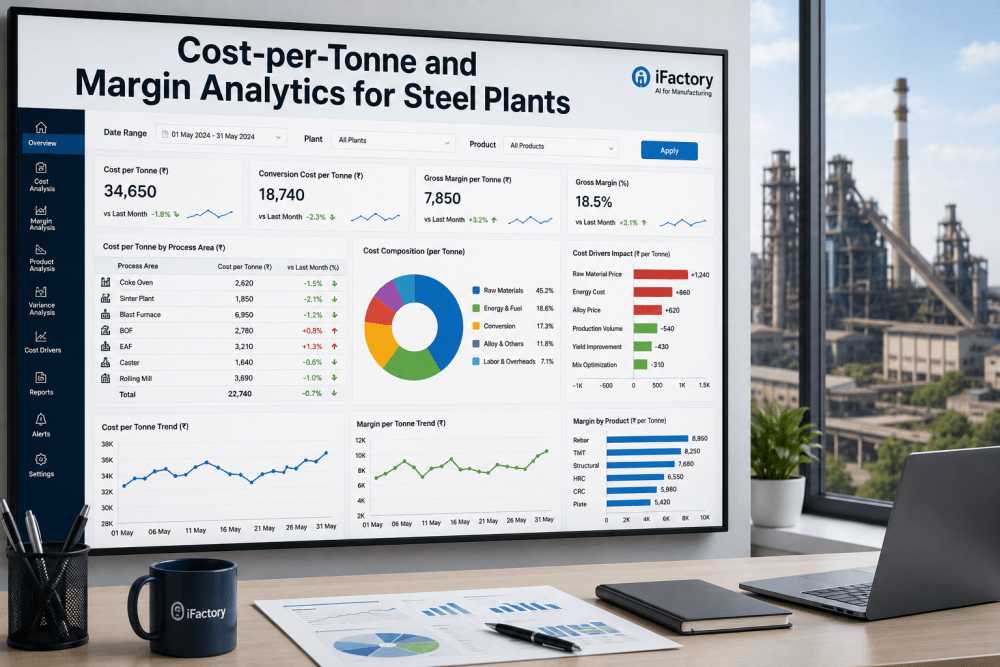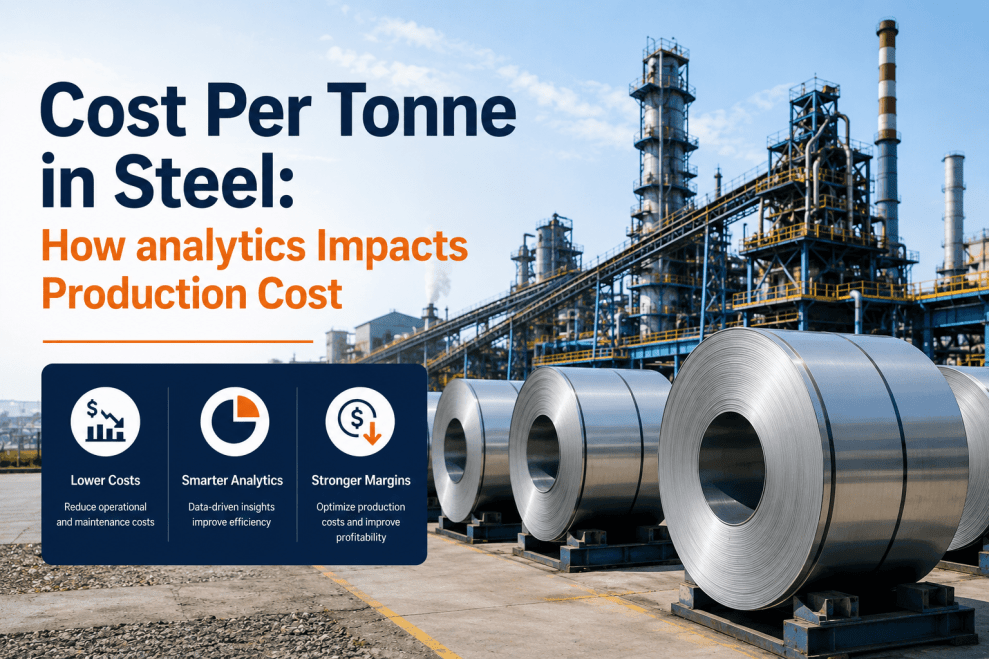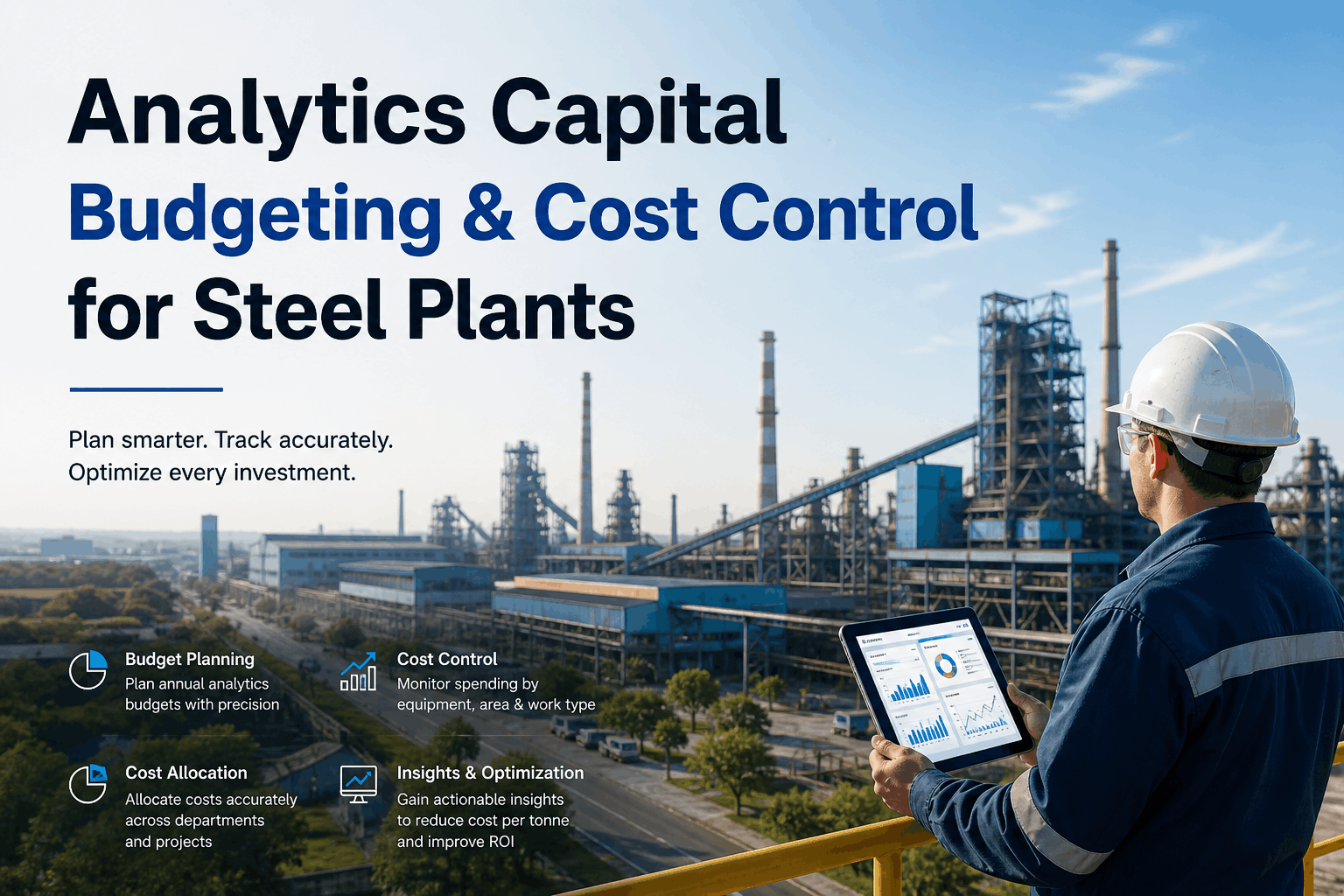
Steel plants operate in an environment of extreme volatility—where fluctuating raw material prices and tight margins make maintenance budget optimization a survival imperative. Traditionally, maintenance costs are viewed as a "black box," where bulk spending is allocated to departments without granular visibility into which specific asset or work type is draining the most capital. Legacy budgeting relies on reactive Excel sheets and "gut-feel" estimates that result in massive budget variances and unplanned emergency spending. Implementing iFactory AI-driven maintenance budgeting synchronizes SAP work order costs, spare parts consumption, and labor hours into a unified financial twin. By predicting asset failures and aligning budget cycles with actual equipment health, producers drastically reduce cost-per-tonne and eliminate financial leakage. Book a Financial Strategy Session to learn how modern cost control identifies hidden spending traps before they impact your quarterly bottom line.
Master Maintenance Budgeting & Cost Control for Steel Operations
Granular asset-level spend tracking, predictive spare parts budgeting, and real-time variance alerts — iFactory transforms maintenance from a cost center into a value driver.
Legacy vs AI Budgeting — Why Manual Cost Tracking Fails the Modern Steel Plant
Traditional maintenance budgeting is a slow, month-end ritual that provides "too little, too late" information. iFactory's live financial engine integrates directly with your CMMS to provide real-time visibility into every rupee spent. Schedule a budget readiness assessment to map your cost centers.
The 6 Strategic Pillars of Maintenance Cost Optimization
Mastering maintenance budgets requires more than just limiting spend; it requires allocating capital to the highest-ROI assets at the precise moment of need.
Asset-Level Cost Allocation
Automatically maps every invoice, spare part, and labor hour to the specific functional location. Identifies "Bad Actor" equipment that is disproportionately consuming your annual budget.
Predictive Spare Parts Planning
Fuses reliability data with supply chain lead times. Ensures budget is allocated for critical spares only when failure risk is high, reducing dead inventory by up to 25%.
Labor & OT Cost Management
Analyzes internal labor utilization vs. contractor spend. Identifies opportunities to reduce overtime by optimizing the preventive maintenance schedule around high-cost shifts.
CAPEX vs OPEX Modeling
Determines the precise "Point of Diminishing Returns" for aging assets. AI recommends when to stop patching (OPEX) and initiate replacement (CAPEX) for maximum long-term ROI.
Energy & Utility Budgeting
Correlates equipment health with power consumption. Identifies when a degrading asset is "bleeding" energy, allowing maintenance to be justified as a direct utility saving.
Work Order Financial Integration
Binds SAP PM/MM data directly to the budget dashboard. Every work order completion updates the "Budget Remaining" in real-time for immediate supervisor visibility.
Budget Optimization Roadmap — From Data Silos to Financial Control
A full financial analytics deployment follows a structured 4-phase programme — delivering measurable cost savings within the first quarter of operation.
Connection to ERP (SAP/Oracle) and CMMS data streams. Mapping cost centers to physical functional locations. Data cleaning and integrity audit completed.
AI identifies historical spending patterns and identifies "Leakage Zones." Benchmarking of cost-per-tonne against industry standards and similar plant configurations.
Deployment of "What-If" scenarios. Simulating the impact of deferred maintenance vs. increased spare parts spend on total plant availability and quarterly profit.
Autonomous variance alerts firing directly to department heads. Real-time budget vs. actual tracking for every work order. Full financial transparency achieved.
Budget Accuracy Benchmark — Impact Across Steel Departments
The transition from manual to AI-driven budgeting results in a dramatic reduction in "Unplanned Spend" across the most capital-intensive areas of the plant.
| Departmental Zone | Target Variance | iFactory AI Budgeting | Legacy Excel Tracking | Verdict |
|---|---|---|---|---|
| Blast Furnace & Sinter | ±5% | ±2.1% | ±18.4% | High Precision |
| SMS & Continuous Casting | ±3% | ±1.4% | ±12.6% | High Precision |
| Rolling Mills & Finishing | ±8% | ±3.8% | ±15.2% | High Precision |
| Utilities & Power Plant | ±10% | ±4.2% | ±9.5% | Consistent |
What a Maintenance Director Said
Our biggest struggle wasn't the total budget; it was the 'September Surprise' where we realized we had consumed 90% of our annual allocation by the third quarter due to unplanned mill breakdowns. iFactory's budget analytics changed everything. We now see exactly which assets are bleeding cash in real-time. By shifting to predictive spare parts budgeting, we reduced our inventory carrying costs by ₹14 crore and maintained a 99% budget accuracy for the first time in 20 years.
Frequently Asked Questions
Can the platform integrate with my existing SAP PM/FI modules?
Yes. iFactory features a native RFC/API bridge that synchronizes work order costs, spare parts issues, and labor confirmations directly from your SAP instance for real-time budget tracking.
How does AI predict the budget needed for the next quarter?
Our engine analyzes the failure probability of every critical asset. It then calculates the expected cost of spares, labor, and downtime risk to generate a data-driven budget forecast.
Can we track contractor spending and OT costs separately?
Absolutely. The platform categorizes labor costs by work-type and vendor, allowing you to identify if internal labor optimization can reduce expensive external contractor dependencies. Book a labor cost review.
Does the platform help with CAPEX planning for large mill upgrades?
Yes. By tracking the rising maintenance cost trend of aging assets, the AI calculates the exact 'Break-Even Point' where a CAPEX upgrade becomes more profitable than continued OPEX patching.
Is the financial data secure and compliant for auditing?
iFactory uses enterprise-grade encryption and full mTLS tunnels. Every budget adjustment and cost allocation is logged with a permanent audit trail for ISO and internal compliance.
What is the typical reduction in 'Unplanned Spend' after deployment?
Most plants see a 30-40% reduction in emergency reactive spending within the first 6 months as the system shifts the budget from 'Repair' to 'Preventive' focus.
How does the platform handle multi-currency budgeting for international mills?
Our engine integrates real-time currency conversion layers for global portfolios, allowing group-level consolidation while maintaining local plant-level currency for tactical execution.
Can we allocate budget based on critical vs. non-critical equipment?
Yes. You can set "Criticality Multipliers" that automatically prioritize funding for bottleneck assets like blast furnaces over auxiliary utility equipment during budget cuts.
Does the system provide automated financial reports for board meetings?
The platform generates 1-click executive summaries (PDF/Excel) that highlight ROI, budget utilization, and cost-per-tonne trends, eliminating the need for manual report preparation.
How does iFactory handle 'emergency repair' funding vs. pre-planned budgets?
Emergency work orders are flagged instantly, pulling from a dynamic contingency fund while the AI adjusts the remaining quarterly budget to maintain total fiscal compliance.
Rule Every Rupee of Your Maintenance Budget
Eradicate budget leakage, destroy unplanned spending, and assure unmatched financial transparency by mobilizing AI across your entire plant configuration.