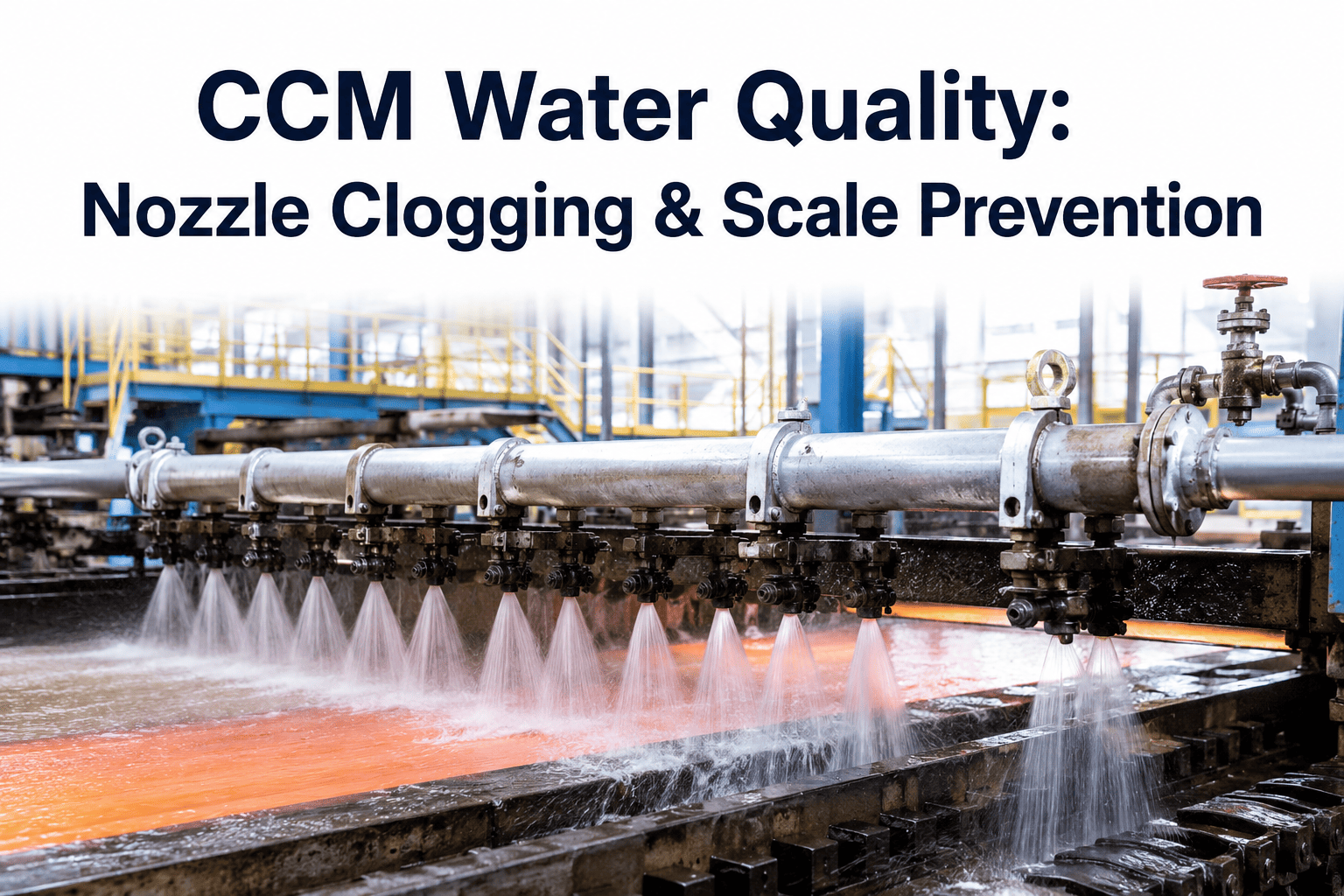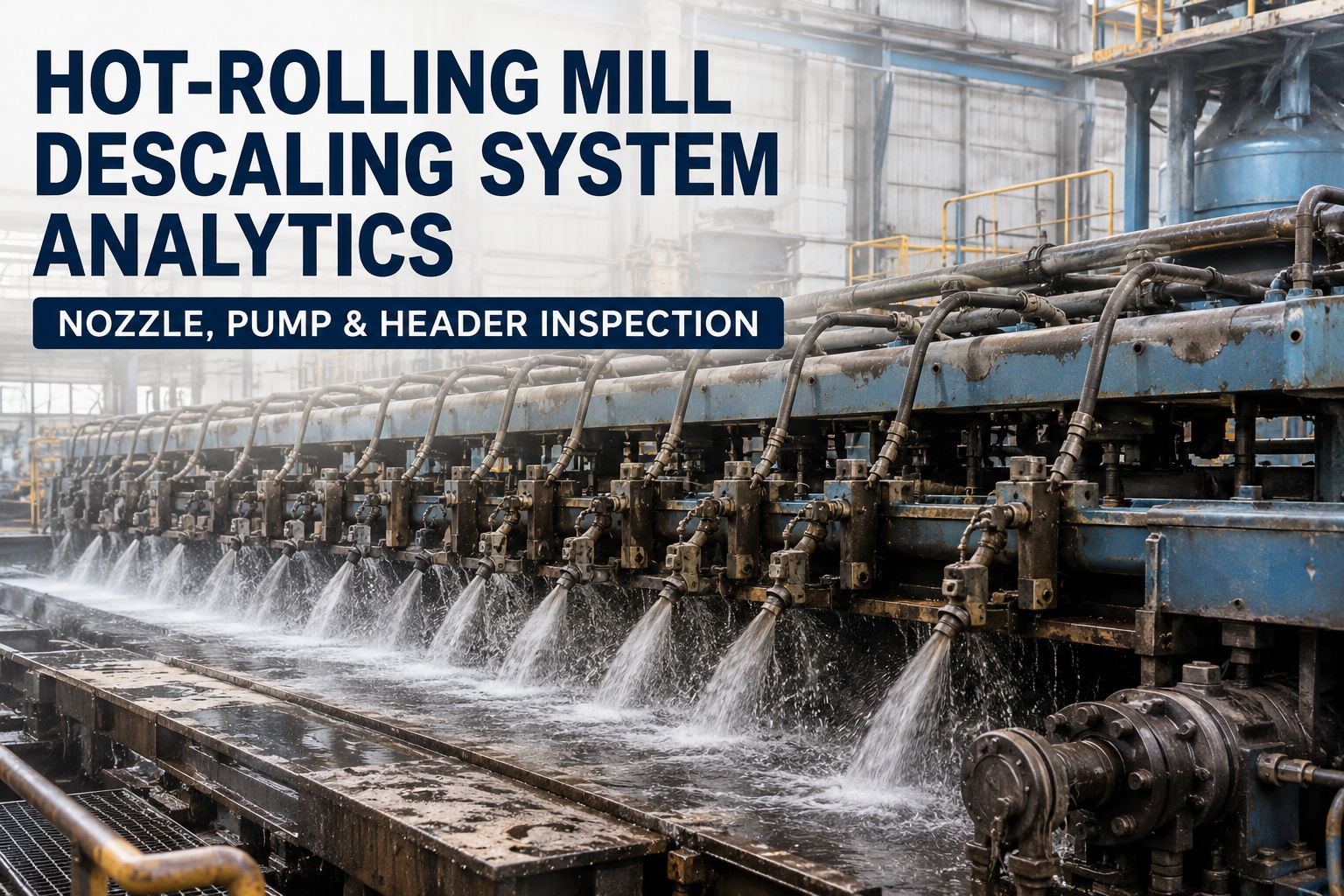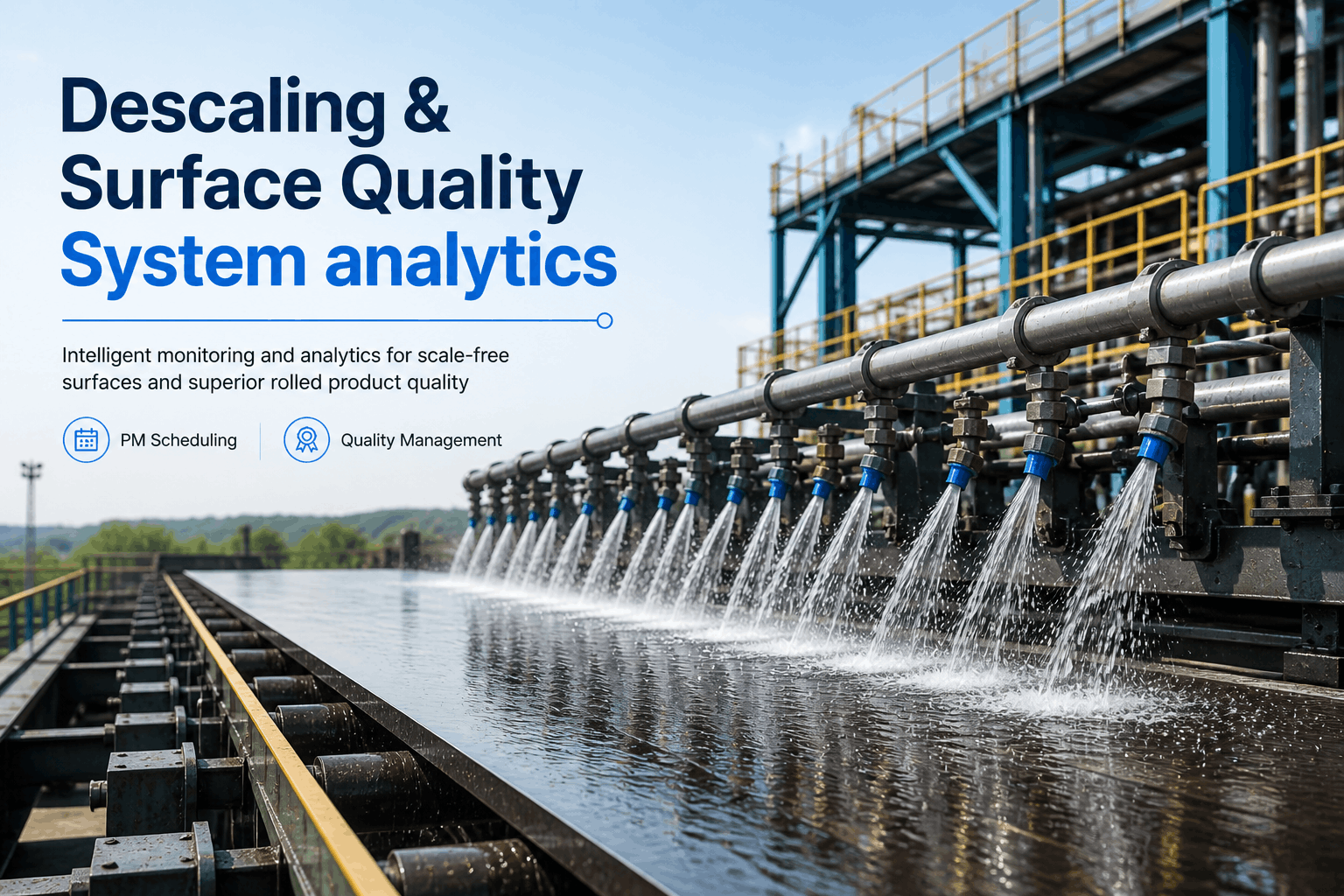
Descaling is the critical "Quality Gatekeeper" in hot rolling operations, responsible for the absolute removal of secondary scale that otherwise results in permanent surface defects, pitting, and rolled-in scale rejects. Effective immediately, the shift from "Pressure Monitoring" to AI-driven surface quality analytics is the mandatory standard for mills producing high-value automotive and API grades. For Quality and Rolling Directors, the window for manual nozzle inspections and "after-the-fact" reject analysis is closed. Understanding your obligations around Impact Pressure KDEs, Header Tracking Events, and real-time nozzle wear is the only way to maintain a scale-free surface and protect your mill's yield from the "Invisible Pitting Drain."
What Is AI-Driven Descaling Analytics?
AI-driven descaling analytics, codified within the iFactory quality framework, establishes a new digital recordkeeping standard for high-pressure spray headers. Unlike prior SCADA monitoring that only tracks main-header pressure, this is a "Nozzle-Level" intelligence system. It defines a mandatory, standardized approach to tracking the health of spray headers through the entire production cycle — from the first scale-breaker to the final interstand spray. The system introduces a structured vocabulary of surface quality built around two foundational concepts: Diagnostic Tracking Events (DTEs) and Key Data Elements (KDEs). Every Quality Director must understand these two constructs in metallurgical, not just mechanical, terms.
The Descaling Scope — the baseline for surface excellence — covers scale-breaker headers, roughing stand sprays, interstand finishing descalers, and high-pressure descaling pump stations. If your mill produces strip, plate, or section products where surface finish is a customer-critical specification, iFactory's predictive surface logic applies to your operations.
Understanding DTEs: Diagnostic Tracking Events in Descaling Systems
Diagnostic Tracking Events are the defined moments in the descaling cycle where quality data must be created and analyzed. The iFactory platform has identified a structured set of DTEs that apply across the rolling mill. For steel quality teams, the most operationally significant DTEs are:
Nozzle Clogging Signature (Detection)
The point at which micro-particulate begins to obstruct spray patterns. Required data includes flow-head curves and header-end pressure differentials. iFactory identifies the 'un-even cooling' signature before it causes a surface strip.
Header Pressure Transient (Latency)
The delay between the valve-open command and the achievement of full impact pressure. AI identifies "Lazy-Valve" response in under 100ms, preventing the first 5 meters of a strip from being under-descaled.
Accumulator Charge Drift
The moment a descaling accumulator bladder begins to lose pre-charge pressure. This CTE is the primary indicator for imminent pump "Hammering" and inconsistent spray force during heavy production loads.
Filter Backwash Inefficiency
The detection of excessive particulate carry-over through the main descaling filters. AI correlates backwash cycles with nozzle clogging DTEs, ensuring that the water quality baseline is maintained.
Surface Vision Correlation
The final DTE where surface vision defect data is linked back to a descaling header transient. Book a demo to see how iFactory creates the "Quality Thread" from spray to strip.
Key Data Elements (KDEs): What Your Surface Twin Must Capture
Key Data Elements are the specific data points that must be recorded at each Diagnostic Tracking Event. iFactory has defined both required KDEs — which must always be captured — and reference document KDEs, which link descaling health to surface inspection records. The practical quality challenge is capturing "Impact Force" as a calculated variable in real-time. Book a demo to see how iFactory maps KDE capture to your rolling mill descaling manifolds.
| Event (DTE) | Required KDEs (Diagnostic Data) | AI Inference Required? | Impact on Yield |
|---|---|---|---|
| Spray Latency | Valve Command (ms), Manifold Pressure, Header-End Flow, Strip Speed | Yes — Timing Model | Head-End Surface Defect |
| Nozzle Wear | Total Cubic Meters, Particle Load, Pressure Decay, Spray Overlap Index | Yes — Wear Predictive | Longitudinal Scale Bands |
| Thermal Shock | Water Temp, Header Flow, Slab Thickness, Rolling Temperature | Yes — Quench Balance | Mechanical Property Drift |
| Accumulator Health | Nitrogen Pre-charge, Piston Travel, Cycle Frequency, Bladder Temp | Yes — Bladder Life | Pump Motor Harmonic Stress |
| Surface Mapping | Header ID, Nozzle Position, Vision Defect ID, Defect Coordinates | Yes — RCA Linkage | Direct Reject Prevention |
The "Secondary Scale" Transformation: The Most Complex Quality Challenge
For mills producing high-value grades, the "Secondary Scale Transformation" introduces the most complex reliability requirement. Secondary scale forms instantly after the scale-breaker, and its removal is a function of both impact pressure and water volume. At the point of transformation, the system must record all header KDEs and correlate them with strip surface vision data to ensure the scale was physically removed rather than just cooled.
This linkage requirement — connecting high-pressure transients to strip surface defects — is what makes AI-driven descaling fundamentally different from simple pressure tracking. It requires that your quality system captures data at the spray-impact zone, not just at the pump station. Book a demo to see how iFactory handles scale-to-vision linkage across hot strip mill configurations.
AI-Driven Yield: How Technology Closes the Descaling Intelligence Gap
Manual and SCADA-based systems fail surface quality on three fronts: they cannot capture KDEs at high enough frequency, they cannot reliably link nozzle wear to surface bands, and they cannot produce complete RCA chains within the required window. AI-driven platforms address each of these points through automated edge capture and intelligent quality linkage. Book a demo to see iFactory's AI-driven descaling module in action across a live mill scenario.
Automated Header Edge Capture
Integrated with manifold transducers and high-speed valve controllers, iFactory captures KDEs automatically at the edge — eliminating the "SCADA Polling Lag" that misses nozzle cavitation and spray transients.
Surface-Vision Defect Linkage
Intelligent diagnostic engines automatically link strip defects back to specific header manifolds — maintaining the "Traceability Chain" of quality from the scale-breaker to the coiler.
Instant RCA Quality Compilation
On-demand quality reports compile complete descaling histories for any coil — in seconds, not days. Records are formatted for Quality Directors and can be accessed on mobile devices during mill audits.
Predictive Nozzle Maintenance
Built-in Wear-Modeling tools allow Maintenance Managers to replace nozzles based on actual "Spray-Intensity-Work" rather than arbitrary calendar dates, ensuring zero-defect spraying at minimum cost.
Descaling Reliability Gaps: Where Rolling Mills Are Most at Risk
Based on industry analysis of hot rolling mill descaling readiness assessments, the following reliability gaps appear most frequently in facilities approaching their digitalization deadline.
Building a Surface Quality Roadmap: A Step-by-Step Approach
For Quality and Rolling Directors leading their organization's digital transformation, the surface quality roadmap has five operational phases. Each phase has a defined output that feeds into the next, creating a structured pathway from current-state assessment to audit-ready operation.
Scope Determination: Map Your Header Configuration
Audit every descaling manifold, interstand spray, and accumulator station. Document which headers trigger "High-Value" surface obligations (e.g., Automotive grades) and at which point in your process each DTE applies. Output: a facility-specific Header Map.
KDE Gap Analysis: Assess Impact Pressure Capture
For each in-scope header, compare the KDEs your current SCADA captures against the 100ms transients required by AI. Identify fields that are missing or recorded in formats that cannot be used for Vision-Linkage. Output: a KDE gap register.
Nozzle-Level Wear Model Design
Design a diagnostic structure that meets quality requirements: unique nozzle identification, linkage to KDE records, and spray-overlap modeling for reject prevention. Integrate AI model triggers into quality workflows. Output: a documented Nozzle schema.
Technology Platform Selection and Integration (MES/Vision)
Select and deploy a quality technology platform capable of automated KDE capture, surface-vision linkage, and 24-second record production. Integrate with existing Surface Inspection Systems (SIS). Output: a deployed quality system with validated data flows.
Mock Traceback Exercise and Audit Readiness Validation
Conduct a minimum of two mock traceback exercises — one forward trace from a header pressure transient to strip defect, and one backward trace from a customer reject to the original spray KDEs. Time the record production against the "Quality Standard." Output: validated audit-readiness certification.
Frequently Asked Questions: Descaling & Surface Quality
Can iFactory detect a single clogged nozzle in real-time?
Yes. By analyzing header-end pressure differentials and flow-transients, the AI identifies the 'Spray-Band' signature of a clogged nozzle before it impacts strip quality.
How does the system link descaling to surface vision data?
We use mill-time synchronization to map descaling transients to exact coil coordinates, correlating spray force with Vision Defect IDs (e.g., Scale Pitting).
What is the "Secondary Scale" transformation challenge?
It is the proprietary AI logic that connects raw header pressure transients to the metallurgical removal rate of secondary scale across different steel grades.
How long does it take to deploy iFactory on a descaling manifold?
Most mills achieve full deployment on critical headers in 8–12 weeks, covering sensor installation, SIS integration, and predictive nozzle model validation.
Can iFactory predict descaling accumulator bladder failure?
Yes. By monitoring pre-charge pressure drift and piston travel-times, the AI identifies bladder degradation before it causes hydraulic hammer or spray force loss.
Does the system provide energy optimization for high-pressure descaling?
Absolutely. iFactory optimizes pump-duty and accumulator pre-charge based on real-time rolling schedules, reducing descaling energy costs by up to 18%.
Is the system compatible with legacy descaling valve controllers?
Yes. We use external transducers and valve current sensors to bring legacy descaling systems into the digital age without requiring a complete controller replacement.
What is the typical ROI for AI-driven descaling analytics?
Most facilities achieve full payback within 6-10 months through a 34% reduction in surface rejects and significant nozzle lifecycle extensions.
Does iFactory handle different slab temperatures and grades?
Yes. The AI correlates slab-reheat furnace data with descaling intensity, ensuring optimal scale removal for both standard grades and high-alloy grades.
Can iFactory predict descaling pump NPSH suction risks?
Yes. By monitoring supply-tank levels and suction-side pressure transients, the AI prevents pump cavitation that damages expensive mechanical seals.
Does the platform monitor interstand spray timing?
Yes. We track the millisecond-level timing of interstand sprays to ensure the strip is scale-free before entering the next rolling stand, preventing scale-pitting.
Can iFactory integrate with Surface Inspection Systems (SIS)?
Yes. We provide a bidirectional data bridge that allows descaling analytics to be overlaid on strip vision maps for definitive root-cause analysis.
What is the "Quality Thread" in descaling analytics?
It is the unbroken digital record connecting descaling pump health, manifold pressure, nozzle spray-force, and final strip surface finish.
How does the system handle different spray nozzle brands?
iFactory is vendor-agnostic; we calibrate our wear models based on the specific flow-curves of your installed nozzles to ensure 100% diagnostic accuracy.
Does iFactory provide shift-level surface quality scorecards?
Yes. iFactory provides real-time descaling performance data for every shift and product grade, surfacing variables that drive surface quality deviations.
"Before iFactory, our descaling maintenance was entirely reactive—we only knew a nozzle was clogged after we saw the rejects at the coiler. By linking header pressure transients directly to our surface vision system, we've reduced scale-related rejects by 34% and extended our nozzle replacement cycles by nearly a month. It's the first time we've had a truly predictive view of our surface quality gatekeeper."