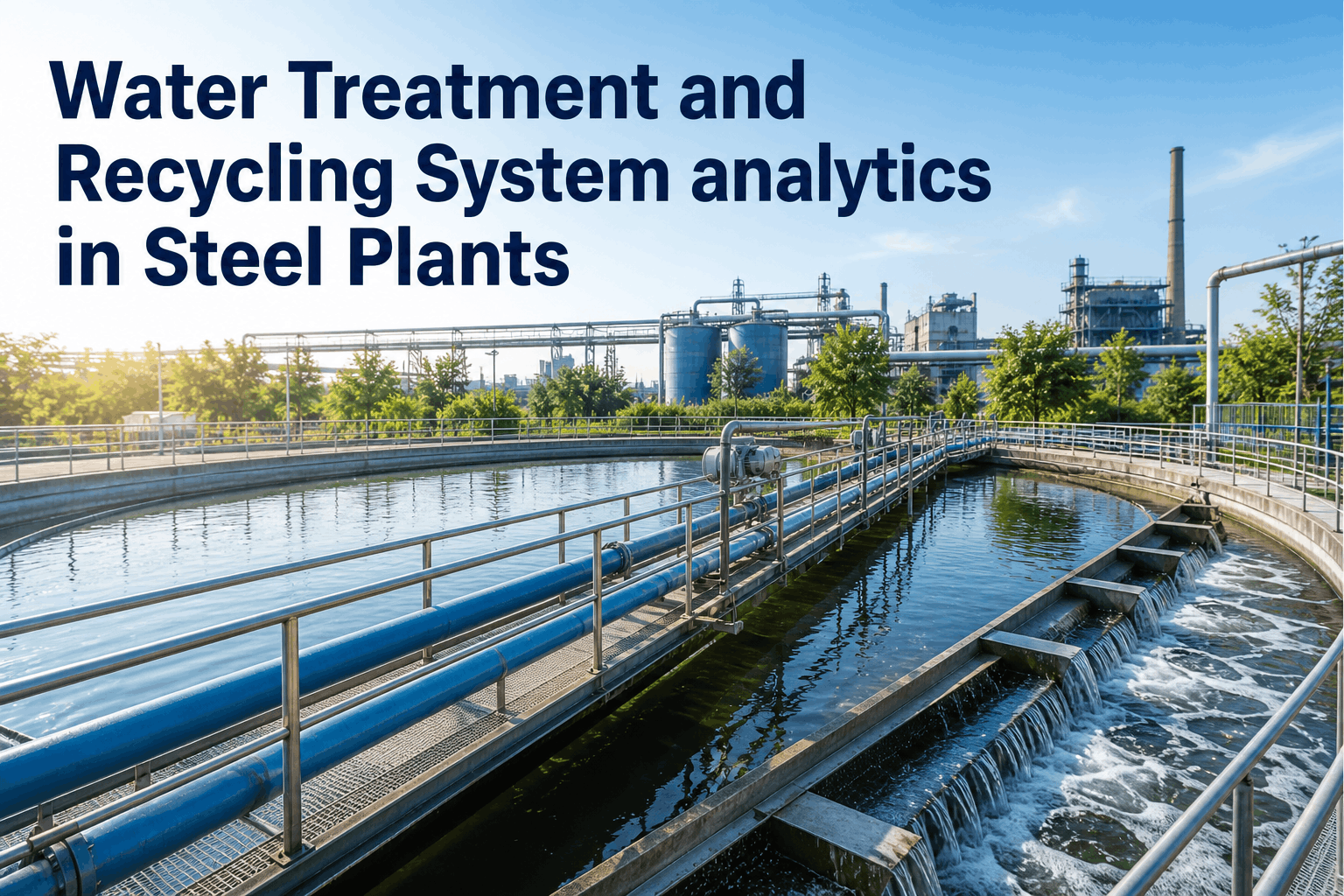
Most steel plant utility managers believe they have full control over their cooling water systems—until a furnace wall fails due to undetected scale or a secondary cooling pump cavitates into a catastrophic outage. The reality of "Connected Water Systems" in most mills is a patchwork of manual titrations, 30-minute sensor averages, and siloed chemistry reports that fail to catch process drifts until damage is done. If your water analytics platform cannot predict a nozzle clog or a LSI (Langelier Saturation Index) deviation before it impacts slab quality or equipment integrity, you don't have a cooling strategy—you have a reactive maintenance bill. To see how iFactory's AI-driven Water & Cooling analytics closes the visibility gap, Book a Demo with our industrial utility team today.
The "Chemistry Gap" Hiding Inside Steel Water Systems
Why Monitoring pH and Conductivity Isn't Enough
In a steel plant, water is the lifeblood of asset protection. From the copper staves of a blast furnace to the spray headers of a continuous caster, water must be metallurgically "tuned" to prevent scale, corrosion, and biological growth. However, many mills still rely on legacy "batch-and-report" analytics. Sensors may log data every second, but the underlying analytics layer often hides critical fluctuations in "averages." A 20-minute conductivity spike might be smoothed out on a dashboard, even as it triggers a localized scale event in a high-heat furnace zone. The "Chemistry Gap" is the difference between simply recording water parameters and **predicting** their impact on equipment life. Plants that treat water as a utility rather than a critical asset are constantly exposed to the risk of "Internal Corrosion Fatigue"—the silent killer of steel plant availability.
5 Root Causes of Cooling System Analytics Failure
Diagnosing the Visibility Gap Before the Next Unplanned Outage
How Water Analytics Gaps Amplify Steel Operational Risk
The True Cost of Utility Invisibility
The financial impact of a cooling system failure is never limited to the "repair bill." In the steel industry, a failed cooling pump or a scaled furnace stave triggers a cascade of losses: lost production hours, energy waste during heat-up, and potential safety risks. When your water analytics is fragmented, you are essentially flying blind through these risks. A localized chemistry imbalance that iFactory would detect in 60 seconds can propagate for days across a siloed environment, leading to permanent equipment damage that shortens asset life by years. The table below outlines the annualized risk exposure of common water system failure modes.
| Failure Mode | Primary Asset Impact | Secondary Operational Risk | Annualized Cost Range |
|---|---|---|---|
| Chemistry Lag / Scale | Furnace Wall Burn-through | Emergency Outage & Re-bricking | $250K – $650K |
| Pump Cavitation | Impeller & Seal Destruction | Flow Reduction & Quality Drift | $80K – $220K |
| Spray Clogging | Uneven Slab Cooling | Surface Rejects & Yield Loss | $140K – $380K |
| Tower Inefficiency | Excessive Make-up Water | Energy & Chemical Waste | $60K – $180K |
| Biocide Failure | Biological Slime / Legionella | Regulatory Fine & Efficiency Loss | $110K – $310K |
What Genuine Real-Time Water Analytics Requires
The Architecture of a Self-Optimizing Cooling Loop
True water system intelligence requires more than just "online sensors." It requires a four-pillar architectural approach: **1. Streaming Ingestion** of high-frequency pressure, flow, and chemistry data; **2. Production Contextualization** to understand how current heat loads should impact water demand; **3. Predictive AI Inference** to identify cavitation or scaling signatures in real-time; and **4. Event-Driven Dosing** that adjusts chemistry automatically based on predicted demand rather than historical averages. This is the difference between "monitoring water" and "engineering asset availability."
The 5-Step Framework for Steel Water Optimization
Regulatory & Environmental Risk in Water Management
Zero Liquid Discharge (ZLD) and Discharge Compliance
As environmental regulations tighten, the "Analytics Gap" becomes a legal liability. Failing to accurately monitor blowdown cycles or discharge quality can lead to heavy fines and operational shutdowns. iFactory’s Water suite automates compliance documentation, providing an unbroken, timestamped record of discharge parameters and chemical neutralization efficacy. This isn't just about saving money—it's about protecting your license to operate in an increasingly regulated landscape.
Frequently Asked Questions
What causes pump cavitation in steel cooling systems?
Common causes include blocked suction strainers, low NPSH (Net Positive Suction Head) due to basin level fluctuations, and air entrainment from cooling tower vortexing. iFactory detects the specific hydraulic harmonic of cavitation, allowing for corrective action before impeller damage occurs.
How does AI improve water chemistry dosing?
Instead of fixed dosing rates, our AI correlates makeup water quality, ambient temperature, and live furnace heat-loads to predict the exact amount of inhibitor or biocide needed. This prevents both under-dosing (risk) and over-dosing (waste).
Can iFactory detect nozzle clogging in the continuous caster?
Yes. By monitoring the "Pressure/Flow Signature" of individual headers and comparing them against the caster speed and slab grade, the AI can identify subtle flow reductions indicative of localized nozzle clogging or scaling.
How do you measure the ROI of water analytics?
ROI is measured across four domains: 1. Reduced chemical consumption (typically 15-20%), 2. Lower water blowdown costs, 3. Extended life of critical assets (pumps/staves), and 4. Prevention of unplanned production outages (the largest ROI driver).
What is the "Chemistry Gap" in utility management?
It is the delay between a water chemistry deviation occurring and it being detected by manual testing. In high-heat steel processes, even a 4-hour gap can allow permanent scale formation in furnace staves or heat exchangers.
Does the system help with Zero Liquid Discharge (ZLD) systems?
Yes. iFactory optimizes the salt-balance in the brine concentrators and crystallizers, ensuring maximum water recovery without reaching the saturation points that cause system-wide fouling and downtime.
Can it integrate with existing water treatment controllers?
Absolutely. iFactory sits atop your existing Level-1 controllers (like Walchem or Grundfos) and provides the "Intelligence Layer" via OPC-UA or MQTT to optimize their setpoints based on production context.
Is predictive maintenance for pumps really worth it?
For critical cooling pumps, yes. A single emergency pump swap costs $40K+ in parts and labor, plus the risk of production impact. Predicting failure 2-4 weeks in advance allows for scheduled maintenance at 30% of the cost.