Augmented Reality (AR) for steel plant analytics and training is fundamentally transforming how heavy industry manages complex maintenance in hazardous environments. From overlaying real-time pressure data on hydraulic rolling mill units to providing step-by-step guided repair instructions for blast furnace cooling staves, AR technology bridges the critical gap between raw sensor data and frontline human action. As the global steel workforce faces an unprecedented generational shift, organizations that schedule a demo with iFactory are discovering that they can accelerate technician competency by 40% using AI-integrated AR workflows that bring remote expert support directly into the most challenging zones of the melt shop.
Empower Your Technicians with AR-Guided Steel Plant Repairs
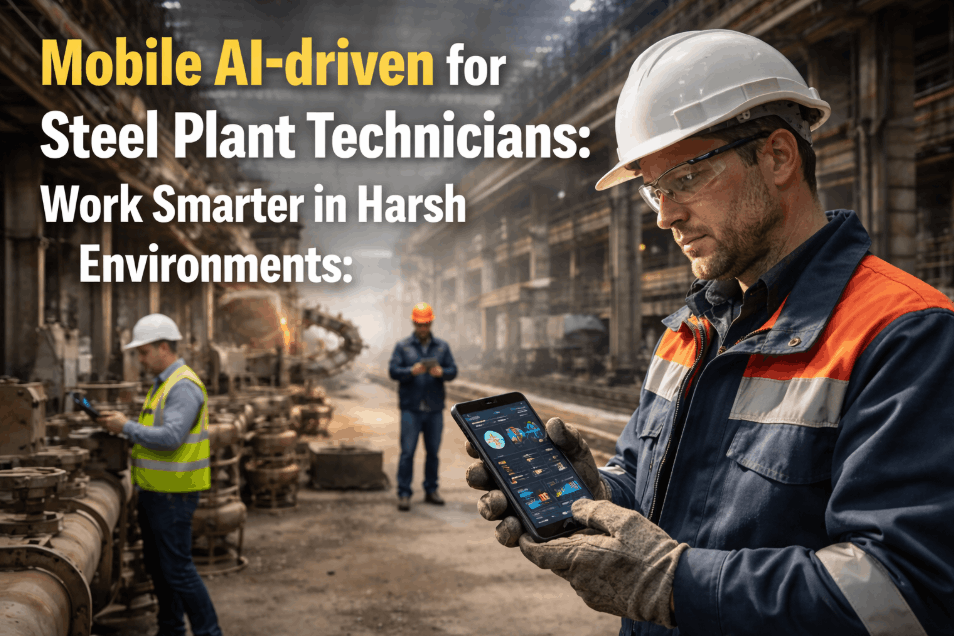
iFactory's Mobile AI-driven App delivers real-time AR data overlays, remote expert visual support, and interactive work instructions — purpose-built for the high-heat, high-risk steel manufacturing floor.
Why AR-Guided Support is Essential for Hazardous Steel Zone Analytics
Maintaining equipment in a steel mill involves navigating extreme heat, abrasive dust, and high-voltage systems. Traditionally, a technician in a remote motor room or on top of a charging crane would have to carry heavy paper manuals or leave the site to consult with a specialist. This not only increases mean-time-to-repair (MTTR) but also exposes personnel to prolonged durations in hazardous areas. Maintenance teams exploring AR-driven efficiency often begin by choosing to schedule a session to assess how AR-integrated work instructions can reduce on-site exposure times.
Augmented reality steel plant solutions allow for "See-What-I-See" remote assistance. A remote expert, located anywhere in the world, can annotate a technician's live field of vision on a tablet or AR glasses. This capability is critical for Level 2 system troubleshooting or complex servo-valve calibration where specific, high-level expertise is required. iFactory integrates this visual field with live AI health scores, so the technician sees not just the machine, but its predictive failure probability overlaid directly on the physical component.
Guided Repairs Gap
Technicians often struggle with complex hydraulic manifolds. AR overlays highlight the exact bolt to turn and the specific pressure to reach, eliminating human error.
Expert Accessibility
Senior engineers are few. Remote expert support enables one specialist to supervise multiple repairs across different steel sites simultaneously.
Hazard Zone Safety
AR enables "Hands-Free" operation through voice commands. Technicians can view data without taking their eyes off the equipment or using their hands.
Digital Twin Verification
Compare "As-Built" vs "As-Found" directly in the field. AR identifies missing guards or modified wiring that doesn't match the master digital twin.
What a Comprehensive Steel AR Analytics Platform Must Deliver
A robust AR implementation for steel mills must be more than just a video call. It must provide context-aware data that correlates physical assets with digital records. The iFactory AR ecosystem is built around three core modules: Visual Instruction Overlays, Remote Expert Collaboration, and Real-Time IoT Visualization. Mill managers looking to deploy these capabilities often book a demo to align the software with their existing ruggedized hardware fleet.
Module 1 — Interactive Work Instructions (IWI)
Replace PDF manuals with spatial instructions. For a caster mold change or an EAF electrode replacement, AR provides 3D animations overlaid on the equipment, guiding the technician through every lockout-tagout (LOTO) point and torque specification.
Module 2 — Remote Specialist "Telepresence"
Enable real-time collaboration with OEM experts. Using low-bandwidth visual streams, field technicians can show live video of a vibrating motor or a leaking seal to a remote specialist who can draw instructions directly on the technician's screen.
Module 3 — Spatial IoT Data Analytics
Transform how data is consumed. Instead of looking at a control room monitor, a technician walking through the mill can look at a pump and see its live temperature, vibration health, and "days-to-failure" prediction floating above the asset.
The Impact of AR-Guided Scalability and Knowledge Retention
AR technology solves the two biggest challenges in steel plant maintenance: the scarcity of senior technical experts and the slow speed of knowledge transfer. By digitizing the "Expert Field of View," iFactory allows a single specialist to supervise multiple high-stakes repairs across different furnace or mill zones simultaneously, effectively duplicating your most valuable human assets. Maintenance teams exploring this workforce scalability often schedule a session to see how AR bridges the internal skills gap.
Real-time feedback loop in technician field-of-view eliminates "blind" adjustments. AR highlights precise torque and position targets directly on the hydraulic manifold, ensuring rolling mill gauge stability.
Guided visual overlays for drilling and stave replacement in extreme heat zones. Remote experts verify LOTO safety and alignment before the first cut is made, reducing hazardous exposure time by 45%.
AR glasses highlight stress fatigue points on crane rails by correlating live thermal scans with master digital twin structural models, identifying hairline fractures invisible to traditional visual inspections.
Integrating Augmented Reality Into Daily Steel Mill Reliability
The deployment of AR technology for steel plant analytics requires a shift from reactive problem-solving to proactive, guided execution. Maintenance teams use AR to bridge the "Seniority Gap," allowing junior technicians to perform complex Level 2 and Level 3 maintenance tasks with the safety net of AR-integrated AI guidance. Reliability leads often book a demo to explore how AR-enabled checklists can feed directly into their site-wide audit logs.
| Maintenance Task | AR Analytics Capability | Traditional Approach | AR-Integrated Approach | Outcome |
|---|---|---|---|---|
| HAGC Calibration | Spool feedback overlay | Physical gauge & Radio to control room | Real-time feedback loop in field-of-view | Perfect Thickness Sync |
| Craneway Inspection | Structural defect highlighting | Visual check from crane cab | AR glasses highlighting stress cracks | Early fatigue detection |
| Conveyor Splicing | Alignment & Cure guides | Manual measurement & paper logs | Step-by-step AR alignment guide | 20% longer splice life |
| Furnace Hydraulics | Leak detection heat-maps | Manual spot checks (Hazardous) | Thermal AR for instant leak ID | Reduced Fire Risk |
| Operator Training | Melt shop simulations | Classroom + High-risk shadowing | AR-simulated tap-hole practice | Faster certification |
Building a Future-Ready AR Maintenance Team
Implementing AR for steel analytics is a journey from simple remote assistance to fully autonomous spatial diagnostics. Organizations often choose to schedule a strategy session to determine which zone of their plant will yield the highest ROI for a pilot deployment.
Remote Support Activation
For: Critical Troubleshooting
- Live video "See-What-I-See" calls
- Basic spatial annotations
- Digital manual library access
- Technician tablet integration
Guided Workflow Deployment
For: Complex Planned Tasks
- 3D step-by-step repair guides
- LOTO safety verification check
- AR-integrated spare parts ordering
- HPU & Mill health score overlays
Spatial Asset Intelligence
For: Total Plant Optimization
- Real-time thermal/vibration heat-maps
- Autonomous diagnostic suggestions
- AR glasses for hands-free operations
- Multi-site expert command center
"We operate a high-speed rolling mill where even a minor HAGC valve issue stops the entire line. Training our new technicians used to take 2 years. With iFactory's AR guided work instructions and remote expert support, we've cut that training time in half and virtually eliminated maintenance errors. It is the most vital safety and reliability tool in our digital steel strategy."
Augmented Reality in Steel Plants — Frequently Asked Questions
Do technicians need expensive AR glasses to use this system?
No — iFactory's AR modules run perfectly on standard ruggedized industrial tablets and smartphones. While we support advanced AR headsets (like HoloLens 2 or RealWear), most steel plants start with tablet-based AR for immediate ROI.
How does the system perform in high-heat or low-light steel zones?
Our computer vision models are trained specifically for industrial lighting. We also utilize thermal camera integrations and edge-enhancement AI to ensure that AR instructions remain visible and accurate even in dusty or dimly lit galleries.
Can a remote expert see what the field technician is seeing in real-time?
Yes — the platform provides a low-latency "See-What-I-See" video stream. The remote expert can freeze the frame, draw instructions, and place spatial markers that stay locked to the physical component even as the technician moves.
Does AR training help with steel plant safety and compliance?
Absolutely. AR ensures that critical safety steps — like verifying Lockout/Tagout points or wearing specific PPE — are physically checked and digitally logged before a technician can proceed to the next step of a repair.
What happens if there is no Wi-Fi or cellular signal in a remote area of the mill?
iFactory features an "Offline Maintenance Mode." Technicians can download AR work instructions and digital twins locally to their device. Once they return to a covered area, all completion logs and annotations sync automatically.
How does AR integrate with the existing SCADA and Level 2 systems?
We use secure IoT gateways to pull data from SCADA. This data is then "spatialized," meaning it is attached to the physical asset's 3D coordinates, allowing the technician to see live sensor data as they look at the machine.
What is the typical learning curve for a maintenance technician?
The interface is designed for simplicity. Most technicians become proficient with the AR work instruction interface in less than 30 minutes, as it follows a familiar "smartphone app" logic with intuitive visual cues.
Is the platform compatible with specialized OEM maintenance software?
Yes — iFactory provides open APIs that allow AR work instructions to be linked to OEM service portals, ensuring that the latest technical bulletins are always available to the technician on the floor.
Bridge the Skills Gap with AI-Driven Augmented Reality
iFactory's Mobile AI-driven App delivers integrated AR work instructions, remote expert collaboration, and spatial data visualization — built for steel manufacturers ready to lead in the digital age.
-for-steel-plant-analytics-hands-free-guided-repairs.png)