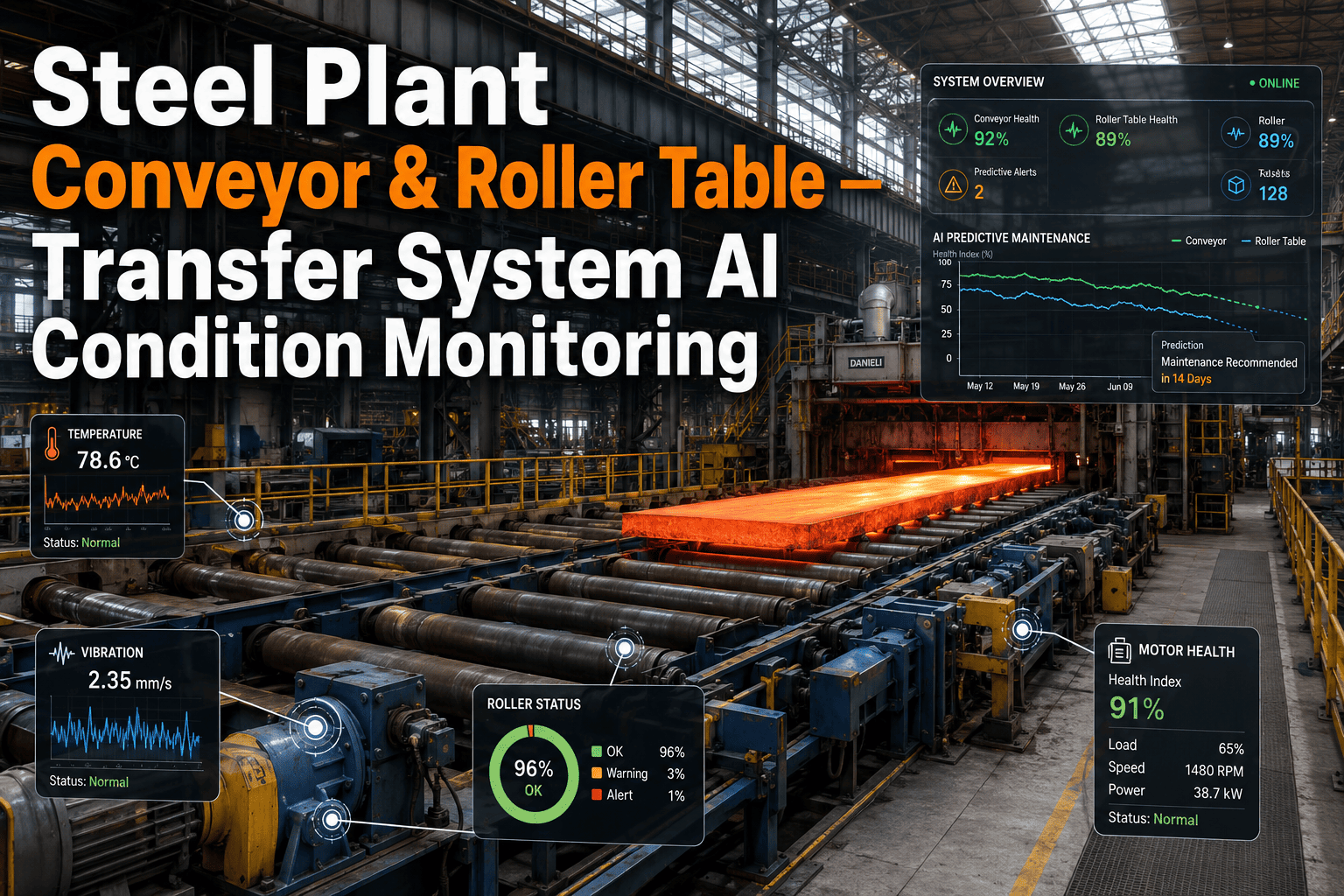
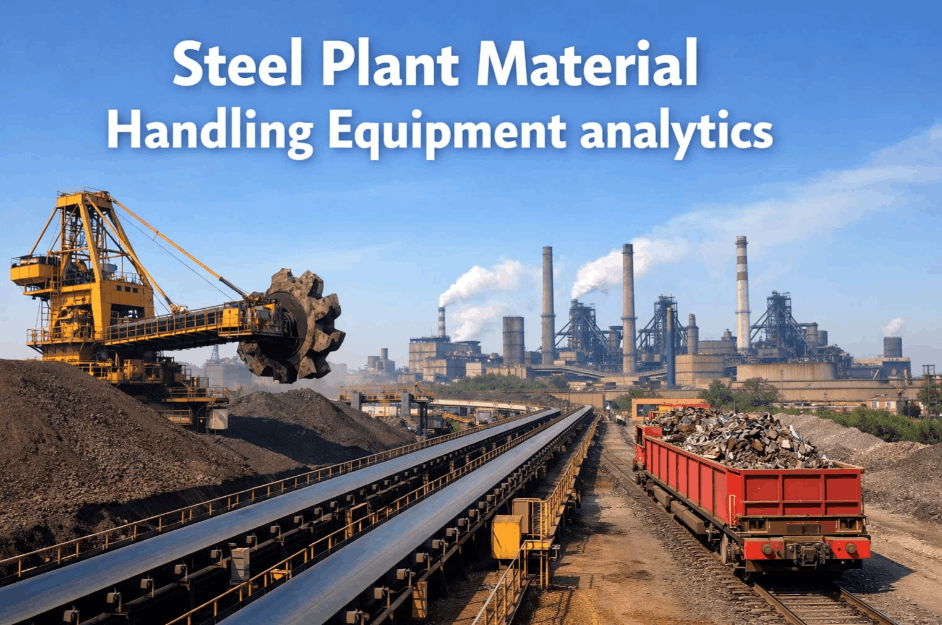
Steel plant conveyor analytics and material handling health monitoring are revolutionizing how integrated mills manage thousands of meters of critical belt infrastructure in high-abrasion environments. As the industry moves toward autonomous ore handling and predictive maintenance, the gap between traditional manual walkaround inspections and real-time AI-driven monitoring continues to widen — creating both an operational risk and a significant cost center that structured analytics training and deployment programs are uniquely positioned to solve. Organizations that book a demo with iFactory are discovering that their existing material handling systems can achieve up to 20% longer belt life when supported by AI-driven vision and acoustic sensors built specifically for the harsh conditions of steel manufacturing.
Eliminate Unplanned Belt Failures with AI-Driven Health Monitoring
iFactory's Mobile AI-driven App delivers real-time belt condition monitoring, idler wear tracking, and transfer point health alerts — purpose-built for integrated steel plant reliability.
Why Steel Plant Conveyor Networks Must Now Integrate Predictive Analytics
The modern steel plant is a continuous flow environment where a single belt failure in the ore yard or coal handling plant can starve the blast furnace within hours. Despite the high stakes, many facilities still rely on reactive maintenance or periodic visual checks that cannot catch the millisecond-scale events—like tramp metal penetration or splice fatigue—that lead to catastrophic longitudinal rips. The transition to analytics competency is not just a technology upgrade; it is a financial imperative to protect multi-million dollar belt assets.
Under modern safety and efficiency standards, facilities must demonstrate that their maintenance protocols are commensurate with the scale of their operations. As monitoring shifts from human sampling to continuous sensor integration, technicians who cannot interpret AI-generated deviation alerts or navigate digital health dashboards are increasingly misaligned with world-class manufacturing (WCM) goals. Teams exploring this shift often begin by scheduling a session to book a demo and assess how their current material handling fleet maps against predictive requirements.
Belt Rip Detection Gap
Traditional rip switches only trigger after the damage is done. AI vision identifies the penetration event in real-time, stopping the drive before the rip extends.
Idler Seizure Analytics
Acoustic signatures of failing bearings provide weeks of warning, preventing the "frozen roller" scenario that saws through the belt bottom cover.
Transfer Point Health
Chute blockages and carryback buildup are leading indicators of belt misalignment. Analytics quantify spillage to prioritize cleaning and adjustment.
Splice Integrity Deficit
Manual splice inspections are infrequent. AI-driven thickness and surface analysis tracks splice elongation continuously to prevent sudden breaks under load.
What a Comprehensive Steel Conveyor Health Platform Must Monitor
Designing an effective material handling analytics program requires a structured approach that bridges structural monitoring with process data. The most successful deployments at iFactory are built around three interconnected modules: Belt Carcass Integrity, Idler Acoustic Tracking, and Transfer Point Flow Analytics. Each module reinforces the other — creating a holistic view of the conveyor's health. Steel plant reliability managers often book a demo to see how these modules integrate with their existing CMMS like SAP or Maximo.
Module 1 — Belt Carcass & Splice Condition Monitoring
High-speed industrial cameras and magnetic sensors analyze the belt's top and bottom covers at full operational speed. The system detects gouges, longitudinal cracks, and edge fraying, while also measuring splice elongation. This prevents the most common cause of multi-day downtime: the catastrophic belt snap.
Module 2 — Acoustic Idler & Bearing Diagnostics
By utilizing wireless acoustic sensors along the conveyor gallery, the platform identifies the specific frequency of a bearing in its pre-failure state. This allows maintenance crews to replace a $50 roller during a planned 20-minute window rather than stopping production for 4 hours to replace a seized idler that has damaged the belt.
Module 3 — Transfer Point Flow & Spillage Analytics
Computer vision monitors the material flow at discharge and loading zones. It identifies "plugged chute" conditions, excessive dust emission, and carryback on the return side of the belt. This module ensures that material stays on the belt and off the plant floor, reducing manual cleaning costs by up to 60%.
Integrating Predictive Material Handling into Steel Mill Operations
Material handling is no longer just "the belt between two machines." It is a sophisticated logistical system that must be optimized for throughput and reliability. Modern steel plants utilize AI to quantify "Conveyor Health Scores" (CHS), which aggregate vibration, temperature, and visual data into a single actionable metric. This allows managers to prioritize capital expenditure where it is most needed. Teams looking to baseline their current conveyor performance often book a demo to explore the CHS framework.
| Monitoring Area | Core Metric Tracked | Traditional Manual Approach | AI-Integrated Approach | Reliability Outcome |
|---|---|---|---|---|
| Belt Condition | Rip and Gouge Depth | Visual walkarounds (Weekly) | 24/7 Computer Vision Surface Analysis | Instant Rip Prevention |
| Idler Health | Bearing Acoustic Profile | "Ear" test or heat gun checks | Wireless Acoustic & Thermal Sensor Mesh | 4-Week Predictive Warning |
| Splice Integrity | Elongation and Cracking | Periodic physical measurement | Magnetic & Vision Splice Tracking | Zero Splice Failure Downtime |
| Material Flow | Chute Level & Spillage | Manual high-level probes only | AI Volumetric & Flow Pattern Analytics | Optimized Throughput/Zero Spillage |
| Motor & Drive | Current & Thermal Signature | SCADA high-temp alarms | Predictive Current Signature Analysis | Pre-failure Winding Detection |
Implementing a Scalable Conveyor Analytics Framework in Steel Mills
A structured deployment framework addresses three levels of operational criticality — from the foundational monitoring of the main ore yard belts to advanced analytics for finished product finishing lines. Organizations building these tiers often book a demo first to align the sensor roadmap with their next planned shutdown.
Primary Ore & Coal Monitoring
Focus: Main Feed Belts
- Rip detection for high-cost carcasses
- Primary idler bearing tracking
- Drive station thermal monitoring
- Mobile app alert integration
Integrated Material Analytics
Focus: Entire Handing Network
- Full belt thickness & wear analytics
- Transfer point spillage monitoring
- Automated CMMS work-order creation
- Acoustic signature mesh for galleries
Autonomous Reliability Lead
Focus: Predictive Quality
- Edge-AI autonomous drive adjustment
- Finished product surface mark detection
- Energy consumption optimization
- Cross-site reliability benchmarking
Measurable Performance Gains in Steel Plant Material Handling
Integrated steel plants using AI-driven conveyor analytics report significant improvements across all core maintenance KPIs. By moving from a time-based replacement schedule to a condition-based model, facilities reduce unnecessary part changes by 40%. The following metrics represent average improvements across iFactory-enabled steel sites.
"Steel material handling is a brutal environment. Heat, dust, and massive loads destroy equipment. iFactory didn't just give us alerts; they gave us a predictive window. We now catch bearing failures 3 weeks before seizure, saving our belts from secondary damage. It's the most significant reliability upgrade we've made in a decade."
Steel Plant Conveyor Analytics — Frequently Asked Questions
How does iFactory detect longitudinal rips before catastrophic failure?
We use high-speed computer vision at key transition points. The AI identifies foreign object penetration in real-time and triggers a drive stop signal in milliseconds, often limiting damage to less than 2 meters.
Can the sensors survive the heat of a sinter plant or blast furnace area?
Yes. Our industrial sensors are rated for extreme temperatures and come with specialized thermal enclosures and air-purge systems to maintain lens clarity in high-dust and high-heat environments.
How is the acoustic idler tracking different from manual walkarounds?
Manual checks are snapshots in time. Our acoustic mesh monitors 24/7, using frequency analysis to identify lubrication loss or ball race fatigue long before the bearing generates detectable heat.
Does the system integrate with existing CMMS platforms like SAP or Maximo?
Absolutely. iFactory provides API-level integration to automatically generate work orders, attach health data, and trigger parts procurement when a failure is predicted.
What is the typical ROI for a steel plant conveyor deployment?
Most facilities see full ROI within 12-14 months through prevented belt losses, reduced cleaning labor, and 20% average extension of belt asset life.
Is the mobile app accessible for technicians in remote galleries?
The iFactory app features an offline mode that syncs once a technician reaches Wi-Fi or cellular coverage, ensuring all data and alerts are captured regardless of signal strength.
Can iFactory monitor belt thickness and top cover wear?
Yes. Using structured light and thickness sensors, we map the entire top cover of the belt to predict end-of-life based on actual wear rates.
Protect Your Critical Material Handling Assets with iFactory AI
iFactory's Mobile AI-driven App delivers structured conveyor analytics, predictive idler tracking, and autonomous health scores — built for steel manufacturers who are ready to eliminate unplanned downtime.