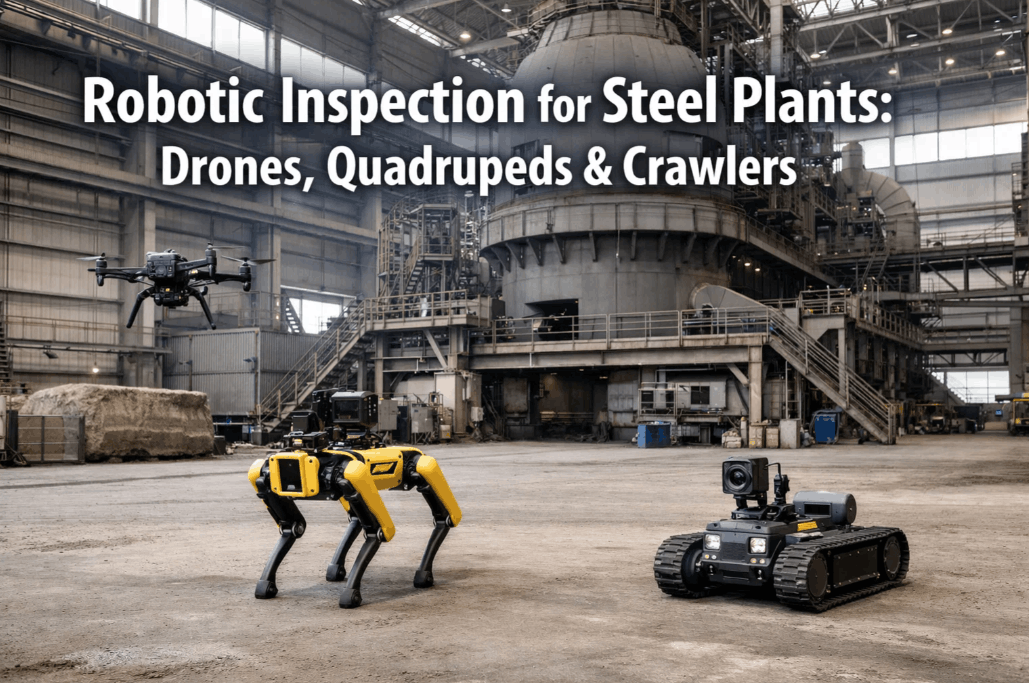
A steel plant contains thousands of feet of elevated structure that no maintenance team can safely or economically inspect on a traditional scaffold-and-rope schedule. Furnace shells operating at 1,600°F. Crane rails suspended 80 feet above live production floors. Stack liners handling corrosive off-gas 24 hours a day. Roofing systems covering acres of high-temperature, dust-laden environments. For decades, these assets were inspected on fixed calendars, by rope-access teams, or simply not inspected at all until a visible failure forced the issue. Drone inspection programs change that equation entirely. UAV-mounted thermal imaging, LiDAR scanning, and gas-detection payloads turn a three-week scaffold inspection into a two-day aerial survey — with higher resolution data, zero production disruption and a permanent digital record that feeds directly into your work order system. Plants that are discovering how drone integration with AI-driven analytics and automated work order generation turns raw aerial data into actionable maintenance intelligence. Book a demo with iFactory
Traditional inspection cycles leave critical elevated assets unmonitored for 12–36 months at a stretch. Drones close that gap at a fraction of the cost.
70%
reduction in inspection cost vs. traditional scaffold access
$0
production disruption during a drone structural survey
10×
more surface coverage per inspection day vs. rope access teams
The business case is not theoretical. When a blast furnace shell develops a hot spot indicating refractory degradation, finding it during a planned drone survey costs a few thousand dollars in flight time and analysis. Finding it after a shell breach costs a campaign restart measured in tens of millions. The same logic applies to crane rails with progressive fatigue cracks, stacks with liner spallation, and roof panels with thermal bridging that accelerates corrosion from the inside. This article maps exactly what a mature steel plant drone inspection program covers, how it integrates with your maintenance management system, and what outcomes operations and reliability leaders should hold it accountable to.
The Four Inspection Domains Where Drones Outperform Traditional Methods
Steel plant UAV programs are not a single-use-case technology. The same drone fleet — equipped with interchangeable payloads — covers four structurally distinct inspection domains, each with its own data type, defect signature, and work order trigger. Managing them as a unified program multiplies the return on the initial fleet investment and the pilot training cost.
01
Furnace Shell & Refractory Thermal Surveys
Infrared-equipped drones fly the full circumference of blast furnace, EAF, and ladle metallurgy shells, mapping surface temperature gradients at millimeter resolution. Hot spots above baseline thresholds — typically 15–25°C above adjacent panels — indicate refractory thinning or void formation. Data is overlaid on a 3D shell model and triggers targeted repair work orders before unplanned shell failure.
Thermal IR Payload3D Shell MappingCampaign-Linked
02
Crane Rail & Structural Steel Surveys
LiDAR and high-resolution visual payloads survey crane rails, gantry structures, column connections, and runway beams for weld cracking, rail gauge deviation, corrosion section loss, and bolt pullout. Millimeter-accurate point clouds compare against as-built drawings and previous survey baselines, flagging progressive structural change that monthly visual walks would never detect.
LiDAR ScanningBaseline ComparisonStructural Fatigue
03
Stack, Flue & Chimney Liner Inspection
Internal and external drone flights survey exhaust stacks and BF gas flues for liner spallation, erosion, and joint failure. External thermal imaging detects liner separation through temperature anomalies in the shell casing. Internal visual flights — using confined-space-rated UAVs — document brick condition, bypass damper integrity, and drainage effectiveness without rope or scaffold access.
Internal UAVLiner ConditionEmission Compliance
04
Roof, Cladding & Gas Leak Detection
Multispectral and gas-sensor payloads survey industrial roofing systems for heat bridging, panel delamination, gutter blockage, and active water infiltration. Electrochemical and optical gas sensors detect BF gas, coke oven gas, and natural gas leaks at concentrations below human-detectable thresholds, allowing preventive repair before any explosive risk threshold is approached.
Gas Sensor PayloadMultispectralSafety-Critical
Want to see how a drone inspection program maps to your steel plant's asset register and work order system? Schedule a live platform walkthrough with iFactory's inspection integration team.
Program Architecture: From Flight Plan to Work Order in Four Steps
The most common failure mode in industrial drone inspection programs is the data-to-action gap. Excellent aerial footage sits in a folder for weeks because there is no structured process to convert findings into prioritized maintenance actions. A mature steel plant UAV program eliminates that gap with a four-step closed loop running from pre-flight planning through work order closure.
Drone Inspection Closed Loop: Flight Plan to Work Order Closure
1
Mission Planning & Risk Assessment
Asset register and inspection history pulled from the CMMS. Flight zones mapped against production schedule to avoid active crane movements and gas release events. Payload selection confirmed per asset type — thermal for furnace shells, LiDAR for structural steel, gas sensor for roof and flue surveys. Permit-to-fly issued and logged against the work order.
2
Data Capture & Real-Time Flagging
UAV executes automated flight path with onboard GPS and obstacle avoidance. Thermal, visual, LiDAR, and gas-sensor data streams are captured simultaneously. Edge-processing algorithms flag anomalies in real time — thermal exceedances, point cloud deviations, gas concentration spikes — so the pilot can hover and capture higher-resolution follow-up imagery before leaving the site.
3
AI Analysis & Defect Classification
Post-flight, AI models process the full dataset. Thermal images are analyzed for hot spot severity and trend against previous survey baselines. Point clouds are differenced to quantify section loss. Gas concentration maps are overlaid on the site plan and graded by leak rate. Every finding is classified by severity — Immediate Action, Planned Repair, or Monitor — and geo-referenced on the plant asset map.
4
Work Order Generation & Audit Trail
Findings above severity thresholds automatically generate work orders in the CMMS, pre-populated with asset ID, defect description, severity classification, and supporting imagery. Maintenance planners receive mobile alerts with one-tap access to the full inspection report. Every finding, work order, and closure is time-stamped and audit-logged — building a structural health record usable for insurance, regulatory, and capital planning purposes.
5
Trend Analysis & Re-Inspection Scheduling
Defect trends across multiple survey cycles are analyzed to predict deterioration rates and optimize re-inspection intervals by asset. A furnace shell panel showing 0.5°C/month thermal drift gets a 60-day re-survey flag. A crane rail with stable geometry gets its interval extended to 12 months. Resources are allocated to risk, not to calendar.
Payload Selection Guide: Matching Sensor to Defect Type
The most common planning error in steel plant drone programs is deploying the wrong payload for the inspection objective. A high-resolution visual camera tells you nothing about subsurface refractory degradation. A thermal camera tells you nothing about millimeter-level crane rail gauge drift. Payload selection is not a procurement decision — it is an engineering decision that determines whether the inspection data answers the reliability question being asked.
Most steel plant surveys deploy thermal + visual as the baseline payload combination, adding LiDAR or gas sensors based on the specific inspection objective for each flight.
Connect Your Drone Inspection Program to iFactory Work Orders
iFactory's Drone Integration module auto-generates prioritized work orders from UAV inspection findings, links them to your asset register, and builds a permanent structural health record — all without manual data re-entry. See how it works on your plant's asset types in a live demo.
Safety, Regulatory & Program Governance: What Most Steel Plants Get Wrong
A drone inspection program that operates without a formal governance framework is a liability, not an asset. Steel plants are complex air spaces with active overhead cranes, high-voltage bus bars, pressurized gas mains, and rotating equipment at every elevation. FAA Part 107 compliance is the minimum entry requirement for any commercial UAV operation in the United States — but Part 107 is a certification floor, not a safety program. A mature steel plant governance framework adds six additional layers that Part 107 alone does not cover.
FAA Part 107 remote pilot certification for all operators
LAANC authorization for controlled airspace if applicable
FAA Remote ID compliance for all fleet UAVs
Inspection findings documented for OSHA and EPA audit trail
Flight clearance coordinated with crane operations and production schedule
Exclusion zones defined around BF tapping, tapping, and charging events
EMI assessment completed near high-voltage bus bars and VFD cabinets
Thermal payload calibration verified before every furnace shell survey
Severity classification criteria defined per asset type before first flight
Work order auto-generation thresholds reviewed by reliability engineering
Inspection reports retained in CMMS with 7-year minimum retention
Survey baseline established within first 90 days — without it, trend analysis is impossible
Want a governance framework template scoped to your steel plant's regulatory environment? Book a 30-minute consultation with iFactory's inspection integration specialists.
KPI Benchmarks: What a Mature Steel Plant Drone Program Delivers
Return on investment from a steel plant drone inspection program runs through three channels simultaneously — risk reduction, maintenance cost optimization, and regulatory compliance efficiency. Plants that measure all three from program launch build the strongest internal case for program expansion and fleet investment. The benchmarks below reflect outcomes from integrated steel plant UAV programs running for 12+ months with CMMS work order integration.
70%
Reduction in structural inspection cost
UAV surveys replace scaffold, rope access, and aerial work platform hire for the majority of elevated structural inspections. Cost per linear foot of crane rail inspected drops from $45–$80 to $8–$15 using drone LiDAR.
85%
Of defects detected before failure threshold
Plants running quarterly drone thermal surveys on furnace shells report that 85%+ of refractory interventions are planned rather than emergency, versus 40–55% in calendar-only inspection programs.
$2.4M
Average avoided loss per prevented furnace shell event
A single unplanned blast furnace or EAF shell breach requiring emergency campaign restart typically costs $1.8M–$3.2M in lost production, emergency labor, and refractory repair. Drone thermal programs routinely prevent 1–3 per year.
Expert Perspective
"The real value of a steel plant drone program is not in the footage — it is in the trend. Any rope-access team can tell you a furnace panel is at 320°F today. What changes the maintenance equation is knowing that the same panel was at 295°F six months ago and 278°F twelve months ago. That 15°F-per-period drift rate tells you exactly when to plan the reline, how much material to order, and whether you can make the next planned outage window or need to move it up. Without a UAV program generating that baseline and trend data on a repeatable schedule, you are not managing refractory health — you are reacting to it."
— Steel Plant Reliability & Inspection Engineering, Industry 4.0 Best Practice
40%+
of unplanned BF stoppages have a detectable structural precursor visible 30+ days prior
2–4 wk
time to first live drone survey after iFactory integration go-live
12 mo
typical full ROI window for an integrated steel plant drone inspection program
Conclusion: From Annual Survey to Continuous Structural Intelligence
For most steel plants, the shift to drone-based inspection is not a technology upgrade — it is a program design change. The hardware is available, the regulatory framework is established, and the payload options are mature. What separates a drone program that delivers measurable reliability improvement from one that produces hard drives full of unused footage is the integration between aerial data, AI defect classification, CMMS work order generation, and trend-based re-inspection scheduling. Plants running that integrated loop are replacing $40,000 scaffold campaigns with $4,000 UAV surveys, finding structural defects 30–90 days before they reach failure thresholds, and walking into regulatory audits with complete, time-stamped structural health records. The question for operations and reliability leaders in 2026 is not whether to implement a drone inspection program. It is whether your current maintenance system is built to turn the data those drones generate into actionable, auditable maintenance intelligence.
Turn Aerial Data Into Maintenance Action — Automatically
iFactory's Drone Integration module connects UAV inspection findings to asset-linked work orders, severity-graded alerts, and a permanent structural health record — deployed over your existing CMMS in 2–4 weeks. Get a free drone program readiness assessment scoped to your steel plant's asset inventory.
Frequently Asked Questions
What FAA certifications are required to operate a drone inspection program inside a steel plant?
All commercial UAV operations in the United States require FAA Part 107 remote pilot certification for each active drone operator. Operations within 400 feet of structures require specific airspace awareness protocols, and flights near airports or helipads require LAANC authorization through the FAA DroneZone system. All drones weighing more than 0.55 lbs must now comply with FAA Remote ID requirements, broadcasting identification and location data during flight. Beyond federal requirements, most steel plants require a site-specific flight operations plan approved by the EHS and operations management teams before any UAV activity begins inside the facility fence line.
Can thermal imaging drones reliably detect refractory degradation through a blast furnace shell?
Yes, when surveyed under controlled conditions. Radiometric thermal cameras can detect surface temperature differentials of 0.05°C, which is more than sufficient to identify the 15–40°C hot spots that indicate refractory thinning or void formation beneath the furnace shell plate. Accuracy requires consistent survey conditions — stable ambient temperature, low wind, consistent time of day relative to furnace operating schedule — so that baseline and trend comparisons are valid. A well-designed furnace shell survey program establishes a thermal baseline in the first survey and compares every subsequent flight against it, identifying deterioration rate rather than just point-in-time temperature.
How does a drone inspection program integrate with an existing CMMS or work order management system?
Modern drone inspection platforms integrate with CMMS systems via REST API, allowing inspection findings above defined severity thresholds to automatically generate work orders pre-populated with asset ID, defect description, location coordinates, severity classification, and supporting imagery. iFactory's integration goes further — linking findings to the asset's full maintenance history, flagging assets with repeat defect patterns for reliability review, and updating re-inspection interval schedules based on deterioration trend data. The integration eliminates the manual step of a reliability engineer reading an inspection report and creating work orders from it, compressing the finding-to-repair cycle from days to hours.
What gas types can drone-mounted sensors detect, and at what concentrations?
Current electrochemical gas sensor payloads detect blast furnace gas (CO), coke oven gas (H₂, CO, CH₄), natural gas (CH₄), hydrogen sulfide (H₂S), and oxygen deficiency. Detection thresholds vary by sensor type but typically range from 1–5 ppm for CO and H₂S, and 100–500 ppm for methane, well below the Lower Explosive Limit of any of these gases. Optical Gas Imaging (OGI) payloads can visualize hydrocarbon plumes that electrochemical sensors detect but cannot spatially map with precision. For regulatory compliance documentation — particularly EPA Method 21 equivalent surveys — OGI-equipped drones are increasingly accepted as an alternative to handheld instrument surveys in elevated or hazardous-access locations.
How long does it take to establish a baseline and see measurable ROI from a steel plant drone inspection program?
The structural baseline for primary assets — furnace shells, crane rails, stacks — can be established in the first 2–4 weeks of program operation. Measurable ROI typically appears on two timescales. Immediate ROI comes from the first survey cycle, where drone surveys replace scaffold or rope-access inspection costs that are often $30,000–$80,000 per campaign. Reliability ROI — the avoided cost of unplanned failures caught before failure threshold — typically accumulates over the first 6–12 months as the trend database matures and predictive intervention timing becomes possible. Plants with historically high unplanned structural failure costs commonly achieve full program ROI within the first 12 months of operation.



-for-steel-plants-digital-compliance-framework.png)